AI scientists leap out of the screen! An MIT professor tossed 4 photos, and 3 Grok units fabricated the parts within one hour.
Four photos, completely unrelated to one another.
Markus Buehler, a professor of engineering at MIT, presented these four photos, along with a highly complex mechanics problem, to three AI agents.
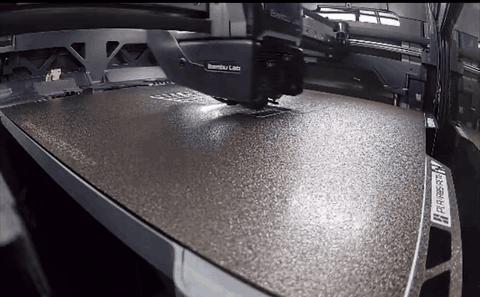
Over an hour later, the 3D printer on his desk extruded two plastic parts weighing 19.48 grams in total.
From the photos to the finished parts, the three AIs completed the whole process in relay:
Interpret the images, extract structural rules, write a runnable physics simulator, conduct 47 experiments, export the model file, slice it, and send it to the printer.
All previous demonstrations of "AI scientists" stopped at the same stage: a report, a piece of code, or a simulation diagram.
If you wanted to turn the results into real objects, you still needed an automated laboratory that costs at least millions of dollars to build.
This time, the AIs bypassed the million-dollar threshold and directly manufactured the physical products.
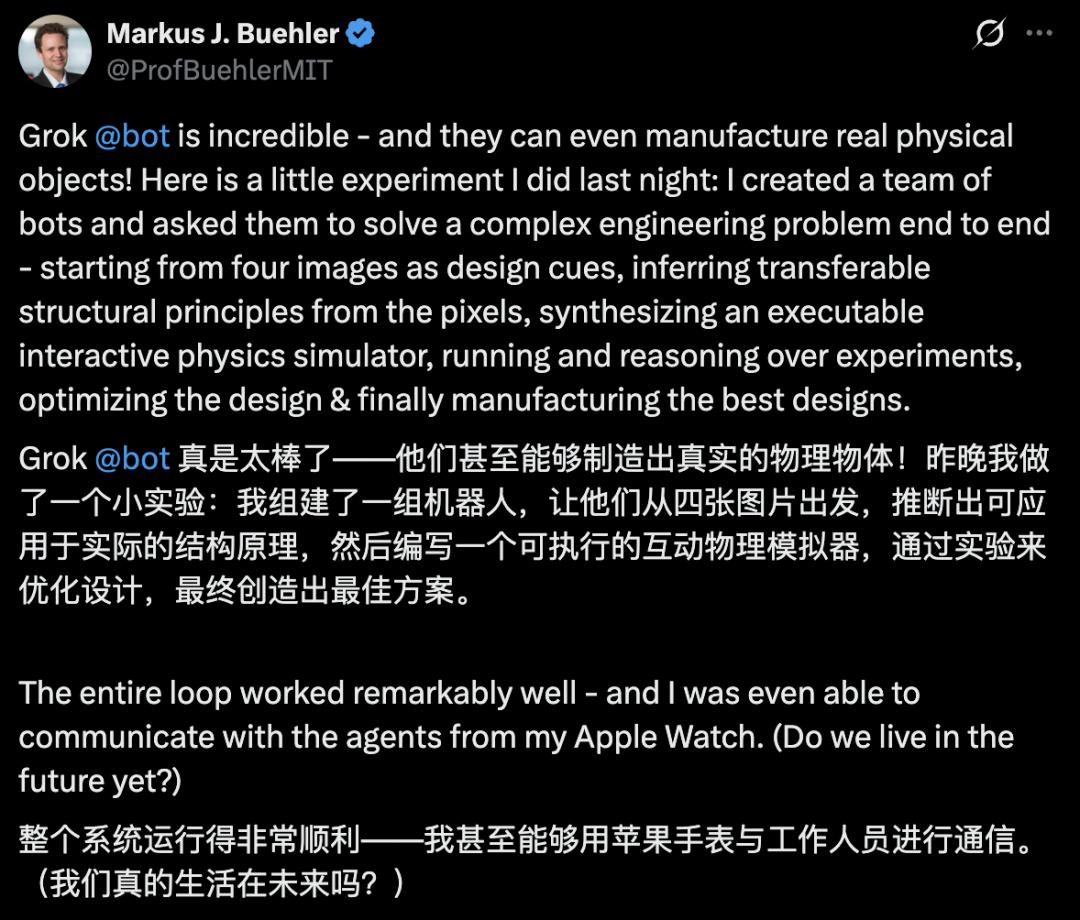
Buehler wrote in his post with emotion: Are we already living in the future?
The staffing framework newly released by xAI
MIT professor put it into practical use directly
The three working agents are all Grok Bots.
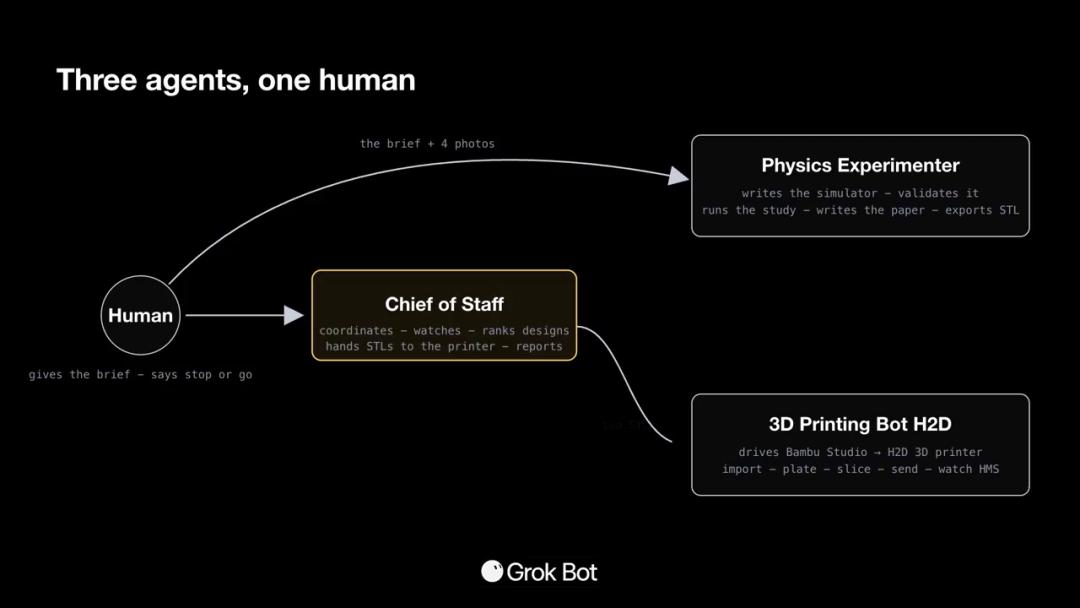
This is the division of labor diagram of the three Bots: the Chief of Staff coordinates in the center, the Physics Experimenter agent writes the simulator and conducts research, and the 3D Printing Bot drives Bambu Studio.
This set of staffing framework was designed by xAI, and Buehler built a real project team based on it.
Chief of Staff, the project supervisor.
The only role in the whole process that does not directly produce deliverables. It keeps track of what the other two agents are doing, pulls the results back to the main conversation, transfers files between them, and urges the work to keep progressing.
Physics Experimenter, a scientist and programmer.
It reads images, writes simulators, runs experiments, analyzes results, and finally submits a scientific research report in LaTeX format.
3D Printing Bot, the workshop supervisor.
It prepares materials, slices models, generates manufacturing codes, sends tasks, and monitors the printer.
This division of labor was not randomly conceived by Buehler.
On August 11, xAI just launched the early beta version of Grok Bot.
Each Bot is equipped with its own cloud computer, which can log into accounts and open web pages to work like a human. Multiple Bots can work in parallel, and there is usually a Chief of Staff above them to manage the workflow.
xAI itself uses this framework internally. The engineering Bot reproduces the bug in the product interface, submits a work order, and then assigns the fix task to the adjacent debugging Bot.
The official also made a pointed remark: There is a world of difference between completing 90% of a task and completing 100% of it.
Most AIs can only take you to the "almost done" stop, and you have to get off and finish the last 10% by yourself.
What Grok Bot aims to do is to take you directly to the final destination.
20 Minutes
Three Grok Bots built a laboratory
Buehler only provided two inputs: 4 reference photos and a research question.
A pinnate leaf vein, a mesh similar to a Voronoi diagram, a cluster of randomly arranged fiber lattices, and a radial and circumferential spider web.
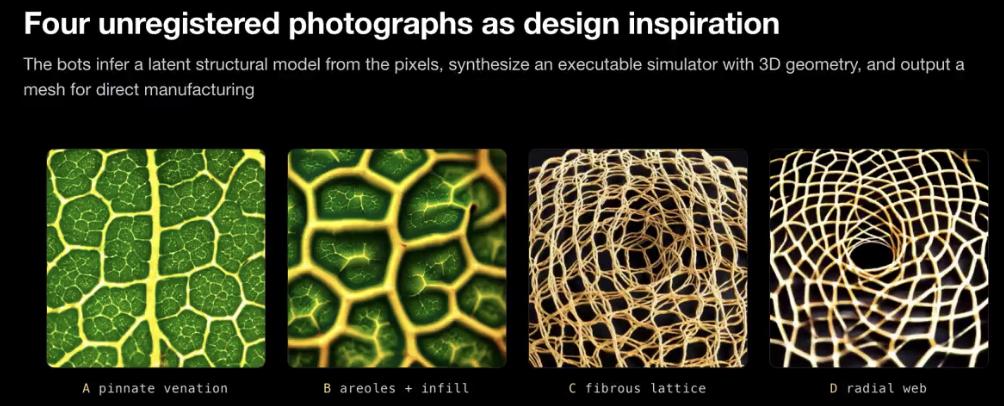
The four images differ in scale, subject, are not aligned with each other, and there is no ready-made engineering drawing at all.
Apart from the photos, he also raised a question:
With the total amount of fixed material, how do hierarchical depth, redundancy, disorder and interlayer strength change the stiffness, peak load, energy absorption, and the transition from "brittle fracture" to "progressive failure"?
To put it in plain language: Why are natural objects both lightweight and strong? Leaf veins, spider webs and bones all have nested layer upon layer structures. At which step exactly does this "hierarchy" play a real supporting role?
He did not tell the agents how to build the model, nor did he specify which software to use.
He only put forward one requirement: infer transferable design principles from these 4 images, and then use them to build an experimental platform for fracture research.
About 20 minutes later, an interactive two-dimensional layered Euler-Bernoulli beam network laboratory was up and running.
It did not call any existing mechanics simulation software, but wrote a simulator from scratch.
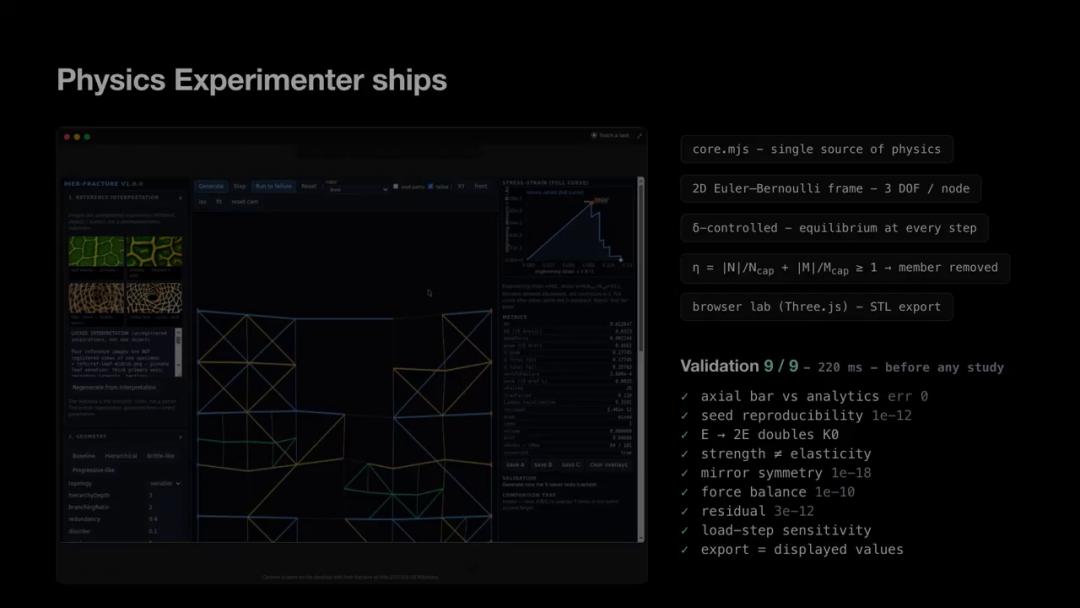
It named the simulator HIER-FRACTURE v1.0.0. Before conducting research, it ran 9 self-checks, which took 220 milliseconds and all 9 items passed.
After the self-check was passed, it started the formal work.
This laboratory is connected to the simulation end at one end and the printer at the other end: after the experiments are completed, it directly exports the model file for 3D printing.
At this step, it did not call an existing tool, but created the tool itself first.
47 Simulations
The AI overturned its own hypothesis
Then, it began to conduct experiments.
47 simulation experiments were carried out, 6 of which were reserved for testing.
This means that these 6 sets of data were not involved in parameter tuning in advance, and were specially reserved for finally verifying the validity of the conclusion. This is a habitual operation unique to human experimenters.
The conclusion is a bit counterintuitive: under the premise of fixed total material, the stiffness of these structures is similar, with a maximum difference of 20%; but their impact resistance varies greatly, and the best one can be several times better than the worst one.
The reason is essentially a competition for materials: the more auxiliary fine structures are added, the thinner the main beam will be. Networks with deeper hierarchies are often less resistant to impact than simple single-layer lattices.
Those weak connections are like a row of fuses: they break first, spread the impact force, and turn the failure mode of the whole structure from "sudden collapse" to "progressive collapse".
The most interesting part is the last step.
Before the experiment started, it set up a hypothesis called H2: the reason why additional hierarchies are harmful is mainly the connections between layers, which are too weak to limit the performance of the whole structure.
After 47 runs, it overturned the hypothesis it put forward earlier. The real reason is: the total amount of material is fixed, adding an extra layer means you have to take materials from other parts.
An AI overturned the preset hypothesis in the workflow and noted the reason, which is a behavior more like real scientific research than any performance benchmark test.
Software becomes the hands of AI
After the optimized design was handed over to the 3D Printing Bot, the situation became different again.
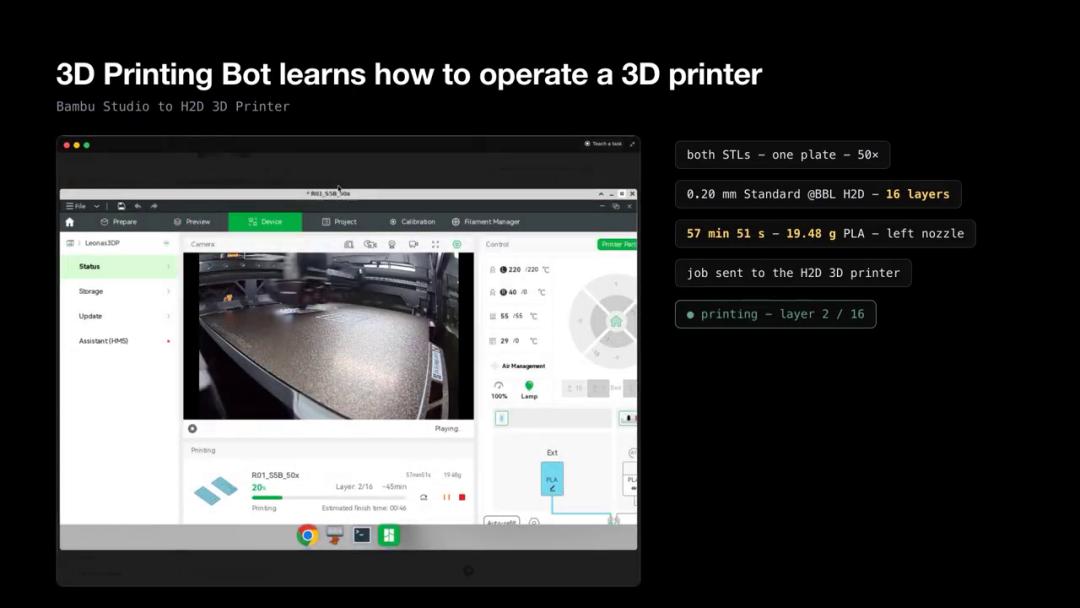
The Chief of Staff sorted the 47 runs according to the fracture energy, selected two designs to export the model files, and scaled them up by 50 times uniformly.
It opened the slicing software Bambu Studio, connected to the printer named Leonas3DP, placed the two models on the same build plate, scaled them up by 50 times uniformly, set the parameters for slicing, clicked send, and then monitored the real-time camera of the printer to watch the nozzle lay down the plastic layer by layer.
In less than an hour, the two parts were printed successfully.
Grok Bot did not drive the printer's motor directly, nor did it use any dedicated interface. It operated the software interface just like a human does.
This is probably the most critical step in the whole event.
In the past, it was generally assumed that for agents to enter the physical world, they needed robotic arms, embodied intelligence, and a complete set of new hardware protocols.
This time it took another path: the manufacturing industry has long been fully digitized into software, and the graphical interface is a ready-made entry.
Being able to click the mouse is equivalent to growing a pair of hands.
Automated science has been developed for more than ten years, and the hardest nut to crack is the driver: each instrument has a set of interfaces. To allow AI to operate, you either have to modify the equipment or deploy a robotic arm.
The robotic chemist at the University of Liverpool ran about 700 experiments in eight days, taking the robotic arm route, at the cost of an automated laboratory costing millions of dollars at a minimum.
Grok Bot took a third path: no equipment modification, no robotic arm, just directly use the mouse to operate the software that humans use every day.
As long as the device has a graphical interface, it already has an accessible interface: CNC machines, oscilloscopes, microscope consoles, any device with a GUI is theoretically within its operating range.
On one side is a million-dollar level automated laboratory, and on the other side is a desktop 3D printer that can be ordered on e-commerce platforms for only 1749 US dollars.
The cost structure has thus been completely rewritten.
Humans always stay in the loop
The task was assigned by Buehler, the four photos were selected by him, and the scientific research question was also defined by him.
The xAI official also stated clearly that when Bots encounter operations that require approval, they will return to humans for confirmation.
Throughout the whole design process, humans always stay in the loop.
Buehler is no stranger to this kind of practice.
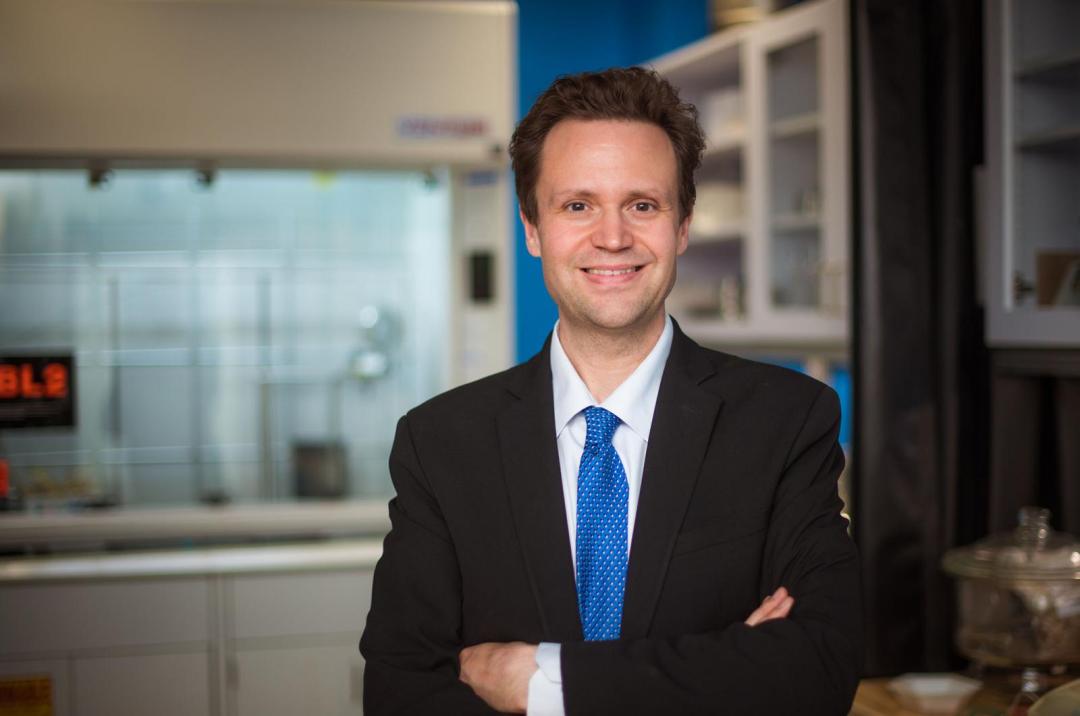
Markus Buehler, the Jerry McAfee Professor of Engineering at MIT, winner of the 2025 Washington Award
He is the McAfee Professor of Engineering at MIT, and holds faculty positions in both the Department of Mechanical Engineering and the Department of Civil and Environmental Engineering. His research areas cover AI, fracture mechanics, hierarchical materials and additive manufacturing. He has published more than 800 papers and is a member of the National Academy of Engineering.
Therefore, this is not a casual test by an ordinary user, but a stress test conducted by one of the most authoritative experts in this field in his own field of expertise.
In 2024, he published the MechAgents research, which allowed multiple agents to collaborate to solve mechanics problems and check errors for each other.
That paper also honestly noted that the agents once took the wrong stress component, and did not correct it until humans gave prompts.
Multi-agent system solves the problem of division of labor, but it does not automatically mean that the results are reliable.
The real breakthrough this time is not on the intelligence side.
In the past few years, the output of agents has always been limited to reports, codes, charts and simulation results — they are very intelligent, but they have no hands to interact with the physical world.
However, the entire modern manufacturing industry is built on software: CAD, slicers, machine tool consoles all have graphical interfaces, all of which are designed for human operators.
Now, these interfaces have found a tireless operator.
References:
https://x.com/ProfBuehlerMIT/status/2091108225806454802
This article is from the WeChat official account "AI Era" (ID: AI_era), edited by Yuan Yu, and published by 36Kr with authorization.