The Fruit Fly version of The Matrix is here: Google has spent a decade mapping the entire brain of a fruit fly, and a master's student used GPT-6 to make it operate smoothly in a sandbox within only two days.
A fruit fly is flying in Minecraft.
In a locked room built of glass blocks, all four walls are completely transparent, the floor is paved with gray stone bricks, and outside the walls is the iconic blue sky of Minecraft.
A small reddish-brown fruit fly hovers in mid-air, flapping its wings, flying a few blocks, turning a corner, rolling over, facing left for a moment, and belly-up the next, just like a real fruit fly that has just been put into a jar and hasn't figured out the situation yet.
What drives it to fly is not a game script, but a complete connectome of the central nervous system of a male fruit fly.
166,700 neurons fire in the simulation, and neural activity directly determines every turn of this virtual fruit fly.
This brain atlas codenamed MaleCNS v1.0 has an extremely impressive background:
HHMI Janelia, the University of Cambridge and Google Research spent ten years on it, with 44 person-years dedicated solely to manual proofreading, and it was just published in the journal Cell on September 3.

But just two days later, it was ported into the game.
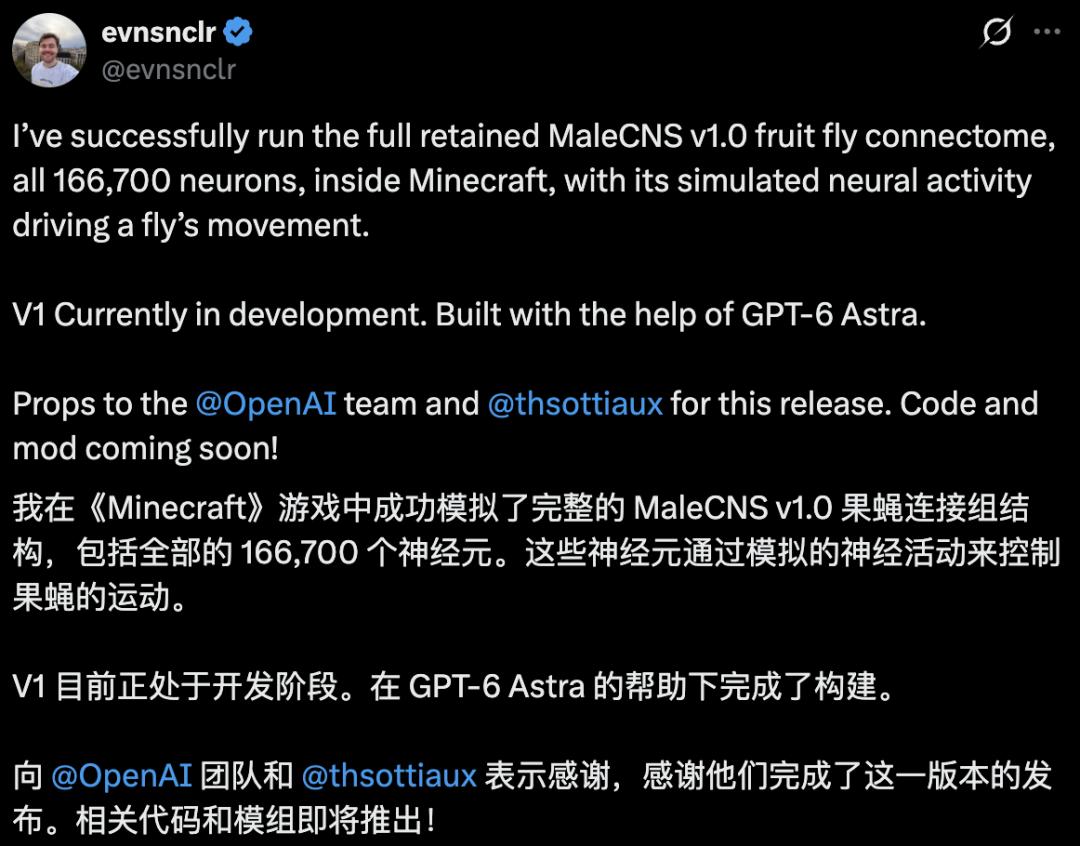
The one who did this is not a top lab, but a graduate student named Evan Smith at the Georgia Institute of Technology, and his only helper is GPT-6 Astra.

Evan Smith
This decade-long scientific research achievement was turned into a simulation mod in the sandbox game in less than a week.
It took him only two days to break down the wall between cutting-edge science and civilian geeks.
Evan Smith left three sentences in the original post: "V1 is still under development", "Completed with the help of GPT-6 Astra", "Code and mod will be released soon".
The comment section immediately exploded.
Some people say this is the fruit fly version of *The Matrix*, some say the simulation theory seems to be true, and others feel sorry for this fruit fly: just imagine, you are a simulated fruit fly that can't smell any scents.
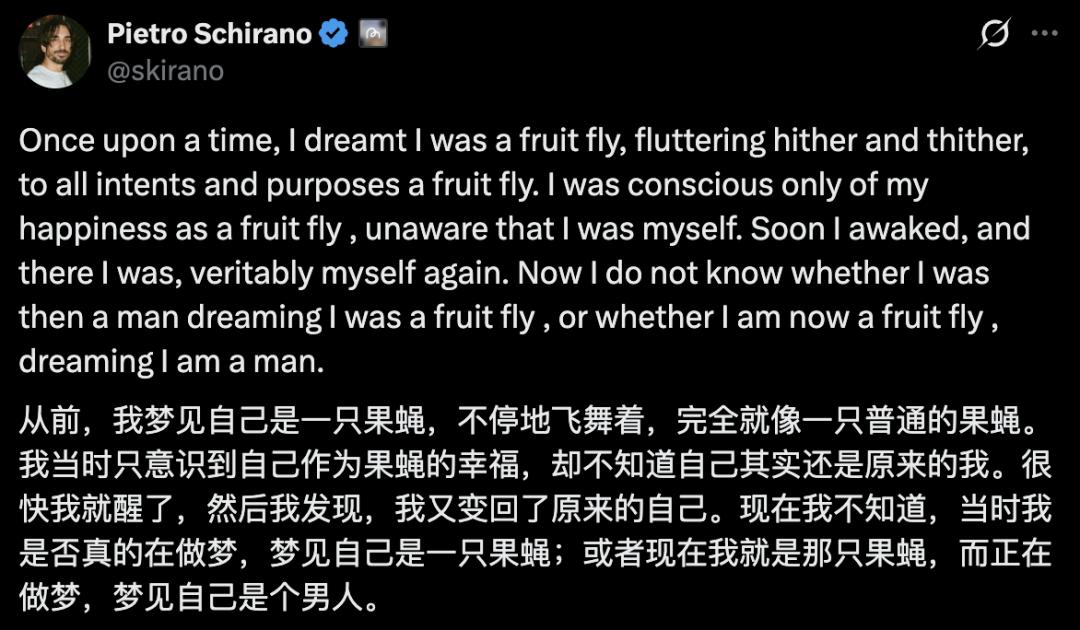
Pietro Schirano, former designer at OpenAI, left a comment adapted from Zhuangzi:
Now I don't know whether I dreamed that I turned into a fruit fly at that time, or whether I am a fruit fly now dreaming that I am a human being.
Although the code has not been made public yet, it has already proved one thing: the threshold for whole-brain simulation is dropping to the level of personal projects.
166,700 Neurons
An Open-Source Top-Level Brain Atlas
The atlas MaleCNS that was ported into the game this time is the first complete connectome of the male fruit fly's central nervous system.
This is not just a single brain.
It covers the central brain and optic lobes, and also includes the ventral nerve cord equivalent to the fruit fly's spinal cord. Most importantly, the neural connections at the neck are completely preserved, and the pathway of how the brain commands the body has been fully mapped out on a single atlas for the first time.
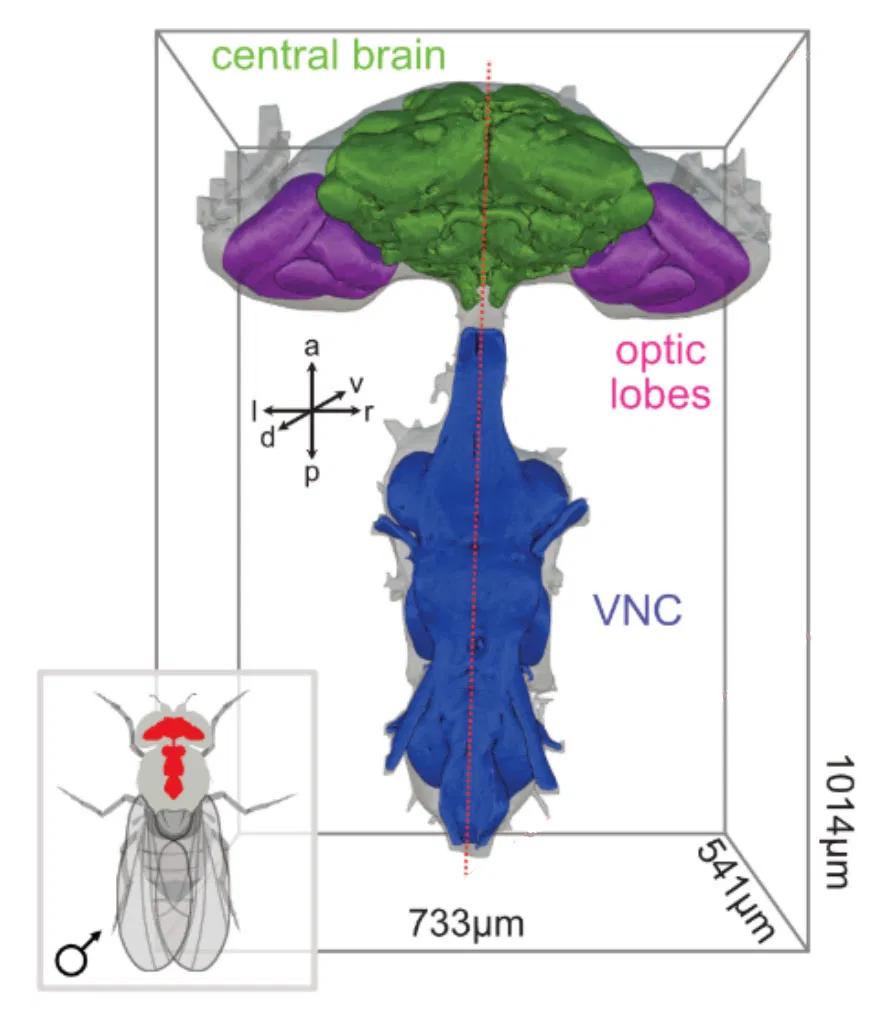
MaleCNS covers three parts: the central brain (green), the optic lobes (purple), and the ventral nerve cord (blue). For the first time, the auditory, visual, and olfactory inputs are connected to the motor outputs on the same atlas.
Scientists also discovered 262 male-specific cell types and 114 cell types with different morphologies between the two sexes through comparison.
These differences are concentrated in higher-order brain regions, which not only explain the gender differences in fruit fly courtship and aggressive behaviors, but also verify that tiny changes in circuits can cause whole-brain level effects.
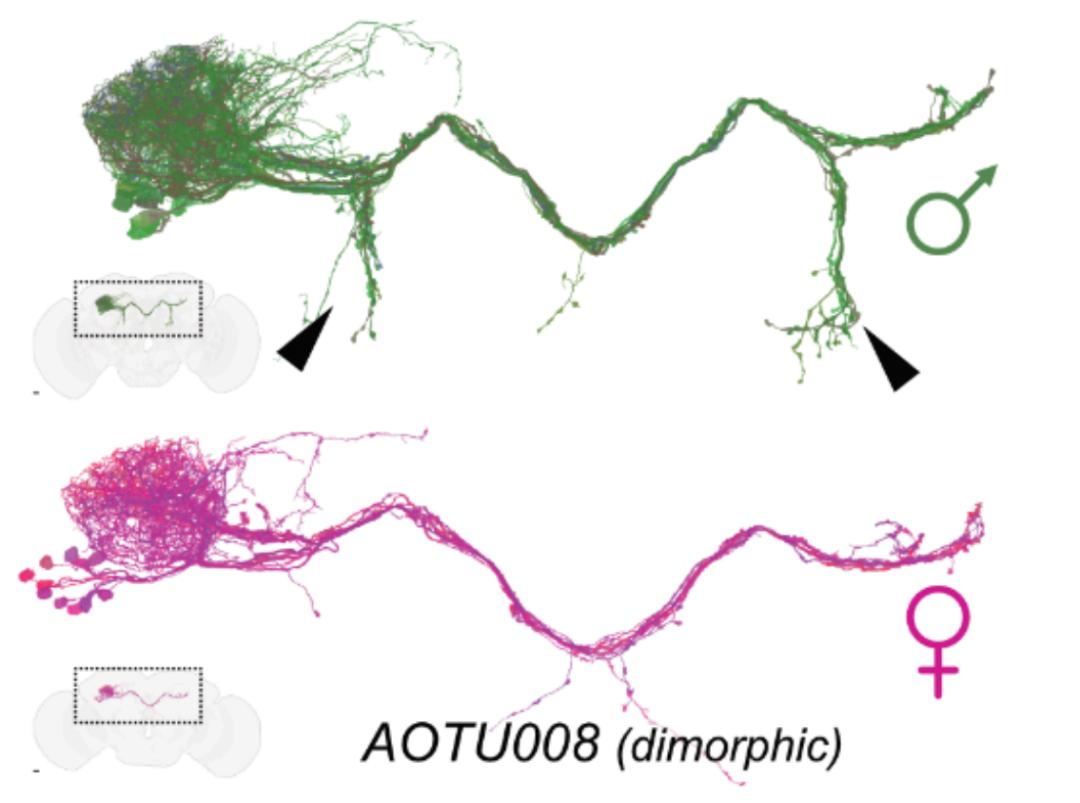
The difference of the same type of neuron AOTU008 between male (green) and female (magenta) fruit flies: the male has two extra projections.
How did this brain atlas, which has 125 million synaptic connections and is the largest one in terms of neuron count so far, come into being?
Researchers first cut a fruit fly into millions of thin slices and scanned each slice under an electron microscope; then Google deployed flood-filling networks and the PATHFINDER system to stitch the massive 2D slices back into 3D neuron morphologies; finally, experts from Janelia carried out manual proofreading and annotation one by one.
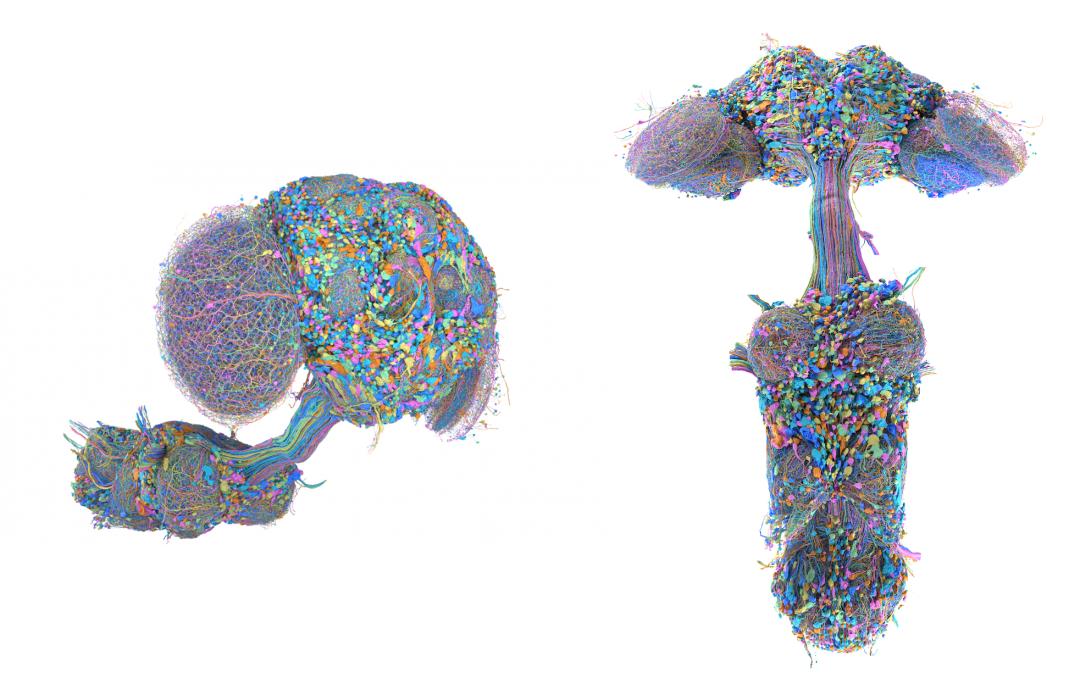
A small part of the neurons in the male fruit fly's brain and central nervous system, viewed from a front oblique angle (left) and from a top-down angle (right).
After ten years of hard work and the dedication of three top institutions, what was finally delivered to the public is an extremely geeky interface: the entire dataset is fully open source under the CC-BY license.
You only need to register to get a token, enter a line of pip install command, and run a few lines of code to pull the upstream and downstream connections of any neuron to your local device.
A brain containing 125 million synapses has become an open source file that anyone can download.
Waking This Brain Up
What Are The Missing Steps In Between?
From the wiring diagram to the virtual fruit fly, what exactly is connected in engineering?
The neural connectome is essentially just a static "wiring diagram". To turn this diagram into a runnable virtual life, three key engineering processes need to be completed.
The first one is neuronal dynamics.
How each neuron accumulates inputs and when it fires must be supported by mathematical models. The Leaky Integrate-and-Fire model is commonly used in academia at present.
Only by connecting the dynamic equations can the static coil turn into a surging data flow.
The second one is sensory input. The light, glass blocks and distances in Minecraft must be accurately encoded into the visual neurons of the fruit fly.
The third one is motor output. How are the electrical signals of the nervous system translated into the physical displacement of the character in the game?
Coincidentally, the *Cell* paper this time just provides a ready-made pathway: from R1 to R6 visual neurons, and then to DNg13 motor neurons, this is a fully explored vision-motor link.
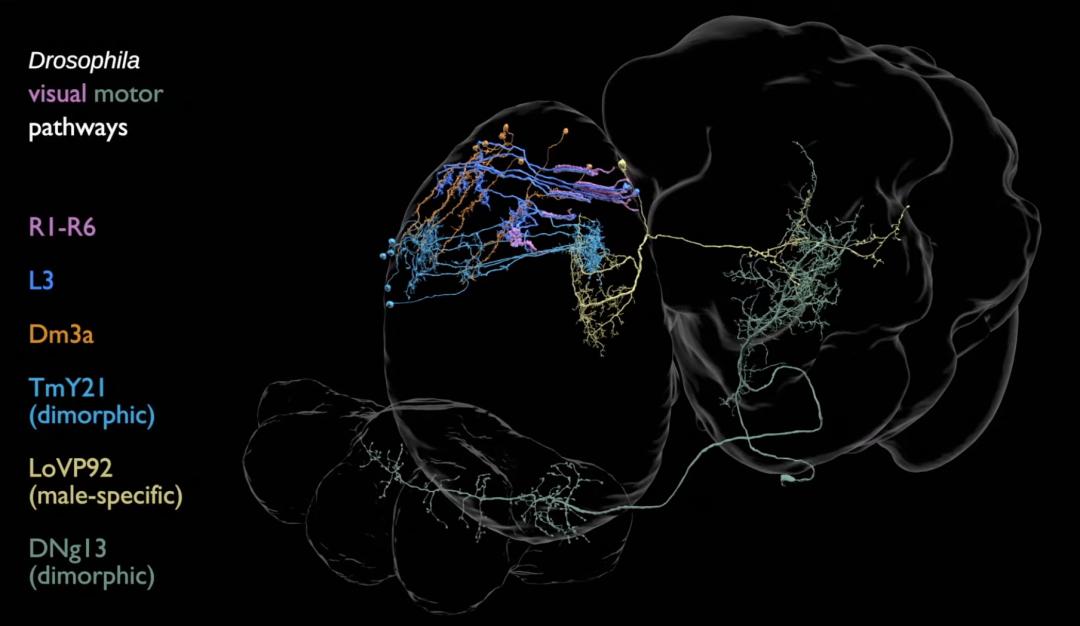
A complete visuomotor pathway demonstrated by Janelia: from R1 to R6 visual neurons all the way to DNg13 motor neurons.
As long as the interfaces on this pathway are correctly written, the virtual fruit fly will make a real reaction when it sees the blocks in front of it.
Atlas, AI and Sandbox Engine
The Scientific Research Threshold That Has Been Completely Leveled
Why can a master's student run through the whole set of whole-brain simulation in just two days?
Let's first look at what has been gathered this week.
The first thing is the fully open-source brain atlas.
It provides nanometer-level precise structural data and directly usable APIs.
The second thing is the soaring AI code capability.
Turning the connection table of hundreds of thousands of neurons into a runnable simulator involves a large number of tedious interface engineering: reading data, building networks, writing dynamics, and connecting to the game engine.
In the past, this was the workload of a professional engineer team for several months, but now GPT-6 Astra has reduced the engineering volume to a level that a graduate student can handle in their spare time.
The third thing is the sandbox engine that everyone has access to.
Minecraft comes with a mod ecosystem, physical rules, and light and collision systems. If you want to test whether the fruit fly avoids obstacles, stacking a few glass blocks makes a wall; if you want to test whether it chases light, just place a torch.
The atlas provides the structure, AI lowers the engineering threshold, and the game provides an intuitive visualized world.
The combination of the three turns a scientific research topic that used to require project approval, funding and team building into a reproducible open source game.
Let's compare the history of whole-brain simulation.
The most well-known OpenWorm project has only 302 neurons in its nematode. Scientists and engineers formed an open source community and worked for more than ten years to make the virtual nematode wriggle in the simulator.
Even half a year ago, when Eon Systems connected the FlyWire female fruit fly whole-brain model to the MuJoCo physics engine to make the virtual fruit fly walk, groom and eat, it also required extremely high configurations: a full-time company plus a lab-level physics engine.
Even Elon Musk, the founder of Neuralink, went to the comment section to express his amazement.
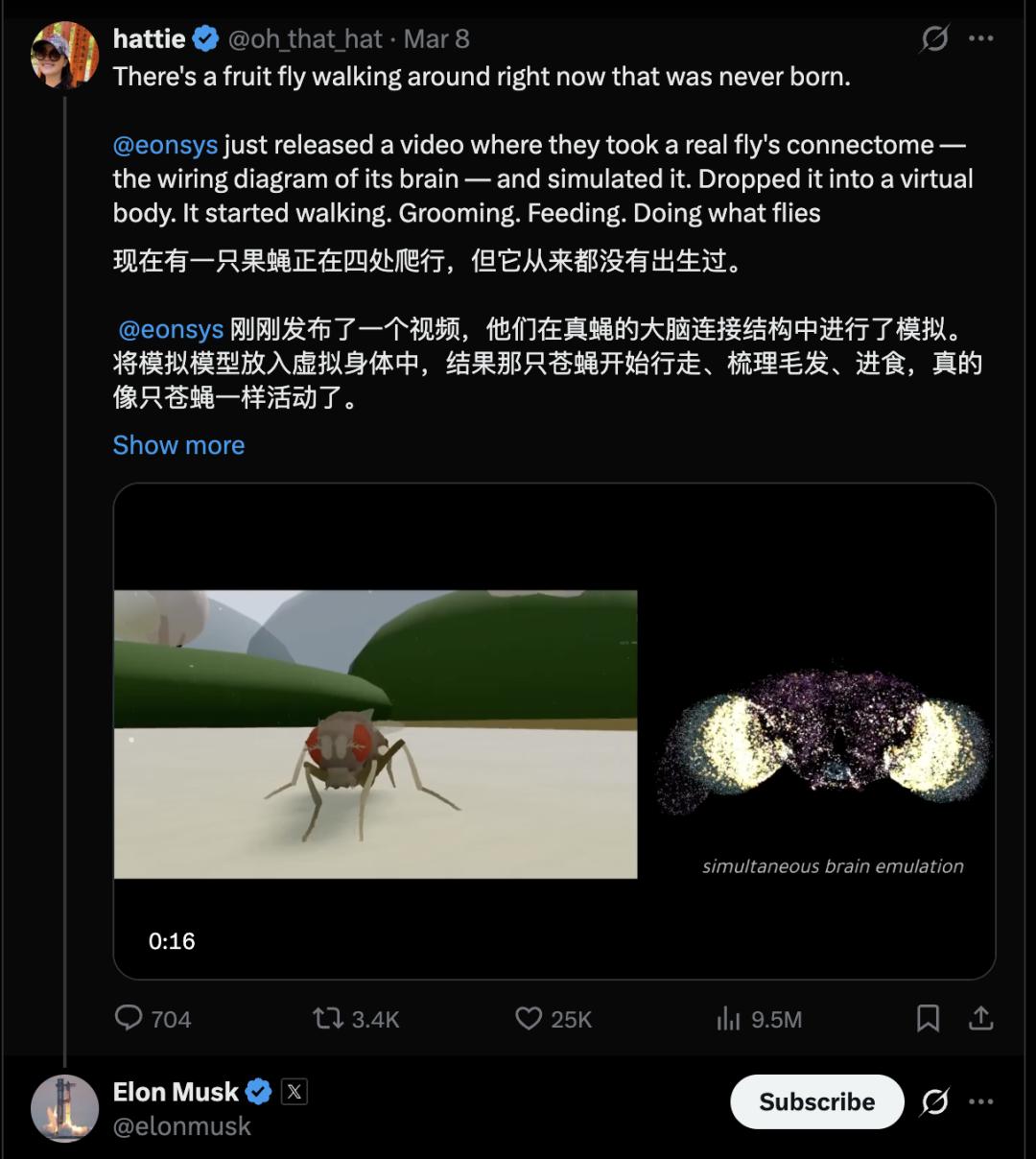
But this time, the number of neurons in the fruit fly is more than 500 times that of the nematode, while the configuration is reduced to one graduate student, one AI, and a computer that can run Minecraft.
It is foreseeable that once the code is open sourced, this fruit fly brain will be connected to Unity, Unreal Engine, and even real robot bodies. From the same atlas, countless different digital fruit flies will be generated.
The biggest change that cutting-edge AI brings to scientific research may not be directly helping scientists discover the truth, but pushing down the access line of "who is qualified to conduct verification" by a large margin.
The Romantic Conjecture 2000 Years Ago
Finally Has Its Code For The First Time
When Pietro Schirano, former designer at OpenAI, reposted Evan's post, he left a comment adapted from Zhuangzi.
The romance of Zhuang Zhou dreaming of being a butterfly was once an insurmountable physical gap in front of science.
Being able to drive behavior does not mean having consciousness at all.
The current project can only prove that simulated neural activity drives the movement of the character.
This blocky fruit fly wandering in the glass box can't smell scents or feel temperature. No one knows whether it has subjective experience or whether it can dream.
But the advancement of science never relies on fantasies, but on verification at the behavioral level.
If we change the game environment, will it make a stable response? If we disrupt several neural connections, will its flight trajectory change accordingly? If we turn off part of the neural activity, will it crash immediately?
In the past, these problems required lengthy wet experiments, raising insects painstakingly, performing gene knockout, and waiting a long time for results.
Now, researchers can first disconnect a few lines of code on the computer to run a test, pick out the conjectures that are really worth verifying, and then go back to real fruit flies for testing.
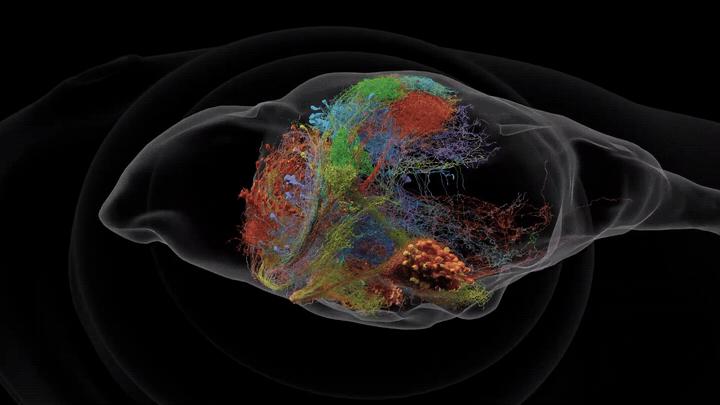
A 6-day-old larval zebrafish, with about 140,000 neurons being lit up category by category in its transparent outline. This is the first connectome covering the entire vertebrate brain, and the whole-brain activity records of the same fish have also been aligned into it.
It is foreseeable that once the code is open sourced, this brain will be connected to Unity, Unreal Engine, and even real robot bodies.
From the same atlas, countless different digital fruit flies will be generated.
For a very long time in the past, making a fruit fly brain move in a digital body required a company and a lab-level physics engine.
Now, all you need is a graduate student, an AI, and a computer