Embodied ICL has arrived, attracting numerous startup players, and the context sector has become a brand new Scaling track.
In 2020, GPT-3 shocked the NLP community with its capability of learning new tasks by simply looking at a few demonstrations; six years later, the same story is unfolding in the field of embodied intelligence.
That's right, it is exactly In-Context Learning.
In mid-August, Skild AI released S1, its foundational robotics model. By only showing the robot a task demonstration video, it can attempt to complete new tasks it has never been trained on without fine-tuning or additional post-training. The task can last up to 10 minutes and include dozens of operation steps.
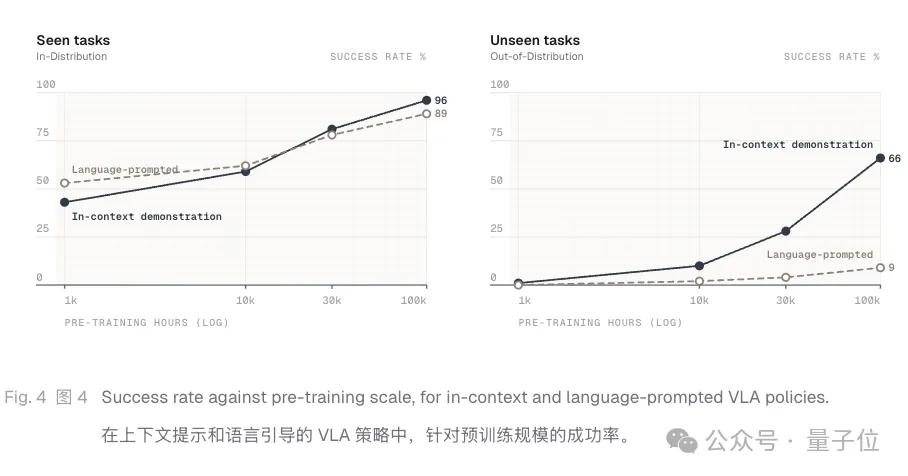
Skild compared the ICL video Prompt and the traditional language Prompt VLA on both tasks that appeared in its (training data) and unseen tasks.
Test results show that when the training data volume is only 1000 hours, the language Prompt delivers better performance, while as the data scale increases, ICL starts to surpass it. For unseen tasks, adding video context improves the model's performance by about 7 times compared to using only language instructions.
One week before the release of S1, Generalist AI launched GEN-1.5, which also takes One-Shot Learning as its core capability. The robot can learn new tasks in a few seconds with only one demonstration, without the need for gradient updates or fine-tuning, and supports human demonstration to robot execution, compositional generalization, and Sim-to-Real transfer.
Both of these advances are attempts to enable robots to learn to leverage longer multimodal Context.
The path of In-Context Learning (ICL) has been verified in the LLM field and has become a critical part.
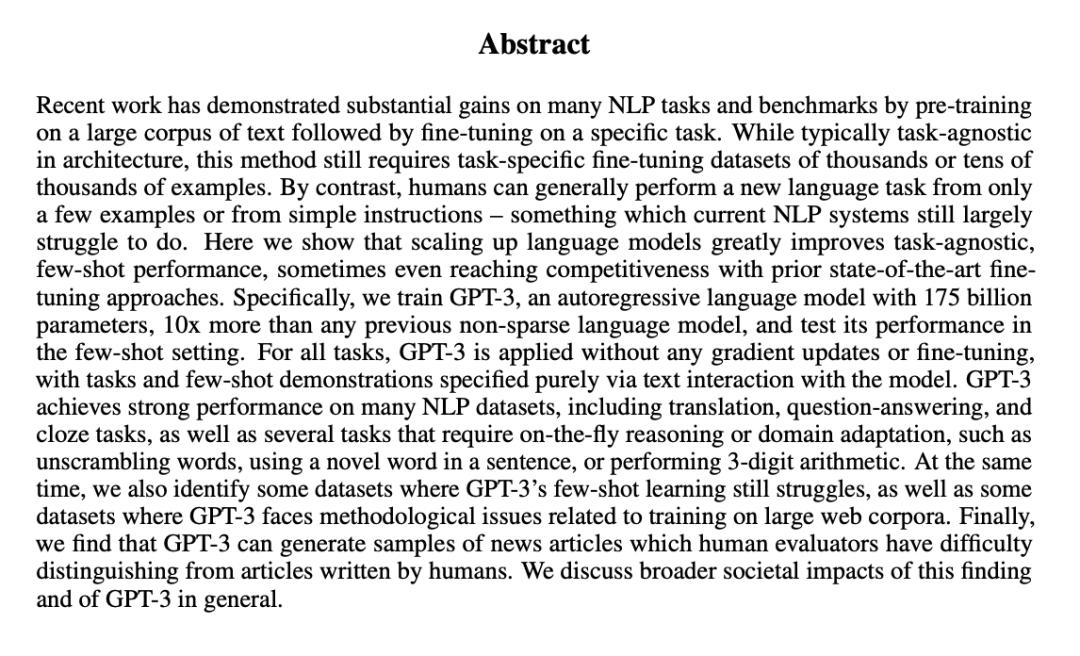
In 2020, OpenAI proposed ICL in its GPT-3 paper Language Models are Few‑Shot Learners, defining it as a capability: without any parameter updates to the model (no fine-tuning or back-propagation training), by providing several task demonstrations/examples only in the input prompt, the model can identify and execute the new task in a single forward inference process.
Over the past three years, the context window has expanded from 4K to 1M, allowing models to process an entire book or a codebase in one go, and ICL is the core engine behind this progress.
Different from LLMs, embodied models face a composite context intertwined with visual observations, language instructions and action sequences, and real-world tasks are non-Markovian — "what to do next" depends on "what was done a few minutes ago".
Simply put, the context faced by embodied models is dozens of frames of visual observations per second, plus proprioceptive states and action sequences, with an information volume several orders of magnitude higher.
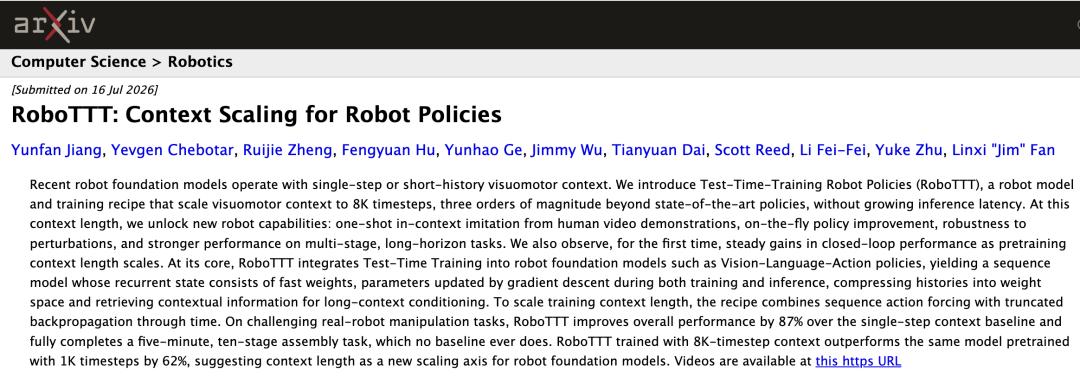
Until July 16 this year, the long-context policy model and training scheme for robots, RoboTTT, co-authored by Li Feifei, Jim Fan, Yuke Zhu and others, systematically brought the "context scaling" route to robot vision-motion policies for the first time.
In August, Generalist and Skild released their relevant achievements.
Although the two companies only demonstrated the model effect in the form of achievement releases, without full disclosure of technical details, the discussion about ICL in the embodied field immediately surged.
Whether this path can really work in the embodied field depends on a series of far-from-resolved technical issues.
Precisely because of this, we have developed more specific curiosity:
If embodied intelligence really continues to move forward along the direction of Long Context and ICL, how on earth can robots understand such complex context?
How can demonstrations, language, historical actions and even human corrections be fed into the model?
Therefore, we found COCO Matrix, a domestic startup dedicated to building In-Context Learning into the underlying paradigm of embodied intelligence.
The company was founded in April 2026.
However, Gao Yuxiang, its founder and CEO, told me that when he and his co-founder had in-depth discussions on startup-related matters in January this year, they both agreed that it was time to bet on ICL.
Gao Yuxiang is 30 years old this year. He graduated from the Junior Class of Xi'an Jiaotong University, dropped out of his PhD program at Johns Hopkins University (JHU), and focused on human-robot interaction research during his study there.
Gao Yuxiang said that when GPT-3 demonstrated the capability of in-context learning, he was still pursuing his PhD at JHU and had already been thinking: can this capability of "learning new tasks by only looking at examples without parameter updates" be transplanted to robots?
In the following five years, he dropped out of school, returned to China to start a business, joined the industry, and started a business again.
During this period, Gao Yuxiang led the team at Fourier Intelligence to get through the full-link of full-size humanoid robots from teleoperation, data collection to model deployment, and from May to August 2025, with a total cost of more than 1 million RMB, he trained a world model with certain generalization capabilities on a full-size bipedal humanoid robot.

https://about.yuxiang.io/
In April this year, COCO Matrix was officially established, turning the problem he started to get in touch with back in school into its entrepreneurial direction.
Different from Generalist and Skild, the idea of COCO Matrix is to advance the post-training ICL to the pre-training stage.
Therefore, I had an in-depth conversation with Gao Yuxiang in Shanghai, covering the technical progress, implementation challenges and industry controversies around embodied ICL.
(The following is the transcript of the conversation, slightly edited without changing the original intention)
Why does embodied intelligence need to switch to a new Scaling route?
QbitAI: For a long time in the past, embodied intelligence has been scaling data along the route of large models. Why did people believe that piling more data can scale up robot capabilities?
Gao Yuxiang: At the very beginning, the whole industry was actually quite optimistic.
After early solutions such as ACT and Diffusion Policy were verified, many core problems of behavior cloning and imitation learning were basically solved.
At that time, it was natural for everyone to continue the successful logic of large language models: as long as the data was continuously expanded, when the data volume accumulated to a certain threshold, the model would emerge general capabilities, and finally realize full-range task adaptation.
In the industry environment at that time, this line of thinking itself was not problematic, so the whole industry began to fully expand data on a large scale.
QbitAI: Where did the problem arise later?
Gao Yuxiang: For a single task, now collecting about 200 pieces of data can fit the task very well. The whole process from demonstration to model adaptation for a new task can be completed in about 18 hours.
However, after continuing to increase the data, the model never showed the expected general generalization capability.
At the same time, embodied data itself is also very difficult to scale. The quality of teleoperation data is not uniform, and the diversity of objects and scenarios is limited. Relying solely on such data can hardly provide sufficiently rich perception coverage.
QbitAI: Apart from this, what other problems are there?
Gao Yuxiang: Many early VLAs followed the pre-training system of LLMs and VLMs, but when facing the physical world, the original visual representation can hardly cover different levels of information required by robots at the same time, so many solutions need to constantly splice different visual modules.
This route is still effective in many scenarios, but over the past year or so, people have gradually found that continuing to stack data and modules along the original VLA paradigm will make subsequent capability improvement more and more difficult.
New Attempts on the Scaling Route of Embodied Intelligence
QbitAI: If data coverage cannot be achieved, what is the industry starting to scale now?
Gao Yuxiang: It is obvious that people are starting to pay attention to the learning capability and adaptability of robots.
In the past, more attention was paid to how much data the model has seen and how many tasks it has learned during the training phase. Now people are starting to ask another question: when a robot enters a new environment or new task that it has never seen before, can it quickly learn by leveraging the current Context?
Some obvious signals have emerged this year.
Works like RoboTTT are trying to solve the encoding, compression and utilization of longer historical information, so that robots can continuously refer to visual and action Context over a longer period of time.
The One-Shot capability recently demonstrated by Generalist AI and Skild AI goes a step further. After showing the robot a task demonstration once, it can quickly adapt to the new task based on this segment of Context, without the need for full fine-tuning or retraining for each task.
Therefore, the Scaling dimension of embodied intelligence is expanding now.
In addition to continuing to scale models, data and task coverage, whether robots can continue to learn after deployment and quickly acquire new capabilities from demonstrations, historical experience and interaction processes has also become a new Scaling direction.
The Scaling logic that has been verified by LLMs, why is it so difficult in the embodied field?
QbitAI: It is the same ICL, but the difficulty in the embodied field seems to be much higher than that in the LLM field... Where exactly does the complexity lie?
Gao Yuxiang: Robots face the physical world, and their input and task structures are far more complex than pure language.
This complexity is mainly concentrated in two major dimensions: one is the input, output and technical architecture problem of the model itself, and the other is the inherent shortboard problem of the data system.
It can be further broken down into three core technical difficulties.
The first is visual understanding.
Robots need different levels of information in different tasks and different action stages. They need to understand high-level semantics such as "what is this", and also obtain fine spatial information directly related to actions such as position, depth and contour.
This is also why many early VLAs need to splice different visual models such as DINO and CLIP at the same time. A single visual encoder can hardly fully cover the information required by robots.
The second is multimodality.
Language is far from enough for robots. Vision may carry most of the information, but tactile sense, hearing and proprioception will also affect actions.
The problem is that the data volume of these modalities varies greatly. At present, vision and language can still rely on massive data for pre-training alignment, but the data scale of tactile, sound and proprioceptive states is far from reaching this level.
The third problem is Long Context and Memory.
Robots perform continuous tasks, they need to know what happened before, and judge which past information is relevant to the present. This process involves compression, filtering, extraction and long-term retention of historical information.
In fact, these underlying technologies that support the long-term memory of robots have only begun to show obvious progress in the last six months or so.

From Fixed Window to Streaming Memory
QbitAI: At the end of last month, Skild-AI's S1 model supported long task demonstrations of up to 10 minutes. In contrast, the one-shot ICL demonstration video of Generalist GEN-1.5 is only 3-12 seconds, which completes learning and application within a 30s window.
Although Skild only provided a demonstration demo, this duration is still very surprising.
Gao Yuxiang: I think we should not only look at the duration, but more importantly, the information density.
If a 10-minute video is full of repeated actions and no new task information, it is not high-quality Context for the model.
What we are testing with good results now is a complete task demonstration from the human first-person or third-person perspective.
A human completes a new task once, and after the robot watches it, it completes the same task again in the current scenario. The information density of this kind of One-Shot Adaptation is very high, because it contains complete new task logic, action and scenario information.
On the contrary, if 10 minutes are just many repeated actions, or several simple small tasks spliced together, its learning value is limited.
QbitAI: So the focus of Long Context is not to forcibly extend the fixed window from one minute to ten minutes?
Gao Yuxiang: Exactly.
In real robot tasks, many effective Contexts may only last two or three minutes. It is not necessary to simply make the robot re-read the complete ten-minute history every time.
More importantly, after new Context keeps coming in, the model can continuously filter and compress historical information. Some of the valid information finally retained may come from ten minutes ago, or even from an hour ago.
The Long Context we understand is more like a streaming mechanism.
The ultimate goal is to enable robots to work continuously and continuously leverage past experience, instead of forgetting all the things they learned in the morning in the afternoon because the fixed Context Window is exhausted.
QbitAI: But the video memory and Context capacity of the model itself are limited after all, how to solve this long-term Memory problem specifically?
Gao Yuxiang: At present, we are working on it from two main directions, and these solutions are still under internal testing.
One is to first improve the model's own understanding capability.
If the model really understands the current task, it will be clearer about which information in the history is important and which information can be discarded. Therefore, Memory is not just a compression problem, but also related to the model's understanding capability.
The other is to compress a large amount of KV Cache generated by long sequences, which not only ensures real-time performance, but also controls video memory consumption.
In this regard, large language models and video generation have many technical routes that can be used for reference, such as Linear Attention