GPT-6's best partner = ByteDance Seedance
GPT-6 somehow ended up working for ByteDance Seedance???
And it's not just a regular job — it's taking on multiple roles all at once —
Writing stories, building scenes, arranging characters, setting camera positions, making storyboards, generating videos, editing the final cut...
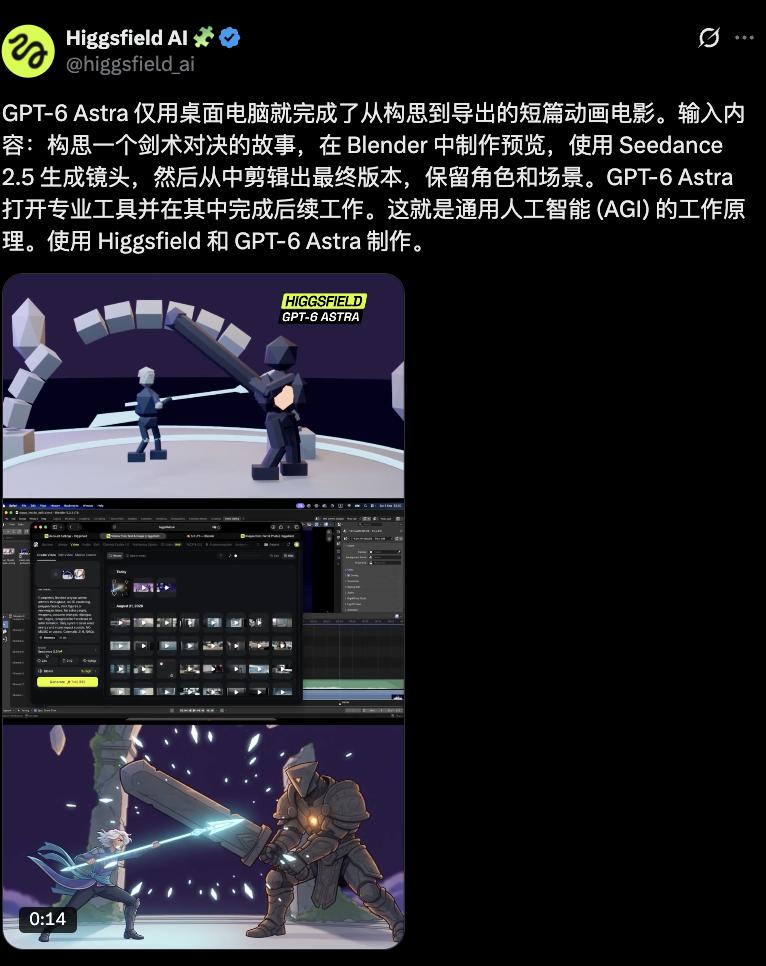
Nice, this time GPT-6 takes the director role, and Seedance 2.5 handles the final footage production.
On the surface, it looks like two anime characters are drawing their swords and dueling in a Japanese-style street alley.
The camera sweeps over the eaves for a moment, then zooms in quickly close to the characters. From confrontation, sprint to close combat, several consecutive shots remain in the same consistent scene.
In the current AI video industry, the final output alone might not make you slump down on the spot (doge meme).
But look at the task that Higgsfield assigned to Astra:
Come up with a sword fight story, complete previsualization in Blender, use Seedance 2.5 to generate the shots, then edit these materials into the final version while keeping characters and scenes consistent.
In other words, humans only gave a general requirement, and GPT-6 Astra handled everything from the initial brief to the final export completely on its own on the desktop.
Nah, at the GPT-6 launch event it was still drawing circuit boards in KiCad and building houses in Blender —
Only two days have passed, and netizens have already arranged it to work in the film and television base...
GPT-6 Acts as Director, Seedance Brings the Performance to Life
The whole implementation path looks somewhat like an AI version of an animation production crew.
After GPT-6 Astra gets the task, the first thing to do is to create a shootable story from scratch.
Who fights who, why they fight, where they fight, how the actions progress, and how many shots are needed — all these points have to be sorted out first.
With the story ready, it then opens Blender.
It first builds a relatively simplified 3D scene including streets, houses, characters and props according to the plot, then puts the two characters into the scene, and arranges their positions and movement routes in different shots.
What is done at this stage is Previs (film and television previsualization).
After going through all this, the entire fight scene has actually been rehearsed once with 3D models in Blender.
GPT-6 Astra then continues to generate reference frames corresponding to different shots based on the previsualization footage, and sends the character images, scene visuals and action references to Seedance 2.5.
At this step, ByteDance Seedance officially joins the production crew.
It is responsible for converting static reference frames and rough previsualization into real videos with character movements, camera motions and anime textures.
Of course, Astra hasn't clocked off work after generation is completed.
It then drags all the clips generated by Seedance into the editing tool, selects shots, arranges the timeline, stitches together the complete version, and finally exports the final footage.
More accurately, GPT-6 has assembled multiple tools and models into a temporary film set:
GPT-6 Astra writes the story, operates Blender to complete previsualization, then calls Seedance 2.5 to generate official shots, and finally returns to the desktop to finish editing and export.
Humans just wait outside for the final footage to be delivered...
Putting aside AGI for now, Seedance 2.5 really performed very steadily this time.
Right after that, netizens moved this set of workflow to Konoha Village.
Astra first made the scene into a 3D Blockout, which is a simplified model that only retains building structures, character positions and general spatial relationships.
Then it set up 6 cameras in advance in Blender, and determined how each of the 6 shots would be taken.
After the shots are confirmed, a frame of image will be exported at each cut point.
These images are then sent to GPT Image 2 for refinement, turning the original rough 3D gray models into key frames with Naruto style.
Finally, Seedance 2.5 steps in, and a 30-second fan-made short video of Konoha Village containing 6 shots is produced this way.
Not satisfied with making animations, GPT-6 and Seedance then targeted Chinese short drama series.
This time the gameplay is even more abstract: with one simple instruction, convert a 30-episode Chinese short drama into a US version.
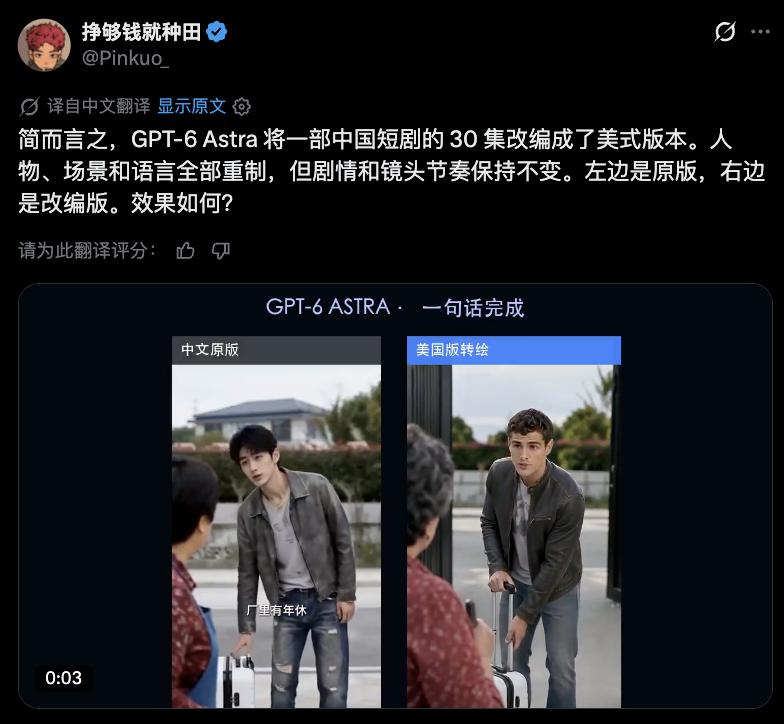
In the comparison video, the main story line and shot rhythm are basically copied, but the characters, scenes, language and cultural background are all replaced with a new set.
Chinese AI actor faces are replaced with US AI actor faces, the original rooms, streets and costumes are regenerated, while the frame composition and character movements follow the original footage as much as possible.
GPT-6, Fable 5.1, Gemini 3.8 All Come to Seedance for Video Production
Moreover, it's not just GPT-6 that comes to team up with Seedance.
In the past two days, GPT-6 Astra, Fable 5.1, Gemini 3.8 Flash took turns writing prompts, and all submitted them to Seedance 2.5 to make videos.
Alright, Seedance directly responds: Rolling camera!!!
The same brief, when handled by different models, actually produced three completely different styles.
Some versions focus on character movements, with the camera advancing quickly following the events; some put more emphasis on composition, lighting and atmosphere, looking more like carefully storyboarded productions; others strictly execute the task step by step with complete information, but have relatively weaker director characteristics.
GPT-6 Astra and Fable 5.1 were even arranged to take several rounds of consecutive tests, all using Seedance 2.5 as the video generation tool.
For example, hand-drawn Japanese-style ghost stories:
Or ink wash animation:
Leaving aside who wins between GPT-6 and Fable, Seedance's ink wash effect is really impressive.
After a round of comparison, the debate over which of the three large models performs better has not come to a conclusion, but ByteDance Seedance has already firmly taken the C position on the film set...
After Seedance Clocks Off, GPT-6 Goes to DaVinci to Work as a Colorist
Right after finishing work on the film set, GPT-6 immediately took a part-time job as a colorist.
This time GPT-6 opened DaVinci Resolve.
Netizens gave GPT-6 Astra a reference image, asking it to adjust the colors of the original video to a similar style just like a professional colorist.
It needs to observe the color temperature, contrast, shadows, highlights and overall color tendency in the reference image, then operate the color grading tools in DaVinci to modify the video little by little.
The effect after 4 minutes of work is like this:
Judging from the before-and-after comparison, the original video looks flat and gray overall. After processing, the color tone is obviously richer, the shadows are darkened, and the cold-warm relationship of the picture is also closer to the reference image.
Of course, netizens' evaluations of this AI colorist are not as consistent as their feedback on the animation short films.
Some people think that completing reference image style matching in 4 minutes is really convenient;
Others bluntly say that the adjusted version looks even worse... Color grading should serve the story, and colors themselves can also be the narrative theme, which AI obviously cannot truly understand these creative intentions...
