The conclusion of "Hilarious Stand-up Season 3" marks that stand-up comedy has entered the "Author Era".
Smell State
Inspecting the pulse of the industry, observing all facets of human life
Series of Observations: Chinese Stand-up Comedy Has Finally Ushered in Its Literary Era
Author | Liu Su
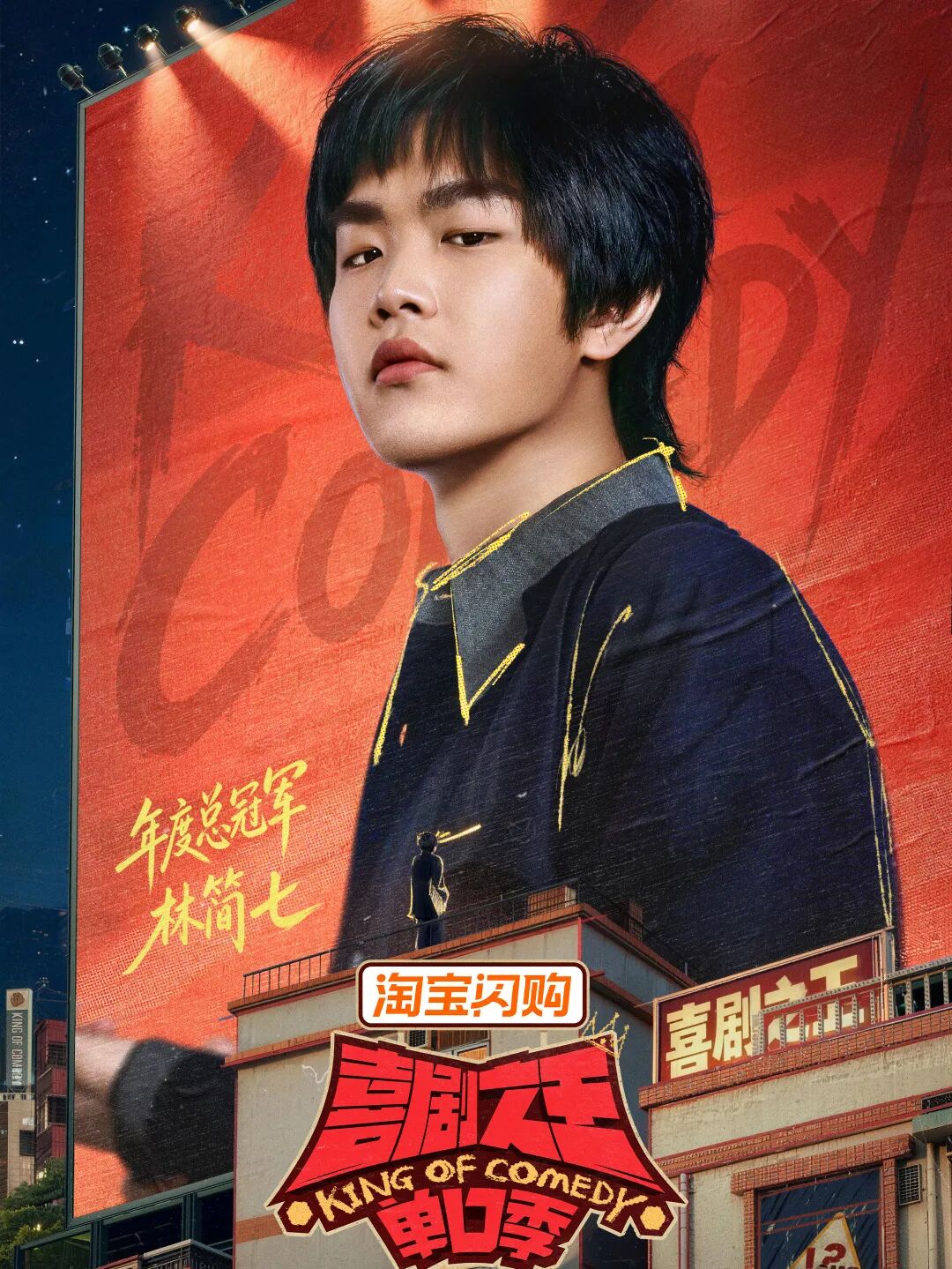
On September 5, the third season of Top Comedian Stand-up Season wrapped up. Lin Jianqi won the annual championship with 413 votes, Zhai Jianing took the second place with 409 votes, and Heideng ranked third with 397 votes.
In the finals, all performers gave their all. Heideng cut into ordinary people's internet life from perspectives including AI customer service, App shake-to-redirect, pop-up ads and non-compete agreements; Zhai Jianing integrated AI into his jokes, imitating the behavior of AI that over-flatters users; Xinbo performed around "fixed-price" ride-hailing services, bringing the ride experience to the stage; Xi Ha used the trope of "possessed by Guan Yu" to address queue-jumping in public places; Lin Jianqi continued to develop the jumping expression that ran through the whole season, adding wordplay, physical performance and Xinjiang dance in the final. Facing the same stand-up stage, these performers have adopted several sets of obviously different creation methods.
The titles of short video clips have completely broken away from the traditional paradigm of "someone talks about a certain experience", and are replaced by short-video-oriented highly condensed highlights such as "Lin Jianqi's Xinjiang dance is a stroke of genius", "Xinbo teases bad fixed-price ride to play with 4D stage" and "Xi Ha 'possessed by Guan Yu' rectifies queue-jumping".
Lin Jianqi's championship makes a change that has existed for several years particularly prominent. When the program premiered in July, Lin Jianqi caught the audience's attention with a "stream of consciousness" performance, and then talked about haircutting, hidden cameras in hotels, shipping campus CP, and his father, until the finals. The themes kept changing, but a set of expression methods featuring jumping, dislocation, association and physicalization gradually stabilized. When iQOO officially launched the program, it put forward the concept of "rejecting pre-made dishes, rejecting assembly lines, rejecting uniformity", and the finals finally awarded the championship to the performer who is the most difficult to classify according to standard templates, forming a kind of echo before and after.
Stand-up comedy has long been discussing quality based on scripts. There are relatively mature evaluation criteria for whether the jokes are dense enough, the structure is complete enough, the story has a twist, and the value expression can be implemented. The new problem left by Top Comedian 3 is that when more and more performers can produce qualified or even excellent scripts, what else can widen the gap between creators?
An answer is emerging.
Authorship.
The Emergence of the Author
The concept of "author" has been discussed in the film industry for decades. The auteur theory emerged in French film criticism circles in the 1950s. Later, American film critic Andrew Sarris summarized the criteria for judging a film auteur as technical competence, recognizable personal style, and the inherent meaning running through the works. The auteur theory once caused a lot of controversies. After all, films come from the collective labor of screenwriters, cinematographers, performers, editors and the production system, but the auteur theory solves a very practical problem: why in a mature industry, some directors' works still carry an indelible personal stamp.
Applying the same method to stand-up comedy, authorship can have a relatively clear definition. Performers need to master the basic grammar of stand-up comedy first, then form a personal processing method that can span different themes. After several or even dozens of works are connected, the audience can still perceive similar perceptiveness and value judgment. Authorship is established by a sequence of works, and a single viral hit can only prove one successful creation.
Lin Jianqi is a perfect example to illustrate the difference. The first episode directly called Lin Jianqi's stage "stream of consciousness". In the third episode, he talked about a haircut experience, then transformed the hidden camera in hotel into an anti-routine imagination, dealt with campus memories and father-son relationship in the semi-final, and continued to integrate Chinese characters, pictures, physical movements and stage space into his performance in the final. When ordinary life enters Lin Jianqi's creation world, it often loses the original causal order first, and then reorganizes according to association. Haircutting is no longer just a source of an unlucky story, nor is the father processed as a common family narrative material. Lin Jianqi cares more about what else a normal situation can be imagined as.
Russian formalism once used "defamiliarization" to explain a similar artistic mechanism. After daily experience is used for too long, people will enter an automatic perception mode. Art rearranges familiar things, making the audience realize again that the accustomed life can still have another form. For Lin Jianqi, "abstraction" only describes the stage viewing experience, while defamiliarization is closer to the process of creation. Reality does not disappear, but its original connection mode is dismantled and reassembled.
Heideng provides another sample of authorship. Judging from his identity alone, it is easy to classify Heideng as a "visually impaired performer", but in Top Comedian 3, Heideng has constantly moved beyond the life of disability itself. He talked about anti-fraud in July, "ancient handmade high-tech" in August, and entered the fields of AI customer service, internet ads and non-compete agreements in the finals. After the themes changed, the observation method that Heideng repeatedly uses is still clear: those rules that everyone in social operation has tacitly accepted will be re-examined. The visually impaired experience provides the initial viewing position, and the part that can continuously produce content is the sensitivity to rule dislocation and system absurdity.
How is at another stage. A master of law, former Northeast lawyer, with a judge mother, and experiences of court trials and internet cafe teenagers provide How with very fresh materials. The episode broadcast on July 17 received 29,000 bullet comments and 661 comments, and his internal professional experience quickly established recognition. But professional recognition is still different from author recognition. If the lawyer identity is taken away, when How talks about consumption, intimate relationships, travel and technology in the future, the audience can still recognize a stable observation method, then the professional experience truly completes the transformation to author ability.
Identity labels are consumables with limited stock, while cognitive models are engines that continuously process reality.
Putting labels on others is leveraging existing impressions. Calling yourself a programmer, a Northeast native or a lawyer, you are leveraging the public's existing stereotypes of this group, saving the effort of building a character. But this kind of bonus decreases with each use. Once the old life is exhausted by jokes, the creator can only stand on the stage and spin in circles.
Authorship is a lens. Facing completely unfamiliar real materials, what really widens the gap is the perspective through which the gaze penetrates. Some people instinctively dismantle absurdity from authority, some are used to picking out thorns in warmth, and others smell superiority in extreme humbleness. This observation frame polished by personal scars, cognitive paranoia and complex experience cannot be generated by AI, nor can it be deduced by formulas.
People without stable cognition can only wait for life to come to them as raw materials; for creators with authorship, even if you throw a piece of pig iron to them, they can hammer it into a knife according to their own framework.
Scarcity Transfer
The reason why authorship stands out in 2026 also lies in an industry background. Chinese stand-up comedy has accumulated enough performers, and basic creation capabilities are spreading rapidly.
The contestants of Top Comedian 3 increased from 48 groups in the previous season to 60 groups. When the program premiered, iQiyi directly wrote "reject pre-made dishes, reject assembly lines, reject uniformity" into its content proposition. Among the 60 contestants, there are lawyers, traditional Chinese medicine practitioners, athletes, doctors, short drama performers and newcomers from different educational backgrounds. By the middle of the third season, the platform even produced special topics such as "those new angles that no one has ever thought of", "observational comedy", "when stand-up performers meet stereotypes" and "the audience's mouthpiece for consumers" to reclassify different creation methods.
The changes brought by expansion are not limited to more materials. In the early stage of an industry, the scarcest resource is people who master professional grammar, and stand-up comedy has also gone through a similar stage. How to lay a setup, how to deliver a punchline, when a callback appears, and how to control the rhythm of a 5-minute script are all skills that can be practiced, summarized and taught. After the number of performers increases, clubs expand, and online programs are broadcast continuously, the industry grammar gradually changes from a secret of a few people to public knowledge, and the difference created by simply "being able to write a stand-up comedy script" naturally narrows.
Technology continues to lower the threshold for standardized content production. A study published in January 2026 shows that performers have tried to use multi-agent systems to generate Chinese stand-up comedy. The system can start from a life theme, process material collection, setup-punchline structure, callback and performance prompts, and finally generate 3 to 5 minutes of Chinese stand-up content. The research result is still far from replacing mature performers, but the signal is quite clear: the parts of stand-up comedy that can be summarized into rules are increasingly easy to be learned by machines.
After standard capabilities become cheaper and cheaper, the parts that are difficult to standardize naturally appreciate in value. A person's childhood, occupation, reading, physical experience, aesthetic taste and long-formed judgment methods cannot be completely copied through a few prompts, thus authorship gains commercial significance. The content industry ultimately faces a very simple scarcity problem: platforms can produce more stand-up comedy scripts and train more qualified creators, but it is difficult to mass-produce "how Lin Jianqi views the world" or "from which gap of rules Heideng can find the punchline".
The market performance of Top Comedian 3 also provides an observation window. According to data disclosed by Snow Leopard Finance on September 5, the program obtained the highest S+ rating from Yunhe 14 days after its launch. As of August 27, it had generated 2613 hot searches across the whole network, with related topics read more than 16.835 billion times. The 44 performers of the first season gained a total of 5 million new followers, the performers of the second season gained a total of 1.6 million new followers, and obtained more than 50 commercial cooperation projects. The investment promotion list of the third season has added brands such as Taobao Flash Purchase, Royal FrieslandCampina Meadson, BYD, Vita Lemon Tea, and Huawei Pura 90 Series. Relevant data comes from media statistics on the commercial performance of the program, and iQiyi has long been at the top of the hit variety show list on its platform during the finale stage.
As a result, a noteworthy shift has taken place in the commercial value of the program. In the past, the core assets sold by variety shows were mainly program traffic, star lineup and naming exposure. Three consecutive seasons of Top Comedian have been creating a large number of performers who can continue to operate independently after leaving the program. The works are responsible for completing the first attention aggregation, and the author is responsible for converting one-time attention into long-term relationships. Commercial cooperation, offline special shows, short video clips and the next season of programs can all be carried out along the same creator.
After the content industry enters a mature stage, the truly scarce assets of the platform will gradually shift from "a good piece of content" to "people who can continuously produce good content".
Beyond Style
For authorship to truly become a commercial asset, it also needs to go through a more rigorous test. High recognition does not mean that one is already a mature author.
There is a common trap in the content industry. Creators become popular because of a certain feature, platforms and audiences quickly give them labels, and then the market requires creators to constantly repeat the verified version. A performer gains attention because of "abstraction", and abstraction can easily evolve into aimless randomness; a performer becomes popular because of identity experience, and the professional label may also become a material mine that is repeatedly mined; after a performance method gets high spread, movements, catchphrases and emotional intensity may solidify rapidly. Authorship originally comes from personal judgment in continuous change, but the commercial system naturally wants to turn successful experience into stable products.
This is exactly the real problem Lin Jianqi faces after winning the championship. The vanishing, painting and Xinjiang dance in the finals have pushed the form very far. Wang Jianguo commented on the relevant performance as "art", and the official iQiyi also described the champion with phrases like "style is not defined" and "expression that belongs only to you". The next stage of test is no longer whether Lin Jianqi can be more weird, but whether the same set of perceptiveness can handle more complex and broader realities.
Only when the constantly influx of new themes can be digested by his world view and grow new expression methods, can personal style truly precipitate into an author system. If the audience is always waiting for the next more exaggerated spectacle, the style will eventually be just a fixed juggling show.
The long-standing doubts about film auteur theory also remind the content industry not to interpret authorship as a genius myth. Sociologist Howard Becker emphasized in Art Worlds that art production depends on a whole set of collective collaboration and industry conventions. Stand-up variety shows also have scriptwriter exchanges, open mic draft testing, program directors, editing, stage art, photography, communication and platform distribution. Performers have never existed independently from the industry.
The value of authorship arises precisely within the industry. Everyone faces similar stages, duration, review requirements and communication mechanisms, but some works can eventually leave a distinct personal mark. The capabilities of the platform will also change accordingly. In the past, it was necessary to train creators to be more in line with standards. A mature content industry must also have the ability to identify deviations, protect deviations, and then transform vibrant personal expression into content assets that can be operated for a long time.
iQiyi has shown relevant attempts in the third season. In addition to the main feature, Top Comedian 3 is split into pure enjoyment versions, high-score stages, special planning, derivative content and hundreds of "quick look" videos. A certain observation method of a single performer can be re-cut from the long variety show for communication. Outside the program, performers can enter offline tours, brand cooperation and new content projects. As a result, stand-up variety shows not only undertake the competition function, but also undertake the functions of creator discovery and creator amplification.
From a commercial perspective, the most important value of authorship may be irreplaceability. The life cycle of a single viral hit is getting shorter and shorter, hot topics are quickly copied, and structures and skills will spread rapidly. A creator who has established a stable viewing method can continuously absorb new social changes. AI, ride-hailing, advertisements, family relationships, professional life can all become new inputs, and the ultimate object of the audience's consumption will gradually shift from a certain theme to the creator himself.
After Top Comedian 3 ends, Lin Jianqi's championship thus leaves a signal more worthy of observation than the ranking. Chinese stand-up comedy has more and more people who can write good jokes, and the competition will then enter an area that is more difficult to replicate. The work that performers need to complete will also continue to move from finding a good experience and forming a distinct persona to establishing a personal reality processing method.
When the audience opens a video just because they want to know "how this person will see it", the author truly appears.
And when a person's name itself is enough to become a content expectation, the content industry has also entered another stage.
This article is from the WeChat Official Account "Smell State", Author: Liu Su, published with authorization from 36Kr.