Where do profits come from? One trick cuts costs by 90%
I. AI is Not Only for Image and Video Generation
Many people have a one-sided understanding of AI, especially practitioners in the e-commerce industry. Once they participate in relevant training, they will take it for granted that AI equals image generation, video generation, digital human live streaming and copywriting creation.
These functions do fall into the category of AIGC, but the scope of AI is far broader. For example, there are embodied intelligent robots, robotic dogs, and the currently most popular Agent.
The core difference between Agent and ordinary tools or large models lies in whether it can independently plan tasks, make autonomous decisions, form a closed loop on its own and execute tasks by itself, rather than only providing suggestions for users.
The first category: Generative AI. Text generation, image generation, video generation, text-to-text, text-to-image, image-to-image, and image-to-video all belong to this category.
The second category: Analytical AI. In fact, everyone has been using it passively. The personalized product recommendations you see on Taobao and Douyin for different users are all driven by analytical AI behind the scenes.
In the past two years, the operation of traffic investment has become simpler, because platforms have launched full-scale promotion tools. Analytical AI supports the whole process of how to target crowds, understand brands and reach consumers.
The intelligent diagnosis in the platform backend, which prompts whether to optimize the title, adjust the price or increase/decrease the traffic investment budget; and the third-party tools that predict sales trends and break down targets, are all completed by analytical AI.
The third category: Executive AI. The customer service robot that receives you when you shop is a typical example of executive AI.
The application status of the three types of AI varies greatly. Most enterprises are currently focusing on generative AI, because it is the most intuitive and has the strongest impact.
Few enterprises use analytical AI, as the industry is still immature. When the best model Gemini 3.0Pro was released at the beginning of the year, its hallucination rate dropped from the previous 88% to 50%. Up to now, after the release of GPT 5.6, its error rate still remains at 30%. If enterprises cannot fine-tune, train and constrain the model, the model will output wrong content randomly.
Executive AI has huge potential, but in the past few years it was basically only used for data collection and crawling, and a small number of better applications were deployed in the financial scenario, where there are many repetitive operations. It is rarely used in operation, commodity management, human resources and supply chain scenarios, the reasons of which are the low acceptance of front-line employees and the traditional production relations.
A counterintuitive finding is that executive AI is a severely undervalued sector. It has reached a high level of maturity, and can solve most repetitive operation scenarios if combined with RPA. However, many business leaders do not understand front-line operations, while front-line employees do not understand relevant tools, forming an information gap between the two sides, so that many applicable scenarios that could have been realized are not developed.

II. Technology Combination: The RPA+BI+AI Triangle
1. Understand the division of labor of the three through the analogy of human organs
Corresponding to human organs: RPA (Robotic Process Automation) frees hands, BI (Business Intelligence) frees eyes, and AI frees the brain. The three are not in a competitive relationship, but a complementary relationship.
RPA has no brain and cannot think, it strictly executes step by step according to instructions, and will not do extra operations, but it will never make mistakes or leak secrets. It can be understood as the hardworking old scalper in the company, which makes no innovation and has no own ideas, but is reliable and steadfast.
BI solves the problem of data governance. In the past, it was very painful to find the root cause of problems and locate issues from a large amount of scattered data, while BI uses dashboard visualization to intuitively show where the problems lie.
AI frees the brain, it generates copywriting, plans, reports and images, helps you make decisions, and processes unstructured information, which refers to colloquial content without fixed formats. Structured data has unified fields and fixed formats, while unstructured data is relatively colloquial.
2. Will RPA be replaced with the emergence of Openclaw and Codex?
People often ask: Now that Openclaw and Codex are available, is RPA no longer needed?
From the perspective of enterprise characteristics, there are two requirements for enterprise operation: the cost cannot be too high, and the operation should be safe and stable.
The computing power cost of tools like Codex is much higher than that of RPA, and the operation of RPA only consumes electricity. For high-frequency repetitive tasks that need to be completed every day, the solution based on RPA which only consumes electricity is more cost-effective.
In financial scenarios, you cannot let Codex process cash withdrawal and tax declaration, but RPA will not make mistakes or leak secrets. Some crawling operations will trigger the platform's anti-crawling mechanism, and RPA has many ways to bypass the restrictions. Therefore, RPA will not be replaced, and each tool has its own applicable scenarios.
Take the scenario of invoicing in finance as an example. In the past, employees needed to manually open the mailbox, download invoices, rename them according to rules, and manually input the data into the financial system.
Now RPA is triggered at fixed time every day, automatically downloads invoices and renames them according to financial rules, uses computer vision and natural language processing technology of AI to extract invoice information, then inputs the data into the system through RPA, and finally the BI dashboard displays the results, realizing the automation of the whole process.
Our experience is that "AI+RPA+BI" is the best solution at present.
The generative part can only be completed by AI; if enterprises cannot constrain and train analytical AI, they can adopt the combination of BI and AI. BI controls the accuracy of data, AI builds the analysis framework and draws conclusions, and RPA fills in the data, so the accuracy can reach a very high level; RPA is mainly used to automate repetitive operations, reducing the computing power cost to the level of electricity cost.
One of our customers had a monthly token cost of 300,000, which dropped to 30,000 after adopting this set of solutions.
III. What on earth is AI transformation and why is it difficult to promote?
1. What on earth is AI transformation?
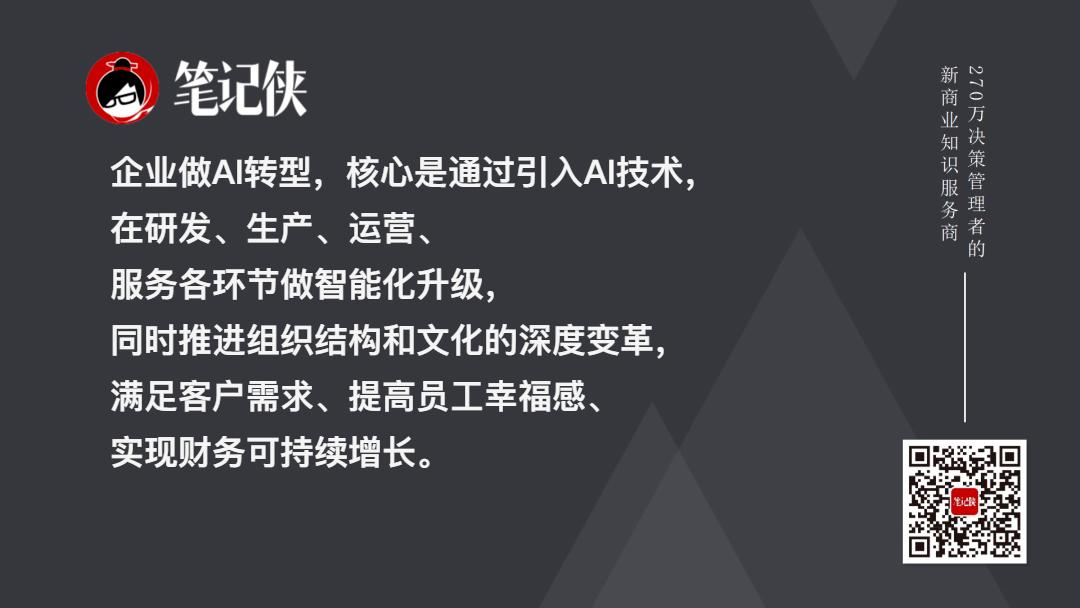
My understanding is: the core of enterprise AI transformation is to introduce AI technology to carry out intelligent upgrading in all links of R&D, production, operation and service, and promote the in-depth reform of organizational structure and corporate culture at the same time, so as to meet customer needs, improve employee well-being and achieve sustainable financial growth.
It is divided into three sections. The first is intelligent enhancement, whose value is far greater than efficiency improvement. Saving the time spent on repetitive work is only a superficial application, with low economic value. Changing the process and enhancing organizational capabilities can bring greater value, helping enterprises achieve things that were impossible before, or raising the performance score from 60 to 80.
The second is organizational reform. The change of human-machine collaboration mode improves organizational efficiency, note that it is organizational efficiency, not individual efficiency.
The third is ecology, the evolution of business models. Its short-term value is to increase revenue, reduce cost and improve efficiency, and its long-term value is to build a new growth engine with AI and reconstruct the business model.
I particularly agree with the definition of AI transformation given by a company: AI is not a tool item, but an upgrade of business capabilities and organizational collaboration modes.

It has three core conclusions:
First, AI is an inevitable upgrade of enterprise operation modes;
Second, AI does not replace humans or systems, but redesigns the division of labor among the three: the system is responsible for factual management, AI is responsible for cognitive processing, and humans are responsible for decision-making;
Third, the goal is not to launch Agent, but to form replicable, reviewable and evolvable business capabilities.
The implementation idea is to supplement the data base from real scenarios, plan AI positions, form new barriers, and finally enable the organization to rely on the collaborative evolution of data, knowledge, AI and humans, rather than driven by individual experience.
2. External factors: fast iteration speed, severe hallucination, and numerous tools
The improvement of the maturity of new external technologies makes it possible to realize monetization in many business scenarios. However, according to our observation, the promotion of AI transformation in many enterprises is relatively slow, and the progress of process governance, organizational division of labor change and knowledge base precipitation is relatively slow, which directly affects the final efficiency. The obstacles are divided into external factors and internal factors. Let's talk about external factors first.
First, models are released faster and faster. Last Spring Festival, only DeepSeek was released, while before this year's Spring Festival, Doubao 2.0 and Qianwen 3.5 were released; in late April, Claude 4.7, Kimi 2.6 and GPT 5.5 were released; up to now, Qianwen has been updated to 3.8 and GPT to 5.6. Enterprises are like Kuafu chasing the sun, and can never catch up with the pace of model iteration.
Second, the hallucination problem is still serious. The training data of most models is up to the end of 2024, with an information gap of one and a half years. When the required information cannot be found through network search, the biggest problem of AI is that it will not say "I can't do it", but make up a wrong answer.
Third, the return on investment is uncertain. Enterprises do not have a ROI dashboard, so they cannot feel how much they have spent and how much return they have obtained, and the dashboard needs to be built by themselves.
Fourth, the terms are complicated and there are too many tools. At present, there are tens of thousands of AIGC tools, and an enterprise needs to use more than 30 kinds of tools on average. There are tools like Dianxiaomi, Qianniu, Feige and Chitu for customer service, and tools like Jimeng, Jianying and Keling for short video. Each department has various tools that are constantly iterated and updated, leading to high trial and error cost.

3. Internal factors: no clear goal, no clear path, no assessment, no weekly milestone breakdown
Internal factors are more fatal, and there are four of them.
First, there is no real goal. I have asked many people if they have set AI related indicators, almost no one raised their hands. Jack Ma of Alibaba once said: "If your company's strategy is clear enough, can the cleaning aunt of your company explain it clearly?" The goal is vague, and everyone promotes it from bottom to top slowly, so it is difficult to move forward.
Second, there is a goal but no clear path, so the goal is only a nominal slogan.
Third, there is a path but no supporting assessment mechanism. Many AI leaders are part-time, and it is difficult for them to balance their primary job and the AI work. Human nature tends to prioritize their primary job, so the promotion of AI work is slow, and their mentality is "at worst, I will be criticized a few words, which will not affect my performance assessment".
Fourth, there is no milestone breakdown down to the weekly level. August and September are the golden period for e-commerce enterprises to carry out AI transformation (because in October, the Double 11 preparation will start, the team will be too busy to have enough energy to invest in the actual AI transformation work), so it is very important to clarify what to do every week and every day.
In short, the root cause why AI transformation cannot be promoted in many enterprises is that there are no business personnel responsible for the AI work. Business personnel know best how to set goals, break down targets, organize paths, carry out assessment and incentives, and split milestones, which is exactly the same for AI transformation work.
What cannot be measured is difficult to manage. Peter Drucker said: "If you can't measure it today, it's hard for you to be effective."
Set the goal first, then break it down. For example, if the annual revenue increase is several hundred million yuan, break down the target to the growth of Tmall, JD, Douyin, Vipshop and Pinduoduo stores respectively, then break down to categories and hot-selling products, and calculate how much growth is contributed by AI; or break down the target to functional modules, such as traffic investment, community operation and live streaming, and each module takes its own share of the growth target.
Only in this way can we iterate and evolve continuously.
IV. AI Transformation Must Be Top-Down
1. Top-down, rather than bottom-up
A student asked me during the break: with so many scenarios, should we promote AI transformation from bottom to top or from top to bottom?
We took the bottom-up path from 2020 to 2024, and developed many low-value products. In 2025, we began to switch to the top-down path. My suggestion is that AI transformation must be top-down in the future.
AI is an amplifier. If the scenarios and underlying knowledge are of high quality, the amplification effect will be very significant; but if front-line employees develop products with 40 points or even 30 points, and then multiply the effect by AI, it will not only not bring incremental benefits, but may even lead to reduction. Because the knowledge itself is incomplete and the underlying logic is wrong, AI will accelerate the wrong speed, running 60 times a day, which will be a disaster for the enterprise.
The core of top-down approach is to split the senior management team into 10 or 100 avatars through AI, expand their influence in all business links and make better decisions. The core competitiveness of enterprises in the future must be based on the judgment and decision-making of senior executives, rather than splitting front-line employees into 1000 avatars.
2. Revenue increase: break down into exposure, click, conversion and customer unit price
Increasing revenue is more valuable than improving efficiency and reducing cost. Decompose the target with the universal sales formula: GMV = exposure volume * click rate * conversion rate * customer unit price.
In terms of exposure volume in the e-commerce industry, the core goal within the platform is to reduce the cost per thousand