China's open-source models are becoming the "metric system" for global AI.
Saudi Arabia has entrusted MiniMax with the development of its domestic Arabic large language model.
On September 3, HUMAIN, an affiliate of Saudi Arabia's Public Investment Fund (PIF), released the Arabic language model HUMAIN-M3. It has a total of 428 billion parameters, activates 23 billion parameters per token, and uses over 1 trillion Arabic tokens for further training. The model is deployed on HUMAIN Node, and weight open access is planned in the future. The chairman of HUMAIN is Saudi Crown Prince Mohammed bin Salman.
Think about it, and think it through.
Unlike companies from certain countries that modify open-source models and claim them as self-developed, HUMAIN stated clearly in its official press release that the model was commissioned to be developed by Chinese company MiniMax, with MiniMax-M3 as its base. Saudi Arabia provides capital, computing power and Arabic language data, while MiniMax provides the model that has completed basic training. The result of the cooperation is then released in the name of Saudi Arabia's national model.
Two days before the release, Saudi tech blogger Sultan Alfaifi claimed on X that it was a "100% Saudi" model. After the post got 285,000 views, someone asked in the comment section: "100% Saudi? Fear God, Sultan." Later, the blogger corrected: "Thanks for the correction, it is based on MiniMax's M3." AI-related pride does exist, and the blogger was obviously carried away for a moment.
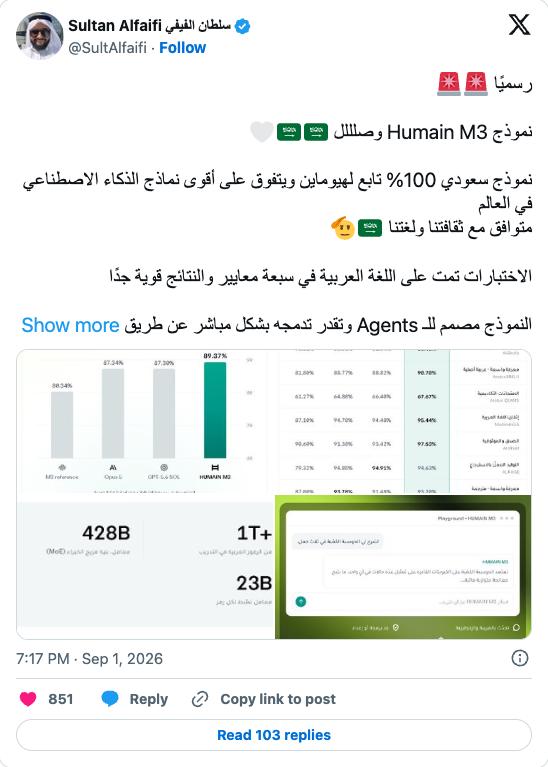
Figure 1 Saudi tech blogger claims HUMAIN-M3 is a "100% Saudi" model: HUMAIN-M3 is here. This is the "100% Saudi" model under HUMAIN, which is claimed to perform strongly in seven Arabic tests and conform to Saudi culture and language. The model is designed for agents and can be directly integrated; weights will be open in the future and can run on local servers in Saudi Arabia. Source: Original post on X
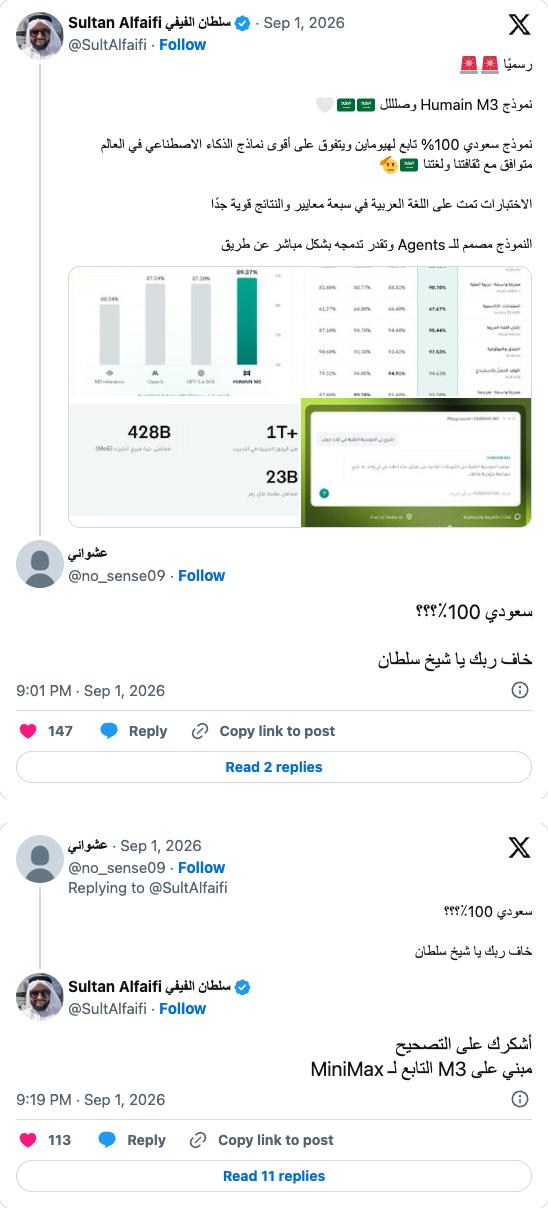
Figure 2 After the comment section questioned the "100% Saudi" claim, the poster corrected that the base model comes from MiniMax: Question: "100% Saudi? Fear God, Sultan." Correction: "Thanks for the correction. It is based on MiniMax's M3." Source: Original post on X
Saudi Arabia uses funds, computing power and local data to exchange for years of training time and model control rights; MiniMax no longer only sells API call volumes to overseas markets, but enters the bottom layer of model R&D of other countries.
This time, the overseas expansion of Chinese large language models has moved one layer forward. In the past, we exported apps and APIs, and overseas customers were end users; now we export base models, and overseas customers can continue to train, rename, and turn them into their own "domestic AI".
Looking further, China's open-source large language models are accommodating various languages, and are almost becoming the unified language of global AI.
Saudi Arabia buys time with money, and also buys control
In May 2025, Crown Prince Mohammed bin Salman personally announced the establishment of HUMAIN. This company is owned by Saudi Arabia's Public Investment Fund PIF, with business covering data centers, cloud, models and applications. What Saudi Arabia wants is not just a chatbot that can speak Arabic, but an AI system where computing power to applications are all controlled by itself as much as possible.
Saudi Arabia has money and energy, and can also buy GPUs, but training cutting-edge models from scratch still requires several years of time and a lot of failure costs. MiniMax provides a model that has completed basic training; Saudi Arabia provides computing power, local data and application scenarios, and then uses more than 1 trillion Arabic tokens for further training. What this cooperation saves first is not API costs, but the time spent on starting from scratch.
According to the data released by HUMAIN, the equal-weighted average score of HUMAIN-M3 on seven public Arabic benchmarks reaches 89.37%, which is 9 percentage points higher than the M3 reference model without localized training, and gets the highest score in five tests. However, these seven are all Arabic benchmarks. But this is enough to prove that a country does not have to start from the first step of pre-training to build a local model.
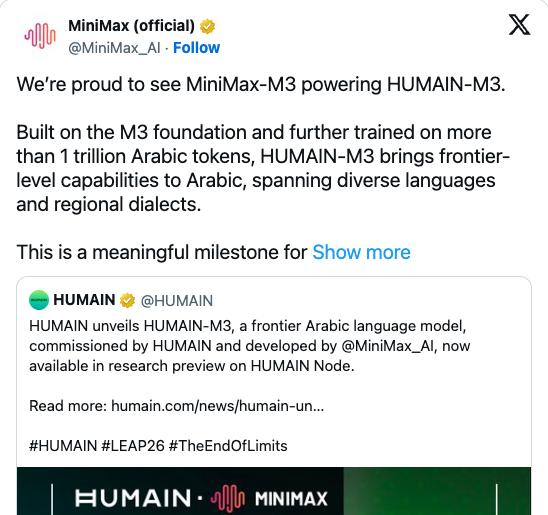
Figure 3 MiniMax officially confirms that MiniMax-M3 provides the base for HUMAIN-M3: MiniMax officially stated that MiniMax-M3 provides the base for HUMAIN-M3. HUMAIN-M3 is based on M3, and uses more than 1 trillion Arabic tokens for further training, covering multiple Arabic languages and regional dialects. Source: Original post on X
Saudi Arabia has thus established AI sovereignty. Compared with only using closed-source models such as ChatGPT and Claude, it can control data, training, services and information security by itself.
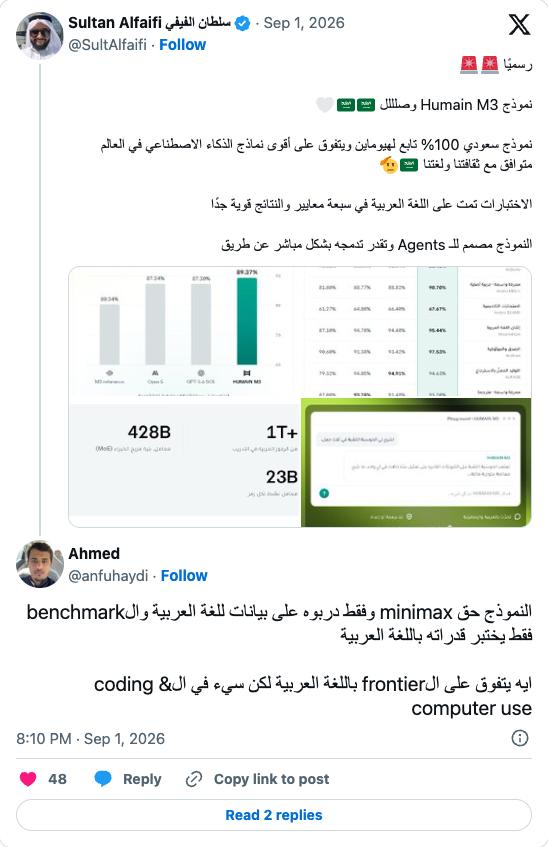
Figure 4 Arabic-speaking developers remind not to extend the language ranking to a conclusion of general capabilities: This model actually comes from MiniMax, and is only further trained on Arabic data. The benchmark only tests Arabic capabilities. Its Arabic performance has indeed reached the cutting-edge level, but its programming and computer operation capabilities are still weak. Source: Original post on X
Chinese models are beginning to become the upstream of "self-developed" models in various countries
HUMAIN-M3 is not an isolated case. More and more "self-developed" claims from overseas institutions no longer mean starting from the first GPU and the first batch of pre-training data. They master local data, complete post-training, and are responsible for deployment and applications, while the base model is selected from globally available open models. Previously, Llama was one of the most common choices; now, Chinese models are entering this field in large numbers.
When Japan's Rakuten released Rakuten AI 3.0, it emphasized that it is a high-performance Japanese model. But in the public configuration file, the model class is written as "DeepseekV3ForCausalLM", and the model type is "deepseek_v3". It cannot be concluded from the configuration alone that Rakuten copied the weights of DeepSeek, but it is enough to show that the architecture and compatibility defined by DeepSeek have entered the technical route of Japan's local models.
Supported by Singapore's National Research Foundation, AI Singapore further trained Qwen3-VL into Qwen-SEA-LION, which is adapted to Burmese, Indonesian, Filipino, Malay, Tamil, Thai and Vietnamese in one go; Thailand's CMKL University used Qwen3.5 to develop the Thai-English bilingual model MANGO. Including Saudi Arabia's Arabic and Rakuten's Japanese, the localization cases around Chinese models and their architectures have covered at least nine non-Chinese languages. Nine languages, nine sets of local data, with names that are more local than each other, but when you look one layer deeper behind the model cards, Qwen, DeepSeek and MiniMax keep appearing.
Meta's "Avocado Plan" brought this trend into large American tech companies. According to reports from Bloomberg and other media, Meta used open models such as Qwen, Gemma and OpenAI's gpt-oss when training the new model codenamed Avocado. Even Meta, which has the world's top research team, no longer insists that all training materials must be produced by itself. For Meta, Qwen does not need to become a final product, as long as it can complement capabilities more cheaply and quickly, it has a chance to enter the training process.
The story of Kimi is even a little dramatic: there were shell products based on Cursor before, and later there were rumors that the team under Claude chose to deploy Kimi K3 locally because the cost of their own model was too high. Although there is no verifiable first-hand identity and deployment record, what can be confirmed is that Kimi has provided a compatible solution for accessing Claude Code; the Associated Press also reported that Mozilla's technical leader Raffi Krikorian has transferred many daily tasks to Kimi K3, on the grounds that it is faster and cheaper.
Although MiniMax, Qwen, DeepSeek and Kimi belong to different companies, their open source routes have been unanimously recognized: cost considerations, retained weights, and more importantly, the fundamental elimination of the possibility of "sanctions". Pre-training from scratch is too expensive, and long-term use of closed-source models will hand over data and services to suppliers. Chinese open models fill the gap between the two.
The data from Hugging Face gives a base number for this trend. In the past year, models developed in China accounted for 41% of the platform's downloads, surpassing the United States for the first time; the Qwen family alone has derived more than 113,000 models. Downloads are still not equal to commercial revenue, and derived models are not equal to permanent dependence. But when download, fine-tuning, deployment and retraining happen at the same time, Chinese open models are no longer just a few popular products, but begin to become an unavoidable upstream when countries build their local models.
Chinese open models raise the global passing line of AI
In the past few years, GPT and Claude have defined the upper limit of model capabilities. When a new model is released, the first thing to prove is how far its reasoning, programming and agent capabilities are from them. Chinese open models have not replaced this standard, but they have changed the passing line: why should similar capabilities be sold so expensively, why can't they be deployed locally, why can't customers continue to train them.
If an overseas model wants to prove that it is worth purchasing today, it is no longer enough to just say "smarter than the previous generation". It also has to answer: compared with Qwen, DeepSeek and MiniMax, how much more expensive is it per unit of capability; whether customers can get the weights; whether governments and enterprises can keep their data on their own servers. When Saudi Arabia's national platform, Japanese enterprises, Singapore's national projects and Meta have confirmed with their own actions, Chinese open models have become a common measurement standard.
The World Artificial Intelligence Cooperation Organization (WAICO), which China participates in the construction of, is also promoting AI capacity building in the Global South; China has also proposed to build an international AI application cooperation center for the Arab League. HUMAIN-M3 is consistent with this policy direction, but there is no public material to prove that the project was directly facilitated by WAICO. It is more like commercial demand has reached the direction pointed by the policy first.
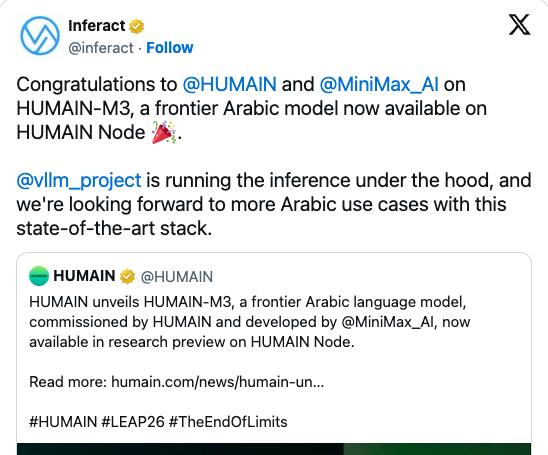
Figure 5 Inferact confirms that the reasoning of HUMAIN-M3 is supported by the open-source framework vLLM: Inferact stated that HUMAIN-M3 has been launched on HUMAIN Node, and its underlying reasoning is supported by vLLM, adopting the technical stack of "open-weight model plus open toolchain". Source: Original post on X
Chinese models have become a measurement standard, and open weights make it convenient for customers to adopt, and also convenient for customers to replace the base model; after the model is retrained and renamed, Chinese brands may even disappear completely. MiniMax uses community licenses, strictly speaking, it is closer to "open weights" rather than unrestricted open source software, but this is undoubtedly a brand new paradigm of the token economy.