This world model "steps aside" after its training is completed, and the robots have become far more capable.
This world model is surprisingly "rebellious" by design —
It spends a huge amount of time training alongside the robot before deployment, but when the robot is finally ready to start working, it exits the deployment pipeline first.
It is common knowledge that traditional world models for robots work like a portable "sandbox in the brain": robots first use them to predict what will happen in the future, then decide their next move accordingly. The more the model thinks, the longer the reasoning pipeline usually becomes.
But this "rebellious" world model takes a completely different approach.
It only stays in the training field, specifically checking what consequences the actions proposed by the robot will cause, and converts these checks into feedback for policy optimization. Once training is completed, the controlled world model is removed from the deployment pipeline, so the robot does not need to predict future states or search for candidate actions when performing tasks.
What is the result?
The robot actually performs far better!
This is the first-generation physics-native world model Phi-WM 1.0 ActEffect (hereinafter referred to as ActEffect) released by Guangxiang Technology in collaboration with the research group led by Professor Li Shengbo from Tsinghua University. Overall, this technology attempts to answer a long-standing question in embodied intelligence:
Robots have learned what actions look like from demonstration data. Can they further leverage the potential consequences of these actions to improve their own policies in turn?
After all, this question will eventually be tested in real-world deployment. Every additional step of model inference for industrial robots brings extra latency, computing power consumption, and cost. Only when a world model can play its full role during training and remain lightweight during the execution phase can its technical value be translated into tangible deployment value.
Judging from the test results, the answer is quite clear.
This work achieves an average success rate of 98.8% on LIBERO, reaches 80.3% on LIBERO-PLUS with seven types of distribution shifts added, and records an average success rate of 67.5% on RoboCasa-GR1 with a 29-dimensional action space.
So how is this "rebellious" method implemented in practice?
Let's dive right in.
First, Let the Robot Submit Three Versions of Answers
The breakthrough of ActEffect actually lies in imitation learning, the most familiar field for robots.
At present, many general robot policies are built on top of VLA. The camera tells the robot what is in front of it, the language instruction assigns the task, and the model generates actions based on demonstration data. During training, the closer the generated action is to the demonstration action, the higher score it usually gets.
But in the physical world, there is still a clear gap between similar actions and correct outcomes.
For example, if the gripper closes a little earlier, the part may not be grasped firmly; if the wrist angle is slightly off, the originally smooth insertion will get stuck. Two actions may look almost identical in numerical values, but lead to completely different outcomes when executed by the robotic arm.
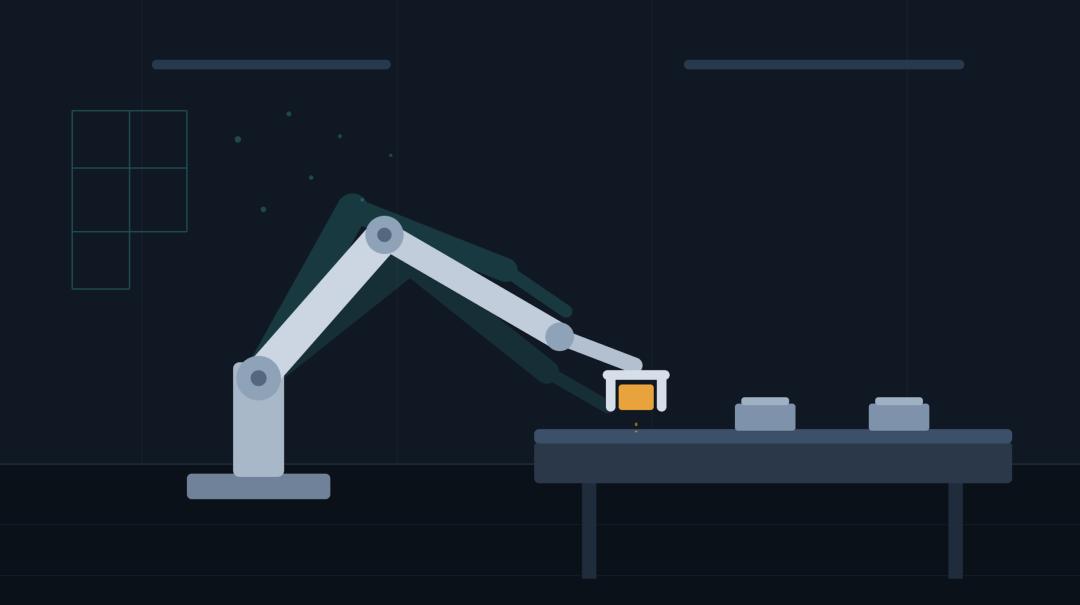
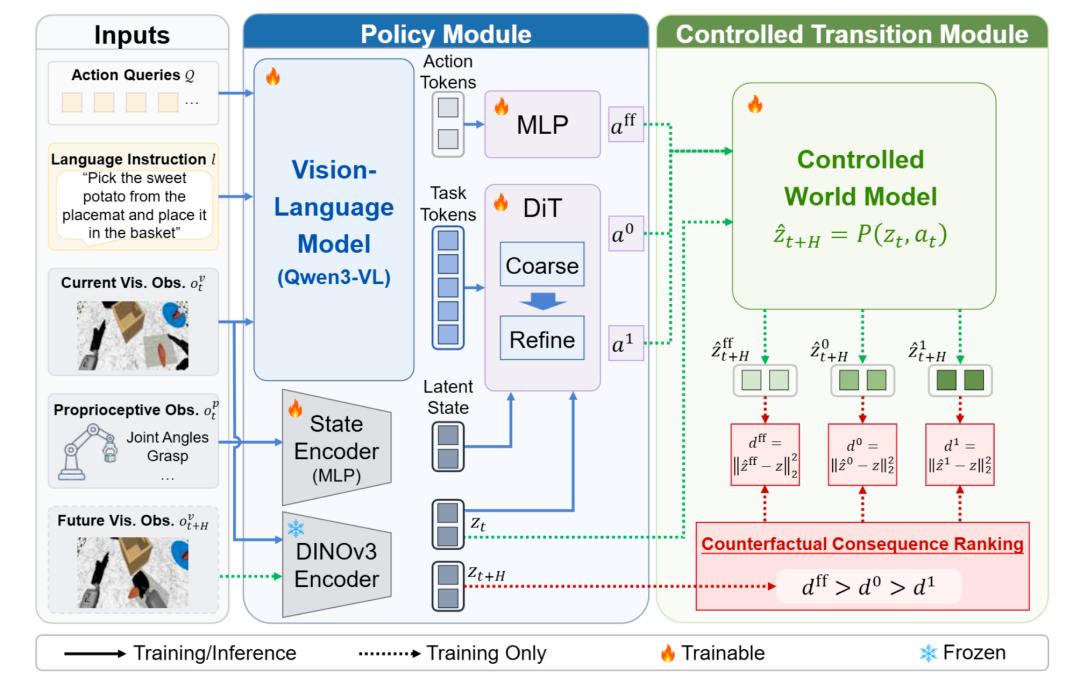
Therefore, ActEffect does not rush to connect the robot to a longer reasoning chain, but first lets the policy output three complete versions of candidate answers:
The first version comes from the feedforward branch, which is like the robot's "first reaction";
The second version is a rough proposal given by the MIP action head;
The third version is refined based on the rough proposal to generate the final action to be executed.
The key to this process lies in "completeness". Policies such as diffusion and flow matching go through many noisy intermediate states during training, so it is difficult to treat each step as an executable action and feed it into the world model. The three proposals selected by ActEffect are all complete, so under the same starting conditions, there is a basis for comparing which one will bring better results.
Next, the controlled world model comes into play.
It receives the current visual state and an action proposal, then predicts what changes will occur in the scene after the action is executed. The three actions are processed respectively, which is equivalent to letting the robot preview the results three times in advance in the training environment.
There is also a very interesting design here. The language instruction remains on the VLA policy side, responsible for telling the robot what to do; the controlled world model only reads the current frame and the action, and does not access the task language at all.
For example, if you reach out to push a cup, how the cup moves depends on its current position, the surrounding environment, and the action applied by the robotic arm. The instructions "move the cup away" or "clean the table" will not change the physical changes caused by this push.
In addition, ActEffect also maps future states to the frozen DINOv3 visual feature space. It does not need to generate a realistic future frame, but only needs to capture how the position, posture of objects and the structure of the scene change. This is exactly what "physics-native" refers to: task semantics are still handled by VLA, and state changes caused by actions are separately extracted for learning.
However, previewing the results of the three versions is not enough. There is another key step: transmitting the difference back to the policy.
The training data already contains the real observation after the action is executed. The controlled world model compares the three predictions with the real future one by one, requiring the refined proposal to be closer to the real outcome than the rough one, and the rough proposal to be better than the first feedforward proposal.
In this way, every time the policy modifies an action, it can know whether this modification pushes the result in the correct direction.
To prevent the model from exploiting loopholes, ActEffect adds gradient clipping to the ranking loss. Poor proposals cannot highlight good ones by becoming even worse, and training can only push better proposals closer to the real future.
Through learning from the feedback signal, the world model's judgment of "consequences" is encoded into the policy weights. When the robot is ready for deployment, the controlled world model and the future observation branch are removed together, leaving only the MIP action head to complete the rough proposal and refinement.
After understanding the method, let's check whether it can actually make the robot smarter.
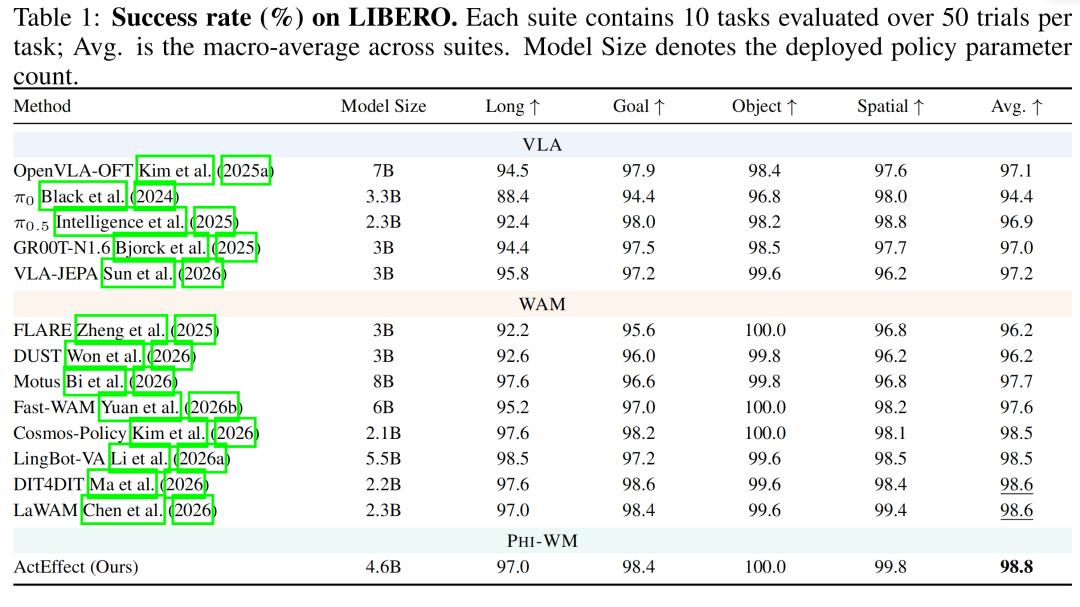
First, take a look at LIBERO. This benchmark includes four groups of single-arm, multi-task desktop operations. ActEffect achieves 98.8% success rate on it, 0.2 percentage points higher than DiT4DiT's 98.6%. Although the lead is not huge, a more noteworthy point is that after introducing consequence feedback, the robot's original basic operation capabilities are not lost during training.
Then look at the more challenging LIBERO-PLUS.
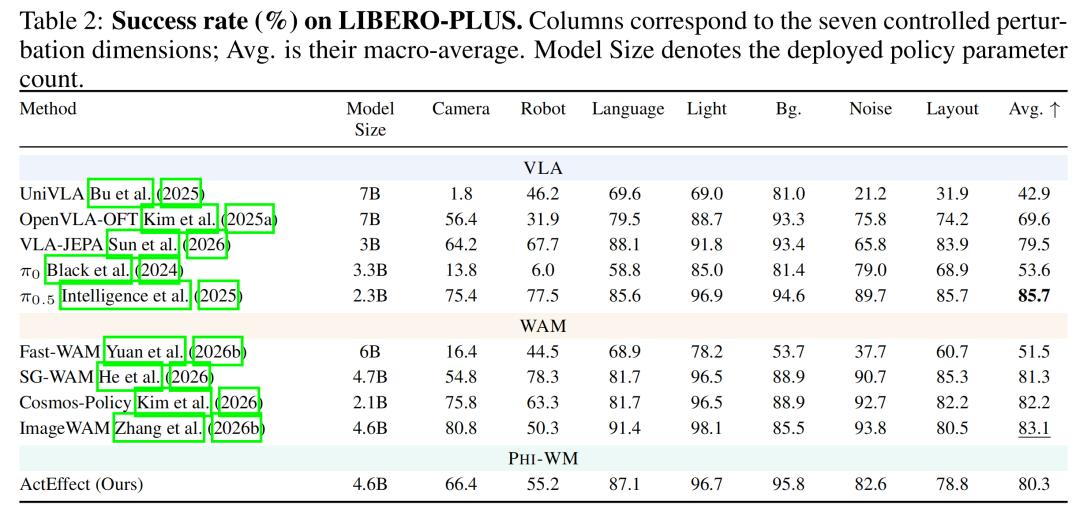
This test set modifies camera perspectives, initial robot states and language descriptions, and introduces changes in lighting, background, sensor noise and object layout. ActEffect reaches an average success rate of 80.3%, far higher than Fast-WAM's 51.5%.
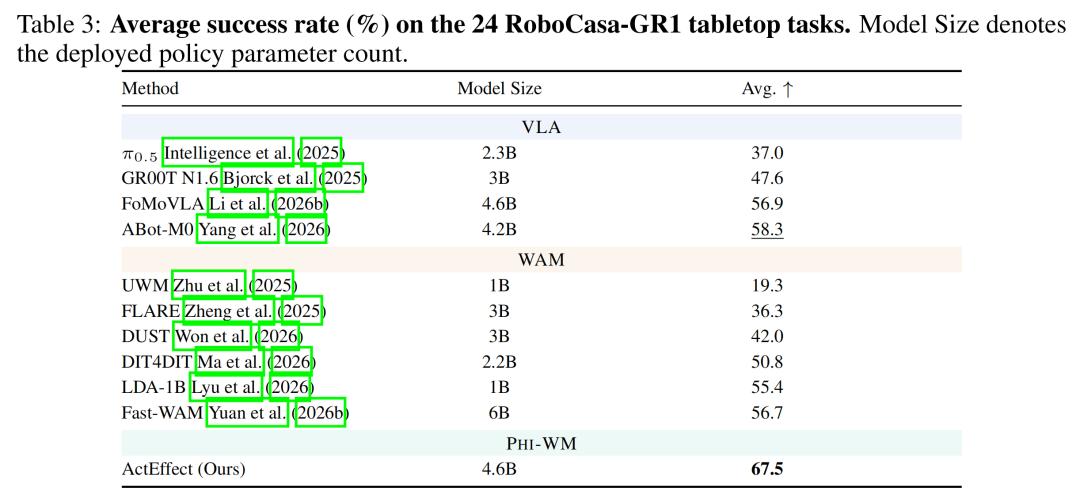
For RoboCasa-GR1, the tasks are different. The model needs to control the GR-1 humanoid robot with dual arms, dexterous hands and waist degrees of freedom to complete 24 desktop operations in a 29-dimensional action space.
ActEffect achieves an average success rate of 67.5%, 9.2 percentage points higher than the second-ranked ABot-M0 in the table, and 10.8 percentage points higher than Fast-WAM. When the action dimension is higher and the body structure is more complex, the role of consequence feedback becomes more prominent.
Ablation experiments further verify the performance of this method by dismantling its components.
After removing consequence feedback, the average success rate on LIBERO drops from 98.8% to 97.0%; replacing the DINOv3 feature space with VLM representation brings the result to 97.3%; removing the ranking loss reduces the performance back to 98.1%.
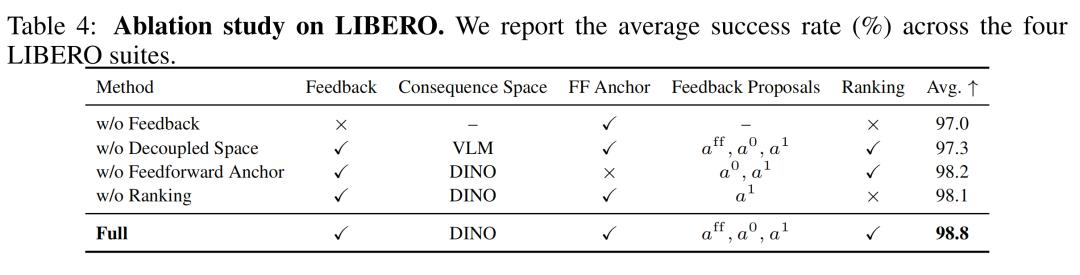
The results of these groups of experiments fully prove the effectiveness of the training method of ActEffect.
Why This Design Is Closely Related to Industrial Deployment
At this point, we can get a more practical answer to why the controlled world model has to "step down" after training.
In the laboratory, the main evaluation metric for embodied intelligence is almost task success rate. But once it enters the real production environment, the evaluation system will be completely different.
Running one extra layer of model in the simulation environment for robots may only be recorded as a computational overhead item in a table. But when the same pipeline is deployed in an automobile factory, every inference will be counted into the production line's cost account.
Moreover, the computing overhead will be amplified as the deployment scale expands. It seems acceptable for a single robot to run one extra future expansion step. But when the solution is replicated to dozens of workstations and hundreds of devices, the extra graphics cards, power consumption and maintenance costs will become very tangible expenses.
By keeping the controlled world model in the training phase, ActEffect perfectly avoids this part of online overhead. It extracts an extra layer of supervision from the existing demonstration data, so that the robot can learn from the "consequence" experience in advance, and does not need to carry the entire world model during execution.
In other words, it leaves the "extended thinking" part to the training process, and reserves a shorter inference pipeline for the execution phase.
The technical route chosen by Guangxiang Technology is also closely related to the scenarios it is targeting.
Automobile manufacturing has a large number of tasks such as loading and unloading scattered parts, and complex surface quality inspection. Traditional automated equipment is usually developed for fixed workstations, with one set of fixtures and one trajectory serving one type of part. When the position of the part changes or the operation space becomes narrow, the originally stable process may get stuck. What embodied intelligence aims to make up for is exactly this adaptive capability.
At present, Guangxiang Technology has completed real-scenario verification for typical high-value workstations such as welding loading and unloading, and mobile quality inspection, and has carried out commercial cooperation with many leading domestic and foreign automotive enterprises. At the 2026 ATC Exhibition, the team deployed Phi-Bot X1 in the welding loading and unloading scenario of NIO Automobile. The robot ran continuously for 3 days, with a total operation time of 21.5 hours, zero errors and zero interruptions during the whole period.
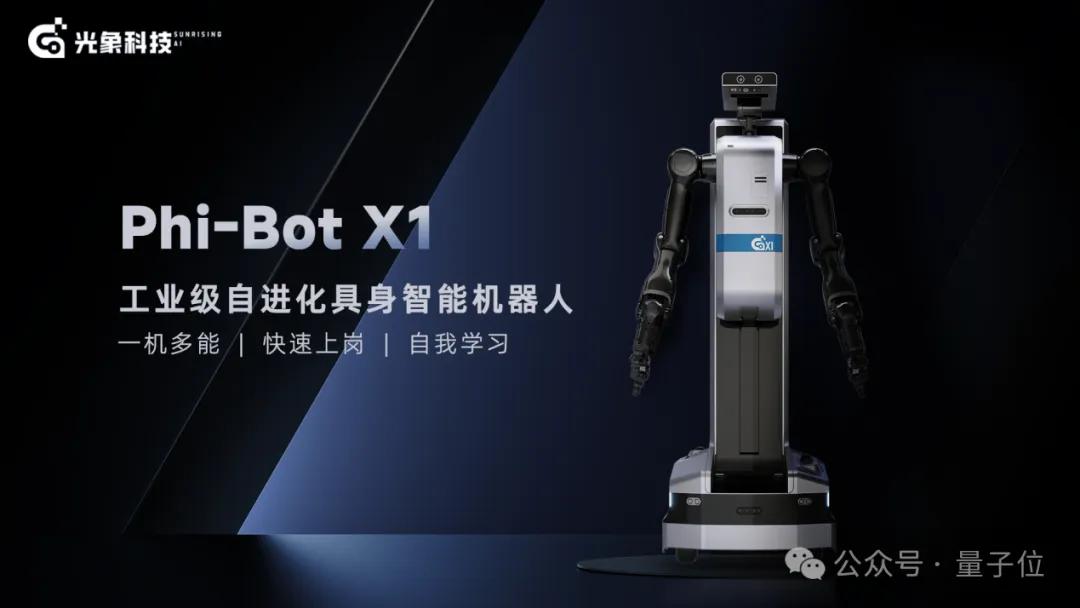
At present, ActEffect has completed the training method validation on three simulation benchmarks. For real machine deployment, Guangxiang Technology already has Phi-Bot X1 to continue the follow-up work. The 21.5-hour operation record comes from the complete industrial embodied system, and the new model will continue to be verified along this real deployment pipeline in the next step.
Fortunately, Guangxiang Technology has accumulated rich engineering experience in the automotive industry.
Guangxiang Technology was founded in April 2025, incubated jointly by the School of Vehicle and Mobility and the School of Artificial Intelligence of Tsinghua University. Its founder and CEO Zhang Tao is a PhD from Tsinghua University and a postdoctoral researcher at Politecnico di Milano. He previously served as technical director and head of the Spatial Perception Engine at Alibaba AutoNavi, and the related technologies have been applied in mass-produced automobiles. Co-founder Li Shengbo has long been engaged in research on autonomous driving and embodied intelligence, and many of his technologies have been put into industrial application.
Therefore, while developing reinforcement learning and world models, the company is also building robot bodies, data algorithm systems and development platforms. After entering the factory, the model is only one part of the entire system. The hardware needs to withstand continuous operation, the system needs to be easy to deploy, and problems must be fixed quickly. Without any of these components, the algorithm performance can hardly be fully implemented on the production line.
The Divide of Embodied Intelligence Will Ultimately Depend on Commercialization Capability
In the past two years, embodied intelligence has no shortage of stunning demonstrations.
Robots can run, jump, fold clothes, and understand a long list of instructions. But once they arrive at the client site, the dozens of seconds in the demonstration video will soon be extended to days, months, or even a whole year of continuous operation.
Of course, factories will not sign for acceptance just because of a benchmark performance. After delivery