Is AGI really here?
In the early hours of September 3, GPT-6 Astra, which had been warmed up for a long time, was officially released.
Half a month before the release, OpenAI had been sending out signals for the launch of this model. On August 18, after judging that Astra might reach the "Critical" cybersecurity capability threshold, the company slowed down the training of some cutting-edge models and suspended the reinforcement learning training for deployed models for two weeks to strengthen monitoring, alignment and research environment security. On September 1, OpenAI further disclosed the security assessment of Astra. After several rounds of information were released in advance, GPT-6 Astra had already attracted a lot of attention before its official release.
However, after the release, most users cannot use it for the time being. At present, GPT-6 Astra is only open to a small number of institutions. Paid users such as Plus, Pro and Business will get access permissions one after another in the next few days, and the API will also be opened gradually. Faced with users' waiting, OpenAI quickly gave a set of compensation plans. Tibo, head of Codex, said that for every day paid users cannot use Astra, they will get a quota reset that can be saved for later use, which also eases the dissatisfaction of some users about the delayed access.
Back to the model itself, there are two most notable changes in this update: The model is more capable of directly operating computers and better at completing complex tasks. OpenAI claims that GPT-6 Astra is the smartest model at present. Compared with GPT-5.6 Sol, it has improved in software engineering, scientific research, cybersecurity and professional work, with particularly obvious progress in computer operation.
The price of the API has also increased. The API price of GPT-6 Astra is 10 US dollars per million input Tokens and 50 US dollars per million output Tokens, which is 2.5 times that of GPT-5.6 Sol and at the same price level as Anthropic's latest flagship Claude Fable 5.1. OpenAI also provides Fast Mode, which can increase the generation speed to about 2 times, but the price will also double.
OpenAI's tone for this upgrade is also higher than before. At the pre-release media briefing, Greg Brockman, President of the company, said "Welcome to the AGI era" and believed that looking back a few years later, people may regard GPT-6 Astra as a node marking the beginning of the AGI era.
It has gained widespread attention and its capabilities are indeed stronger. In addition, both OpenAI and Anthropic have entered the preparation stage for listing. Is GPT-6 Astra enough to support the AGI era mentioned by OpenAI? Can it help OpenAI take the initiative in the new round of competition?
01. Benchmark scores are close to the upper limit, with more obvious progress in long tasks
Let's first look at the most intuitive benchmark scores. We mainly focus on two categories: one is the scores that are close to the test upper limit, and the other is the part that has significantly improved compared with the previous generation.
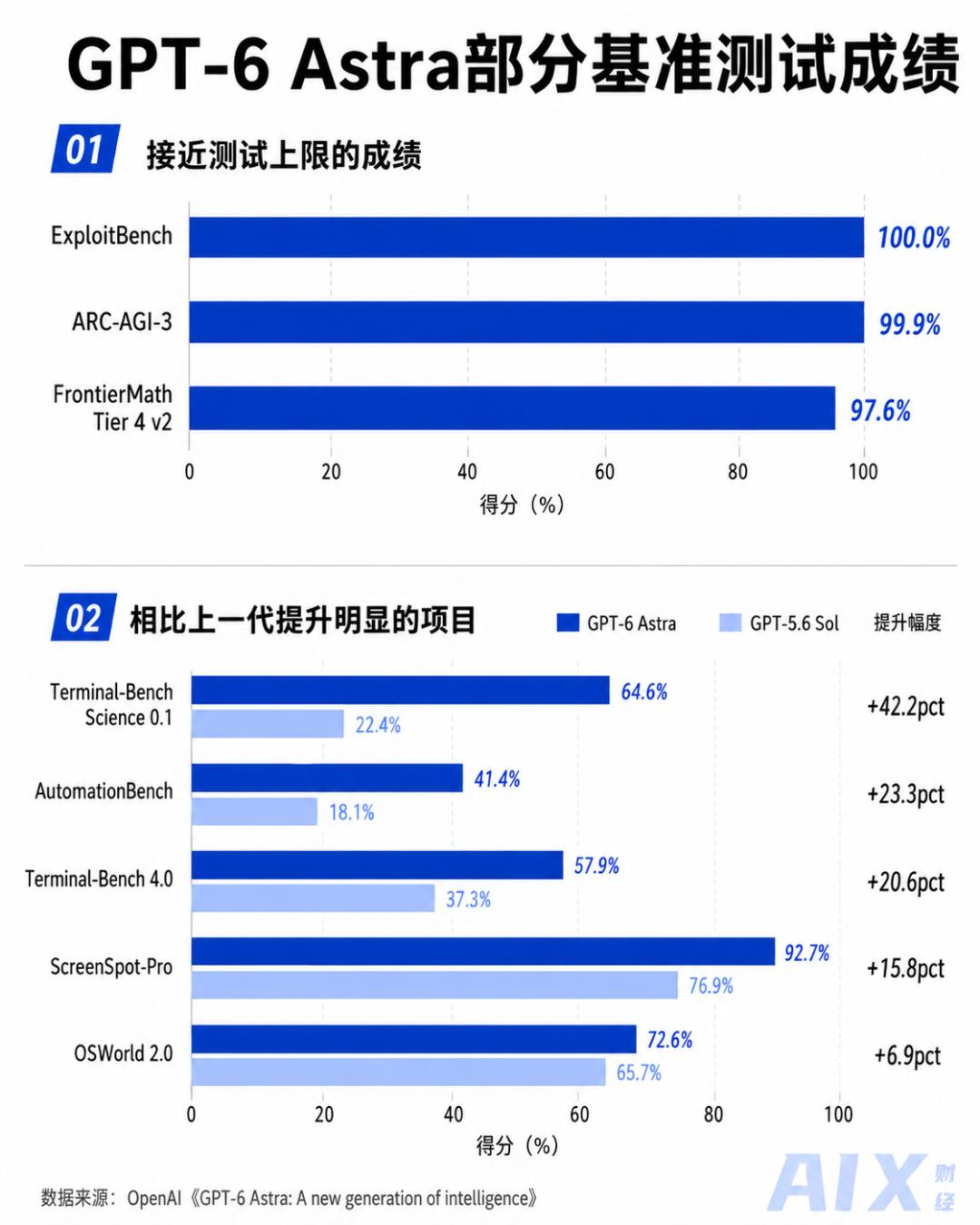
Let's look at the first category first. In the benchmark tests announced by OpenAI, GPT-6 Astra scored 99.9% on ARC-AGI-3, 100% on ExploitBench, and 97.6% on FrontierMath Tier 4 v2.
These three tests examine different capabilities. ARC-AGI-3 examines whether the model can figure out rules in an unfamiliar environment and transfer them to more difficult levels, testing the understanding and adaptation to new environments. FrontierMath Tier 4 v2 examines high-difficulty mathematical reasoning. ExploitBench requires the model to construct an operable exploit program for known vulnerabilities.
This shows that GPT-6 Astra has demonstrated strong capabilities in research-level reasoning, unfamiliar environment adaptation and complex cybersecurity tasks. Especially for ARC-AGI-3, when it was first launched in March this year, the score of cutting-edge models was less than 1%. GPT-6 Astra is now close to full marks, indicating that such unfamiliar environment reasoning tasks, which used to significantly widen the gap between cutting-edge models, can hardly become its bottleneck anymore.
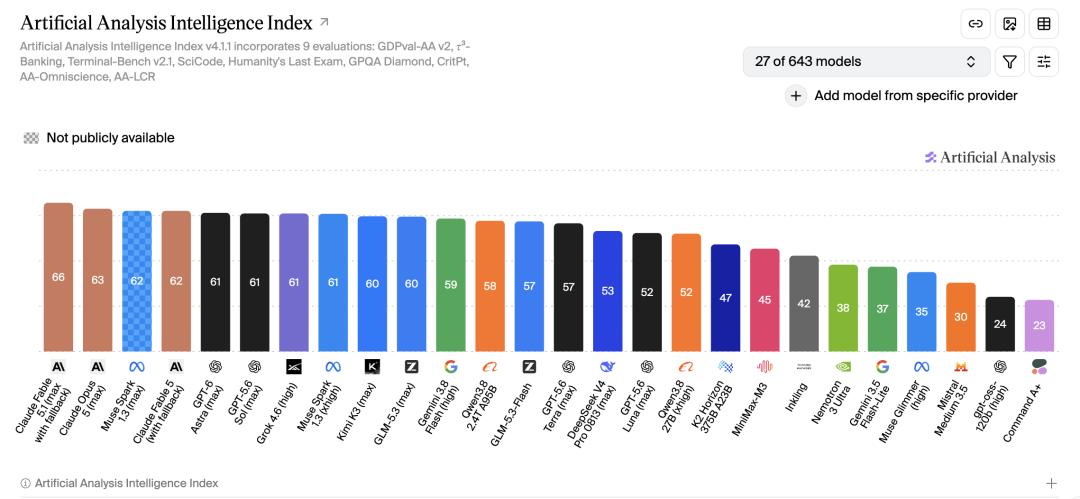
Image source / Official website of Artificial Analysis
However, the scores given by third-party comprehensive tests are not so outstanding. In the latest Artificial Analysis Intelligence Index, the highest reasoning tier of GPT-6 Astra got 61 points, which is the same as GPT-5.6 Sol, ranking 5th, lower than the 66 points of the highest tier of Claude Fable 5.1. From the perspective of comprehensive scores, GPT-6 Astra has not significantly widened the gap with the previous generation, and its progress is more concentrated in some capabilities.
Next, let's look at the part that has significantly improved compared with the previous generation.
This is mainly concentrated in Agent capabilities such as operating computers, calling tools, executing steps continuously and processing longer tasks. Among them, the scientific research workflow test Terminal-Bench Science 0.1 has the biggest change: the score of GPT-6 Astra has increased from 22.4% of GPT-5.6 Sol to 64.6%, which is nearly three times that of the previous generation. Other long-range Agent and automated task tests have also generally increased by about 20 percentage points.
The scores of computer operation have also made obvious progress. ScreenSpot-Pro increased from 76.9% to 92.7%, which means that GPT-6 Astra is more practical in understanding the interface and finding the exact operation position. OSWorld 2.0 reached 72.6%, the score only increased by 6.9 percentage points, but the average simulation time to complete a task was shortened from about 75 minutes to 40 minutes, with the time consumption reduced by nearly half.
These changes can also be seen in the actual tests of the first batch of users who got access to GPT-6 Astra.
A netizen asked GPT-6 Astra to build a virtual scene of Manhattan in Unreal Engine (a 3D creation tool), and the whole task lasted for a week. He mentioned that GPT-6 Astra can gradually supplement architectural and environmental details along the streets, and after running continuously for several days, it can still continue the previous progress to improve the scene. However, the efficiency is still limited. He mentioned that at the current speed, it will still take several months to complete the whole New York City.

Virtual scene of Manhattan
Another netizen conducted six sets of tests including generating 3D models and animations, and making games. He believes that the capability improvement of this generation of models is more obvious than before, especially the stable performance during long-time operation. During the actual test, he ran hundreds of Agents at the same time and did not encounter obvious problems.

Motorboat game
Thomas Ricouard from the Codex team focused on testing the 3D modeling capability of GPT-6 Astra. He asked the model to complete the construction of a 3D scene according to the floor plan of a house. GPT-6 Astra first completed the modeling in Blender, then transferred the scene to Unreal Engine, and finally generated a 3D space that can be "walked through" in real time. Except for the first few prompt words, the subsequent skybox, cinematic lighting, lens angle and other contents were all completed by GPT-6 Astra. Ricouard believes that GPT-6 Astra is very good at 3D modeling, and its processing of materials, textures and visual effects is in place.

3D scene of the house
These actual tests are only early samples, but they are basically consistent with the direction presented by the official benchmark scores. The obvious incremental improvement of GPT-6 Astra is concentrated in long-time execution, professional software operation, and connecting multiple capabilities into a complex task continuously.
02. Is the model starting to absorb Agent?
Two changes of GPT-6 Astra are worthy of separate elaboration. One is Computer Use (computer operation capability): the model can directly read the computer interface and complete operations in the software; the other is Judgment: the model will handle some small problems that do not affect the overall direction by itself, and only stop to ask for user's decision when it is really needed. One solves the problem of how to take action, and the other solves the problem of when to make decisions on its own.
Let's first look at Computer Use. Simply put, it allows the model to work by looking at the screen like a human. It understands the current interface through screenshots, judges what to do next according to the user's goal, and then converts the plan into actual operations such as clicks and inputs. After the execution is completed, it re-reads the page and proceeds to the next step, forming a loop.

Image source / Demo of finding a pediatrician displayed on the official website of OpenAI
It provides a more general software operation path. Many Agents need to access external systems, which usually requires developers to connect APIs, MCP or special tools in advance. Computer Use allows the model to directly operate the graphical interface originally designed for humans, and continue to complete tasks even when there are no ready-made interfaces.
This capability has been tried before. In 2024, Anthropic had already opened Computer Use on Claude, and Microsoft and OpenAI followed one after another. In 2025, OpenAI launched Operator, whose underlying Computer-Using Agent can also understand web pages through screenshots and complete operations with mouse and keyboard. Later, this type of capability was integrated into the ChatGPT Agent product.
The early Computer Use was not very practical. Yao Yuhang, a large model researcher, told "AIX Finance" that Atlas, the AI browser previously launched by OpenAI, also allowed the model to directly control web pages, but the delay was very long and the effect was not ideal. In his view, this type of capability still has much room for improvement in the next one or two years. However, judging from several sets of professional software operation demos displayed by the official this time, GPT-6 Astra has made obvious progress in understanding graphical interfaces and operating software.
The value of Computer Use lies in filling the parts that APIs, CLI and MCP cannot cover. When there are ready-made interfaces, Agents can still choose a faster and more stable way; when there are no interfaces, the model can still directly operate these softwares through GUI.
The fact that the model can read web pages and complete operations by itself also shows that part of the execution capabilities originally undertaken by Agents are being taken over by the underlying model. Yao Yuhang believes that the Agent layer will become thinner and thinner in the future. General capabilities such as looking at the screen and calling common tools will continue to sink into the foundation model. But Agents still have value. After entering professional scenarios such as finance, law and healthcare, domain knowledge, business processes, permission management and responsibility boundaries are still needed. Vertical Agents can retain higher added value by relying on these professional capabilities.
Another notable change of GPT-6 Astra is the Judgment that OpenAI has specially emphasized.
Judgment solves the collaboration problem. When facing missing information, Agents often need to choose between two options. If it stops to confirm frequently, the automated process will become repeated human-computer communication; if it makes decisions entirely on its own, it may not find that the direction is deviated until the later stage of the task.
The approach of GPT-6 Astra is to judge the importance of the missing information first. For small problems that do not affect the final direction, it makes judgments based on the context; for decisions that may change the result, it leaves them to the user to make the final call. Judgment essentially reduces the supervision cost when using Agents. The number of nodes that users need to confirm is reduced, so that Agents can truly take on longer and more complex tasks.
03. OpenAI does not want to fall behind
The release time of GPT-6 Astra coincides with the most intensive round of updates of cutting-edge models.
On September 1, Anthropic released Claude Fable 5.1; on September 2, Google launched Gemini 3.8 Flash, and Meta also updated Muse Spark 1.3 on the same day. Several companies updated their models in the same week, and the leading window of cutting-edge capabilities continues to shorten.
But for OpenAI, the pressure of this release does not only come from competitors. Before the release of GPT-6 Astra, Sam Altman, founder of OpenAI, reviewed OpenAI's performance in the past year in an interview with Time. He admitted that the company did not meet expectations in both product direction and model pre-training. In the past year, OpenAI launched multiple product lines such as Sora and Atlas browser at the same time. Since the beginning of this year, the company has begun to shrink again, pulling more resources back to core projects such as underlying models and Codex.
OpenAI needs to prove again that it can not only build the "strongest" model, but also convert model capabilities into revenue.
Source / pexels
The consumer side is still OpenAI's most obvious advantage. By the end of August, ChatGPT's weekly active users had exceeded 1 billion, and paid subscription users exceeded 50 million, with a user scale far higher than that of Claude.
However, in the B-end market, this advantage is not so obvious. Anthropic seized the commercialization opportunities of AI Coding and Agents earlier, and Claude Code has gradually become a frequently used product for enterprises.
At present, B-end business is becoming more and more important to OpenAI. In April this year, OpenAI disclosed that the revenue from enterprise business accounted for more than 40%. In July, enterprise revenue exceeded consumer revenue for the first time. In addition, the number of