The open-source robotic duck priced at 2700 yuan is reshaping the landscape of the global embodied intelligence industry.
The sunlight shines through the shop window, and Clara the robot stands right in that beam of light, gazing at the pedestrians coming and going on the street, waiting for a child to take her away...
In the works of Nobel Prize-winning author Kazuo Ishiguro, Clara meets that child, and learns love and dedication in the process of getting along with humans.
Today, another robotic duck is waiting in the real world. This time, it is not a child who will buy it, but global developers.
This robotic duck, released by an overseas open-source AI community and manufactured in a factory in Shenzhen, has become a global hit and sparked heated discussions on Chinese internet. In the same month, Unitree Technology landed on the STAR Market with its share price skyrocketing at opening, and the embodied intelligence track raised 935 billion yuan in financing within half a year.
From the scenario where the duck is out of stock in the open-source community to the nearly 100 billion yuan market value in the capital market, the popularity of this industry is being pushed to its peak.
The higher the popularity, the sharper the problems. People keep questioning the practical value of embodied intelligence. The valuation has skyrocketed before the technology is even implemented. Where will the end of this carnival lead? What kind of assistance can a robotic duck bring to the future development of embodied intelligence?
The Viral Robotic Duck
On August 27, Pollen Robotics, a robotics company and partner in the ecosystem of open-source AI community Hugging Face, released pre-order information for a duck robot.
To be exact, it is a 25cm-tall, 800g-weight bipedal robot called Microduck. It is equipped with 15 motors, one camera, one ToF LiDAR and two inertial sensors. It can walk, kick balls, slide on roller skates, and get up on its own after falling. Its duckbill is a small gripper that can pick up socks and markers.
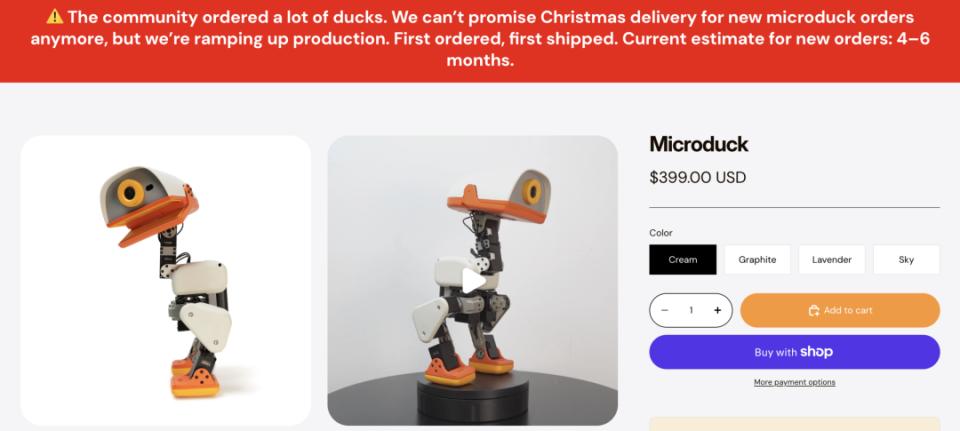
Once released, this duck robot has drawn widespread attention around the world. It is priced at 399 US dollars per unit, equivalent to about 2,700 yuan. About 6,500 units were sold within 24 hours of launch, with the order amount exceeding 2.6 million US dollars. At its peak, one unit was sold every 4 seconds.
The official even released an announcement: We have accumulated too many orders for the duck robot, and new orders are scheduled for 4 to 6 months later. If you place an order now, you will not receive the goods until the beginning of 2027.
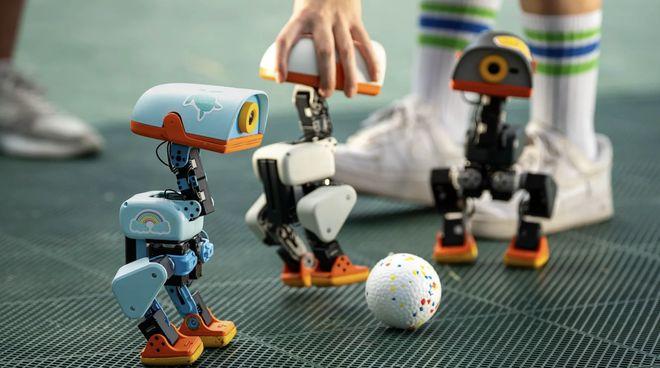
In the world of robotics, this price is quite astonishing. In the past, humanoid robots often cost hundreds of thousands or even millions of yuan. Microduck has greatly lowered the threshold for accessing embodied intelligence, turning it from a money-burning game in the laboratory into a toy for individual developers.
Clement Delangue, CEO of Hugging Face, said on the release day: "This is a 399-dollar open-source robot, and you can teach it new tricks with reinforcement learning. Welcome to the era of open-source affordable robots."
This is an "open-source robot", which means that the entire reinforcement learning training pipeline is open along with the hardware. Developers can teach the duck robot to walk in the simulation environment, export the model and then deploy it to the real machine. The closed loop from simulation training to real machine deployment is open to individuals for the first time.
Hugging Face set a target of cumulative sales of 20,000 units for Microduck, on the grounds that the best-selling robot products in history have sales of around 20,000 units.
The figure of 20,000 units is noteworthy, because it is almost consistent with the mass production target of China's leading robotics enterprises. According to reports from China Economic News, Unitree Technology's humanoid robot G1 has been offline for a total of 11,000 units, with an annual shipment target of 10,000 to 20,000 units in 2026.
The duck robot is sold to individuals, while mass-produced robots are sold to enterprises. There is a whole dividing belt between them from toys to industrial products, and they are not even in the same market. But through this duck robot, we can see the current situation of the entire embodied intelligence industry.
Misaligned Manufacturing
The process of manufacturing and selling the robotic duck reflects part of the dilemmas of Chinese manufacturing, and its viral popularity reflects the situation of the embodied intelligence industry.
According to Sina Finance, Microduck is manufactured by Seeed Studio, an open-source hardware manufacturer that is also the contract manufacturer of Reachy Mini, Hugging Face's previous generation desktop robot. Even the "brain" of the duck robot is the domestic chip Rockchip RK3566.
An application processor released in 2020 is responsible for driving 15 servo motors with a 50Hz control loop. For a robot that sells well all over the world, its heart and body are both marked Made in China.
Although Chinese manufacturing plays a pivotal role in the birth of this duck robot, the profit is quite meager. With 6,500 orders, a unit price of 399 US dollars, and a total revenue of about 2.6 million US dollars, the profit of every link in the entire supply chain is as thin as a cicada's wing.
This is also like a metaphor belonging to the era: in the top-level design of the global AI wave, China is still the silent and efficient "world factory". We have huge production capacity and extreme cost control capabilities, but we are still passive in defining the discourse power of the next generation of intelligent hardware.
In addition, the viral popularity of this duck robot also shows another kind of misalignment: made in China, but unavailable for purchase in China.
When this boom spreads back to China, hot searches such as "Chinese-made robotic duck is out of stock" and "orders for the robotic duck have been scheduled to next year" have appeared on Weibo one after another. Some people reckon that "the domestic version will most likely be available, and those who wait can look forward to it". Action takers posted that they will "make the viral MicroDuck by hand, taking the domestic low-cost route". Even rumors of counterfeiting in Huaqiangbei have spread.
However, the first batch of sales list of Microduck includes the United States, Canada, the European Union, the United Kingdom, Japan and South Korea, but not the Chinese mainland. The production line in Shenzhen made it, and the Rockchip chip drives it, but users in the Chinese mainland who want to take it home have to ask friends to place an order first and then have it transported back to China.
The viral popularity of Microduck, which is sought after and widely discussed, is accompanied by the problems faced by Chinese manufacturing, and also shows the global common expectation for the future of embodied intelligence.
According to reports from China Securities Network, in the first half of the year, there were 322 domestic embodied intelligence financing deals with a total amount of 935 billion yuan, a year-on-year increase of 137%; there were 26 enterprises with a valuation of over 10 billion yuan, 16 of which were newly selected this year.
The other side of rapid development is that the industry is moving from the era of telling stories to the era of focusing on delivery. People have also begun to think about what changes the development of embodied intelligence can bring to life. The robotic duck has given half of the answer first. With a price of 399 US dollars and fully open-source drawings, it has distributed the admission ticket of embodied intelligence to everyone, proving that cheap hardware is enough to open the door to users' living rooms.
In users' homes, this seemingly toy-like robotic duck may provide key assistance for the development of embodied intelligence robots.
Winning the Data Network
At present, an important problem plaguing the development of embodied intelligence is the serious shortage of data samples in real scenarios.
A set of industry-estimated figures is noteworthy. An article on China Economic News mentioned that training a robot "brain" close to human level requires 1 billion hours of real operation data, but as of the beginning of 2026, the total amount of available high-quality physical interaction data in the world is only about 500,000 hours, with a gap of over 99%.
Computing power can be bought with money, but interactive data cannot. It can only come from every grasp, walk, fall and get-up in the real world.
The movements of the robotic duck seem simple, but every duck robot taken home by developers is a 24-hour online data collector. The process of teaching it to somersault is the data accumulation in the real physical world. If 20,000 units of Microduck are really sold, this open-source community will have a data network distributed in living rooms all over the world.
When embodied intelligence crosses the screen and extends its tentacles to the capillaries of the real physical world, the living rooms of millions of ordinary people become the cheapest and largest data refining field.
Data is leading a new arms race in embodied intelligence. Yao Maoqing, partner of Agibot Robotics, believes: "The model determines the starting point, and data defines the endgame. When the data flywheel really starts to rotate, intelligent emergence is only a matter of time."
The trend of capital also confirms this point. The focus of financing is shifting from enterprises that manufacture robots to the industrial chain links that teach robots to work. Statistics from Securities Times show that in 2025, data collection demand accounts for 31% of the 10 million-level orders for humanoid robots, and it is expected to exceed 50% in 2026, becoming the largest source of demand.
The physical forms of robots can never be unified, but the underlying logic is completely common, that is, intelligence precedes form.

Back to the duck robot, it will not become the answer to humanoid robots, and may even just be a step on the long evolutionary path of embodied intelligence. But its significance lies in proving that when the hardware is cheap enough and the code is open enough, the living rooms of hundreds of millions of ordinary people can also become the smallest test field of this revolution.
What Hugging Face sells is not just a duck robot, but a possibility of how AI can enter the physical world.
At the end of the story *Klara and the Sun*, Klara recalls her life in the scrap yard and says she is satisfied that she has finally learned the human heart.
The robotic duck cannot learn the human heart, all it learns is how to stand firm next time. But in every cycle of falling and getting up, data from the real world is continuously accumulated, which is the scarcest asset in the embodied intelligence track.
The endgame has not yet come, and the long night before dawn is long, but the sunlight will eventually shine into the shop window again. The next robot waiting to be taken away will definitely be closer to the answer of embodied intelligence than this duck robot.
This article is from the WeChat official account "Modern AI", author: CC, editor: Sanyu, published with authorization from 36Kr.