Over the past decade, Mogu IoT has connected 260,000 devices, enabling Physical AI to take the lead in being put into operation in energy systems.
The body of Physical AI does not necessarily have to be a robot.
Over the past two years, Physical AI has almost become synonymous with humanoid robots. Giving AI limbs and enabling it to walk, carry objects, and operate machines is certainly a fascinating concept. But if we shift our focus away from humanoid robots, we will find that another form of Physical AI has long entered the real commercial world even earlier. It has no limbs and cannot even move. It exists in the energy systems of factories and data centers, controlling a large number of energy supply equipment such as air compressors, chillers, water pumps, and cooling towers. These equipment do not directly produce products, but may account for 30% to 60% of the electricity consumption of an entire factory. For enterprises, if AI can take over the energy system instead of veteran technicians, it will not only reduce reliance on manual experience, but also mean that every operation optimization can be directly translated into lower energy costs.
This also points to an easily overlooked issue: The true essence of Physical AI is not "whether AI has a human-like body", but whether AI can complete the closed loop of physical control of perception, decision-making, execution and feedback in the real world. From this perspective, energy systems are inherently suitable for Physical AI. They are equipped with a large number of real-time sensors, have clear control objects, and quantifiable results: whether the pressure is stable, whether the cooling capacity is sufficient, whether the equipment is faulty, and ultimately how much electricity is saved.
Therefore, while humanoid robots are still waiting for answers to "when they can be deployed on a large scale", another type of Physical AI has begun to answer a more direct question: can it help enterprises save real money today. Founded in 2016, Mogu IoT is one of the early enterprises that entered this track. Starting from the industrial Internet of Things, Mogu IoT has now applied this set of Physical AI control closed loop to the energy systems of more than 2,000 large factories. It does not follow the path of "building a large model first and then looking for application scenarios", but enters factories first, accumulates communication protocols, real data and industry know-how over a long period of time, and then gradually integrates AI into the control link. In a sense, this is a completely different route from many AI startups today: instead of having AI first and then finding scenarios, it is to deeply engage in energy scenarios for ten years and then mature the AI technology.
Making AI Truly Control Machines Is Far More Difficult Than Connecting to a Large Model
If you only need AI to answer an equipment-related question, it is no longer difficult today. But if you let AI truly sit in the "driver's seat" of the energy system, things will be completely different. Industrial-grade Physical AI has at least three thresholds: data, security and generalization.
The most fundamental one is data. Today, the capabilities of foundation models can be purchased, called, and even quickly caught up with, but real industrial data is difficult to obtain out of thin air. What industrial-grade AI really needs is not an equipment manual. It needs to know the state of the machine at a certain moment, what action the system subsequently performs, and what result this action finally produces. For example, after the pressure drops suddenly, which air compressor increases its frequency? After starting another equipment, is the gas supply gap filled? How much more energy is consumed? These continuous "state-action-result" sequences form the basis for AI to truly understand the operation rules of industrial equipment. This is also why as foundation large models become increasingly popular, proprietary data within enterprises that cannot be obtained from the public Internet is becoming more and more important.
For industrial-grade AI, this scarcity is even more obvious. Because the truly valuable data is not static files, but dynamic records formed by the long-term operation of tens of thousands of physical equipment under different working conditions, different seasons and different production rhythms. Up to now, Mogu IoT has connected more than 260,000 devices, covering more than 30 types of equipment and 8 data dimensions.
But data only solves the problem of "whether AI understands machines". The second problem is whether AI dares to operate machines.
If AI in the Internet world gives a wrong answer to a question, it can generate a new answer again. But if Physical AI issues a wrong control instruction, it may affect equipment safety and even the entire production process. Therefore, industrial-grade AI cannot "do whatever it thinks of". Before the strategy given by AI is actually issued to the equipment, it must go through rules and safety boundary checks, and retain the necessary manual intervention mechanism. This is also one of the most important differences between Physical AI and ordinary generative AI: its output will eventually change the physical world, so it must be responsible for the results.
Taking Over the 30-minute Work of Veteran Technicians in 30 Seconds
This closed loop of "perception-decision-execution-feedback" has become very concrete in energy stations. In Mogu IoT's system, Lingzhi AI (vertical large model) is mainly responsible for prediction and decision-making, while LingX Agent (AI Agent) is responsible for converting strategies into actual equipment actions.
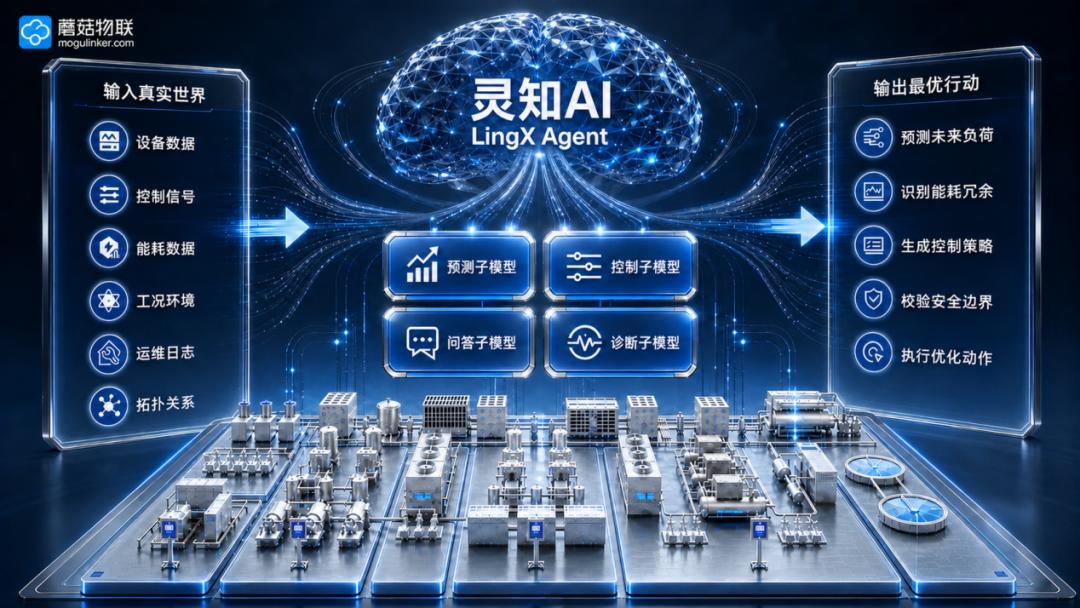
Taking the refrigeration station as an example, the system will perform joint control on chillers, water pumps and cooling towers according to weather changes and real-time cooling load, to find an operation combination with lower energy consumption while meeting the cooling demand.
The air compressor station faces another type of problem. Once the gas consumption demand of the production line suddenly increases, the entire air compression system may face a gas supply gap. At this time, Lingzhi AI will first judge which units still have remaining capacity based on real-time pressure, flow, equipment load and historical working conditions, and then formulate an operation strategy that takes into account both gas supply and energy consumption. Subsequently, LingX Agent converts the strategy into frequency conversion, start-stop and load adjustment of the entire equipment combination, and conducts rules and safety boundary checks before the control instructions are issued. After the equipment state changes, new data is fed back to AI again, entering the next round of adjustment.
The traditional operation relying on veteran technicians takes about 30 minutes to make the entire energy supply system gradually approach the balance between supply and demand, while AI intelligent control can complete the matching in about 30 seconds. This is also the most easily understood moment of the value of industrial Physical AI. It does not generate an extra analysis report for engineers on the screen, but makes decisions on real machines and finally changes the operating state of the equipment.
One Station Running Smoothly Is Only a Project, Cross-factory and Cross-industry Replication Is a Product
However, if Physical AI can only run in one factory, it is still difficult to become a large-scale business.
The equipment brands, topological structures and operating conditions used in different factories may be completely different. The control logic trained in one air compressor station may face a brand new equipment combination when moved to another factory. This is the third threshold of industrial Physical AI: generalization.
What really matters is not "whether this project can be completed", but whether the system can quickly adapt after entering new scenarios instead of being redeveloped from scratch. Mogu IoT currently reduces the cost of repeated development after entering different factories and different industries through Lingzhi AI, LingX and the cloud-edge-end standardized product system. At present, the company has served more than 6,000 industrial chain customers, covering advanced manufacturing industries such as electronics and semiconductors, new energy, automobiles, metallurgy, medicine, and food.
As the deployment scale expands, another advantage also emerges: the more customers there are, the more data can be accumulated; the more data there is, the deeper the model's understanding of the industrial world; the stronger the model's capabilities, the more customers it can further serve. This forms a commercial flywheel of "customer-data-model". This also explains why for industrial-grade Physical AI, the seemingly unglamorous accumulation of equipment Internet of Things in the past ten years has become a barrier again in the era of large models.
Capital Starts to Reprice This "Slow Route"
Recently, Mogu IoT completed the C1 and C2 series of financing in Round C, with a total financing scale of nearly 200 million yuan, and many old shareholders including Yunhui Capital continued to increase their investment. If you look at the financing alone, it is just one of the many capital events in the AI track this year. But the focus of investors is highly consistent with the development path of Mogu IoT.
Xing Li, Partner of Yunhui Capital, believes that Mogu IoT chose to cut into the general scenario of auxiliary energy several years ago, and accumulated energy data for a long time, which enables the company to quickly extend to vertical industrial large models and intelligent agents in the era of artificial intelligence.
Dr. Bin Zhu, Partner of Yuanhe Origin, defines Mogu IoT as a representative enterprise of Physical AI in the field of energy control. In his view, the massive real-time physical data of air compressor stations, refrigeration stations and other equipment accumulated by the company in the IoT era is the foundation for building the "perception-decision-execution" industrial physical intelligence closed loop today.
Behind this, there are actually two completely different entrepreneurial paths in the AI era. One is to have the most cutting-edge model capabilities first, and then look for scenarios. The other is to spend many years deeply engaging in a sufficiently in-depth industry, connecting equipment, accumulating data, understanding processes, and then waiting for AI technology to mature. In the past, the latter path often seemed slower. But as foundation models themselves become more and more commoditized, the things that cannot be purchased through APIs - equipment connection capabilities, industry know-how, and long-term accumulated real-world data - have once again become competitive barriers.
From Chinese Factories to the International Industrial System
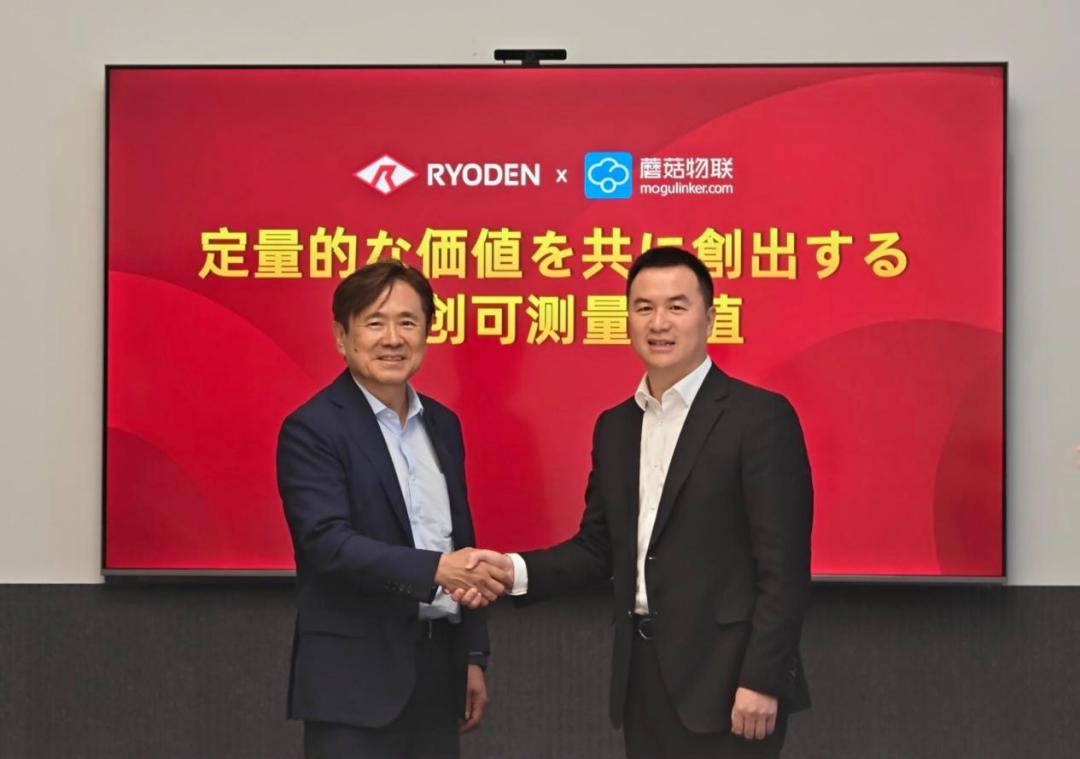
The generalization of industrial-grade Physical AI does not only happen between different factories. In July this year, Mogu IoT reached a strategic cooperation with RYODEN, the core listed company under the Mitsubishi Group. Japanese manufacturing industry has long maintained the world's most stringent requirements for the stability, energy efficiency and lean production of industrial systems. Therefore, the significance of this cooperation is not only adding an overseas partner, but also means that a set of energy control AI that first operated in Chinese factories has begun to enter the mature industrial system for verification and replicate to developed markets. Technical generalization means that it can still be used when moved to another factory; commercial generalization means that it can still be implemented when moved to another country.
At the same time, This capability is not limited to the manufacturing industry. Public institutions such as data centers, schools and government buildings also have a large number of energy systems for water, electricity, cooling and heating, and they are essentially facing the same problem: how to make a large number of physical energy equipment run more efficiently while meeting the actual energy demand. As Physical AI enters more countries and more energy systems, the importance of standardization and compliance is also rising. At present, Lingzhi AI has taken the lead in completing the generative AI service filing of the Cyberspace Administration of China, and Mogu IoT has also participated in the drafting of a number of industrial AI related standards. These actions do not look like a specific commercial signing, but are laying infrastructure in advance for Physical AI to enter more factories, more public institutions and more countries. Because when AI truly begins to control the physical world, what determines how far it can go is not only the model capability, but also a complete set of rules about security, responsibility and industry trust.
The Body of Physical AI Does Not Necessarily Have to Be a Robot
Over the past ten years, what Mogu IoT has done is to connect equipment; in the era of Physical AI, it has begun to let AI understand, make decisions, and truly control these machines. Behind AI computing power is electricity itself. AI is bringing more power consumption, and Physical AI is reducing the consumption of energy systems, releasing more power space for AI computing power. In this sense, this is AI for AI. For Mogu IoT, the body of Physical AI is not a robot, but more than 260,000 connected devices and the various energy systems formed by their combinations.