Shenzhen Hardware Circle "Faction" Map | Panoramic View
"Workplace Bonus" (ID: ZhiChangHongLi)
01 Geography: Industrial Folding Across Six Zones
- Nanshan: Birthplace and Folding Belt
- Bao'an: Brand Headquarters and Mass Production Hinterland -
- Futian: Super Headquarters and Huaqiangbei -
- Longgang District: Huawei Ecosystem and Second Growth Curve -
- Longhua District: Complete Machine Base and OEM Foundation -
- Guangming District & Pingshan District: Industrial Cornerstone for the Next Decade -
02 Capital: Three Valuation Tiers and Three Fates
- Unicorn Tier: 10-Billion Valuation Narrative and Long-term Imagination -
- Listed Company Tier: First Movers, Scale Leaders and Transformers -
- High-potential Startups: Extremely Low Fault Tolerance Margin -
03 Choices: Life Coordinates in the Folded City
On August 3, 2026, the patent infringement lawsuit filed by DJI against Insta360's Luna series opened at the Shenzhen Intermediate People's Court. Both parties presented evidence, cross-examined evidence, and conducted court debates. The hearing concluded without an on-the-spot verdict, and the judgment date is to be determined. In addition, the ownership dispute over 6 patents of DJI against Insta360, which are claimed to be service inventions of former employees, is under trial.
The dispute started in late March. Media reported that DJI filed 6 patent ownership lawsuits against Insta360 at the Shenzhen Intermediate People's Court. Two days later, Liu Jingkang, founder of Insta360, posted a moment on WeChat, saying that he would compile the competitive tactics encountered in the past year into a novel, with the protagonist implicitly referring to DJI founder Frank Wang.
In the following months, the patent war between the two parties moved from the Shenzhen Intermediate People's Court to the U.S. District Court for the Eastern District of Texas, and then back to China. During this period, the Insta360 Luna Ultra gimbal camera and DJI Pocket 4P were released in the same month, and the market feedback was evenly matched.
The headquarters of the two companies caught in the conflict are only 30 minutes apart in commute distance — from DJI's Sky City to Insta360's Qianhai Life Insurance Financial Center, taking a taxi east along Liuxian Boulevard and then south along Nanping Expressway, the whole journey is more than ten kilometers.
Courts, shelves and social media are all battlefields, but the two warring parties share the same supply chain and the same pool of engineers.
The close geographical proximity is the norm of Shenzhen's hardware industry. In June, after becoming Shenzhen's first 10-billion-yuan embodied intelligence unicorn in February, Zhisquare secured nearly 5 billion yuan in new financing, doubling its valuation to over 20 billion yuan. On the same day, Zibianliang also announced that its valuation exceeded 20 billion yuan. Zhisquare claimed to be "the first embodied intelligence enterprise in the Greater Bay Area with a valuation officially exceeding 20 billion yuan", while the latter claimed to be "the first and only embodied intelligence enterprise in the Greater Bay Area with a valuation exceeding 20 billion yuan". The two companies are only 5 kilometers apart.
Products, lawsuits, and financing all point to the same underlying structure: within a geographical radius of 50 kilometers in Shenzhen, the industrial chain, talent pool and capital network are highly folded. Someone once joked: to judge how far a hardware company's competitors are, opening a ride-hailing app is more intuitive than reading financial reports.
Shenzhen is almost the only city in the world that can quickly complete the closed loop of idea, product and mass production. It has the most complete supply chain, factories, proofing capabilities, and extremely fast product iteration speed. Many ideas that might only be PPT elsewhere can be turned into prototypes two weeks later in Shenzhen.
In 2025, the total industrial output value and industrial added value of enterprises above designated size in Shenzhen ranked among the top of all cities in China for four consecutive years; there are 1333 national-level specialized and sophisticated "Little Giant" enterprises, ranking first in the country in total; the total output value of the robot industry reached 242.6 billion yuan, a year-on-year increase of 20.56%, and all four indicators of industrial scale, number of enterprises, listed entities, and investment and financing events led the country.
In November 2026, APEC will once again focus global attention on Shenzhen. From November 18 to 19, the 33rd APEC Economic Leaders' Meeting will be held in Shenzhen, which is the third time China has hosted the event after Shanghai in 2001 and Beijing in 2014. International dignitaries will discuss global trade rules in Xiangmihu.
All districts in Shenzhen have their own clear roles for industrial links such as cutting-edge R&D, brand decision-making, mass manufacturing, global expansion, and future experimentation, with high synergy. Capital enthusiasm rotates rapidly across tracks, and the development traits of enterprises are clearly stratified. What to make, how to make it, and how to scale it up — different regions in Shenzhen answer different propositions of the industry.
Behind different propositions stand different groups of people: job seekers looking for opportunities, investors selecting projects, and industrial chain partners seeking collaborators. As for which corporate culture, which regional trait, and which capital stage correspond to which way of working... perhaps this article can help you align with your own preferences and figure out where you want to stand.
Geography: Industrial Folding Across Six Zones
When you spread out the map of Shenzhen, the locations of hardware enterprises are not random.
The six districts occupy six distinct ecological niches — some areas foster technology, some nurture brands, and some drive production capacity. What is worth seeing is not just any individual company, but their relative positions, and how these positions determine the way they access resources.
● Nanshan: Birthplace and Folding Belt
The 12-kilometer Liuxian Boulevard connects Xili Lake International Science and Education City, Liuxiandong Headquarters Base, and Tanglang Industrial Community, with a cluster of hardware companies including DJI, Anker, EcoFlow, Shokz, Aqara, Zhisquare, and Unitree Dynamics. This corridor is also an important part of the "Robot Valley".
As the core bearing area of Shenzhen's robot industry, the "Robot Valley" has gathered more than 200 enterprises in the robot industry chain and 32 specialized and sophisticated "Little Giant" enterprises, and is home to 11 top universities and research institutions including Southern University of Science and Technology, Harbin Institute of Technology (Shenzhen), and Tsinghua Shenzhen International Graduate School.
Companies in the corridor have a simple and clear classification method — whether they belong to the "DJI Ecosystem".
Anker and Unitree Dynamics belong to the latter. The main R&D team of Anker moved into the new building of China Resources Snowflake Science and Technology City in Xingdong, Bao'an in October 2025, and its old office is located in Building B, Jianxing Science and Technology Building. Unitree Dynamics is across the road from the former site of Anker, with a straight-line distance of only a few hundred meters. It just completed the Pre-IPO round of financing in July this year, with a valuation of about 15 billion yuan. The two companies have similar site selection logic: close to the talent pool of Xili University Town, without being involved in the rent competition in Liuxiandong.
The center of the gravitational field is in Liuxiandong, which is the territory of the "DJI Ecosystem".
"Workplace Bonus" (ID: ZhiChangHongLi)
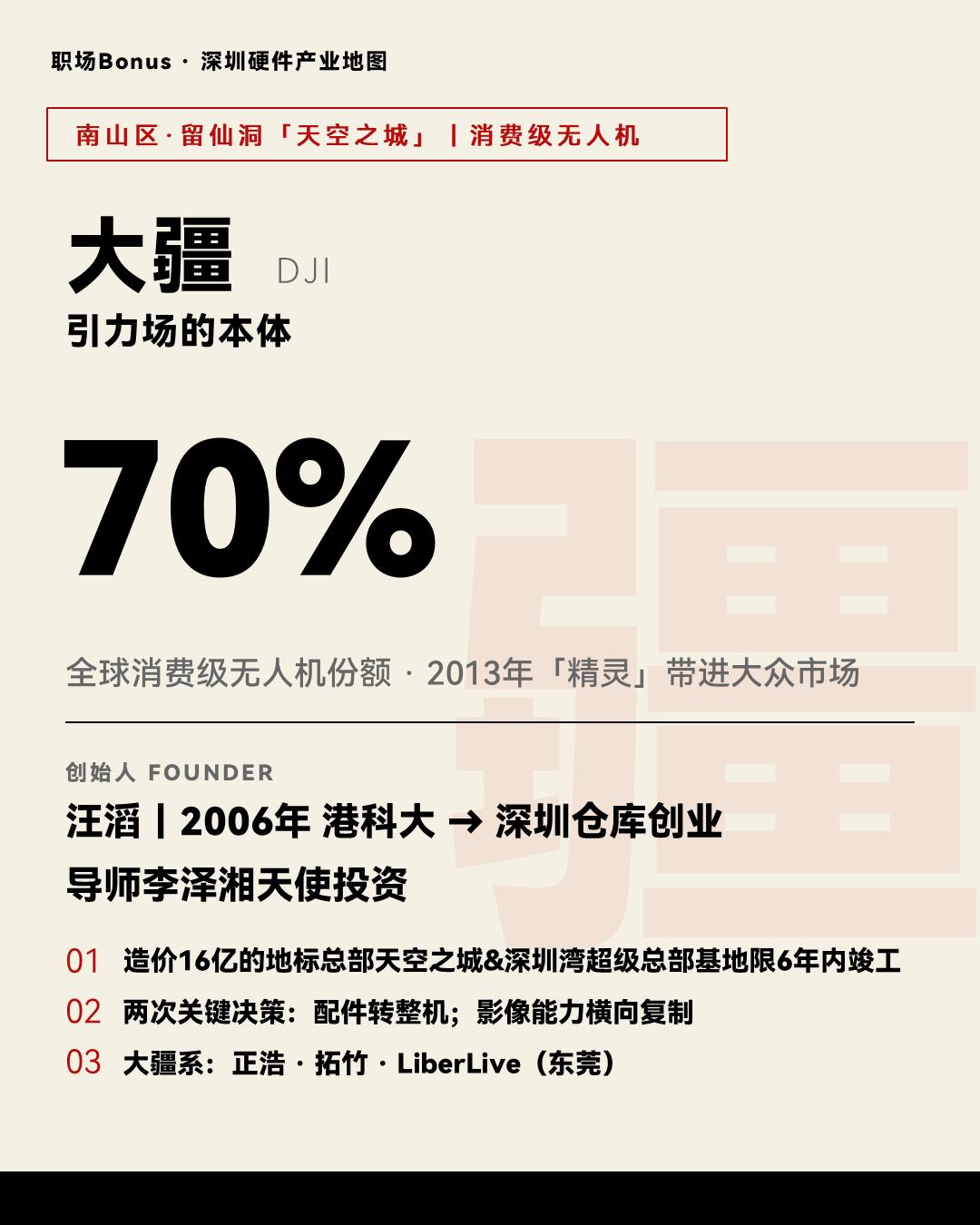
In 2006, Frank Wang, a student at the Hong Kong University of Science and Technology, rented a warehouse of less than 20 square meters in Shenzhen to develop flight control systems, and his tutor Li Zexiang became his angel investor. Later, DJI shifted from selling flight control accessories to full self-developed complete machines. In 2013, the Phantom series brought drones from the model aircraft circle to the mass consumer market, and eventually accounted for about 70% of the global consumer drone market share. Today, its headquarters "Sky City" is a landmark in Liuxiandong, with a construction cost of 1.6 billion yuan, over 18,000 patent applications, and invention patents accounting for more than 60%.
The most core asset DJI left to Nanshan is not its own revenue, but the talent system that continuously overflows outward.
In 2025, DJI saw very frequent talent outflow, and many core sales employees of DJI switched to competitors. Sources said that DJI did not set non-compete agreements for these core personnel, and some of them directly copied DJI's tactics and strategies to competitors.
In order to quickly make up for the shortcomings of core UAV technologies such as flight control, image transmission, and obstacle avoidance, Insta360 launched high-priority talent recruitment, and the number of R&D personnel increased by 59% in 2025, including many core R&D personnel who left DJI.
Li Zexiang once described that technology entrepreneurship is like walking on a dark road, "You will be very afraid alone, but when you walk with two or three or five people, and then you are given a flashlight and a stick to drive away dogs, you will no longer be afraid."
Nowadays, this road is crowded with talents from the "DJI Ecosystem". In the Chuangzhi Yuncheng complex opposite Sky City, EcoFlow founder Wang Lei left DJI's battery department in 2017 and made portable energy storage the No.1 in the world; the founding team of leading consumer 3D printing company Bambu Lab comes from DJI's core consumer UAV business unit; several other companies including Origin of Species, Stone Intelligence, Unitree Robotics, and Hemi Intelligence also have DJI genes. Li Zexiang's own Institute of Science and Innovation is also located in Chuangzhi Yuncheng, and his XbotPark incubated LiberLive smart guitar, whose founder was formerly a DJI navigation algorithm engineer.
Working at DJI is essentially buying a long-term technical belief. The company adheres to technology priority and is willing to give engineers who focus on underlying R&D sufficient room for trial and error. However, complaints about vague promotion paths and high-intensity overtime work frequently appear on platforms such as Maimai and Xiaohongshu. This forms an industrial paradox: DJI continuously spawns startups with valuations of tens of billions of yuan, and it is exactly this extreme R&D-focused corporate culture that drives core talents to leave and start their own businesses.
For all VCs, if they want to find the next DJI-affiliated startup, visiting within a 3-kilometer radius around Liuxiandong will most likely capture clues.
5 kilometers east of Shahe West Road, in the Chongwen Park of Nanshan Science and Technology Park in Tanglang, the positioning is to introduce "key projects of integrated circuits, artificial intelligence, internet, universities and scientific research institutions", with a construction area of about 179,000 square meters. The same building, the same canteen, the same parking lot — the industrial ecosystem here is even folded in a single elevator. On the 8th floor of Building 1 is Aqara, a smart home company rooted in Xiaomi's ecological chain, with 460 R&D personnel, accounting for 48.9%; on the 19th floor is Zhisquare — an embodied intelligence unicorn with the title of "20-billion-yuan unicorn".
"Workplace Bonus" (ID: ZhiChangHongLi)
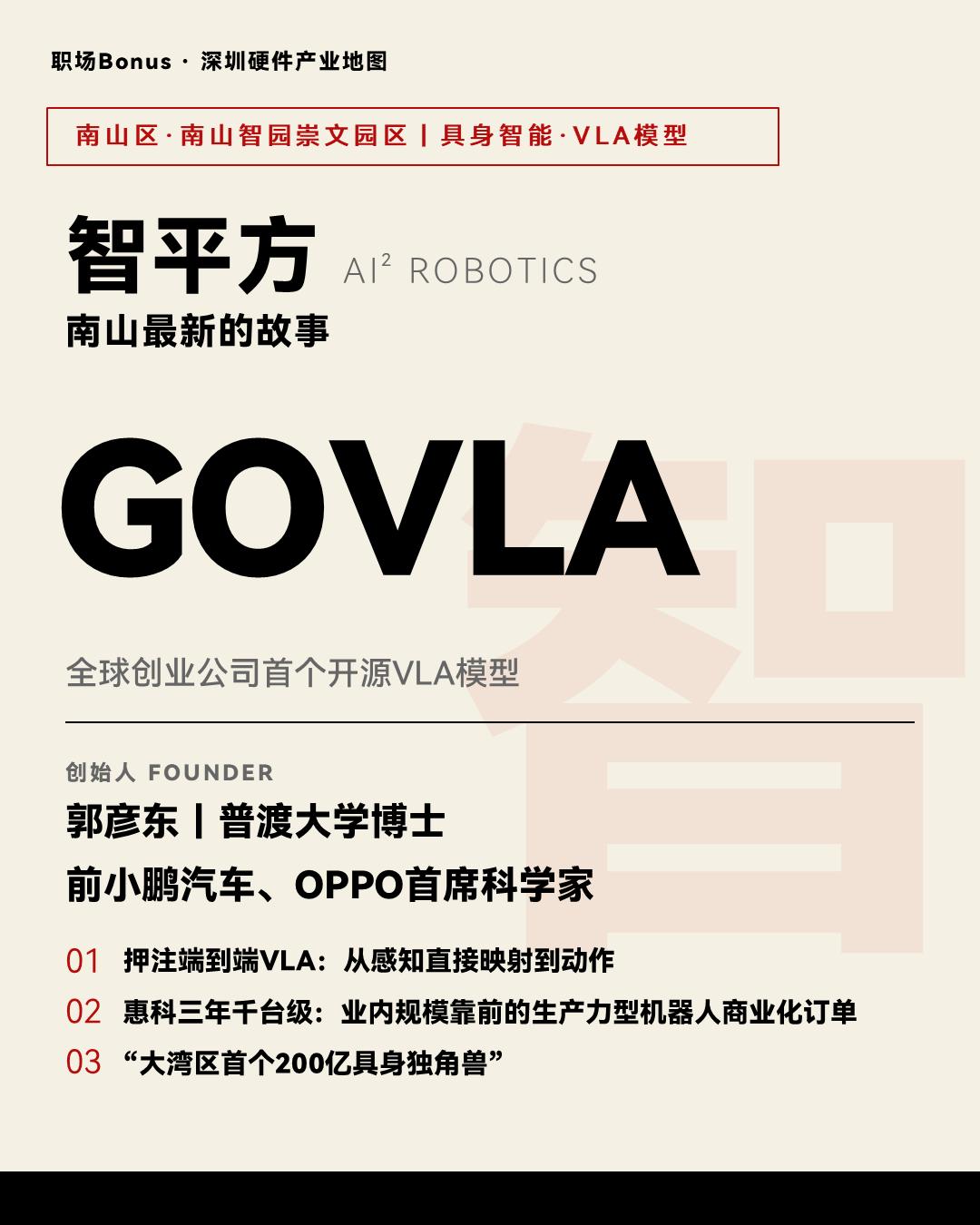
In April 2023, Guo Yandong, a Ph.D. from Purdue University, founded Zhisquare. Guo Yandong has fully experienced the full-cycle wave of smart terminals, and has served as a researcher in Microsoft's core AI team in the United States, and chief scientist of XPeng Motors and OPPO. In the early stage of entrepreneurship, he bet on a technical route that was not mainstream at that time: the end-to-end VLA model, which realizes direct medium-free mapping from robot perception to action.
In June 2024, Zhisquare open-sourced GOVLA0.0 (RoboMamba), the first VLA model of a global startup; in September 2025, it built its own production line and put it into operation, and signed a three-year order for thousands of units of equipment with HKC, the world's third largest panel manufacturer, which is one of the large-scale commercialization contracts for productivity robots in the industry. Entering 2026, the company further upgraded and launched the NeuroVLA brain-inspired model, and open-sourced the AlphaBrain Platform, a one-stop embodied intelligence ecological platform.
At the recently held 2026 World Robot Conference, Zhisquare no longer focused on stage demonstrations, but directly put AlphaBot2 into the official cultural and creative store of the exhibition hall to undertake real order receiving services. The same set of models can not only complete coffee and ice cream production, but also perform industrial tasks such as PCB board grabbing, conveying to the outside world the implementation idea of "robots not only go on stage, but also take up jobs".
If the GOVLA end-to-end route can be fully commercialized in all scenarios, the early employee options of Zhisquare will have considerable income space; but if this technical path is falsified by the market, the company's large amount of early R&D investment will also face risks. The team has both academic and engineering genes, R&D follows the experiment and evaluation standards of top AI conferences, and builds a self-owned 1000+ GPU computing power cluster to support model training. The campus recruitment releases positions for multiple directions such as algorithms, motion control, multimodal, and hardware engineering.
"Workplace Bonus" (ID: ZhiChangHongLi)
