The Golden Age of STEM Prodigies
At the end of last year, Shunyu Yao, a former researcher at OpenAI, joined Tencent with high-profile attention, prompting Tencent to issue an urgent denial: Shunyu Yao does not have a nine-figure annual salary.
In the AI-driven wealth creation wave, the soaring value is not only the net worth of startup founders, but also the annual compensation packages of top-tier employees. The New Money of the new era is being generated in batches. As one of the representatives, Shunyu Yao was born in 1998, and has made four critical choices in his career:
The first choice was his major: In 2015, Shunyu Yao was admitted to the Yao Class of Tsinghua University with a score of 704 in the national college entrance examination, majoring in computer science. He studied under Jiajun Wu, a senior alumnus of Tsinghua and a leading deep learning expert, and began to systematically explore artificial general intelligence.
In 2017, the iconic Transformer architecture was officially introduced, making natural language processing a highly popular research direction.
The second choice was his doctoral supervisor: In 2019, Shunyu Yao went to Princeton University to pursue his PhD. He originally focused on computer vision, but Shunyu Yao believed that natural language processing had greater potential, so he switched his research direction to natural language processing and reinforcement learning, and got acquainted with his supervisor Karthik Narasimhan.
Karthik Narasimhan had just joined Princeton at that time, and had previously worked as a visiting researcher at OpenAI for one year, participating in the landmark GPT-1 paper of the GPT model as a second author. In 2019, OpenAI received a $1 billion investment from Microsoft and rose to prominence in Silicon Valley.
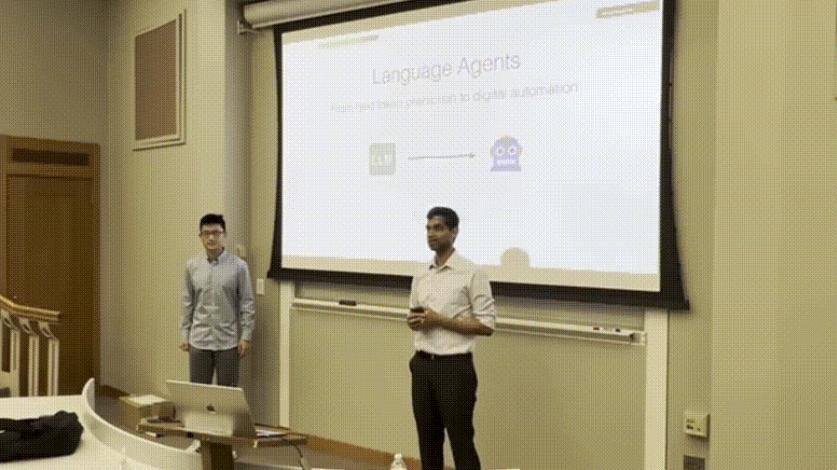
Shunyu Yao and his supervisor at his PhD defense site
Shunyu Yao and his supervisor Karthik Narasimhan have a relationship of both mentor and friend. Later when Shunyu Yao got married, his supervisor even served as the groomsman.
The third choice was his employer: During his time at Princeton, Shunyu Yao published two first-author papers, ReAct and Tree of Thoughts. The former proposed a paradigm that allows AI to call tools while reasoning, with the two processes alternating, which is the foundational paradigm for today's AI Agent systems.
After graduation, Shunyu Yao joined OpenAI, where his supervisor had previously worked. He led the development of OpenAI's agent products and participated in the Deep Research project.
The core R&D positions in many companies have very similar resumes: choosing the right major, following the right research direction, and joining the right company. At the early stage of new technology emergence, there is definitely a shortage of qualified talents. Every correct choice effectively boosts one's own market value.
But different from most people, Shunyu Yao's skyrocketing net worth comes from his fourth choice: when the AI competition is in full swing, he encountered a company that lacks almost everything except capital.
Tencent once fell behind in the large model competition, and as a chaser, it is much more generous in offering compensation. From another perspective, for a company like Tencent, being able to give full decision-making power to a 27-year-old young man means it has no other alternative.
Choose the right research direction - catch the industry boom upon graduation - join a cutting-edge enterprise in the industry - switch to a generous latecomer enterprise. Shunyu Yao's life so far can be summed up in one sentence:
Go long on artificial intelligence with 4x leverage.
What is Your Net Worth
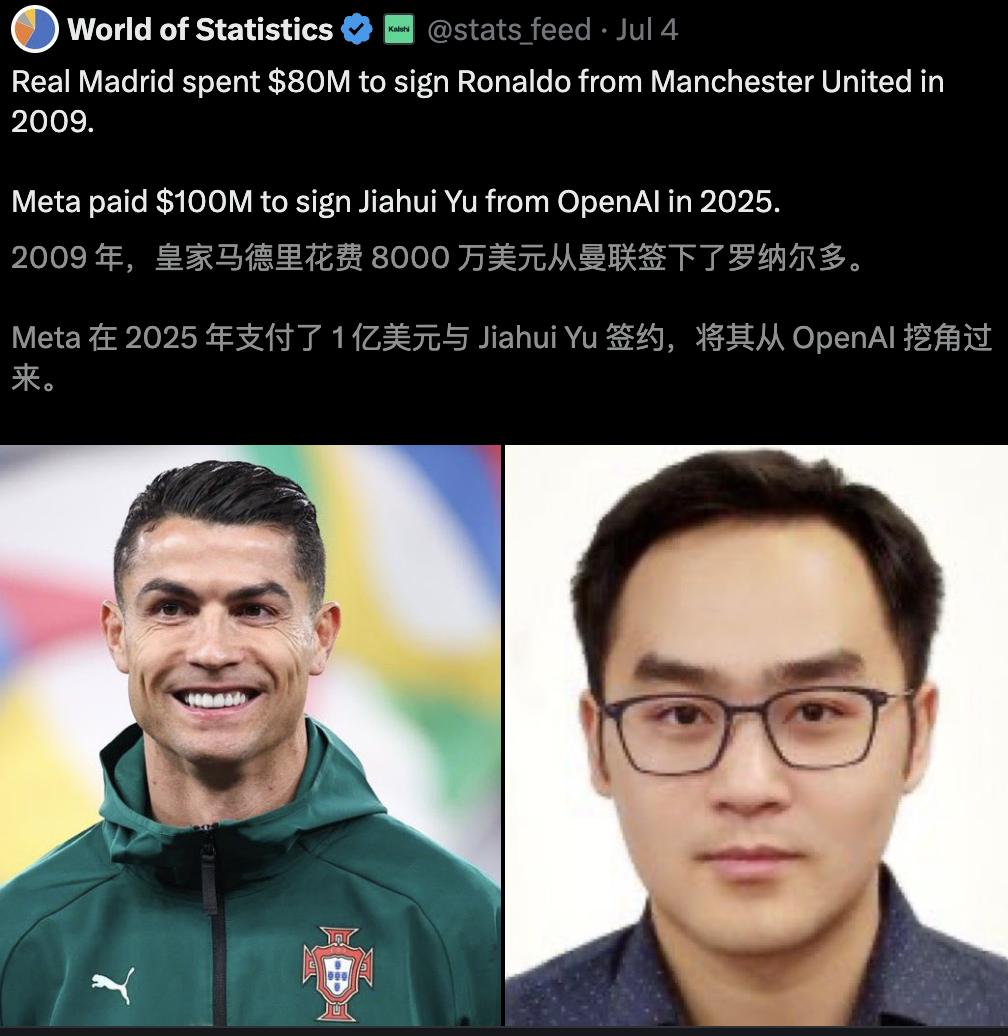
High income in the high-tech industry is not a new thing, but it is probably the first time in human history that capitalists are being as generous as they are today. Sam Altman complained on a podcast last year that Meta offered a $100 million signing bonus to poach one of its researchers.
Meta has encountered many setbacks in large model R&D, but it is always extremely generous when poaching talents.
Last July, Meta poached Ruoming Pang, the head of Apple's foundation model team, and directly offered an annual compensation package of $200 million. What does this concept mean? It is roughly equivalent to having more than $100 million left after paying Cook's full annual salary.
In the same month, Meta spent $14.3 billion to acquire a 49% stake in Scale AI. Alexandr Wang, the founder of Scale AI, then joined Meta and took full charge of Meta's AI team.
With a single decision from Mark Zuckerberg, Alexandr Wang immediately became the youngest billionaire on the 2025 Forbes list. Netizens who usually use AI models to write Xiaohongshu content should stop claiming to be super individuals, as this is what a real super individual looks like.
According to statistics from the Equilar compensation database, the total annual compensation for L5 senior engineers at OpenAI ranges from $829,000 to $871,000, the median total compensation at Anthropic is between $420,000 and $540,000, and top AI researchers can earn more than $10 million per year, a gap of 10 times.
The difference between a genius and an average talent is so straightforward. So much so that Andrew Bosworth, CTO of Meta, could not help complaining in an interview with CNBC:
The market is setting a price for talents at a certain level right now, which is truly unbelievable and unprecedented in my 20-year career as a technology executive.
Distributing cash directly to AI researchers is obviously not a sustainable solution. Valuable cash needs to be spent on purchasing GPUs from Jensen Huang, so equity is the main method to incentivize talents. Andrew Bosworth once refuted the "100 million signing bonus" rumor inside Meta: the compensation is mostly stock, which can only be unlocked after meeting pre-set KPIs.
Using stock to incentivize employees is a common practice, but this round of AI wave has a distinct feature: The valuation of startups is expanding at an astonishing speed.
Cursor, the AI programming platform, was founded in 2022. Its valuation reached $2.6 billion at the end of 2024, and it was acquired by Elon Musk's SpaceX for $60 billion in 2026, multiplying more than 20 times in less than two years. Even Warren Buffett would want to close his trading account, and George Soros would want to call the police upon seeing this.
At the end of 2022, ChatGPT was launched, and OpenAI had a valuation of around $29 billion at that time. This March, OpenAI completed a $122 billion financing round with a valuation of $852 billion, multiplying 30 times in more than 3 years.
During the same period, Meta's market cap quadrupled, Google's market cap increased by 3.6 times, Microsoft's market cap doubled, and the Nasdaq index more than doubled. As for the Hang Seng Tech Index, well, that's a different story.
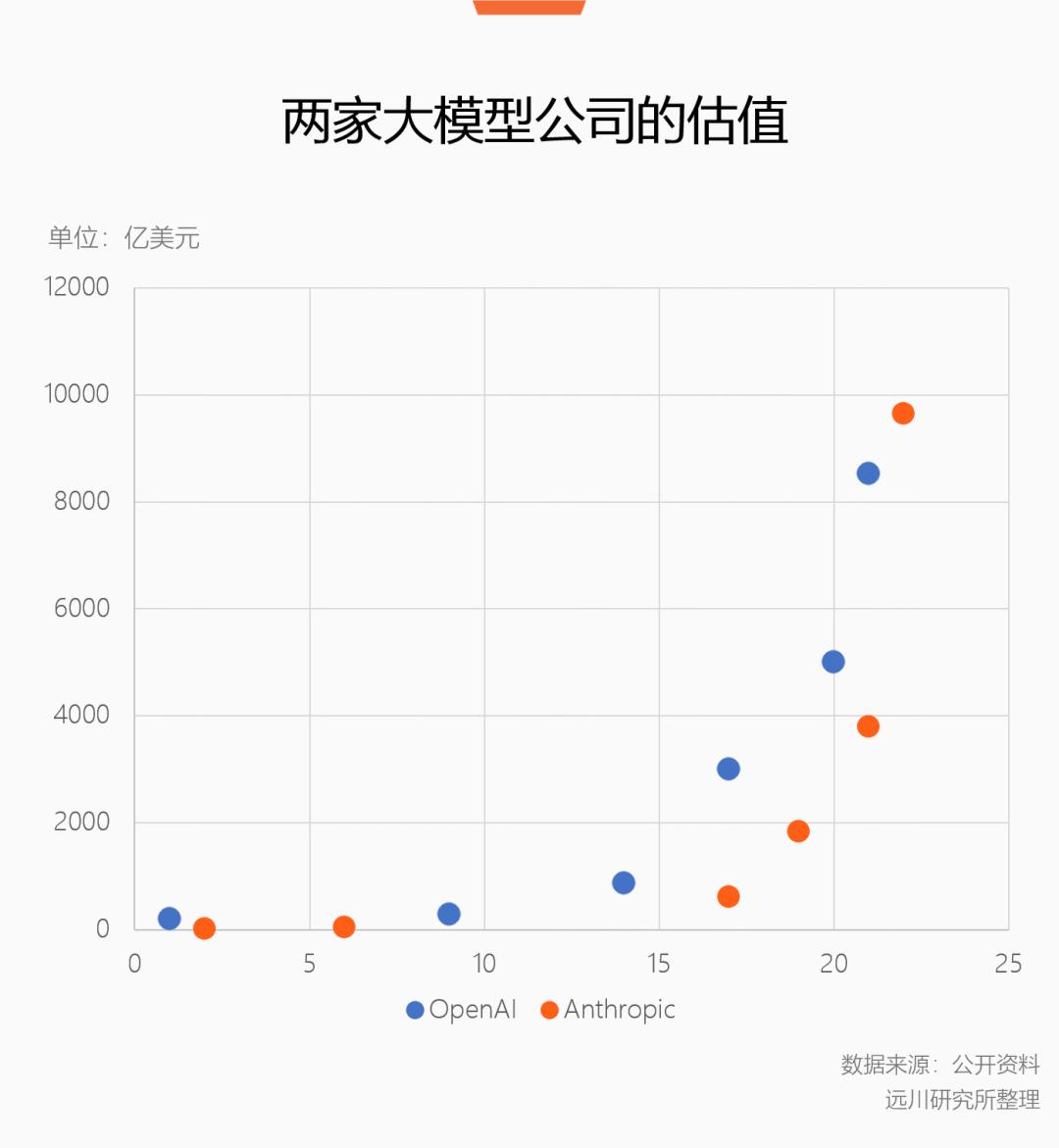
In the trial testimony of Elon Musk's lawsuit against OpenAI, the equity held by OpenAI president Greg Brockman is worth approximately $30 billion; former chief scientist Ilya Sutskever holds $7 billion worth of stock. As valuations rise rapidly, the stock held by employees is becoming more and more valuable, and their net worth increases at an astonishing speed.
Therefore, when large technology companies want to poach top researchers from OpenAI and Anthropic, they not only need to match the salary level, but also include the expected appreciation of the options. When domestic large companies want to poach talents across borders, they also need to take the exchange rate into account.
OpenAI also knows it cannot compete with large companies in financial resources, so it is extremely generous when issuing stock to employees. According to analysis from The Wall Street Journal, equity compensation accounts for about 45% of OpenAI's revenue, far higher than large Silicon Valley companies. In 2024, this figure reached as high as 119%.
In October 2025, OpenAI launched a share repurchase program for its employees. 600 employees received a total of $6.6 billion, and 75 of them sold the full $30 million upper limit set by the company. According to data from the US Department of Labor, the median salary of OpenAI and Anthropic is roughly the same, and the core competitiveness of compensation at both companies lies in options.
Long-termists never focus on their payslips, but without an active even fanatical capital market, the net worth of AI geniuses would never rise so fast.
Of course you can say that this is all paper wealth, just like your own stock portfolio, but at least their books are in the black.
I'm Making Progress, What About You?
Another feature of this round of AI technology wave is that the New Money group is highly youthful, many of whom have achieved financial freedom multiple times at a very young age.
In 2024, AMiner analyzed the core research teams of 10 large global models at that time, and found that 69% of the members are under 40 years old. If we only look at Chinese teams, this proportion reaches 84%.
According to Lei Jun, the average age of the core team behind Xiaomi's MiMo large model is 25 years old. Among them, Fuli Luo, the top leader of the team, was born in 1995, three years older than Shunyu Yao from Tencent. Alexandr Wang, who was listed on the billionaire list by Mark Zuckerberg, was born in 1997, and dropped out of school to start his own company at the age of 19.
In traditional industries, "10 years of work experience" is a core asset, but the industrialization of artificial intelligence has a very short history. The core technology stack of large models was gradually formed around 2018, GPT-3 in 2023 proved the feasibility of the path, ChatGPT made a huge splash at the end of 2022, and many AI labs have been established for less than 10 years.
In other words, an AI researcher who started his PhD in 2018 is already considered a senior expert in the industry.
There are exceptions. Yonghui Wu, the head of ByteDance's large model research department, is a senior in the literal sense. When Yonghui Wu was admitted to the computer science major of Nanjing University in 1997, Shunyu Yao had not even been born.
Yonghui Wu joined Google after graduating with his PhD in 2008, and worked there for 17 years. He joined ByteDance in early 2025, taking full charge of the basic research of large models, and reporting directly to CEO Ruobo Liang.
So age is just a superficial phenomenon. The skyrocketing net worth of tech geniuses is closely related to another big background: The iteration speed of AI technology is extremely fast.
There is a common consensus in the industry: even compared with just a few years ago, today's large models have a disruptive technological generation gap. The training methods used this year are completely different from those two years ago.
For example, TensorFlow used to be the absolute dominant deep learning framework, but today PyTorch has almost monopolized both research and production scenarios. Model scale, architecture and infrastructure are iterating all the time. Experience from five years ago in the AI field is most likely considered an archaeological discovery.
The half-life of experience is so short that the moat of seniority no longer exists. This brings a realistic problem: The knowledge and experience accumulated by individuals are valuable only when the team chooses the correct technical direction.
Yonghui Wu was initially responsible for search algorithms at Google. In 2014, he joined the Google Brain team and switched his research direction to deep learning. In 2023, he was promoted to "Google Fellow" and Vice President of Research at Google DeepMind.
Although he is not young, Dr. Wu has always been working in the most cutting-edge AI research department of Google. Even though Google is not in its prime right now, in 2025 when Dr. Wu joined ByteDance, Google's Gemini-3 series models comprehensively outperformed its peers, and there are countless Silicon Valley pundits who argue in defense of Google.
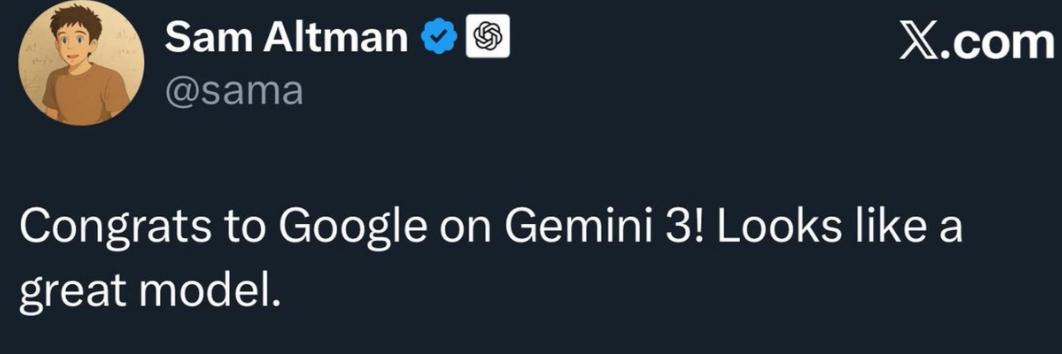

After the release of Gemini-3, Elon Musk, who has always been critical of Google, even reluctantly sent his congratulations
The knowledge, experience and a large number of subtle know-how that Yonghui Wu accumulated at Google Brain and DeepMind are timely help that ByteDance urgently needs. If Dr. Wu had worked in the Android or YouTube departments, he would most likely not have received the job offer from ByteDance.
More than a year after Yonghui Wu joined ByteDance, the Seed model has iterated four versions, the daily token call volume of Doubao has reached 180 trillion, and the video model Seedance has made rapid progress. Shunyu Yao has not been at Tencent for a long time, but the Hunyuan large model has taken on a brand new look.
In the same logic, the clusters Shunyu Yao has operated and the models he has tuned at OpenAI are extremely valuable to Tencent. Tencent has no shortage of PhD holders. Everyone has a doctorate degree, so is the gap between them just IQ?
The net worth of AI geniuses largely depends on the technical architecture and research direction of their employers. Two people with the same background and education, one joining Company A and the other joining Company B, will most likely have completely different career ceilings five years later.
Imagine this scenario:
Your classmate A is researching how to optimize AI Infra at Anthropic, your classmate B is researching how to design Harness at OpenAI, your classmate C is staying up late to learn the 512,000 lines of leaked Claude Code at a startup company, while you are racking your brains in your weekly report thinking:
Why did the five users converted from the AI red packet campaign yesterday fail to stay?
Tacit Knowledge
NASA flight controller Robert Frost once put forward a view:
In the 21st century, the reason why the United States cannot return to the moon is not the lack of rocket blueprints or factories, but the lack of the group of engineers, technicians, scientists and flight controllers who understand the entire Apollo manufacturing process.
For the success of an organization, papers, patents and documents are only part of the assets. The other