The AI unicorn has secured a new round of financing worth 3.7 billion, pushing its total valuation to 33.6 billion.
According to Zhidong News on September 3, the Israel-Netherlands enterprise AI startup Wonderful announced yesterday that it has completed a Series C financing of 550 million US dollars (about 3.7 billion yuan), with a valuation reaching 5 billion US dollars (about 33.6 billion yuan).
This round of financing is led by Insight Partners, with Salesforce participating as a new investor, and existing investors including Index Ventures, IVP, Vine Ventures, 9Yards and Bessemer Venture Partners continuing to follow on. Wonderful stated that the funds from this round will be used to accelerate product R&D, expand the global deployment team, and meet the growing enterprise demand for AI operating systems.
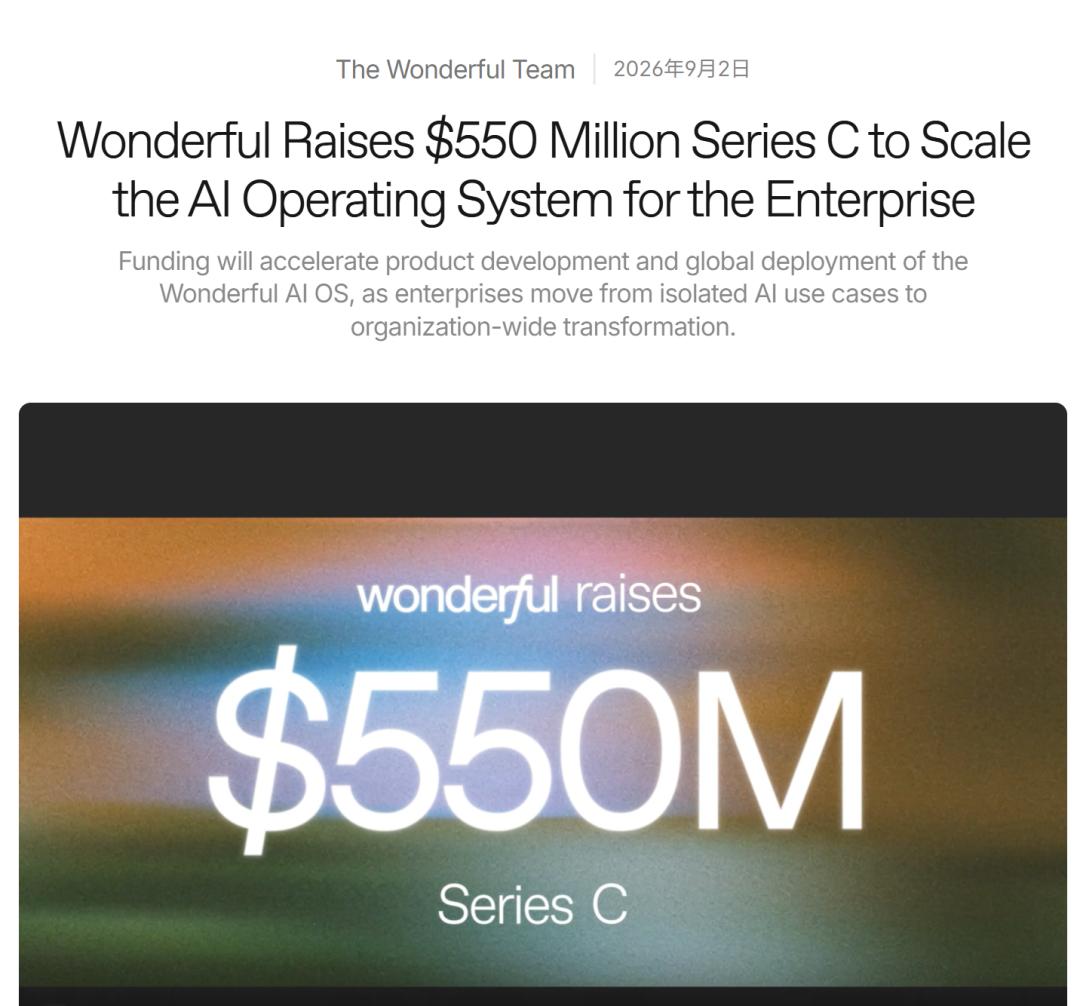
Wonderful announced the completion of $550 million Series C financing (Source: Wonderful)
According to *The Wall Street Journal*, in addition to this round of financing, investors also purchased shares held by Wonderful's employees and early angel investors through secondary market transactions for a total of 170 million US dollars (about 1.14 billion yuan), of which 150 million US dollars (about 1.01 billion yuan) came from Insight Partners.
In March this year, Wonderful just completed a $150 million (about 1.01 billion yuan) Series B financing at a valuation of $2 billion (about 13.44 billion yuan). In less than half a year, its valuation has risen to 2.5 times the original level.
01. Led by two Israeli serial entrepreneurs, building an enterprise-grade AI OS
Wonderful was founded in early 2025 in Tel Aviv, Israel, with its headquarters located in Amsterdam, the Netherlands. The company initially provided customer service AI Agents for non-English markets, and is now mainly developing AI operating systems for large enterprises, helping enterprises deploy AI Agents, automate workflows and develop AI-native applications.
Wonderful's co-founder and CEO Bar Winkler previously worked at app commercialization platform ironSource in charge of product management, business development and global expansion, and later founded enterprise software procurement company Approve.com, which was later acquired by Tipalti.
Wonderful's co-founder and CTO Roey Lalazar previously co-founded AI video localization platform Kaps and served as its CTO, driving the company to achieve an annual recurring revenue of about 1 million US dollars (about 6.72 million yuan) in less than 12 months, and later served as the chairman of Kaps.

Wonderful's co-founder and CTO Roey Lalazar (left) and co-founder and CEO Bar Winkler (right) (Source: *The Wall Street Journal*)
Since the completion of the Series B financing, Wonderful has upgraded its original platform to Wonderful AI OS, an AI operating system covering the entire enterprise. This system includes four core products: managed workflows, productivity Agents, AI-native applications and conversational Agents, which can be used to automatically execute complex end-to-end processes, assist employees in their work and decision-making, supplement or replace traditional software, and serve enterprise customers. Different products can be deployed independently or combined into the same workflow, sharing capabilities of security, governance and task orchestration.
This platform adopts a modular design, is not bound to a single model, and is compatible with the existing enterprise technology stack. Enterprises can select models according to different tasks, adopt new models and capabilities without repeatedly rebuilding the technology stack, while retaining ownership of development achievements. The platform can be deployed in different cloud environments and on-premise environments of enterprises.
Lalazar said that enterprises should not replace everything they already have just to shift to AI-native. Wonderful's Forward-Deployed Engineers (FDE) will work with customers to promote the first application scenario to the production environment, and then transfer relevant knowledge and capabilities to customers, so that enterprises can gradually gain the ability to independently build, expand and operate the platform.
02. With around 100 enterprise customers, the team plans to expand to more than 1,000 people by the end of the year
In terms of business expansion, Wonderful said its business has covered more than 35 markets. According to *The Wall Street Journal*, the company serves customers in Europe, the Middle East, Latin America and Asia, has about 100 enterprise customers, and all current business growth comes from regions outside the United States and Canada.
Calculated at the current revenue level, Wonderful's annualized revenue is about 70 million US dollars (about 470 million yuan), which was only 1 million US dollars (about 6.72 million yuan) a year ago. With the growth of revenue and the arrival of new funds, Wonderful is increasing its investment to compete for market share. Winkler said that Wonderful also plans to expand some target markets through acquisitions.
Wonderful currently has about 650 employees, more than 10 times the number a year ago. The company plans to expand its team to more than 1,000 people by the end of this year, mainly recruiting Forward-Deployed Engineers, who will go to customer sites to connect AI tools to the original data, systems and workflows of enterprises.
According to *The Wall Street Journal*, Wonderful also plans to launch programming Agents and tools that can replace some traditional enterprise software.
03. Conclusion: Enterprise-grade AI balances platform capabilities and product delivery
Wonderful combines the enterprise-grade AI operating system with the FDE team, bringing system integration, local support and practical deployment into product delivery. This model reflects that when large enterprises adopt AI, they are no longer only concerned about model capabilities, but also about whether products can adapt to existing technology stacks and be stably put into production environments.
The flip side of this model is high labor and expansion costs. As Wonderful plans to expand its team to more than 1,000 people, whether its personnel expansion can be continuously converted into stable revenue will become the key to further scaling of this model.
This article is from the WeChat official account "Zhidong", author: Yang Jingli, editor: Xinyuan, published by 36Kr with authorization.