Stepping on venomous snakes 40,000 times and burying a thousand pairs of underpants in the soil — the quirky geniuses of the new Ig Nobel Prize are coming again.
In the early hours of this morning, the 36th Ig Nobel Prize announced its list of winners. This award is designed to recognize peculiar research that makes people burst into laughter first and then fall into deep thought.
Different from previous sessions, this year's Ig Nobel Prize stepped out of the United States for the first time, holding its award ceremony in Zurich, Switzerland. Marc Abrahams, the founder of the award, said that this move is to ensure guests from all over the world can attend the ceremony smoothly, avoiding the impact of the increasingly tightened US visa policy.
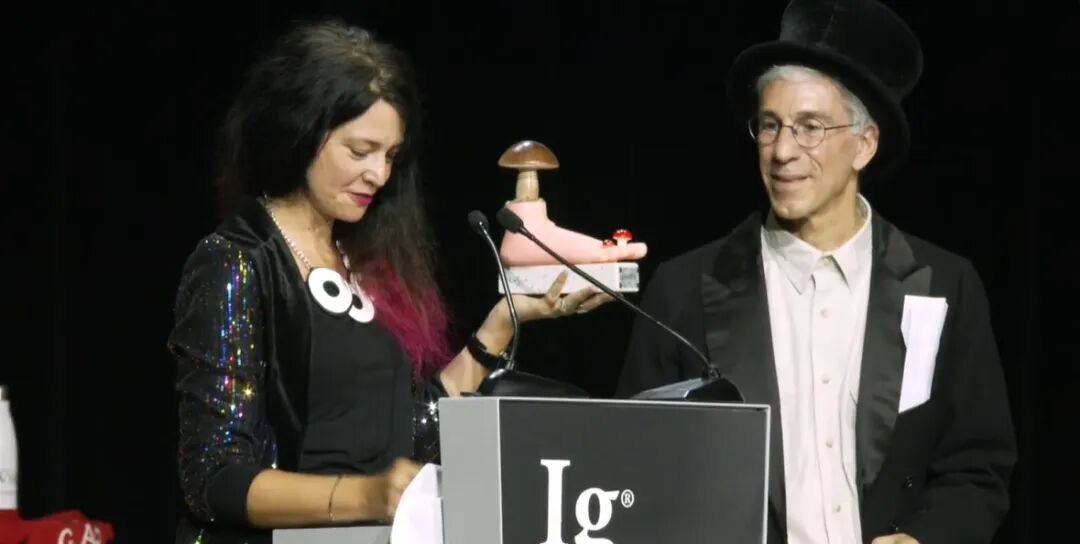
The theme of this year's award ceremony is "Fungi", so the winners received a trophy in the shape of a foot growing mushrooms. | Improbable Research
As usual, 10 groups of winners were honored this time. Now let's take a look at what incredible feats they have achieved in their respective fields.
Soil Science Prize: Planting Underwear
This prize is awarded to S. Franz Bender and Marcel G. A. van der Heijden, who launched a citizen science project calling on people to bury a thousand cotton underwear in the soil across different places, wait for them to rot, and dig them out two months later[1].
The researchers believe that burying underwear and observing its degradation can be used as a simple method to assess soil conditions, and the successful degradation of cotton underwear is a sign of healthy soil.
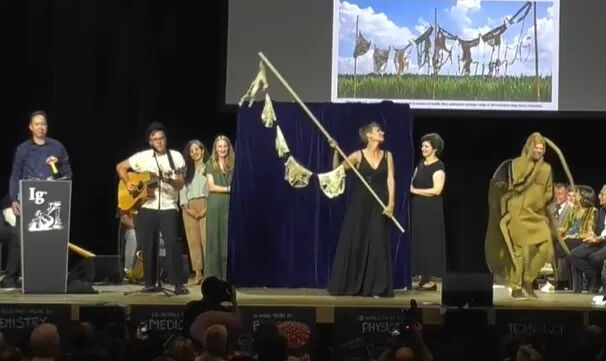
The most awkward part is that the rotten underwear was even displayed on site | Improbable Research
Biology Prize: Gently Stepping on Venomous Snakes
This prize is awarded to João Miguel Alves-Nunes, the snake-stepping enthusiast, and his colleagues. They wore safety boots to gently step on venomous snakes again and again, just to find out under what conditions venomous snakes are more likely to attack humans.
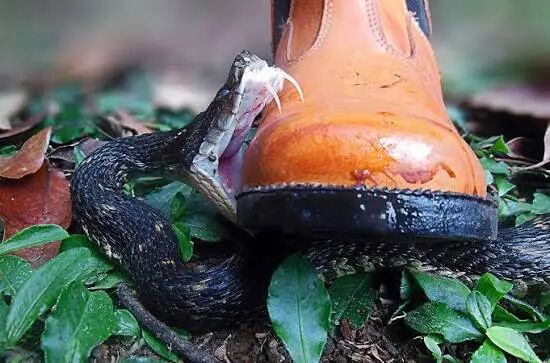
To be exact, the study collected 116 venomous snakes in total, and stepped on them more than 40,000 times | JOÃO MIGUEL ALVES-NUNES
The study found that the attack desire of Bothrops jararaca is related to many factors: they are more likely to bite people during the daytime with higher temperatures, and smaller snakes are more prone to attack than larger ones. When people step on the snake's head, the probability of being bitten is the highest, while when only stepping on the tail, the risk of being bitten is much lower.
Although the researchers stated that the stepping force was gentle enough to not harm the experimental subjects, the study was later retracted due to ethical disputes[2].
Chemistry Prize: Nutritious Cockroach Milk
This prize is awarded to Sanchari Banerjee and others, who studied a magical natural nutritious food: "cockroach milk".
Of course, it is not the kind of milk we are familiar with. It is actually a protein crystal substance produced by Diploptera punctata, which, like mammalian milk, is used to feed its offspring.
The researchers analyzed and determined the structure of this natural protein crystal, and evaluated its nutritional value: it is estimated that the energy contained in a single crystal is more than three times that of ordinary milk of the same mass[3].
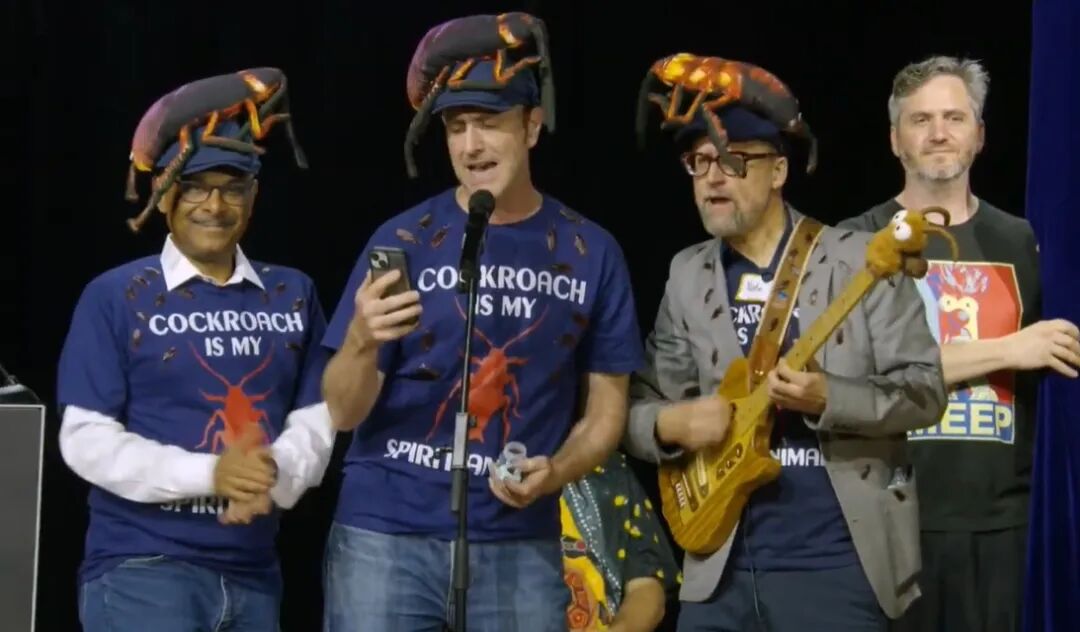
The winners sang a song about cockroach milk on site | Improbable Research
Biomechanics Prize: What Is Kissing
This prize is awarded to Matilda Brindle and her colleagues. After observing many animals including ants, birds, and primates, they decided to give "kissing" a brand new definition: "a non-confrontational interaction involving directed, intraspecific mouth-to-mouth contact, accompanied by some movement of the lips/mouthparts, with no food transfer."[4]
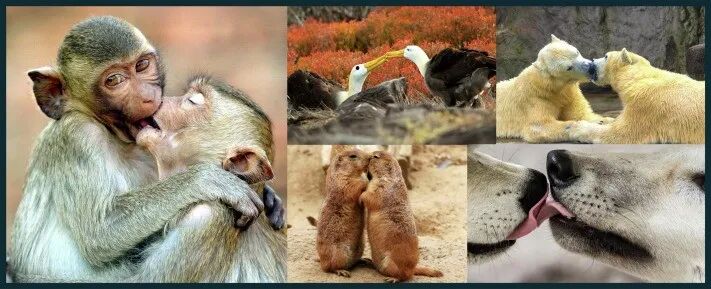
Behavior similar to kissing also exists among animals other than humans. | Matilda Brindle et al.
Their research topic is to understand the reason for the emergence of kissing from an evolutionary perspective. This behavior does not obviously benefit survival and reproduction, but carries the risk of spreading diseases, which makes evolutionary biologists quite confused. At present, the evolutionary significance of kissing is still unclear, and for subsequent research, it is necessary to first give it a definition that gets rid of anthropocentrism.
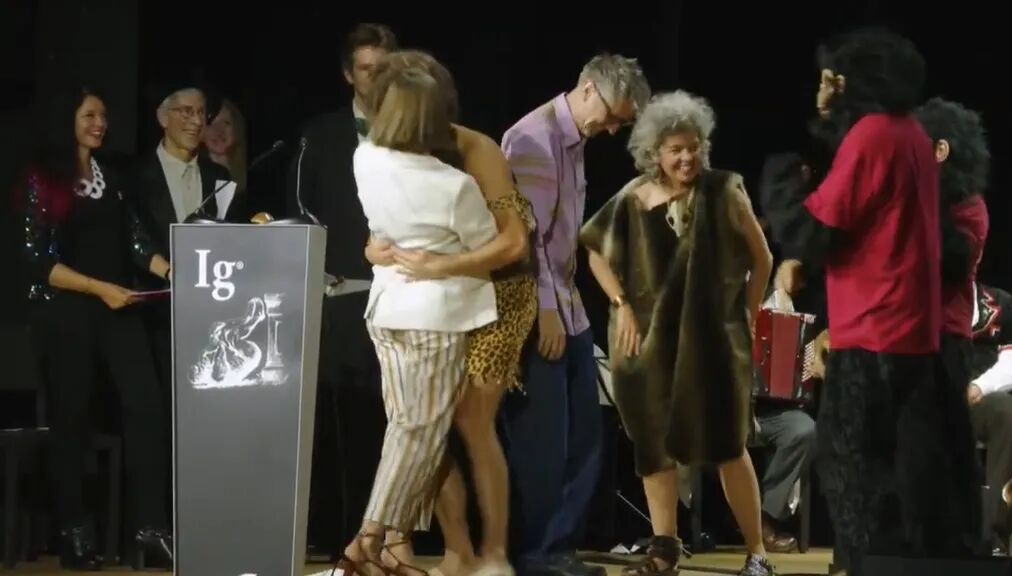
The researcher gave a live demonstration | Improbable Research
Economics Prize: Are Upper-class People More Rude?
This prize is awarded to Paul Piff and others, whose study suggests that people from higher social classes may be more likely to behave rudely[5].
Through experimental and natural observation methods, they conducted a total of 7 analyses on this theme. These studies found that people from higher social classes seem to be more prone to selfish and immoral behaviors — for example, cutting in line while driving at busy intersections, taking more candies prepared for children in the laboratory, and so on.
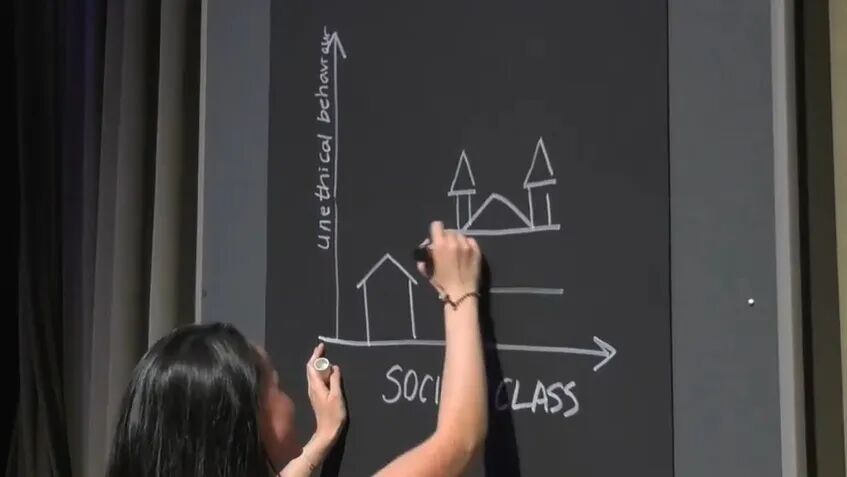
Schematic diagrams of the winners' papers were drawn live at this year's award ceremony | Improbable Research
Medical Prize: How to Blow Your Nose
This prize is posthumously awarded to the late Professor Tokuji Umino of Asahikawa Medical University, who conducted research on how to blow your nose correctly in 1977.
He carried out aerodynamic measurement and analysis on 15 subjects aged from 14 to 48, investigating factors such as the speed and flow of exhaled air, and the pressure exerted on the ears. The study points out that to effectively discharge nasal mucus, you can operate on the left and right nostrils separately, blow hard after moderate inhalation, and keep the action for a relatively long time[6].
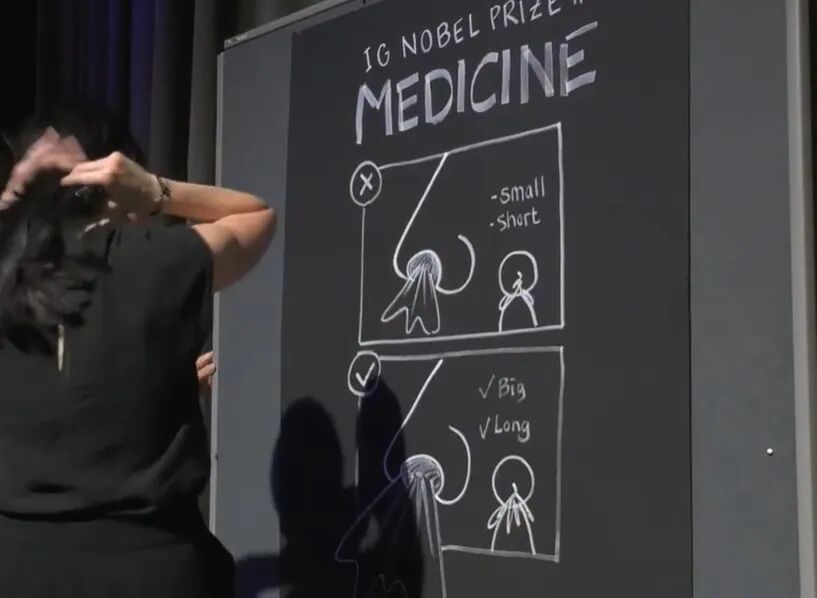
Key points of blowing your nose: hard and long | Improbable Research
Physics Prize: The Perfect Urinal
This prize is awarded to researchers from Canada, the United States, China and Saudi Arabia, who developed a new type of splash-proof urinal through hydrodynamic analysis[7].
Their study found that the impact angle of urine flow is an important factor affecting splashing. As long as the shape of the urinal is changed to reduce the impact angle of urine flow below the critical value, the trouble of urine splashing can be significantly reduced. Based on this theory, the researchers designed a new type of urinal named "Nautilus". If it is widely promoted, it will greatly reduce the cleaning pressure of public toilets and save labor and water resources.
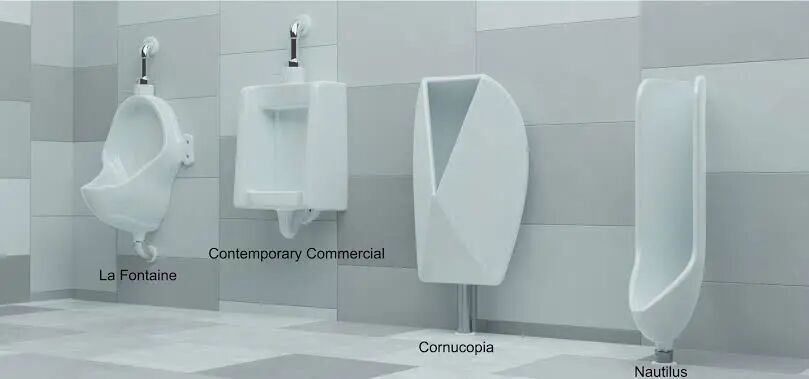
The one on the far right is the Nautilus urinal | Kaveeshan Thurairajah et al.
Technology Prize: 3D Printing with Mosquitoes
The winners of this prize come from China, Canada, the United States and Egypt, they cut off the mouthparts of female mosquitoes to make 3D printing nozzles, and found that they work surprisingly well.
The researchers thoroughly disinfected the female mosquito's mouthparts, stripped off the outer layer, coated it with a layer of photocurable resin, and then cut off both ends to get a hollow "micro-syringe". They used this "micro-syringe" to extrude gel materials and print fine 3D structures. As long as the parameters are properly controlled, a mosquito nozzle can work continuously for at least 14 days, and it is very cheap[8].
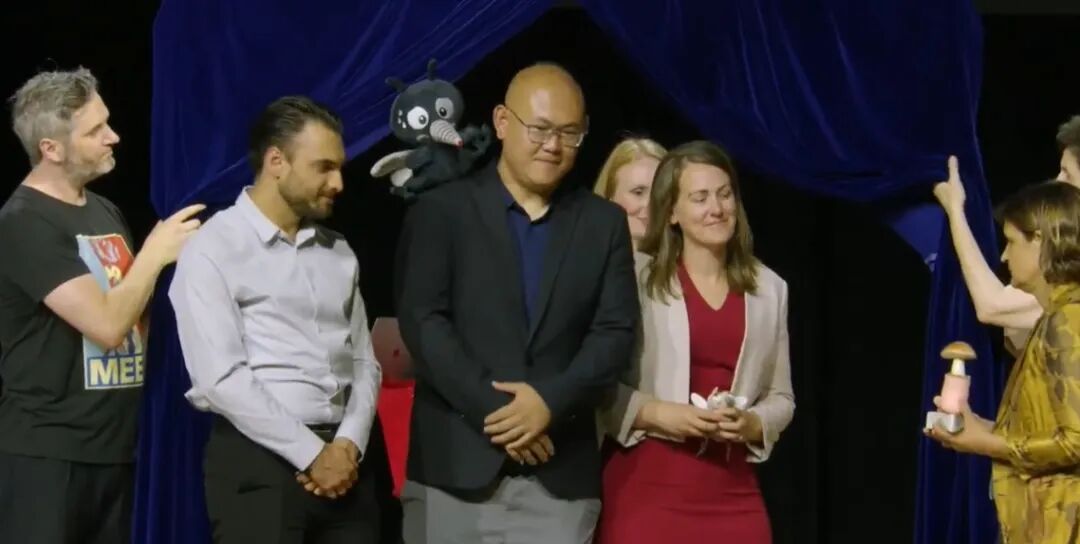
Obviously, the mosquito on the winner's shoulder looks like it is sweating profusely | Improbable Research
Olfaction Prize: Sweet-smelling Babies
This prize is awarded to the research team led by Agnieszka Sorokowska. The team found that for parents, small babies smell very nice, but teenage children do not.
A total of 235 parents were invited to this study, who were asked to evaluate whether they felt pleasant about the smell of their children. The study found that parents' evaluation of their children's smell decreases as the children grow older, and the gender of parents or children does not have a significant impact on this effect[9].
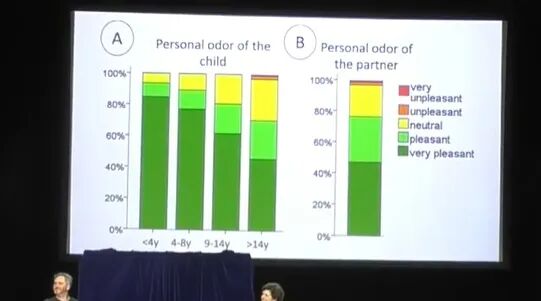
The older the child is, the less parents like their smell | Improbable Research
Peace Prize: Good Friends, Bad Friends
This prize is awarded to Jaimie Arona Krems and others, whose research shows that people value friends who are mean to the people they hate.
Intuition and research both indicate that the most important trait of a good friend should be prosociality, especially being kind and trustworthy. However, when the two-person relationship is placed in a larger social framework, people's preference factors for friends will become more complex.
Through experiments on 1183 people, the researchers proved that in some situations (for example, when facing enemies), people tend to make friends who show "meanness" rather than "kindness"[10]. Of course, this conclusion is quite consistent with most people's life experience.

The winners dressed up as angels and demons | Improbable Research
References
[1] https://www.science.org/doi/10.1126/science.adw0030
[2] https://www.nature.com/articles/s41598-025-88686-x
[3] https://journals.iucr.org/m/issues/2016/04/00/jt5013/index.html
[4] https://www.sciencedirect.com/science/article/pii/S1090513825001370
[5] https://www.pnas.org/doi/full/10.1073/pnas.1118373109
[6] https://topics.smt.docomo.ne.jp/article/jiji/world/jiji-2026090400137
[7] https://academic.oup.com/pnasnexus/article/4/4/pgaf087/8098745
[8] https://www.science.org/doi/10.1126/sciadv.adw9953
[9] https://link.springer.com/article/10.1007/s12078-017-9230-x
[10] https://www.sciencedirect.com/science/article/abs/pii/S1090513823000211
This article is from the WeChat