What enterprises want to recruit is not "people who have learned AI".
You may have already noticed that job hunting and recruitment have been changing a lot recently. When everyone can use AI to write a more impressive resume, what exactly do enterprises rely on to judge who is more worth hiring? For ordinary professionals, as AI becomes increasingly capable, what kind of person should we become to be irreplaceable?
In July 2026, Zhaopin released the 2026 Artificial Intelligence Industry Talent Development Report. The data shows a distinct change: on one hand, new AI positions are emerging rapidly, on the other hand, the skill requirements for traditional positions with high repeatability and high standardization are changing. What is more noteworthy than the change in the number of positions is that the recruitment market is redefining "what kind of people are more valuable". Wang Ting, an alumna of the CEIBS EMBA 2023 cohort, is currently the Vice President of Zhaopin Group, long in charge of strategic planning and business analysis. At the front line of the recruitment market, what she sees is not just the increase or decrease of positions, but that the capability boundaries of positions, processes and people are being rewritten together by AI.
Insights into the 2026 Talent Market from Data
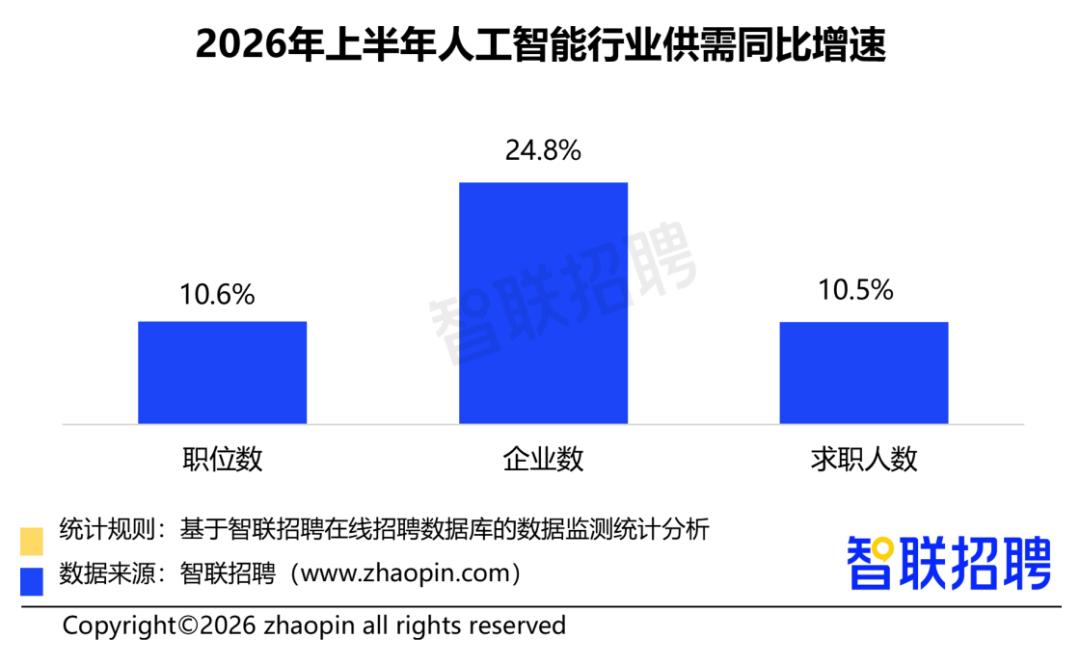
The 2026 Artificial Intelligence Industry Talent Development Report shows that in the first half of this year, the number of recruitment enterprises in the artificial intelligence industry increased by 24.8% year-on-year, the number of positions increased by 10.6%, and the number of job seekers increased by 10.5%.
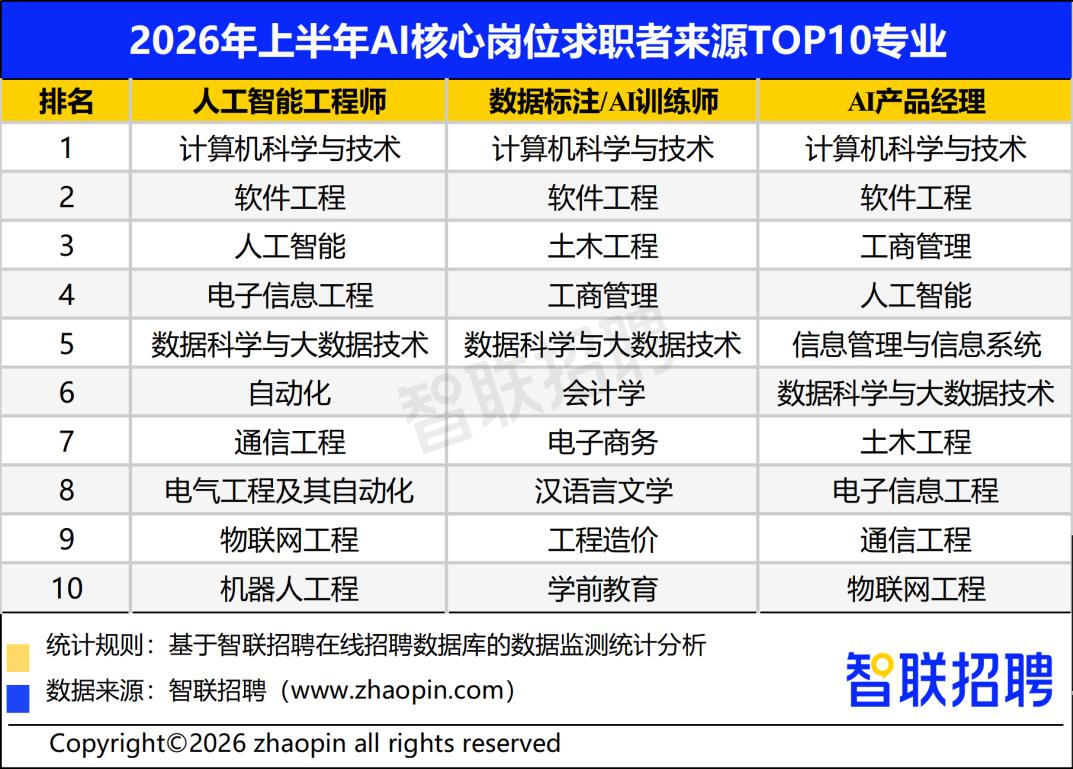
The growth rate of some segmented positions is even faster: the demand for AI agent development talents increased by 244% year-on-year, and the number of AI product manager positions increased by 87.7%; the demand-supply ratio for artificial intelligence engineers reached 2.62, and there is still a shortage of talents. At the same time, non-technical positions such as human resources, sales, and product are also at the forefront of recruitment demand in the AI industry.
From the perspective of cities, Beijing is still the city with the largest scale in the artificial intelligence industry; the number of positions in Shanghai increased by 53.7% year-on-year, the fastest among first-tier cities; first-tier and new first-tier cities together contribute 65% of the recruitment demand in the AI industry.
These data make me feel mixed. On the one hand, AI is coming very fast, and many work contents that were originally considered stable are being rewritten; on the other hand, it has also created new positions that were rarely seen three years ago. Both enterprises and job seekers are accelerating their entry into AI, showing a trend of "double increase in supply and demand", but the two sides do not have a completely consistent understanding of "AI talents".
What enterprises really need is not "people who have learned AI", but "people who can use AI to solve business problems".
In the past two years, there has been another obvious change in the job market, which we often use a term to summarize internally: accelerated skill depreciation.
In the past, a proficient skill might support three to five years of stability; now, it may be redefined by new tools and working methods within one or two years. Requirements such as "prompt engineering" and "AI collaboration" that rarely appeared in job descriptions last year have entered many non-technical positions this year.
Therefore, AI does not simply "eliminate positions", but reconfigures the skill structure of each position: the procedural and standardized parts are compressed, while the capabilities of judgment, creativity and human collaboration are amplified.
Data analysis is a very typical example. After AI takes over part of the basic analysis, analysts instead need to build a more solid data caliber, indicator system and data base first, so that AI can understand and use it accurately. At the same time, the analysis demands that were too late to be fulfilled due to limited manpower in the past are released.
In my team, the demand for data analysis once increased to two to three times of the past, and some analysts even began to use AI to make product prototypes, extending the work boundary from "making plans" to "making products".
This is also an easily overlooked point in AI transformation: Tools can bring the basic actions of many people to a similar level, but will not automatically generate insights. For the same report, some people just repeat the content generated by AI, while others can explain "why this is the case and what to do next" combined with the business background.
The easier the form is, the more important the content and judgment become.
What Kind of AI Talents Do Enterprises Need?
What exactly does "understanding AI" in the mouth of enterprises mean? We have disassembled a large number of job descriptions (JD), which can be roughly divided into three layers.
The first layer is basic competence, that is, having the awareness of human-machine collaboration and being able to use mainstream AI office tools. This is becoming a basic requirement for more and more positions, just like being able to use Office software.
The second layer is professional integration, which means being able to use AI to solve problems in one's own field, and truly connect professional experience with tools. For example, HR uses AI to do talent mapping, and marketers use AI to generate and optimize delivery strategies.
The third layer is business reconstruction at the strategic dimension, which can judge how AI should enter the business process, and act as a "translator" between business pain points and technical possibilities. Such talents are the scarcest.
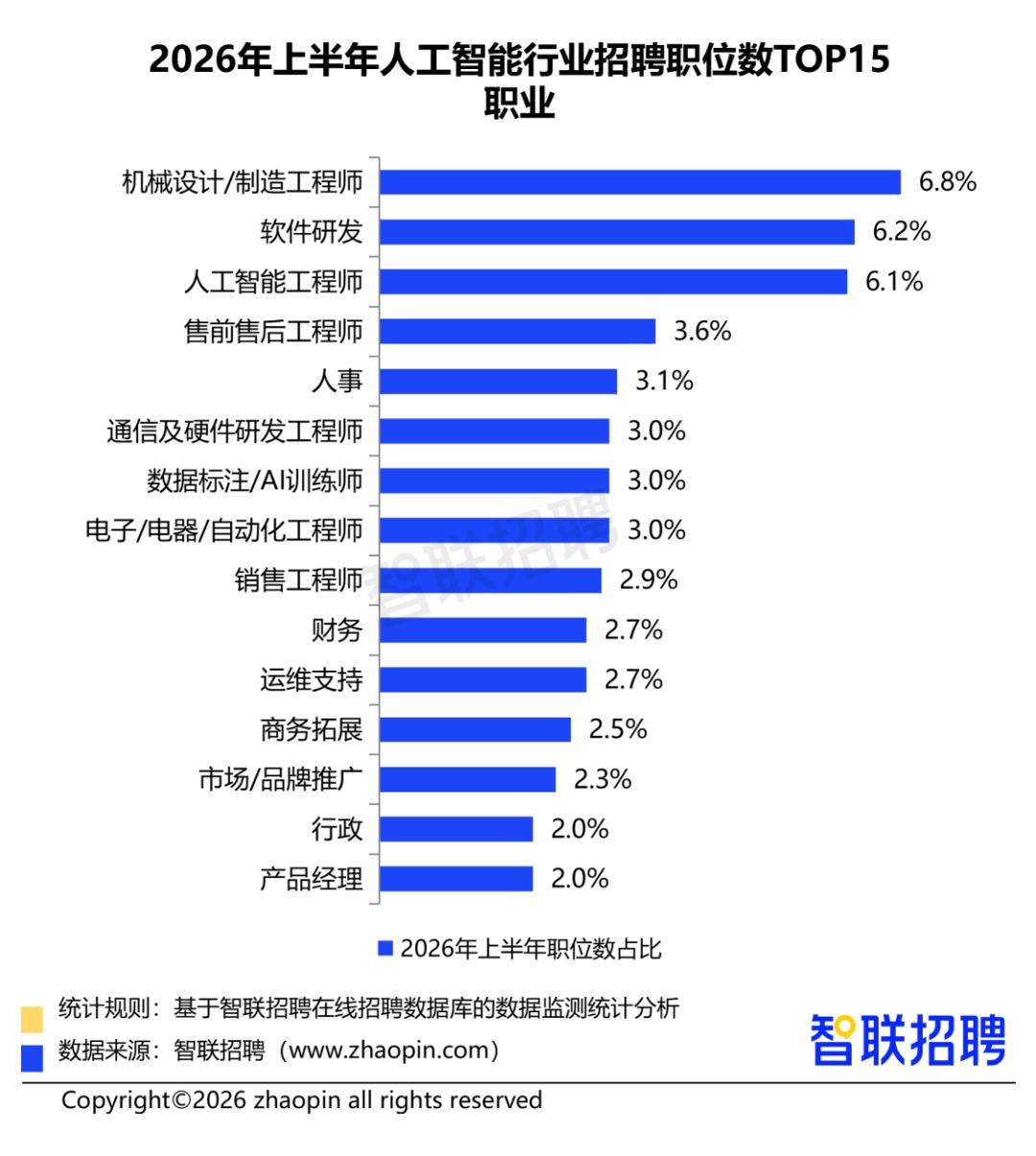
Therefore, in addition to hardcore technical positions such as algorithm engineers, enterprises are also competing for AI Product Managers, Frontline Deployment Engineers (FDE), and Industry Solution Architects. The common point of these positions is that they need to understand some technology, and also understand the industry, business and people.
On the other hand, the skill requirements of traditional positions are also changing. Junior translation, templated design, basic accounting and auditing, and pure execution customer service are increasingly using AI to improve efficiency, and the skill requirements for AI application in new positions have increased. Taking legal affairs as an example, what enterprises need is no longer just people who can look up legal provisions, but also hope that they can use AI to do case analysis and risk prediction.
If we make a simple distinction, the AI talents in the market can be roughly divided into two categories: one category is "people who build AI", including artificial intelligence engineers, agent development, data labeling and training, etc.; the other category is "people who use AI", who are distributed in more industries and functions, turning AI into a daily tool to complete business.
For most enterprises, the broader change actually occurs in the latter group of people. What enterprises really need to answer is often not "how to train my own large model", but "how can AI enter my business and make work better".
This also means that the demand for AI talents is spreading from a small number of technical teams to more business links. AI companies not only need algorithms and engineers, but also product, sales, marketing, human resources and finance teams, to turn technology into products, and then turn products into business.
Similar penetration is also happening in traditional industries. Fields such as automobiles, medicine, new energy, aerospace are all increasing AI-related positions, and the boundary between technical capabilities and industry experience is becoming increasingly blurred.
I have also observed an interesting trend, micro, small and medium enterprises are becoming a very active force in AI recruitment.
The reason is not difficult to understand. They face more direct survival pressure, so the introduction of AI first depends on whether it can reduce costs and increase revenue; at the same time, the organizational chain is short, so decision-making and implementation are faster. More importantly, AI reduces the cost of invoking some professional capabilities, and small companies can also obtain capabilities that previously often required a much larger organization to configure at a lower cost.
Therefore, such micro, small and medium enterprises especially need "people who can use AI to solve specific problems".
I have a classmate at CEIBS who is preparing to launch products overseas. Instead of building a complete team first, he first set up 8 AI "avatars" to take charge of work such as marketing, business, and sales respectively. The preparation process that used to take several months to recruit people, run in and try and error has been greatly compressed; if one market verification fails, it can be adjusted quickly and try the next one.
However, the improvement of individual efficiency does not mean that organizational efficiency will naturally improve. If an employee shortens the report that originally took one day to complete to two hours, but the subsequent approval, communication and decision-making still operate at the old pace, the saved time will be difficult to be converted into real organizational output.
The AI transformation will eventually return to the reconstruction of organizational processes and management methods.
Recruitment Platforms Are Also Being Reconstructed by AI
While AI is changing positions, it is also changing recruitment and job hunting itself.
For Zhaopin, the direction of change is to further evolve from an information matching platform to an AI-driven career development infrastructure.
The most obvious change is the reconstruction of products on both ends. On the C-end for job seekers, the platform is moving from "job list + passive search" to more active matching. For example, during the 2026 WAIC (World Artificial Intelligence Conference), Zhaopin launched the AI job-hunting companion product "Zhi Wukong", covering scenarios such as career planning, resume optimization, position matching, and mock interviews.
On the B-end enterprise side, the AI recruitment assistant can participate in demand analysis, resume screening, information verification, intention communication and part of the interview process. What changes accordingly is that HR's work focus has shifted from a large number of repeated screening to more judgment, communication and candidate experience.
After the efficiency is improved, a new problem also arises: When AI can polish everyone's resume and answers to be more perfect, how can enterprises judge the real level of candidates?
We have already observed that there is an obvious gap between the online test performance of some candidates and the subsequent interviews, and some open-ended answers are also highly convergent in language structure. It is still important to write a standard and complete resume, but more evidence connection is needed between "expressing well" and "truly capable of doing it".
Therefore, the value of background check and capability verification will further rise.
Pure technical defense always has boundaries. More importantly, we need to reconstruct the trust mechanism: the verification focus should not only be placed on one test or one interview, but more on verifiable project works, continuous learning tracks, and whether candidates can explain what they have done, why they did it, and peer reviews, so that integrity itself becomes a traceable competitive capital.
We are still in the exploratory stage in this field, but the direction is clear: encourage job seekers to use AI to empower themselves, not to forge themselves.
At the same time, the more standardized processes are handed over to machines, the more human communication cannot be ignored.
After candidates come to the company, someone introduces the team and talks about the real state of work, which seems inefficient, but is building trust. After all, recruitment is a two-way choice: enterprises are judging whether a person can do things, and candidates are also feeling whether they are willing to work with this group of people.
The better technology is at handling efficiency and standardization, the more human value is concentrated in trust, judgment and experience. Machines are responsible for improving efficiency, and humans are responsible for building relationships and making key judgments — this should be a basic boundary after AI enters the recruitment field.
The smarter recruitment is, the more important the presence of human beings becomes.
How Should Job Seekers Respond?
If positions are changing, enterprises are changing, and recruitment methods are also changing, what individuals most need to do is not to chase every new tool, but to think clearly first: what capabilities do I want AI to amplify for me?
As positions are updated faster, learning ability, cross-domain understanding, and the ability to integrate tools into business will all become more important.
Years of work experience are still important, but no longer the only proof of competence. Enterprises will increasingly want to see: have you really used AI, what projects have you done, and what results have you delivered. "What you have done" on the resume is giving way to the more specific "what you have successfully accomplished".
Projects, works and verifiable achievements will be more convincing than a string of beautiful but abstract skill keywords.
For mature professionals, their real moat is the long-term accumulated experience, judgment, and understanding of complex business and interpersonal relationships. These advantages will not become invalid due to the emergence of AI, but can instead become the most needed context for AI.
Senior practitioners who truly make good use of AI do not empty their decades of experience and retrain themselves to be technical newcomers, but connect AI to their existing professional accumulation: make basic work faster, and leave time for judgment and decision-making. The goal is not to compete with young engineers for who is better at technology, but to become an "AI-augmented expert".
I know a senior sales director. Instead of learning to write code, he uses AI to analyze customer behavior and predict the risk of losing orders. Twenty years of sales experience plus AI's data capabilities form a combined advantage that is difficult for others to replicate.
The value of experience lies not in repeating the past, but in identifying faster what problems are worth solving and what results are worth believing.
