Billion-scale budget, millions of hours of data carnival: How far is embodied intelligence from "out-of-the-box" availability?
In 2026, the most frequently mentioned critical goal in the embodied intelligence industry is undoubtedly the "million-hour dataset".
In January, LuMing Robotics expected to build a UMI data collection capacity of over 1 million hours within the year; in May, Lingchu Intelligence set the timeline for reaching 1 million hours by the end of the year; the Data Base of Beijing Humanoid Robot Innovation Center also put forward the goal of moving towards "the world's first million-hour high-quality dataset". By June, StarSeas Diagram joined hands with Beijing E-Town to launch the "1 Million-Hour Ultra-High Quality Real Data Plan", planning to complete 1 million hours in the current year and move towards 10 million hours in the next three years.
The development of ChatGPT has made the scaling law one of the most core experiences in the AI industry over the past few years. As the volume of data, model parameters and computing power increase, model capabilities also improve, and sometimes capabilities that did not exist before emerge. Today, the same expectation falls on robots.
Since language models can learn to write, program and reason from massive Tokens, robots can also learn to tidy up rooms, organize shelves, and even adapt to a task they have never learned from massive data.
Although the "1 million hours" lacks a precise source, it is more like a tacit understanding of the embodied intelligence industry at the next order of magnitude, behind which is the collective bet on the scaling law.
A head of the embodied model at a large internet company told us that this scale refers to the corpus scale trained by OpenAI during the GPT-3 period. If 1 million hours of video data is converted into tokens, since the information density contained in vision is lower than that of language, after accounting for the loss discount, they tend to believe that the data volume of this scale is roughly equivalent to that of the GPT-3 era.
Therefore, the industry believes that at the scale of "million-hour dataset", embodied intelligence is likely to develop capabilities comparable to GPT-3/GPT-3.5 through data learning.
Can robots reproduce the scaling law of large language models? Can 1 million hours bring the "ChatGPT moment" of embodied intelligence?
In this issue, we start with the composition of these 1 million hours.
I. Robot Data Is Gradually "Breaking Away" From Robots
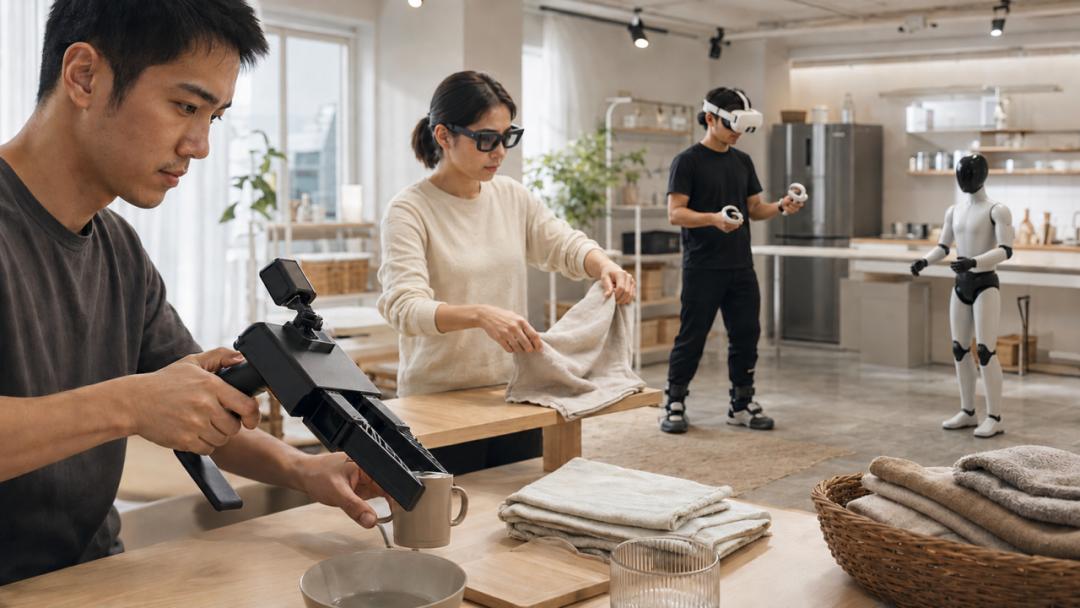
The most direct way to get a robot to learn to fold clothes is to let it "personally" practice repeatedly — the operator controls the robotic arm through a teleoperation device, the camera records the picture seen by the robot, and the system saves the action instructions, joint status and execution results at the same time. After accumulating a certain amount of data, when the robot returns to the same table and faces similar clothes, it can usually produce a decent demo.
This type of real-machine data is collected by the target robot, and the joint range, gripper structure and control method of the robotic arm are already reflected in the action trajectory. After the model is trained, it can be used for control without too much conversion.
A person in charge of an embodied data company told 36RobotLab that in the case of a fixed environment and a single task, dozens to hundreds of high-quality demonstration data can train a decent policy. However, such data can only cover a very narrow range of tasks.
In the laboratory, the robot may only learn to fold one type of clothes. When moved to a home scenario, it has to face clothes of different materials and shapes. Once the environment and tasks change, the amount of data required will increase rapidly.
It is difficult to obtain a large amount of real-machine data in a short period of time. When Google released RT-1 in 2022, it used 13 robots to collect data continuously for 17 months, accumulating more than 130,000 demonstrations covering more than 700 tasks. This was already a rare scale at that time.
According to 36RobotLab's understanding, the current market price of real-machine data collection is about 1000 yuan per hour.
Labor costs, collection efficiency and training requirements are all reasons why costs are difficult to reduce. After the robot completes a task, all items must be put back in place before the next round of operation can start. During the collection process, calibration deviation, equipment failure, hardware wear and invalid data will also be encountered.
Another problem is the strong correlation with hardware. The experience accumulated by dual-arm robots may not be applicable to single-arm robots; if the position of the robotic arm, gripper or camera changes, the original data also needs to be re-adapted.
In 2023, the Open X-Embodiment project led by Google DeepMind began to bring together robot data from different laboratories. 34 laboratories around the world contributed 60 datasets, including 22 robot bodies and more than 1 million real trajectories. Experiments show that after the model absorbs the experience accumulated by other robots, its transfer and generalization capabilities on multiple platforms are improved.
However, these data cannot be directly used to control a new robot. The arm length, number of joints, gripper structure and control method of different robots are still different. Open X-Embodiment expands the range of experience that the model can draw on, but does not make data from different bodies completely universal.
A new collection method emerged in 2024, the Universal Manipulation Interface, referred to as "UMI".
The entire robot is no longer needed at the collection site. Operators only need to hold a gripper with a camera and pose tracking function to pour water, fold clothes and wash tableware in homes, restaurants or factories. While the system records the pictures, it also saves the movement trajectory and opening/closing status of the gripper, and then converts these demonstrations into data that robots can learn from.
In the cup placement task, the UMI team can complete 111 demonstrations per hour, compared with only 35 demonstrations when using teleoperated robots. Collectors can also carry the equipment to move between different rooms without having to re-transport and debug the robot every time they switch scenarios.
In addition to collection efficiency, the collection cost of UMI data has also dropped significantly.
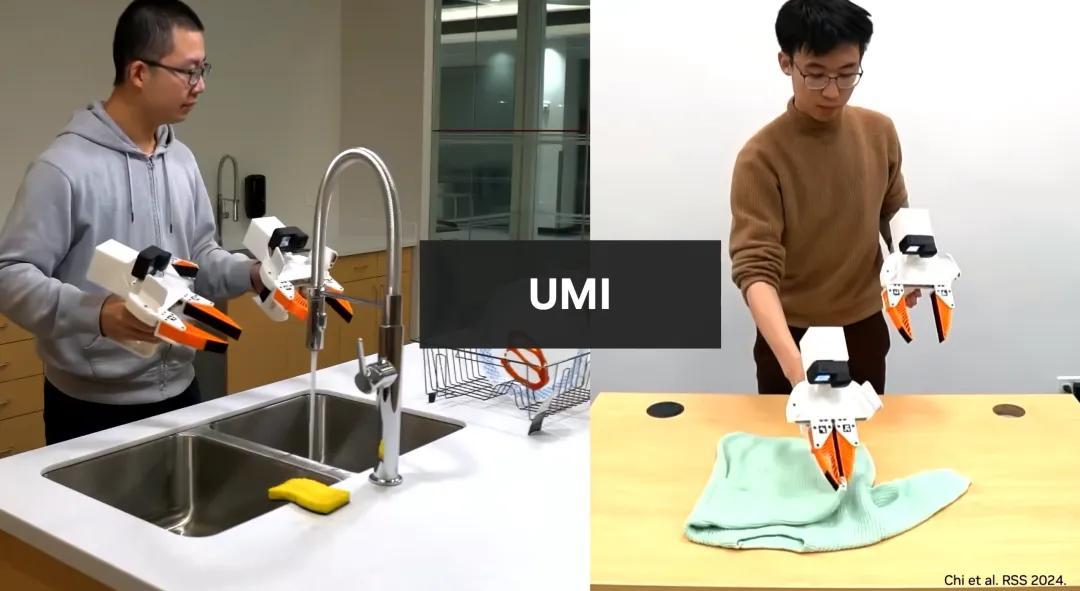
If the equipment, data processing and labeling are all included, the cost of UMI data per hour is only 400 to 650 yuan. It records more complete information than ordinary videos and does not need to occupy the entire robot all the time, so it has quickly become an important way for embodied intelligence companies to expand their datasets.
However, UMI still requires a dedicated set of gripper equipment. The parallel gripper makes human demonstrations closer to the robot's action space, but also limits the actions that can be collected. Humans can flexibly rotate their wrists, change their grasping methods and complete some fine operations, and not all of these actions can be reproduced by the gripper.
In October 2024, the Georgia Institute of Technology and other institutions released EgoMimic, which further simplified the collection tool to Project Aria glasses. Collectors sort items, grab toys or complete housework with their hands as usual, and the system extracts hand movement trajectories from the first-person view, then trains human demonstrations together with robot data.
The threshold for collecting first-person view data is lower. Human movements are much faster than robots, and there is no need to frequently debug mechanical equipment. Homes, offices and shops can all become collection sites. In the same hour, the model can see more operations and be exposed to more objects and scenario changes.
However, these videos are further away from the actual control loop of the robot. It can record what people see and how their hands move, but cannot directly provide the joint instructions, gripper status and contact information of the robotic arm. Therefore, EgoMimic usually trains human demonstrations together with real-machine data, and narrows the gap between the two through cross-domain alignment. The cost of such data can be reduced to about 300 yuan per hour.
At this stage, robot training data is no longer limited to real-machine trajectories. It includes actions completed by the target robot itself, experience accumulated by other robots, demonstrations completed by humans holding grippers, and hand movements extracted from first-person view videos. Different types of data can teach the model different contents. Some are closer to low-level control, while others are more suitable for supplementing task knowledge and scenario changes.
π0, released in October 2024, put these data from different sources into the same foundation model framework. Physical Intelligence used data collected by 8 types of robots in training, and also introduced the Open X-Embodiment dataset. Starting from the vision-language model that has received pre-training on internet images and texts, the model has acquired part of the understanding of objects, language and the real world before learning to control actions.
In February 2025, π0 further opened its code and model weights. Embodied companies and research teams can start directly from a general model, and then use their own robot data to complete fine-tuning. Physical Intelligence disclosed that in some internal experiments, some tasks only need 1 to 20 hours of target platform data to complete adaptation.
Therefore, if you see a robot company announce that it has "1 million hours of data" today, the first thing to clarify is where these data come from.
They may be collected by the target real machine, or come from other robots, UMI devices or human first-person view videos. Data from different sources have different collection costs, contain different information, and play different roles in the model.
Only reporting a total volume makes it difficult to judge how much capability the model has actually obtained from it. It is also necessary to know what the 1 million hours consist of, what role each type of data plays, and how much target real-machine data is finally used to convert the experience learned by the model into actions that a specific robot can perform.
II. What Can A 1-Billion-Yuan Data Budget Bring Back?
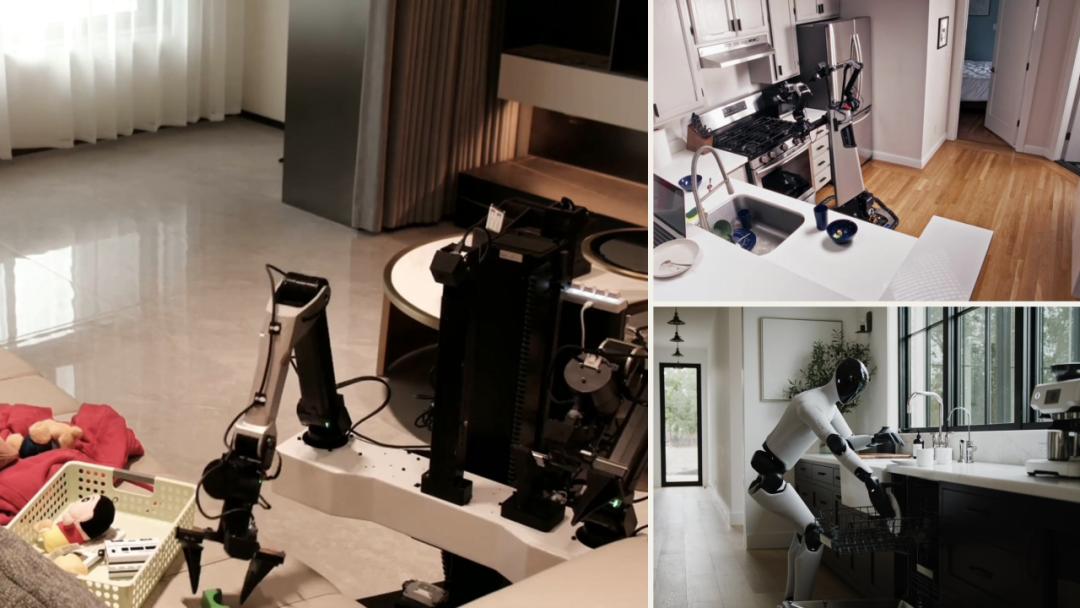
According to the previous cost estimation, if all 1 million hours use labeled real-machine data, the cost will be as high as 1 billion yuan; if all use full-process UMI data, the cost will be about 400 million to 650 million yuan; if all use Ego data, the cost only needs 300 million yuan.
The huge difference in costs is essentially a choice between different data routes: bet on real-machine data that "costs more and is closer to real control", or trust Ego data that "has larger scale and wider coverage". This is almost a problem that every robot company has to face when training foundation models.
Actual model training usually does not use only one type of data. Ego and UMI data can cover more scenarios at low cost, while real-machine data is closer to the final control. How the budget is allocated depends on which stage of training these data are placed in, and what capabilities the model lacks at that time.
Xiaomi-Robotics-1, released in July 2026, divides training into two stages: pre-training and post-training.
The pre-training stage used 100,000 hours of UMI trajectories, covering more than 1700 real scenarios in homes, commerce, industry and outdoors. Xiaomi first cut these trajectories into fragments, and then the vision-language model automatically describes the state changes between the gripper and the object, so that the model can learn a wide range of action generation capabilities.
The data used in the post-training stage includes more than 7200 hours of real-machine data, filtered open-source robot data and part of high-quality UMI data.
Among them, the self-collected data comes from real homes, covering tasks such as tidying sofas, organizing shoe cabinets and arranging kitchenware. At this stage, it is necessary to align the capabilities obtained from pre-training to the real robot, and at the same time shift the model from describing object state changes to understanding natural language instructions and executing them directly.
Therefore, 100,000 hours of UMI data and more than 7200 hours of real-machine data cannot be directly compared to see which one is "more efficient". UMI pre-training expands the range of environments and operations that the model has been exposed to, while real-machine and cross-body data deal with the action execution of specific robots.
The two types of data enter the model at different times and undertake different tasks.
Xiaomi disclosed that as the scale of pre-training data and model increases, the model's verification action error continues to decrease, and the real-machine success rate after post-training also increases accordingly. In four new tasks: mobile phone packing, printer consumable replenishment, washing machine loading and carton loading, the average success rate reached 75% with less than 10 hours of additional real-machine demonstrations for each task; after the average number of demonstrations increased to less than 40 hours per task, the overall success rate rose to 85%.
In Xiaomi's evaluation, it can be seen that as the scale of pre-training data increases, the model's learning efficiency on new tasks is significantly improved, and the amount of additional real-machine demonstration data required is reduced accordingly.
Physical Intelligence adopted another combination in π0.5. It trains web multi-modal data, robot data collected in multiple home environments, robot data from different bodies, and target mobile robot data together.
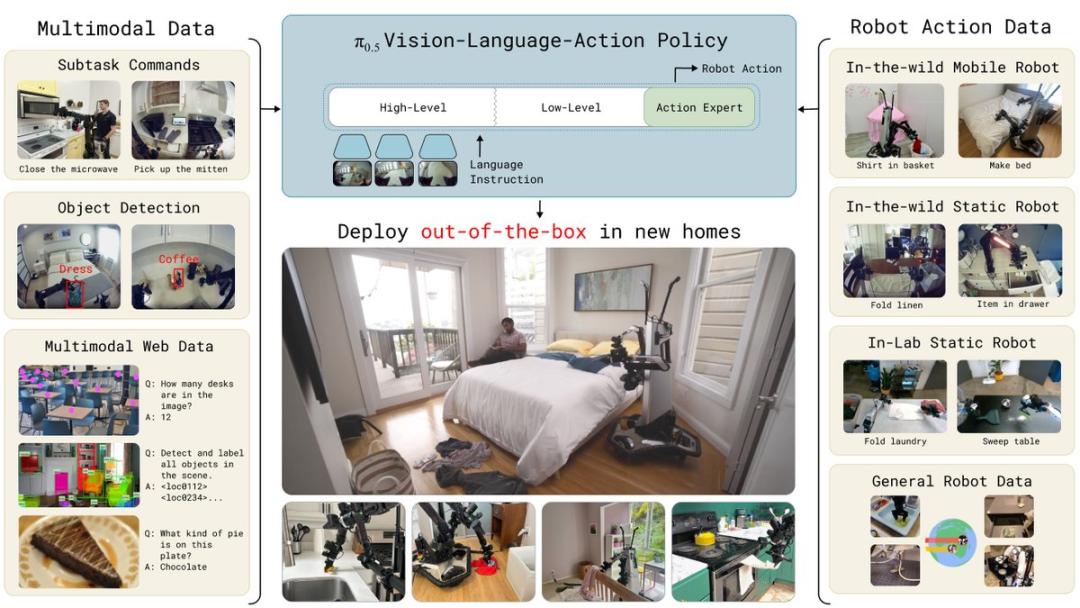
In Pi's evaluation, after removing the web multi-modal data, the model's success rate within the training distribution only dropped from 83% to 82%, while when facing object categories that did not appear in training, the success rate dropped from 94% to 74%. After removing the cross-body robot data, the two success rates dropped to 67% and 49% respectively; after removing the multi-environment robot data, they dropped to 57% and 31% respectively. If both multi-environment and cross-body data are removed, only about 400 hours of target mobile robot data remains in the training set, and the model cannot achieve the generalization performance under the full data combination.
These results show that web data is more helpful for identifying unseen objects, while cross-body and multi-environment robot data affect the execution performance in both familiar and unfamiliar scenarios. About 400 hours of target robot data provides actions directly corresponding to the deployed body, but relying only on these data is not enough to allow the robot to continue completing tasks after entering an unseen home.
Xiaomi and π0.5 adopted different training methods, but reached similar conclusions.
Xiaomi uses large-scale UMI data for pre-training, and then completes post-training through real-machine and other robot data; π0.5 trains web, multi-environment, cross-body and target robot data together. The former shows that different data can undertake different tasks at different training stages; the latter further proves that the capabilities brought by multi-environment and cross-body data cannot be completely replaced by a small amount of target real-machine data.
Therefore, what kind of data should be purchased with 1 billion yuan is not to choose the only answer among real-machine, UMI and Ego data. Low-cost data can be used to expand task and scenario coverage, and target real-machine data is responsible for aligning with specific hardware and control systems.
A more important question is what the 1 million hours consist of, what proportion each type accounts for, and which stage of model training they will be used in.
A reasonable data combination can improve the utilization efficiency of 1 million hours, but after having 1 million hours, can we really usher in the ChatGPT moment of embodied intelligence?