Keke | Hisense JUOS, making every screen in your home incredibly easy to use and more capable of understanding your family's needs from now on
There are more and more screens and home appliances at home, but using them is getting increasingly tiring: TVs, projectors, and smart companion screens all come with their own independent interfaces, and you have to learn the operation logic for each device separately. The elderly find the new interfaces hard to understand, no reminders will be sent when children watch screens for too long, and when you are busy and want to turn on the air conditioner, you even have to open the corresponding App first. Technology is clearly getting more powerful, but people are constantly "accommodating" to technology — because every device is waiting for you to adapt to it, instead of adapting to you.

Official image
On August 31, Hisense released JUOS, the industry's first home smart companion-level AIOS, which aims to reverse this logic, enable every screen and every home appliance to share the same AI brain, and cover every family member and every corner of the home with one single system.
What is JUOS: The industry's first smart companion-level AIOS
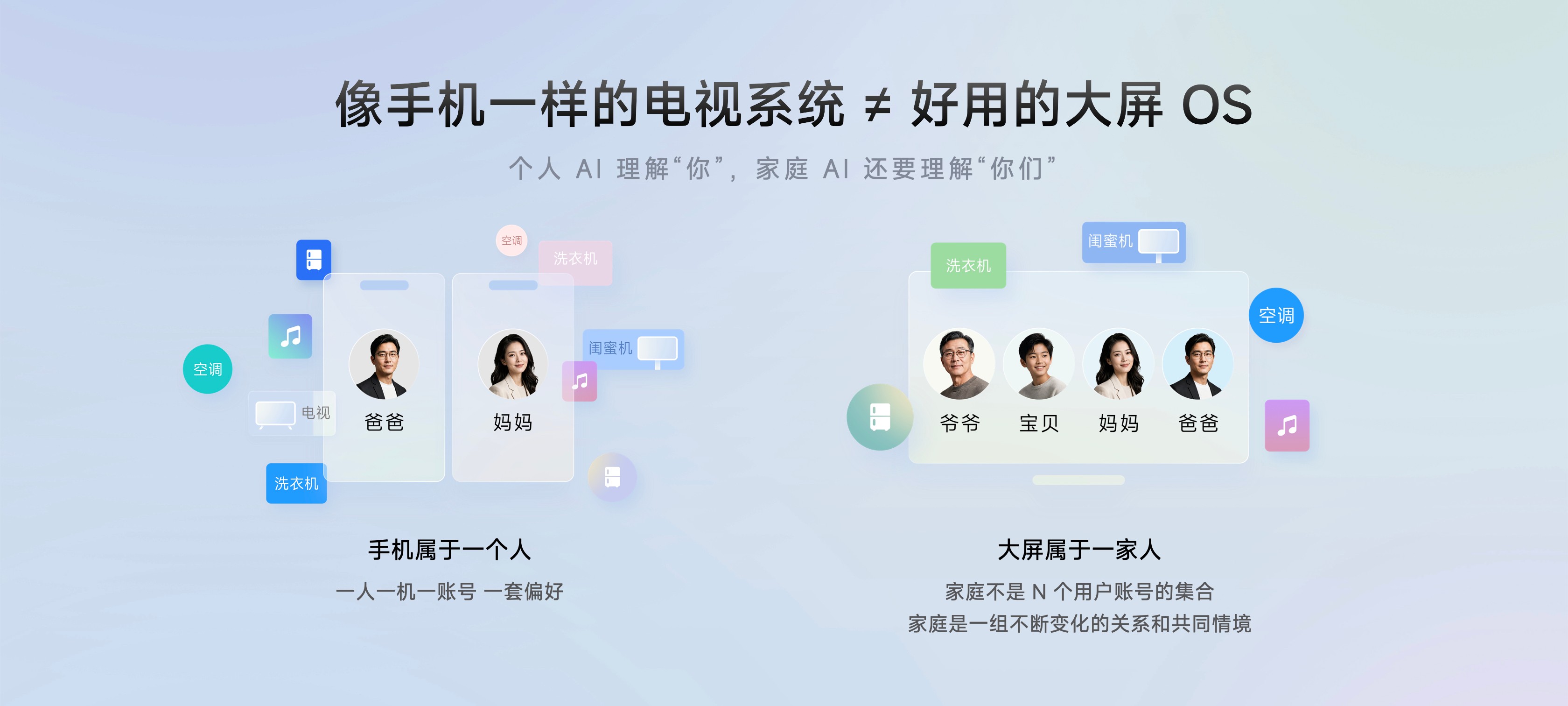
Mobile phone AI and in-vehicle AI mostly serve a single person, while the home scenario is completely different: there are elderly people in the living room, children in the bedroom, and busy family members in the kitchen. With multiple screens and multiple devices, the demands vary wildly, and what is missing is an AI system that can meet the full-scenario needs of all family members at home.
Official image
JUOS is developed exactly to fill this gap. It is not an exclusive system for a single device, but an AI system that connects all smart devices across all home scenarios. It natively adapts to multiple terminals including native TVs, projectors, and smart home appliances, so that devices in every corner are scheduled by the same "Super Xiaoju", all large and small screens, living rooms, bedrooms and kitchens are fully connected with one system.
Official image
Three most surprising changes for users
1. Searching for, inquiring about and watching videos are extremely easy
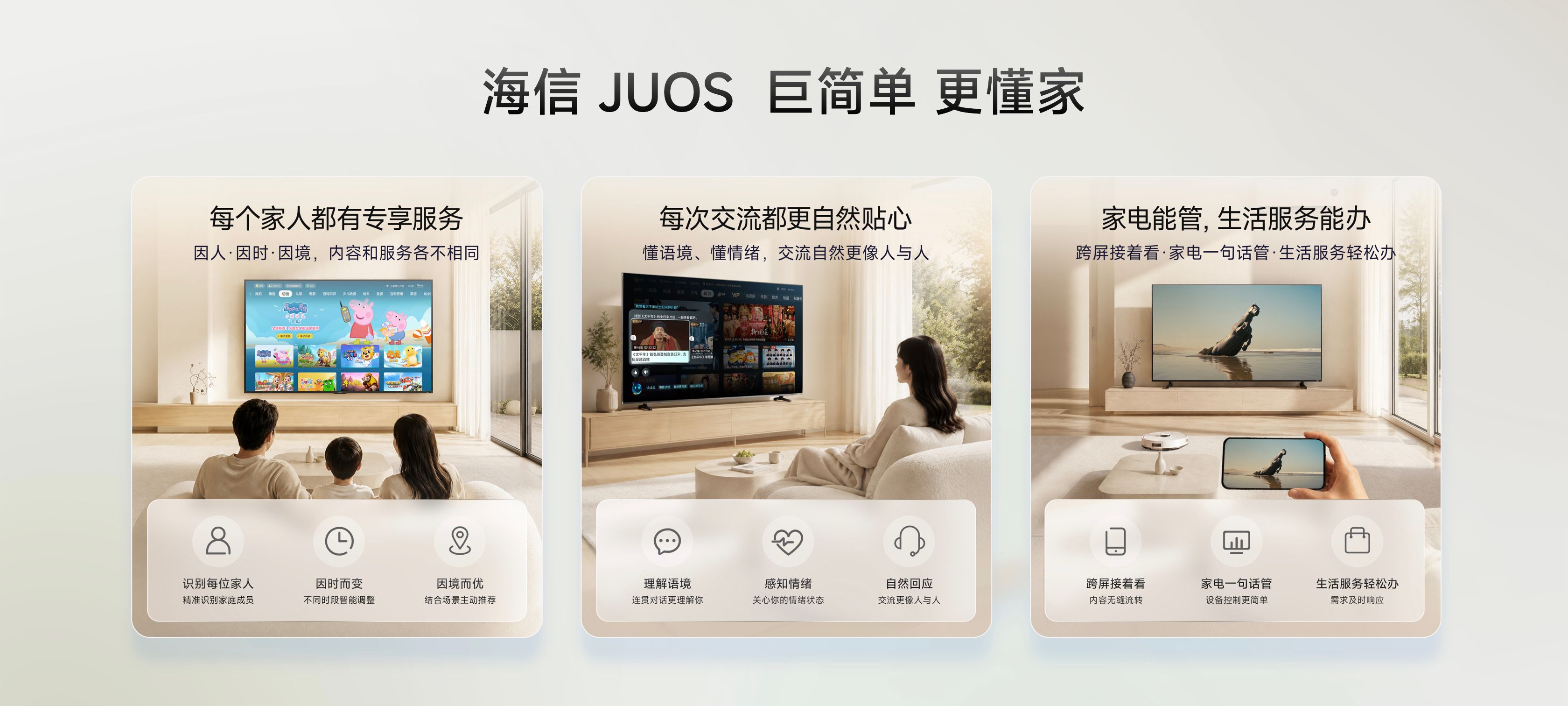
"For all matters on the screen, just ask Xiaoju." You don't need to remember the full name of the video to search for it, you can find it with just a line of lines or a character name. When you meet an actor you don't know while watching a drama, or don't understand the rules while watching a ball game, you don't need to pause and take out your mobile phone, just ask the screen directly, and you will get an instant answer without stopping watching. It is also available when the screen is off: you can ask it to tell stories, play music, or check the weather at any time, and it can even perceive your tone and emotion to give more humanized responses.

Official image
2. The first content you see after booting is exactly what you want to watch right now
JUOS's AI personalized desktop can identify who is sitting in front of the screen through face recognition or voiceprint recognition: when the elderly sit down, it will prompt to switch to the exclusive interface, with operas and news placed in the front row; when children come near, it will push age-appropriate content on demand, and also turn on reminders for viewing distance and duration; when young people use it, the episodes you are watching and pre-match reminders will be presented in front of you as needed, which means different people can see different boot screens.

Official image
3. One-sentence linkage for all home devices
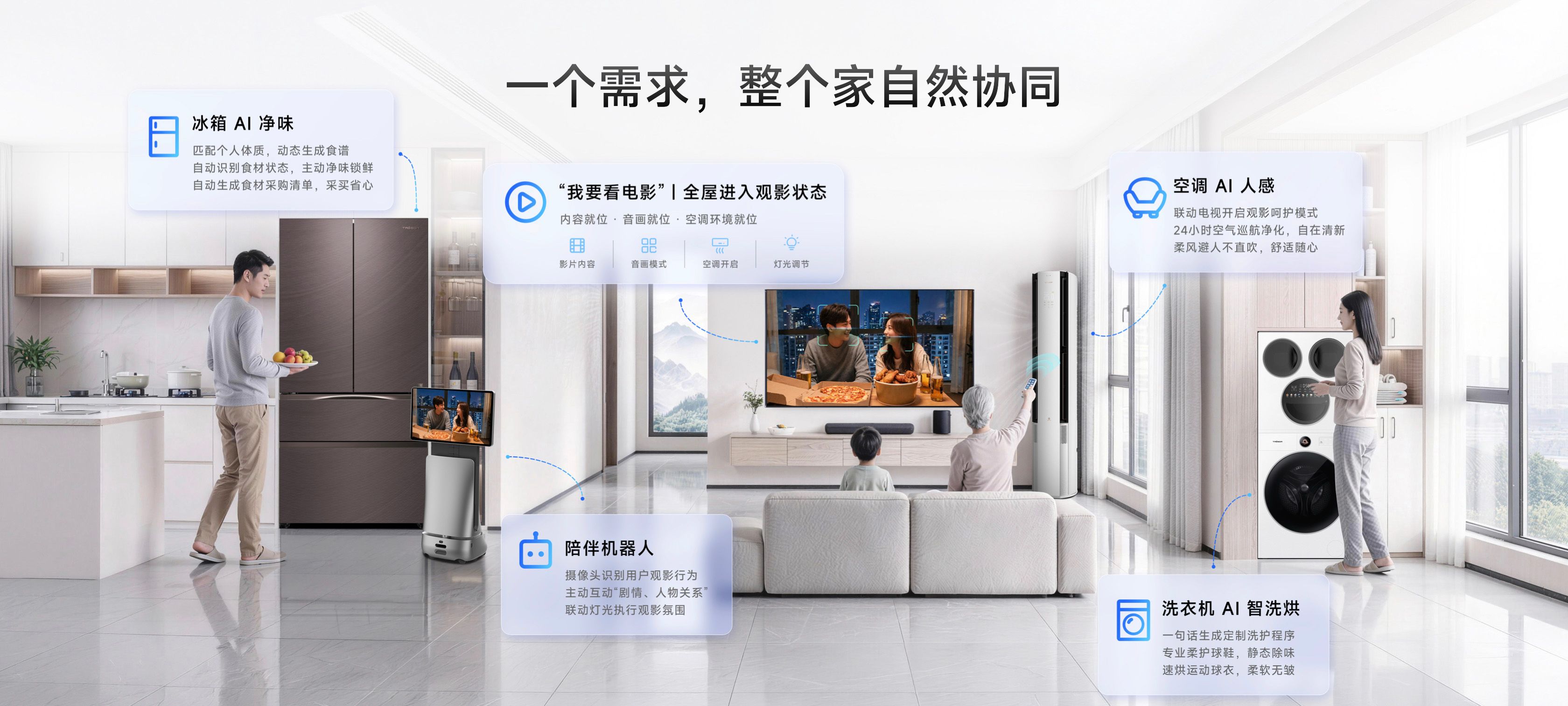
The content you are watching halfway on the small screen can be seamlessly continued on the large living room screen, without reopening the application or searching for the progress repeatedly. NAS, set-top box and game console can be recognized once connected, with picture quality and operation mode matched automatically. After connecting to Hisense's smart home ecosystem, with the large living room screen as the core, you can mobilize all home devices including companion robots, air conditioners, refrigerators and washing machines with just one sentence.
Official image
Which devices in your home can be compatible? Here is the upgrade timeline
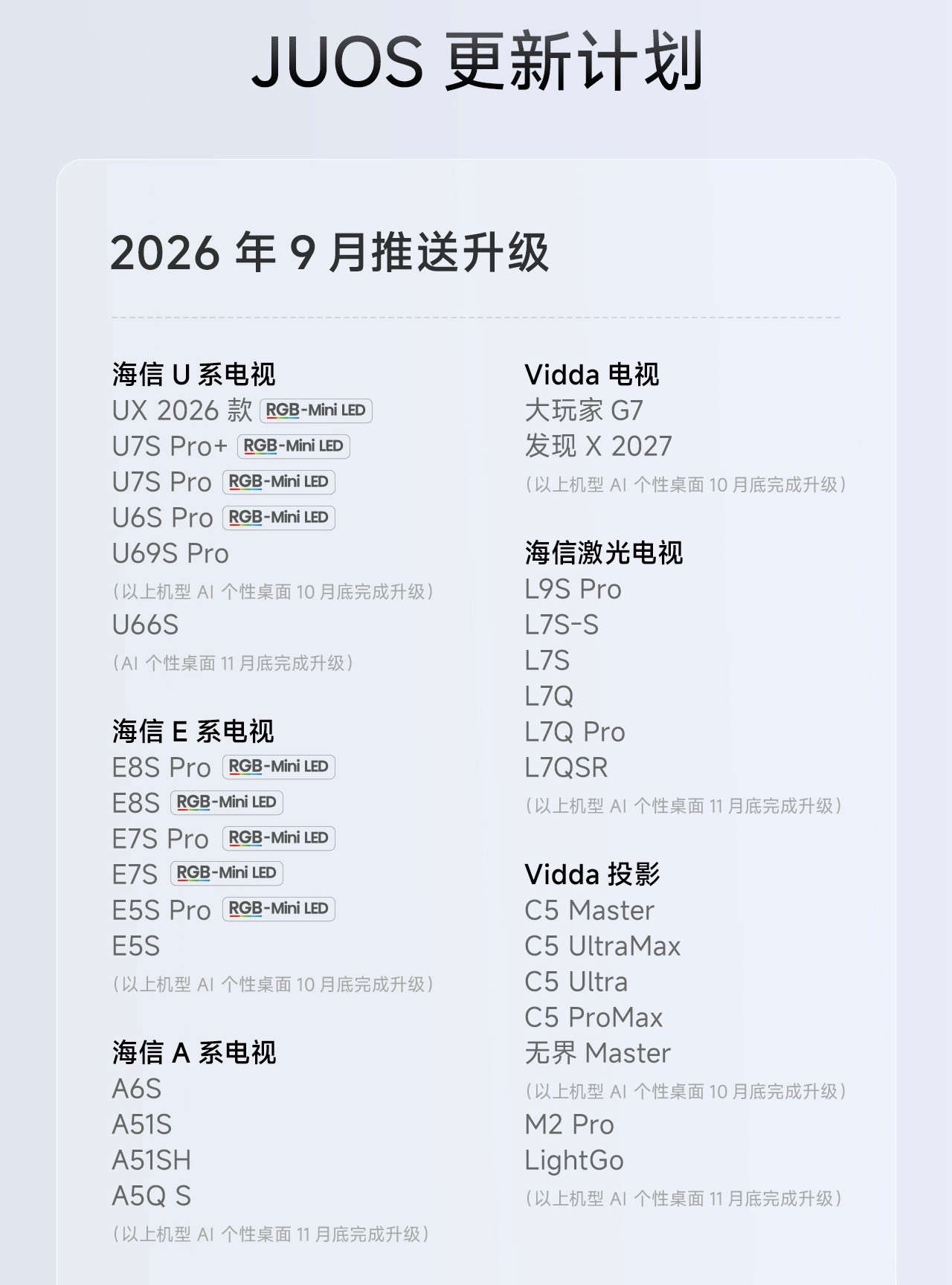
This upgrade is not only limited to TVs: Hisense's U/E/A series TVs, laser TVs released in recent years, as well as mainstream terminals such as Vidda TVs and Vidda projectors are all covered. The push for the first batch of models will start in September, and subsequent models will be rolled out in batches.
Official image
Suggestions for three types of users: users who already own recent models of Hisense or Vidda TVs can pay close attention to the system push starting from September, and you can unlock new experiences such as Xiaoju smart search and Xiaoju screen query with a free upgrade. Users who have many devices at home will see more terminals open for upgrade in succession later. Users who are still waiting to buy new devices can choose new products that support Hisense JUOS, the extremely easy-to-use AI experience that understands home better is well worth expecting.
Final note: A real home AI should never let family members adapt to technology
The more technology iterates, the more it should leave complexity to technology and leave simplicity to users. What JUOS aims to achieve is to make every screen and every device at home understand every family member and serve every daily routine without disturbance. Extremely easy to use, better understanding of home, displays are everywhere, and AI makes display better.