Three key terms that thoroughly explain the viral "robotic duck"
Can you believe it? The biggest breakout hit in the embodied intelligence industry in 2026 is surprisingly a duck! A 25cm-tall, 800g-weight robotic duck that runs all over the table with a sock in its beak.

Just how popular has this duck from Hugging Face become?
Within 6 hours of opening pre-orders, the order value exceeded 1 million US dollars; within 24 hours, it surpassed 2.6 million US dollars. At its peak, one unit was sold every 4 seconds, and the backlog of new orders has been extended to 4 months. If you place an order now, you might not even receive it by Christmas.
Looking to the future, Thomas Wolf, co-founder of Hugging Face, stated bluntly that the sales target is 20,000 units, since the best-selling robot product in history has a sales volume of around 20,000 units, meaning this product is on track to break the record.
Why is this duck such a huge hit?
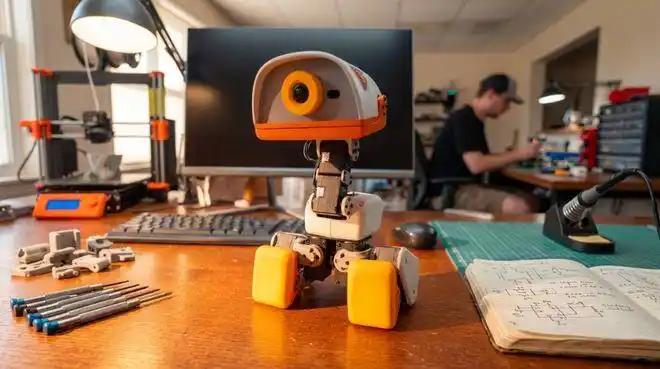
There are only three core keywords: affordable, trainable, and endearing.
The first is affordability. The little yellow duck is priced at 399 US dollars, equivalent to about 2,681 RMB. In the past, the minimum threshold for physical verification of reinforcement learning for bipedal robots was a humanoid prototype costing tens of thousands of dollars, which ordinary developers and student teams could simply not afford.
This duck has for the first time compressed the complete "simulation-to-real machine" closed loop down to the thousand-yuan price range.
The second is trainability. The little yellow duck comes pre-installed with 7 basic behaviors, and is also equipped with 15 motors, one camera, LiDAR, two inertial sensors, and supports Wi-Fi, Bluetooth and NFC. Developers can program with Python and JavaScript, train a new gait in just one or two hours, then export and deploy it to the on-board chip.
Even more impressively, trained movements can be uploaded to the Hugging Face Hub, where ducks all over the world can download and use them, making it easy to build the entire ecosystem.
The third is its endearing appearance. Unlike "humanoid robots", the little yellow duck's design deliberately takes the opposite path: a single-eyed mechanical duck with 90s retro aesthetics and a body style reminiscent of Sony Walkman. There is also a detail that every duck will randomly generate a unique "voice line" when powered on, which remains unchanged for life. There are no two Microducks in the world that have exactly the same quack, so it can quickly build an emotional anchor with users.
A little duck that can get back up on its own after falling, looks silly and cute, and has a unique quack, is far easier to enter ordinary households than a 2-meter-tall silver humanoid prototype.
However, the above three points are only the superficial value of the little yellow duck, the core capability of this product has only one keyword: "drop resistance", which refers to the cost of a single fall multiplied by the scale of millions of trial and error attempts.
In fact, 99% of the training time for a reinforcement learning agent is spent falling, hitting walls, and doing useless work. For any robot with reinforcement learning as its core, the top indicator of the ontology performance is not repeat accuracy and load capacity, but whether it can withstand falls.
The cost of the 800g little yellow duck falling once is vastly different from that of an 80kg humanoid robot falling once. The latter's fall is an accident, while the little duck's fall is a set of training data.
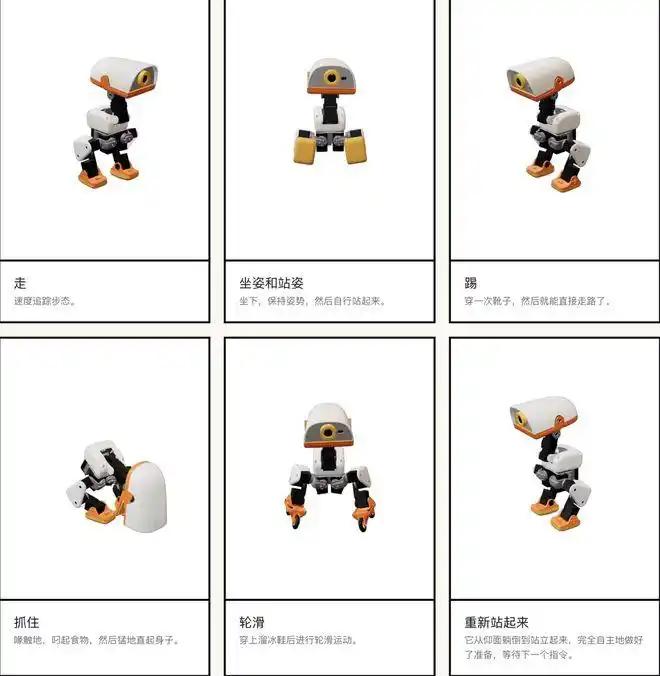
What you get for 399 US dollars is essentially the right to unlimited free trial and error. So what does this viral little duck mean for the embodied intelligence industry?
It is a course correction.
The past narrative of humanoid robots was "bigger, faster, stronger", competing in running speed, load capacity, and the degrees of freedom of dexterous hands, leading to an increasingly fierce hardware arms race.
All of this is off track, because the current bottleneck of embodied intelligence is not the robot ontology, but data. Where does the data come from? It comes from tens of thousands of cheap, fall-resistant robots that developers all over the world can afford.
The little yellow duck, Microduck, is doing exactly that, compressing the threshold of physical AI experiments by about two orders of magnitude. As the CEO of Hugging Face said: "Welcome to the era of open-source affordable robots."
Are you ready to step into this era? Feel free to share your thoughts in the comment section.
This article is from the WeChat Official Account "Lao Tech", Author: Hong Chen, Editor: Tou Tou, published by 36Kr with authorization.