Baseus has taken the lead in strategic layout, and the competition logic in the era of the new national standard has changed.
The power bank industry is undergoing an in-depth transformation from "unrestrained growth" to "order reconstruction".
On April 3, 2026, the mandatory national standard Safety Technical Specification for Power Banks (GB 47372-2026) (hereinafter referred to as the "New National Standard") was officially released, putting forward core requirements for cell safety, intelligent management, full-process traceability and other key dimensions.
The new national standard is far more than a formal document, but a clear watershed that elevates industry competition from the internal friction of simple parameter and price competition to a systematic game centered on safety and quality.
Looking back several months after its release, the implementation of the new national standard has actually placed numerous brands at a crossroads of strategic choices: in the turbulent period of industry reshuffling, how to seize the express train of industrial transformation, and turn the "safety order reconstruction" of the whole industry into an opportunity to consolidate users' trust in brand safety performance?
As a participating drafting unit of this new national standard, Baseus took the lead in responding to the industry challenges, and launched its first product compliant with the new national standard — the Card Magnetic Air Magnetic Power Bank.
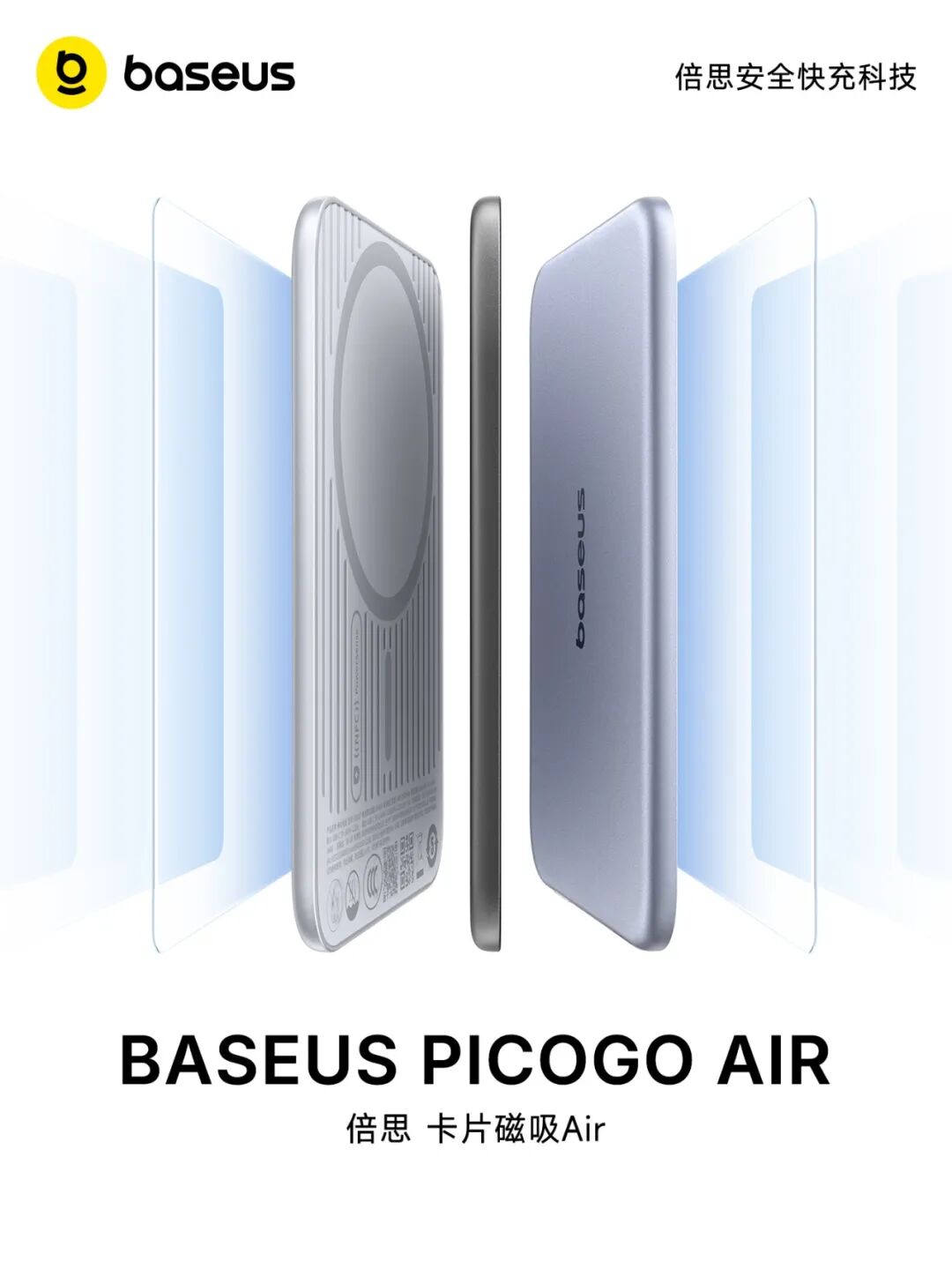
According to official introduction, this ultra-thin magnetic wireless power bank has fully passed the strict tests of the 2026 new national standard for power banks. The safety cell it is equipped with can even withstand 3 consecutive puncture tests with a 4mm steel needle, and all its safety parameters have been comprehensively upgraded. In the first week after its launch, the product took the Top 1 spot on Tmall's new product list, and has remained firmly at the forefront of sales rankings for new national standard compliant power banks.
At the same time, competition in the industry continues to intensify. For technology brands that have been deeply engaged in the industry for many years, this transformation is both a challenge and a driving force — rigid thresholds such as cell certification, flame retardant standards and energy efficiency levels force enterprises to restructure their supply chain and quality control systems. Although short-term growing pains are inevitable, in the long run, established manufacturers with accumulated technical strength and manufacturing genes are more likely to consolidate their competitive moat at this stage, and they have begun to shift the focus of competition from traffic grabbing to more essential product and service competition.
Against this background, we take Baseus as a sample to analyze the complex environment and strategic choices that current power bank manufacturers are facing. In this transformation, what kind of environment are leading brands facing exactly? And what kind of attitude are they adopting to participate in the new round of industry reshuffling?
The "Narrow Gate of Cost" Under the New National Standard
The release of the new national standard has not only brought compliance requirements to the industry, but also triggered an in-depth reconstruction of the cost structure and competition logic of the whole sector.
It must be acknowledged that the whole industry is generally facing the challenge of rising compliance costs. With the improvement of safety requirements, multiple factors including cell upgrading, circuit scheme optimization and superposed certification and testing costs have begun to affect the entire industrial chain. Industry insiders who participated in the seminar for the new standard once revealed that the overall cost of the industry is expected to increase by 20%-30% after the implementation of the new standard.
This undoubtedly brings huge survival challenges to a large number of small and medium-sized brands, and triggers a more brutal elimination round in the industry. Data from RUNTO shows that the scale of China's power bank market will reach 48.6 billion yuan in 2026, with a year-on-year growth of 9%. The new national standard puts forward higher requirements for safety indicators such as cells, protection circuits and heat dissipation, which will eliminate about 70% of low-quality production capacity, and further concentrate market share on leading compliant enterprises.
For a large number of small and medium-sized brands, the sharp increase in compliance costs and the squeeze on profit margins have put them in a dilemma of "reducing configurations to survive" or "exiting the market". Low-cost unbranded products are forced to exit the market due to cost pressure, and the supply of low-quality products at the channel end is also shrinking at an accelerated pace, indicating that the industry has shown a trend of rapid iteration.
For leading brands, it is also necessary to put forward a clearer stance at this stage. Actively adopting higher-specification safety solutions is no longer an "optional question", but a "must-answer question".
In this balance between cost and safety, Baseus not only did not step on the brakes, but accelerated the upgrading of its products. Judging from the new national standard compliant products released on the current market, most manufacturers are generally testing the waters through basic power bank products priced at around 100 yuan; while Baseus directly applied the new national standard requirements to its flagship ultra-thin magnetic power bank products. Even with the rising industry costs, Baseus still dares to adopt a more "aggressive" product strategy, which is backed by its accumulated supply chain resources and technical confidence from years of deep engagement in the industry.
It is not difficult to see that Baseus has regarded safety as the cornerstone of its brand, rather than a mere cost item.
The strategic choices of leading brands under the new national standard have far-reaching impacts on their own development and the trend of the whole industry — taking safety as the foundation of brand strength is not only the trust fulcrum for them to continuously attract users amid industry fluctuations, but also shapes the public's quality perception of the entire product category.
Leading Brands Show Their "Safety Cards"
In fact, every policy change in the industry will trigger unexpected chain reactions across the upstream and downstream of the industrial chain.
Especially for product categories like power banks that combine the fast iteration rhythm of consumer electronics and high safety sensitivity, technical strength directly determines whether a brand can seize the opportunity in the transition window period of the new regulation.
From a technical perspective, as a participating drafting unit of the new standard, Baseus has made forward-looking layouts long before the release of the policy — based on the improved safety requirements of the new national standard, Baseus aims to explore more extreme safety performance on the original safety benchmark, and seek breakthroughs in safety configurations. It is reported that its internal safety standards are stricter and cover more key test items than the requirements of the national standard.
Take the Card Magnetic Air product as an example, on the premise of fully meeting all the mandatory requirements of the new national standard, the product also carried out in-depth safety verification with China's aerospace-level laboratory, simulating extreme environments such as high and low temperature and high-frequency vibration in aerospace projects, and fully introduced the strict standards of aerospace engineering into consumer electronics products.
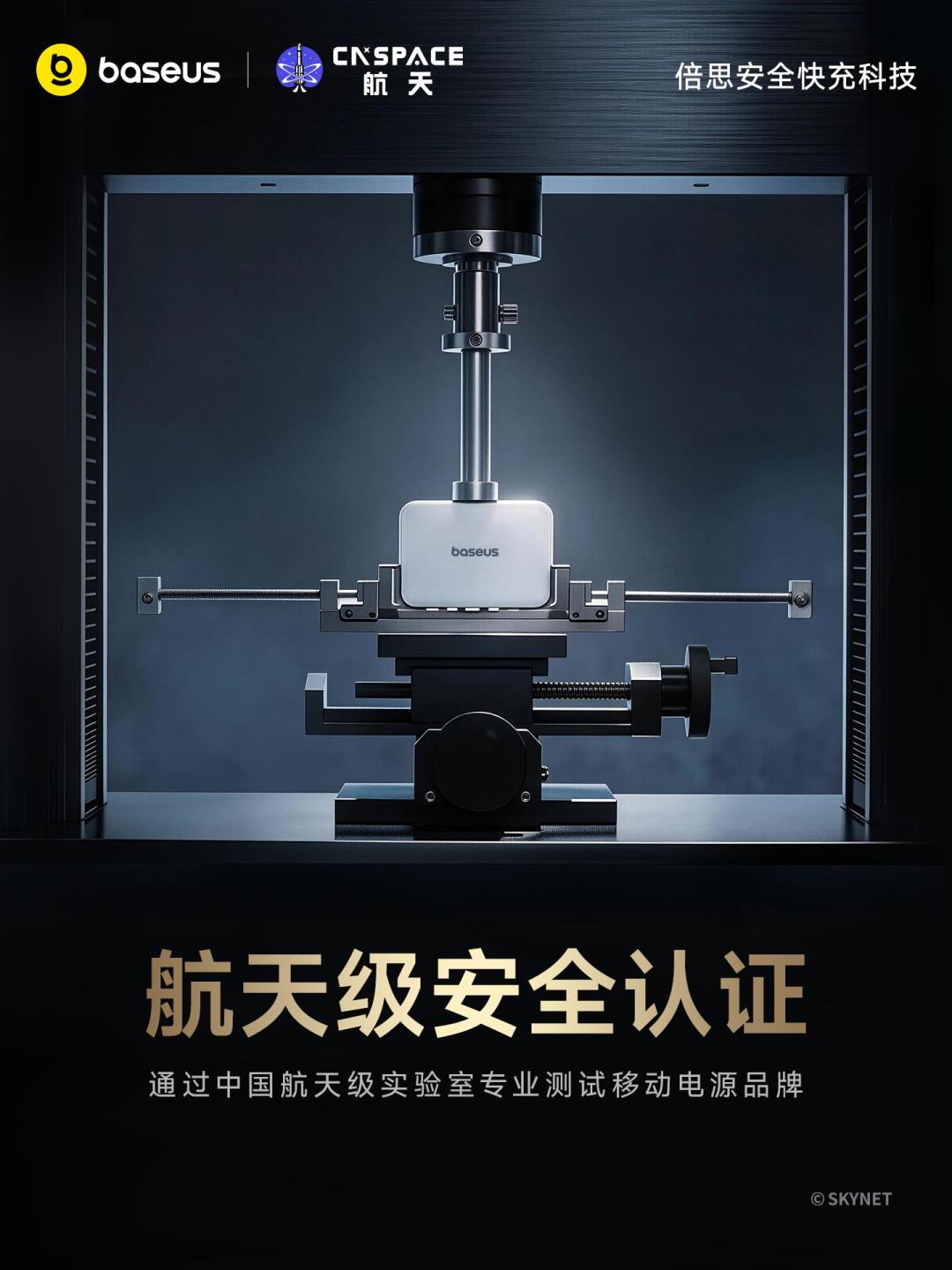
At the same time, in terms of the core cell safety of power banks, the cells selected by Baseus also reach the top-level standard in the industry. In addition to passing extreme tests such as puncture, extrusion and thermal abuse, this type of cell can still maintain more than 90% of its capacity after more than 800 charge-discharge cycles — while ordinary cells show obvious attenuation after 500 cycles, so the durability and long-term safety have been greatly improved.
These technical inputs and rigorous hardcore tests reserve more safety redundancy for users, which is equivalent to adding a "double insurance" on the passing line of the national standard.
Similar practices are rare in the industry. After all, this is a "safety over-allocation" mindset that tests the brand's willingness to invest and technical capabilities. In contrast, small and medium-sized brands usually cannot afford the long-cycle R&D investment and supply chain transformation costs required for technical upgrading.
Taking Baseus as an example, current leading brands have already stopped at the stage of "basic compliance". They have taken a step further, providing users with "safety redundancy" while accumulating more long-term "trust assets" for the brands themselves.
At the same time, for brands like Baseus that continuously participate in the formulation of industry rules, this process has also brought a deeper role transformation — from reshaping the order together with the whole industry to actively guiding the direction of the industry and setting benchmarks for other players.
The Final Destination of the Industry Remains User Experience
The new national standard sets safety as the "entry ticket" for the industry, but above this threshold, what truly determines the height of a brand is the user experience built on the basis of safety. In this context, the battlefield of leading brands has quietly shifted to the deep water zone of competition for user trust and product value.
When every compliant product can pass the basic safety tests, users' decision-making logic will also move upward: they will no longer pay only for basic safety, but vote for better experience and comfort.
To a certain extent, this has triggered a deeper level of industry competition, with the focus shifting to product strength and user experience beyond basic safety performance.
This requires brands to move from laboratory standards to real user scenarios, and truly understand the subtle pain points and unmet expectations of consumers when using power banks. More specifically, brands even need to re-examine the logic of product definition: is the pursuit of lightness and portability at the expense of safety? Is the piling up of functions at the cost of ease of use? Can technical parameters be converted into perceptible experience value?
This has become the core basis for many brands to carry out product iteration at the current stage.
With profound technical reserves, based on users' core demand for the portability of magnetic power banks, Baseus does not compromise on experience under the premise of extreme safety. With an ultra-thin body of 6.9mm and a light weight of about 105g, it realizes truly imperceptible portability, which also raises the portability standard for magnetic power banks.
In addition, in the Card Magnetic Air product, Baseus is equipped with its self-developed NFC Safe Tap technology: users can tap the product with their mobile phones to view real-time safety data such as cell health status, charge-discharge cycle times, and temperature protection records. It is understood that considering the actual use experience and convenience for users, although the development difficulty has multiplied, Baseus finally chose the NFC tap interaction form, so that users can view the information conveniently through their mobile phones, making all data more transparent and visible.
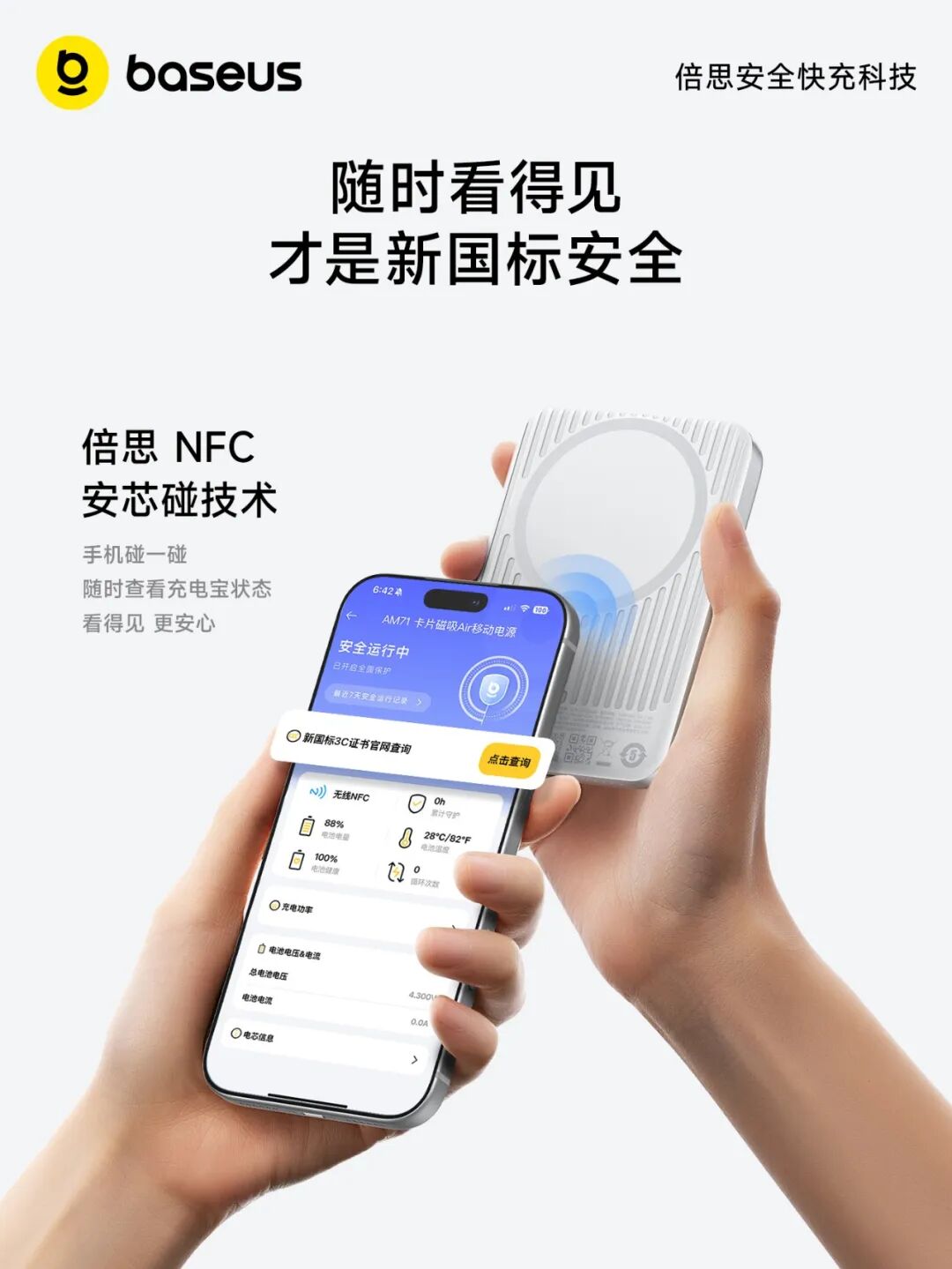
For portable devices like power banks, this perceptible sense of safety itself is the psychological foundation for high-frequency use. NFC realizes the full visualization and transparency of information, allowing users to actively confirm the product status through a simple tap, and the safety defense line has been upgraded from passive dependence to active control.
There are also some extremely detailed product updates that help Baseus better meet user needs.
At present, slow charging speed and overheating during charging are the biggest pain points for users of magnetic power banks. Therefore, for this generation of products, in addition to redesigning the stacking structure and heat dissipation scheme, Baseus also customized an extra cable with maximum 60W output for users. When the mobile phone is connected to wired charging, the wireless charging function will be automatically cut off, ensuring faster charging speed and reducing overheating during the process.
These experience improvements are not only technical "micro-innovations", but also the implementation of the brand's philosophy. Supported by Baseus's "Base on User" concept, the brand is practicing a methodology: safety is not only a compliance requirement, but also a careful insight into user experience and ultimate service for users.
The launch of Card Magnetic Air is just a microcosm. It proves that the brands that truly lead the industry are not the ones who just "pass the exam" on the compliance line, but the ones that establish higher safety standards beyond users' expectations. The new national standard is the upward driving force for the industry, and the active investment of leading brands in safety and experience is the core engine that promotes the evolution of the entire product category.
When compliance becomes the starting point rather than the end point, Baseus has already stood at the forefront of the next round of competition.