Sand.ai: The world's first 100-billion-parameter open-source MoE video generation model MAGI Preview
"Generating a 10-second video for 0.5 yuan, the cost of video generation has shifted from 'unaffordable' to 'accessible'."
On August 5, 2026, Sand.ai released and open-sourced MAGI Preview, the world's first 100-billion-parameter open-source MoE video generation model. Its total parameter count is approximately 114B, and only around 6B parameters are activated in a single forward pass. It ranks 6th on the Artificial Analysis text-to-video leaderboard. The inference cost of generating a 10-second 1080P video is about 0.5 yuan, which is roughly one-tenth of that of mainstream models in the industry.
This combination of metrics has never appeared in the video generation field before. Some media commented that this can be regarded as the "DeepSeek moment" of technological equalization in the AI video model track.
Indeed, Sand.ai and DeepSeek share the same set of breakthrough logic.
In the field of language models, DeepSeek used the MoE architecture to reduce the training cost to 5.576 million US dollars, which is about 1/20 of that of ChatGPT, and the inference cost was reduced by 99%. Sand.ai has taken the same path in the video generation field. In November 2025, Sand.ai made a non-consensual decision at that time to shift the model architecture from Dense to MoE. Eight months later, MAGI Preview delivered the answer.
Image source: online materials
The technical routes of the two are highly consistent. DeepSeek innovatively launched the Mixture-of-Experts architecture, reducing the training cost of large models from tens of millions of dollars to millions of dollars. Sand.ai transplanted this path to the video field. The token scale of video far exceeds that of text: a 720P image is divided into nearly a thousand patch tokens, and one second of video contains 24 frames, making the sequence length easily hundreds of times that of pure text tasks. MAGI Preview responded to this challenge with the Ultrafinegrained MoE architecture. It has a total of 114B parameters, and only about 6B are activated in a single forward pass. The model can continue to expand its capacity, but it does not need to call all weights for each inference.
DeepSeek open-sourced 70% of its core models and training frameworks. Sand.ai not only open-sourced the model weights, but also fully open-sourced the code and a 61-page technical report. In the field of video generation, the parameter scale of open-source models previously mostly stayed within 10+B. This is the first time in history that a 100-billion-parameter MoE video model has been open-sourced.
Sand.ai aims to answer two questions: how to stably expand the scale of video models and continuously raise the upper limit of capabilities, and how to control training and inference costs after the model becomes larger. DeepSeek has answered these two questions in the field of language models, and Sand.ai has also given the same answer in the video field.
01. Two Major Challenges in Video Generation
In the past two years, the parameter scale of video generation models has soared all the way, but two paths have never been feasible.
The first is the capacity problem of video generation. The sequence length of the model far exceeds that of text. A 1000-word English essay roughly corresponds to more than 1000 tokens. Video is of a completely different order of magnitude. A 720P image will be divided into nearly a thousand patch tokens under the visual encoder, and one second of video contains 24 frames. When processing a video of several seconds, the model needs to deal with hundreds of thousands or even millions of visual tokens at the same time, plus audio waveforms and text instructions, making the sequence length easily hundreds of times that of pure text tasks. Any increase in resolution, frame rate, and generation duration will further push up the number of tokens.
The second is the cost of video training. Facing such a huge token scale, each forward pass needs to process a far larger amount of data than text. In a dense model, as the model parameters increase, the computational complexity of a single token rises synchronously; multiplied by the ultra-long sequence of video, the training and inference costs soon become unbearable. The parameter expansion method that is feasible in language models often hits the constraints of cost and efficiency first when applied to video tasks.
A large part of the reason why OpenAI shut down Sora in March 2026 is that with the architecture and inference cost at that time, large-scale commercialization was almost economically unfeasible, making it a very costly model that could not generate revenue.
Image source: online materials
To alleviate this problem, language models rely on the MoE (Mixture of Experts) model, which retains a large pool of experts, and only a small part of them is activated for each token, thus separating the total capacity from the single computation. However, when this method is transplanted to video models, the difficulty mainly lies in the communication link. Traditional expert parallelism first selects the experts to be called for each token, and then sends the token to the GPU where the expert is located. The more experts are activated and the longer the sequence is, the more data needs to be transferred between devices. This mechanism can still work in text sequences, but when it comes to the token scale of video, cross-card communication can easily offset the computing power saved by sparse computation.
In the past two years, the parameter scale of open-source video generation models has mostly stayed within 10+B, and the largest one is only 20-30+B. For language models, open-source models have long entered the era of hundreds of billions or even trillions of parameters. The parameter scale of video models has remained at this level for a long time, which is mainly constrained by the two hard constraints of capacity and cost.
There is a widely held judgment in the industry that video models have an impossible triangle: cost, speed, and quality, and it is difficult to achieve all three.
But MAGI Preview points to where the breakthrough point of this triangle lies.
02. Two Key Technical Decision Points
MAGI Preview has made two key technical decisions, which directly respond to the contradiction between capacity and cost.
The first decision is the MoE architecture.
MAGI Preview adopts an ultra-fine-grained expert architecture called "Ultrafinegrained MoE". It splits the 3072-dimensional hidden representation into 12 heads of 256 dimensions, and uses MultiHead MoE in all 36 layers of the main network. Each head has 256 experts, and 6 of them are selected each time. One token activates a total of 72 small experts in 12 heads, and each layer thus forms 3072 head-local expert units.
This is essentially different from the routing method of traditional MoE. In coarse-grained MoE, a complete token is routed to the expert as a whole, one token is assigned to at most 2 experts, and the number of experts is usually 8 to 16. Under the MultiHead MoE architecture of MAGI Preview, different subspaces of the same token can be processed independently by different experts, and the same original token can call 4 to 8 experts at the same time. Different heads independently select experts in their respective low-dimensional subspaces, and then re-fuse the results, providing finer processing units for information such as character appearance, action timing, language semantics, speech, and environmental sounds.
It has a total of 114B parameters, and only about 6B are activated in a single forward pass. The model can continue to expand its capacity, but it does not need to call all weights for each inference.
However, when MoE is transplanted to video models, the difficulty first appears in the communication link. Traditional expert parallelism first selects the experts to be called for each token, and then sends the token to the GPU where the expert is located. The more experts are activated and the longer the sequence is, the more data needs to be transferred between devices. This mechanism can still work in text sequences, but when it comes to the token scale of video, cross-card communication can easily offset the computing power saved by sparse computation.
The solution of MAGI Preview is to introduce the Head Parallel mechanism. Before dynamic routing occurs, the model distributes the head representations of fixed shapes to different devices, and then selects and executes experts locally after the data arrives. The main communication volume is determined by the input representation, and the communication cost does not grow linearly with the number of activated experts.
Around this architecture, Sand.ai has also self-developed the MagiMoE high-performance operator library, covering the complete link of expert routing, sorting and calculation, reducing intermediate results and video memory transfer by fusing calculation steps, and optimizing the forward and backward processes for a large number of small matrix calculations. The distributed optimizer MagiMuon uses Muon to process the main matrix parameters, and uses AdamW to process parameters that are more suitable for conventional updates. The collaborative design of the model, system and data is the first open-source route that the 100-billion-parameter video MoE has successfully implemented.
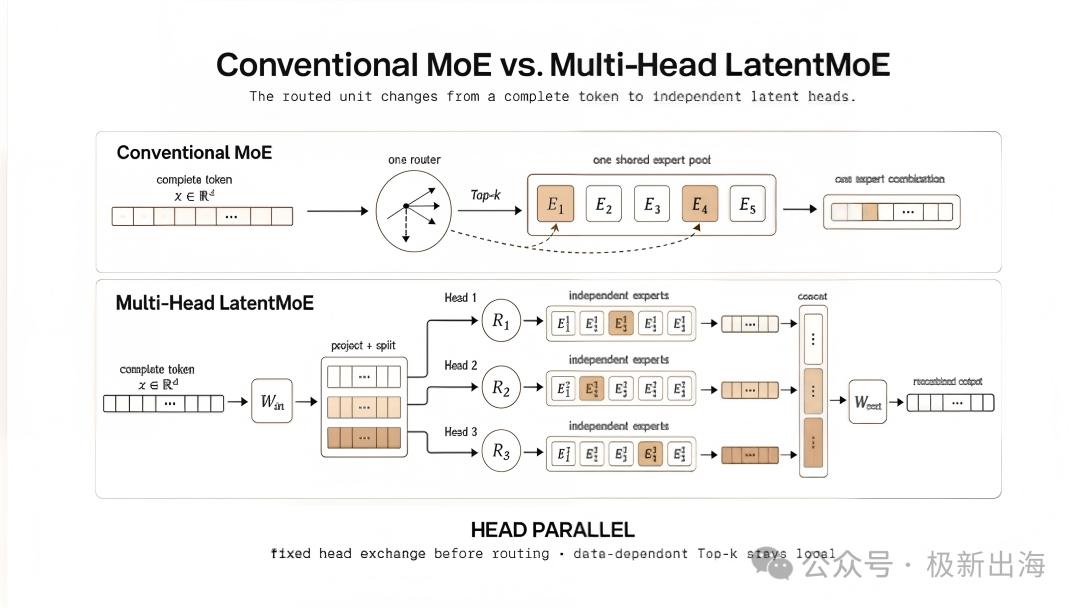
Image source: official website of sand.ai
The second decision is the single-stream audio and video unified architecture.
Existing unified audio and video models usually have two common paths. One is the multi-stream architecture, where video and audio enter different network branches, and then exchange information through cross-attention or a dedicated fusion module. The other is the cascade scheme, which generates pictures and sounds separately and then completes synchronous processing. Both schemes have a common problem: audio and video are modeled separately in the early stage of generation, and audio-video alignment relies on subsequent links. The longer the link is, the easier it is to accumulate delay and errors.
MAGI Preview continues the single-stream architecture proposed by Sand.ai in the daVinciMagiHuman paper. The tokens of text, video and audio are spliced into a unified sequence, which is processed by the same Transformer backbone. Language, lip movements, body movements, sounds and camera rhythms continuously exchange information throughout the model, instead of letting different modalities interact only at the narrow cross-attention interface.
The model is also equipped with shared experts and modality-specific experts inside. Shared experts handle the commonalities between different modalities, and specific experts handle the unique information of language, pictures and sounds respectively. When a character speaks, the model synchronously generates lip shapes, expressions and body movements; when an impact sound appears in the environment, the objects in the picture react at the same time; when the music rhythm changes, the character performance and camera movement adjust accordingly.
The unified backbone shortens the generation link and reduces the interface, waiting and maintenance costs brought by the series connection of multiple sets of models. For content such as advertisements, short dramas, animations and games, one generation can be closer to a complete shot that includes pictures, sounds and performances at the same time.
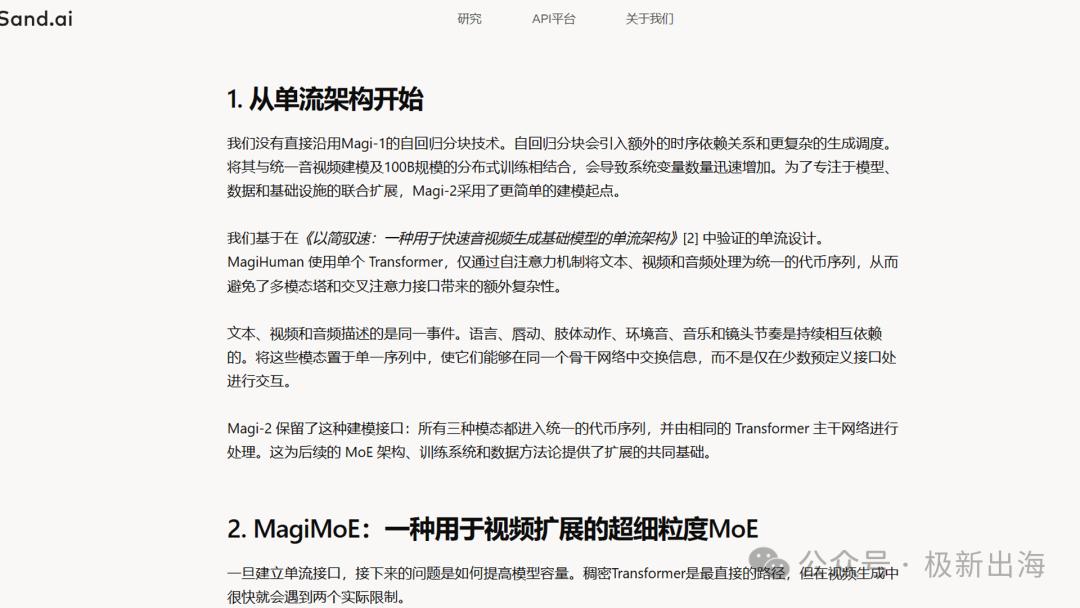
Image source: official website of sand.ai
The superposition of the two decisions constitutes a complete breakthrough logic. MoE solves the cost problem, and the single-stream architecture solves the quality problem and audio-video synchronization problem. The fact that generating a 10-second 1080P video for 0.5 yuan is worthy of attention is not only because it is cheap, but also because the combination of its inference cost and technical capabilities means that video generation has changed from "occasional use" to "high-frequency invocation".
03. The True Meaning of Lower Cost
The significance of generating a 10-second 1080P video for 0.5 yuan does not lie in its low price, but in that it is cheap enough to be called at high frequency.
Nowadays, generated videos rarely fully meet expectations on the first attempt. A movement of a character, a turn of the camera, or even a pause in a line of dialogue may affect the final effect. If the single cost is reduced, the same budget can be used to test more prompts, adjust actions, compositions and styles, and then select available shots from multiple versions.
Between 0.5 yuan and several yuan, it seems to be just a difference in the decimal point. But in real creation, what it changes is the cost structure and content production method. Video generation begins to have the conditions to enter high-frequency applications.
Sand.ai not only open-sourced the model weights, but also fully open-sourced the code. In the past two years, the parameter scale of open-source video generation models has mostly stayed within 10+B. This is the first time that a 100-billion-parameter MoE video model has been open-sourced.
The value of open source does not lie in being free, but in that it lowers the experimental threshold of the entire industry. Anyone can use this model to verify their ideas, without having to spend tens of millions of dollars to train their own model first.
Sand.ai is led by Cao Yue, winner of the Tsinghua Special Award and Marr Prize. In early 2024, Cao Yue founded Sand.ai. In June 2026, Sand.ai successively completed two rounds of financing within three months, with a total amount of over 100 million US dollars. The investors include Su Hua, founder of Kuaishou, the family office of Wang Huiwen, Jiukun Investment, Matrix Partners and other institutions. The core revenue product of the company is VidMuse, a C-end music video creation product. Its ARR has exceeded 10 million US dollars just two months after its launch, verifying the commercialization potential of AI video in specific scenarios.
The team's technical route has always been very clear: use the single-stream audio and video architecture to solve the audio-video synchronization problem, and use the MoE architecture to resolve the contradiction between scale and cost. In November 2025, Sand.ai made a non-consensual decision at that time — to shift the model architecture from Dense to MoE. Eight months later, MAGI Preview delivered the answer.
04. Three Directions We See From This
The release of Sand.ai points to three clear directions.
Reassess the usage cost of video generation. Generating a 10-second 1080P video for 0.5 yuan means that video generation has changed from occasional use to high-frequency invocation. For overseas content teams, advertising teams and game teams, this cost line means that video generation can be embedded into the daily production process.
Open-source models can become the technical starting point. Small and medium-sized teams do not need to train their own models from scratch, and can directly carry out secondary development based on MAGI Preview. The technical threshold of video generation is changing from something only giants can do to something anyone can try.
The capability of audio-video synchronization is becoming a standard feature. Characters have corresponding lip shapes and expressions when speaking, and environmental sounds respond synchronously to picture movements. For advertisements, short dramas, animations and game content, one generation can get a complete shot, instead of splicing the picture and sound twice separately.
Cost determines whether it can be used at high frequency, open source determines whether it can start at low cost, and audio-video synchronization determines whether the content can meet the delivery standards.
When the inference cost of video generation drops to 0.5 yuan, when the 100-billion-parameter model