If we take the imperial harem as a company: "Workplace Survival Report of 293 Imperial Consorts and Concubines in the Qing Dynasty"
In the eighth month of the 10th year of Shunzhi's reign, an imperial edict was sent to the central palace: Empress Borjigit was immediately demoted to Consort Jing and moved to a side palace. This Mongolian noble lady, the biological niece of Empress Dowager Xiaozhuang who got married at the age of 14, went from the empress of the Great Qing Dynasty to an ordinary imperial consort. From the proposal to the issuance of the edict, the whole process took no more than 20 days. After that, she completely disappeared from historical records, with unknown year of death and unknown burial site, becoming the only formally deposed empress in the Qing Dynasty.
More than a hundred years later, another woman took a completely opposite path. Lady Chen entered the palace at the age of 13 to serve Emperor Qianlong when he was still a prince. She was not favored and had no children, and stayed at the rank of "Concubine" for 46 years — Consort Ling, Consort Shu and Consort Qing who entered the palace later than her all rose to prominence later, taking all the limelight. But she did not fight, did not scramble, did not get angry, and lived all the way to the 12th year of Jiaqing's reign, passing away at the age of 92, becoming the longest-lived person in Qianlong's harem. In her later years, she was honored as Noble Consort Wan, firmly occupying the first place in Shoukang Palace. One fell rapidly from grace, the other survived for an extraordinarily long time. Putting them in the same table, you will find that this is not an accident in palace fighting dramas, but a set of survival logic that can be verified by data.
We collected the complete life files of 293 imperial concubines in the Qing Palace from historical materials, spanning from the reign of Emperor Taizu of Qing to the reign of Emperor Guangxu, covering all eight ranks from "Empress" to "Attendant". We extracted behavioral indicators from first-hand materials such as conferring edicts, posthumous title texts, promotion/demotion events, birth records, and palace conflicts, made reverse inference scores according to the Big Five personality model (OCEAN: Openness, Conscientiousness, Extraversion, Agreeableness, Neuroticism), and then tried to use organizational behavior methods to answer a question that all Qing Palace drama enthusiasts care about: if you travel back to the Qing Dynasty harem, what kind of person can laugh last?
Why is the harem called "the most extreme workplace"?
It is quite reasonable to compare the harem to a company. It is an organization with an extremely complete system. The Qing Dynasty harem was divided into eight ranks: Empress, Imperial Noble Consort, Noble Consort, Consort, Concubine, Noble Lady, First Attendant, and Second Attendant. The "salary package" of each rank is accurate to the individual number: the empress has an annual stipend of 1,000 taels of silver and 10 palace maids, the imperial noble consort has 800 taels and 8 palace maids, and the stipend decreases step by step downwards. The lowest rank, Second Attendant, only has an annual stipend of 30 taels and 2 palace maids. Even the daily rations of pork, chicken, duck, rice and noodles are clearly written according to rank.
This is also a company operating on zero-sum game. The emperor's attention is the only core resource. If you get one more point, others will get one less point; there is no enrollment expansion for promotion, there is only one imperial noble consort, two noble consorts, four consorts, and six concubines. The most critical point is that you cannot resign from this company. There is no job hopping, no voluntary exit. The so-called "layoff" refers to demotion, house arrest, or deposition, which are real and frequent organizational events, and are often irreversible.
In such an extreme organization with strict hierarchy, zero-sum resources and infinitely high exit cost, what kind of personality is more capable of surviving and getting promoted? After being demoted, who has the ability to stage a comeback? This is the question this research aims to answer.
Let AI "conduct interviews" with historical figures
Traditional historical research gets stuck at this point: archives only record behaviors, not psychology. We can find out which year a certain imperial concubine was promoted and which year she was demoted, but no one knows what she was thinking on the night she was demoted.
The solution of this research is rather innovative, which is divided into three steps.
The first step is archive coding. Based on the behavioral records in the archives of *Miscellaneous Knowledge of Qing Dynasty Imperial Concubines*: fertility information, family network, rank changes, birth and death dates, posthumous title evaluations, etc., we conducted "Big Five Personality" reverse inference coding for 293 imperial concubines one by one. The Big Five personality is the most fully verified personality model in psychology, which divides personality into five dimensions: Openness (daring to break rules), Conscientiousness (being able to be self-disciplined and trustworthy), Extraversion (loving to show and socialize), Agreeableness (being good at cooperation and empathy), and Neuroticism (emotional stability). Each dimension is standardized with a mean of 50 and a standard deviation of 10, and marked with five levels to indicate high or low.
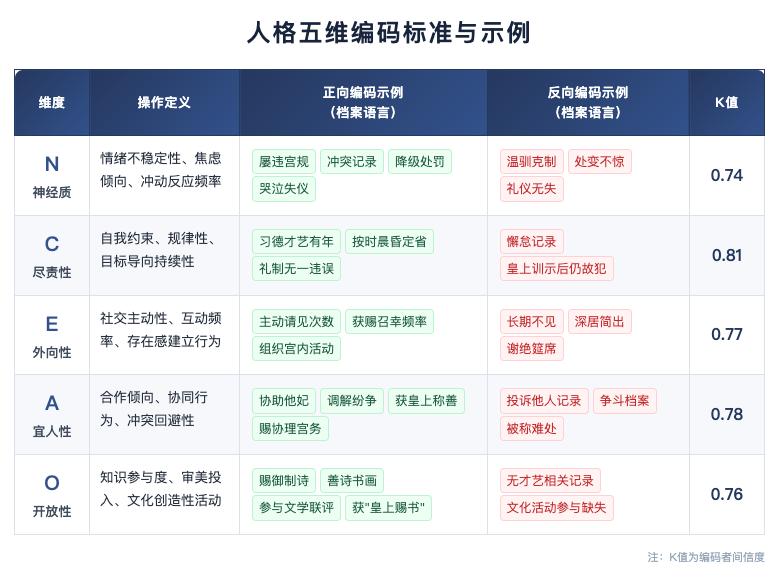
Each concubine's score on each dimension uses a 1–7 point scale, which is independently rated by two coders and then averaged; for scores with a difference of more than 2 points, a third party will conduct arbitration. Cohen's κ is calculated based on 30% random sampling review (n=48). Those with insufficient archive record density (main record items ≤5) are marked as "low-reliability coding", and the effect changes before and after their elimination are separately tested in sensitivity analysis.
The second step is that AI generates "personality prototypes". Let AI combine the complete life experience of each character to generate "Persona" of different personality types, and then reversely fit the personality portrait that best matches the historical records.
The third step is virtual in-depth interview. We carried out 3 focus groups and 6 one-on-one in-depth interviews for the 10 core fitted Personas, specifically collecting their psychological narratives when facing demotion and loss of favor. This three-stage method of "archive coding - AI Persona generation - virtual interview verification" distinguishes this research from traditional historiography: macro statistics tell you "what happened", while virtual interviews try to answer "what was she thinking at that time". The cold behavior coding is thus transformed into a warm psychological narrative.
Ten personalities, ten destinies
Based on the above method, we constructed ten representative Personas. For the convenience of understanding, we translate their personality types in the language of modern workplace.
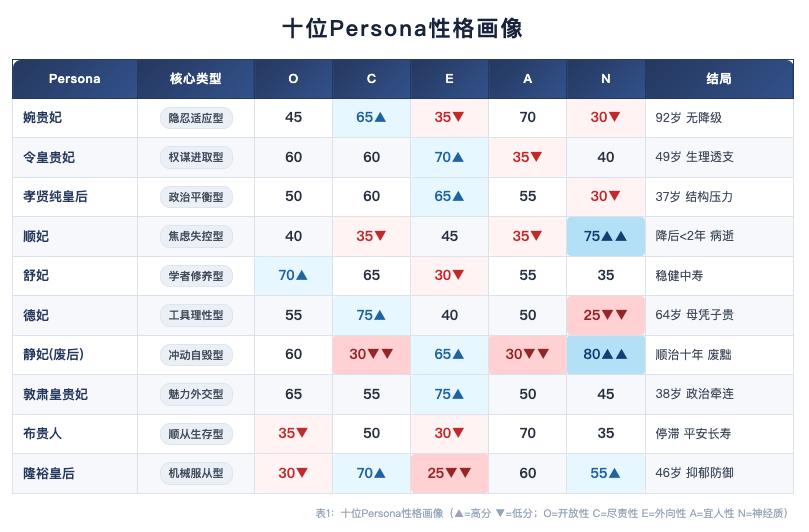
First look at these Personas fitted by AI, you can almost find prototypes of each of them in your own office.
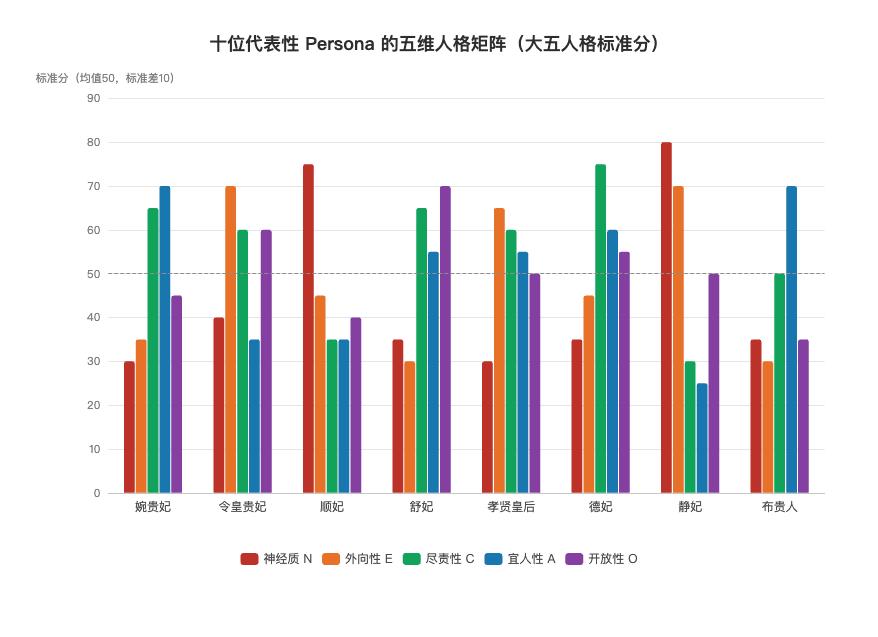
Forbearing adaptive type (Consort Wan, Lady Chen): high scores on both conscientiousness and agreeableness, low scores on both extraversion and neuroticism. No demotion record, lived to 92 years old. The golden quote from her virtual interview is: "The one who lives the longest is often not the most favored one. I fought for nothing, so I lost nothing."
Strategic aggressive type (Imperial Noble Consort Ling, Lady Wei): Born as a bondservant of the Imperial Household Department, full scores on openness and extraversion, low score on agreeableness. She got promoted extremely fast, took charge of the affairs of the harem, and her son became Emperor Jiaqing — but she died at the prime of her life at the age of 49. Her self-narration is: "Build yourself as a complete political product. Dignity is not taught, it is taken back."
Instrumental rational type (Consort De, Lady Uya): Extremely high conscientiousness, extremely stable emotions, lived to 64 years old relying on her children and prudence, was honored with a noble title in her later years, and laughed last. Her reflection is thought-provoking: "I won power but lost the warmth of being a human. If I could do it all over again, I don't know what choice I would make."
Anxiety out-of-control type (Concubine Shun, Lady Niohuru): Scored 75 on neuroticism, died of depression after being demoted two ranks in a row, at the age of only 41 — the reason for demotion is not recorded in official books or archives.
Impulsive self-destructive type (the deposed empress Consort Jing of Shunzhi): Scored 80 on neuroticism, fell directly from empress to the cold palace, with zero resilience. Her virtual monologue is: "I would rather burn out than be tamed. At least I have lived, loved and felt."
The rest are equally distinct: Consort Shu of the scholar-cultivation type is stable and self-consistent relying on spiritual independence; Empress Xiaoxian of the political balance type, Lady Fuca, was born in a top noble family and was thoughtful in everything, but died of overwork at the age of 37; Imperial Noble Consort Dunsu of the charming diplomatic type maximized the operation of emotional assets, and died of illness at the age of 38 on the eve of the collapse of the Nians' family; Noble Lady Bu of the obedient survival type lived a safe and long life by being a "transparent person"; Empress Longyu of the mechanical obedience type was appointed empress by imperial edict, and spent her pre-arranged life in depression.
It must be noted that these interviews are not real psychological records of historical figures, but mechanism assumptions generated by AI based on personality settings. But it is this layer of "psychological narrative" that gives the cold demotion events in the archives an understandable emotional logic — this is also the core value of the AI Persona method: making data speak.
After demotion: your personality determines whether you can "make a comeback"
Demotion is the harshest punishment in this company: the shrinking of resources is only the surface, and the systematic blow to self-worth is the internal injury. The research question is: facing the same demotion, why do some people die of depression while others bounce back from the bottom?
We constructed a "resilience index": Resilience = Low Neuroticism × 0.6 + High Conscientiousness × 0.4. The logic is straightforward: emotional stability is the core buffer to prevent "dying of depression" after demotion, so it has a higher weight; while self-discipline and compliance are the operational path to rebuild a "compliant image" in the power structure.
The data results are shocking: the high resilience group (emotionally stable + self-disciplined) can live an average of 22.8 years after demotion, while the low resilience group (emotional + undisciplined) only 4.2 years, with a difference of 18.6 years, and the statistical significance reaches P<0.01.
The predictive power of resilience far exceeds family background. After losing, personality is more important than background.
These two paths are repeated in the archives:
Collapse path: emotional out-of-control - demotion - refusal to repair - physical and mental exhaustion, Concubine Shun is the sample, who died of depression after demotion.
Resilience path: demotion - low-key discipline - passing the "obedience test" - reinstatement. Consort Dun, Lady Wang in Qianlong's reign is the sample: in the 43rd year of Qianlong's reign, she was demoted to concubine for beating a palace maid to death, after that she abided by the rules strictly, and soon recovered her rank of consort.
The so-called "obedience test" essentially means that the high-pressure organization is testing: after being punished, can you still maintain compliant behavior? People with high conscientiousness can pass it accurately: after demotion, they still strictly abide by every rule, maximize the display of "harmless and useful" to their superiors, and earn back trust little by little. When you lose everything, personality is your last reliance. The one who lives the longest is often not the most favored one.
The most counter-intuitive finding of the whole sample is: 85% of the long-lived samples over 70 years old have the personality combination of "high conscientiousness + low extraversion + low neuroticism".
In other words, in a zero-sum competition organization, the long-lived people are not the most favored, but the least troublesome. Low-key and self-disciplined people get the longest life span with the minimum political risk exposure.
Noble Consort Wan stayed motionless at the rank of concubine for 46 years, and made this sentence a literal reality. But on the contrary, if you want to get promoted quickly, you have to rely on a completely different set of personalities. The study found that 70% of the "rapid promoters" (promotion cycle less than 5 years) have the combination of "high extraversion + high openness + low agreeableness", they are good at managing emotional capital and showing themselves strategically, but low agreeableness leads to a fragile ally network. Once the situation changes, the innovative moves brought by high openness will become "violation signals".
Imperial Noble Consort Ling is a textbook example of this path: it took only three years for her to be promoted from Noble Lady to Consort, and she was born as a bondservant all the way to the imperial noble consort in charge of harem affairs, at the cost of burning out and dying at the age of 49. This is the double-edged sword of ambition. As for wanting to be reinstated after demotion, there is only one path left: extreme compliance. The only common feature of the reinstatement group is high conscientiousness, which is the strongest single predictor of reinstatement success rate (correlation coefficient 0.47). High-profile rebound and passive exit are more expensive choices.
The promotion algorithm: background determines the steering wheel
What determines the promotion speed? The answer given by the regression model is the interaction between personality and family power (model explanatory power R²=0.38, the interaction term is significant). Specifically: without family support, high extraversion is the accelerator of promotion — you have to take the initiative to show yourself, otherwise you will always be transparent; but with a strong background, high-profile extraversion will instead increase political risk, arouse jealousy and suspicion, and the promotion advantage will weaken or even reverse.
Low family power + low-key, easy to stagnate and be forgotten; high family power + low-key, is the most stable combination. The contrast between speed and life span is even more cruel. The average life span of the strategic aggressive type (high extraversion) group is about 43 years old, and the average life span of the forbearing adaptive type (low extraversion) group is about 67 years old, a full difference of 24 years. The former needs to maintain the deviation of "superficial enthusiasm and internal calculation" for a long time, forming continuous emotional labor: short-term promotion dividend corresponds to long-term health overdraft. As one Persona said in a virtual interview: "There is indeed anger late at night, but I turn anger into chips. Chips have interest, paid by your life."
The most dangerous signal: emotional instability
If there is one dimension that is the "number one killer" for survival, the answer is neuroticism. The high neuroticism group (≥60 points) has an average life expectancy of about 44 years old, and the low neuroticism group (≤40 points) about 62 years old; every 10-point increase in neuroticism shortens life expectancy by about 8 years, with the highest level of statistical significance. The mechanism is: when loss of favor, loss of children, and political