Guangzhou AI hidden champion has completed its full Series C financing.
The boom of Physical AI is sweeping in.
Looking around, most physical AI companies are focusing on exploring how to liberate embodied robots from remote controls; while a Guangzhou-based enterprise has already enabled AI to take charge of over 260,000 energy devices in energy station rooms.
What exactly is taking over?
It means that at 3 a.m. when the disinfection equipment in the pharmaceutical factory is started, AI monitors the meters in the energy station room, and stabilizes the air pressure instead of two workers who originally needed to be on all-night duty; it means that before the terminal cooling load of the electronic factory rises, AI has calculated and adjusted the curve, making chillers, water pumps and cooling towers form the most power-saving parameter queue; it means that AI reads tens of columns and tens of thousands of lines of energy consumption data, intelligently identifies every waste point caused by running, leaking, dripping and seepage, and then issues a rectification work order.
A shared name emerges behind all these scenarios — Mogu IoT. PE Daily has learned that Mogu IoT has recently completed the C1 and C2 series of financing under Round C, with the accumulated financing scale reaching nearly 200 million yuan, and many old shareholders including Yunhui Capital continue to increase their holdings.
At the moment when the AI track is generally facing the challenge of commercial verification, this round of financing is regarded by the market as the most solid capital vote for the "physical AI commercial closed loop": a group of people who know the company best have once again chosen to increase their heavy positions in it.
Behind the Old Shareholders' Additional Investment: Ten Years, Three Stages of Iteration
This is undoubtedly a financing with landmark significance.
At a time when AI companies are generally "seeing revenue growth but no profit growth" and capital is shifting from "investing in concepts" to "investing in implementation", this round of financing sends two clear signals:
First, the commercial closed loop of physical AI has been verified — it serves more than 6,000 enterprises, has saved more than 3.6 billion kWh of electricity cumulatively, and can release nearly 20% of energy-saving space. "AI moves from the digital world to the physical world" is no longer a slogan, but an auditable electricity bill;
Second, insiders are bullish on it — many old shareholders continue to increase their investment. They have experienced the most difficult stage when the company's R&D expenses remained high but it was difficult to achieve large-scale operation, and they know the true strength of this company better than any external due diligence report. The continued heavy investment of old shareholders and the high proportion of repurchases from old customers are trust votes that carry more weight than the financing amount itself.
Of course, investing is essentially investing in people. Looking at the resume of Shen Guohui, founder of Mogu IoT, the first half of it is full of the word "unsexy".

He was born in 1982, majored in mathematics, was recommended for postgraduate study in management science and engineering, and studied operation optimization of water conservancy and electric power engineering — boring but practical. After graduating with a master's degree in 2006, he joined a large factory, and was promoted to deputy general manager of the refrigerator and washing machine division in 3 years, and later took charge of the implementation of the group's smart home construction.
During the ten years working in the factory, he realized a truth: home appliances worth hundreds or thousands of yuan can be intelligentized, and once the large equipment worth hundreds of thousands or millions of yuan per unit on the production site is intelligentized, its value will be far beyond comparison.
In 2016, Shen Guohui was determined to start a business and founded Mogu IoT. In the first three years, he did even more "boring" work — equipment connection: IoT gateways, communication protocols for energy equipment, and data applications. Others thought it was tough, but he said it was digging a well, "The logic of digging a well is to choose one direction and keep digging down. When you reach the underground river, everything will get through smoothly."
Looking back on the ten years of entrepreneurship, the iterative evolution of Mogu IoT is clearly divided into three stages: the first three years was the "equipment connection period", the second three years opened up the "industrial SaaS" business for the equipment industry chain; in the third three years, when the surging ChatGPT wave hit in 2022, the team realized that large models would become "knowledge workers", and immediately launched the R&D of Lingzhi AI multi-source vertical model.
Li Xing, partner of Yunhui Capital who witnessed the whole process of Mogu IoT's rise, also has deep feelings. In his opinion, the management of Mogu IoT accurately grasped the development law of industrial Internet several years ago, established a bottom-up development path, chose the general scenario of auxiliary energy, and adopted the market strategy of making efforts on FSU three-end customers at the same time, which has been proved correct by practice. With the advent of the artificial intelligence era, the above correct development strategy enables Mogu IoT to follow the trend, take advantage of the world's unique big data advantages of public auxiliary energy, quickly develop vertical industrial large models and agents, and form unique competitive advantages and business barriers. With this advantage, the company can smoothly lead and enter domestic and overseas markets, participate in the two major cycles of domestic and international markets, and become one of the recognized leading enterprises of industrial and energy artificial intelligence in the industry.
"The correct choice of strategic direction highlights the wisdom of Mogu IoT's management team, and the rapid grasp of the opportunities in the large model era proves the alertness, flexibility and determination of the management. Such a team and company are worthy of long-term continuous additional investment." Li Xing commented.
Why Energy Efficiency AI
Why focus on energy efficiency AI?
This starts from Mogu IoT's unique dichotomy: from the energy perspective, all energy-consuming entities can be divided into the energy side (energy supply end) and the production side (energy consumption end).
The logic behind this is self-evident — the production side is too "picky": the production logic of pharmaceutical manufacturing and automobile manufacturing is completely different, with strong product and process attributes; while the energy side is very "unified": air compressors, chillers, water pumps, fans, their core indicators are the same all over the world, with extremely strong cross-industry versatility, covering a large number of scenarios such as factories, data centers, commercial complexes, and colleges and universities.
In Shen Guohui's words, "It is naturally much easier to be the 'top scorer' in a certain industry than to be proficient in all 360 industries."
More importantly, the comprehensive energy system usually accounts for 30%-60% of the total electricity consumption of enterprises, which is the most generalized and standardized entry point for physical AI implementation — according to rough calculation, the annual energy-saving value space is as high as 240 billion yuan. And philosophically, AI is becoming the biggest inducement for new energy consumption, and at the same time AI also brings brand new energy-saving space.
Shen Guohui saw a key trend: from the coal era to the new energy era, every energy revolution is accompanied by a control revolution. The control revolution in the coal era was the centrifugal reducer; this time, the name of the control revolution is exactly physical AI.
As is known to all, the essential feature of physical AI is not whether it has hands and feet, nor whether it can move, but whether it can complete the physical closed loop of "perception-decision-execution". At present, it is difficult to distinguish the true from the false in the AI track. Many manufacturers use the banner of physical AI, but in fact they only add a general large model dialogue shell on the traditional PLC automation system. In this regard, Shen Guohui vividly put forward two "inspection" criteria to distinguish the true from the false:
First, whether there is an AI visual interface. Similar to the SR interface of autonomous driving, it can recognize in real time that there are cars, people, and traffic cones around, and truly control the steering wheel, accelerator, and brake — the data corresponds to the execution one by one. For pseudo-physical AI, the interface may be cool, but the data is disconnected from the execution.
Second, whether the vertical model has completed the filing with the Cyberspace Administration of China. "It must stand the verification of the national-level audit institution, which is the most basic and rigid requirement for doing physical AI."
There are many AIs that can write PPT, but few AIs dare to take the initiative to control energy equipment. There is no doubt that energy efficiency physical AI is a long-term project. The real competition is not just how strong the model capability is, but the high-quality data in the professional field, the generalization ability of the model, and the safety control capability. It is to realize "experience backflow" through Agent, and turn every feedback from the real world into the improvement of the next round of model capability.
Data Barriers That Money Cannot Buy
In the physical AI era, the scarcest resource is not the model, but the "dark data" — those real operation data that only flow between equipment and sensors and have never been collected on a large scale by the Internet. They can be vectorized, encoded and compressed into the latent space, and become the latent variables for the model to understand the physical world.
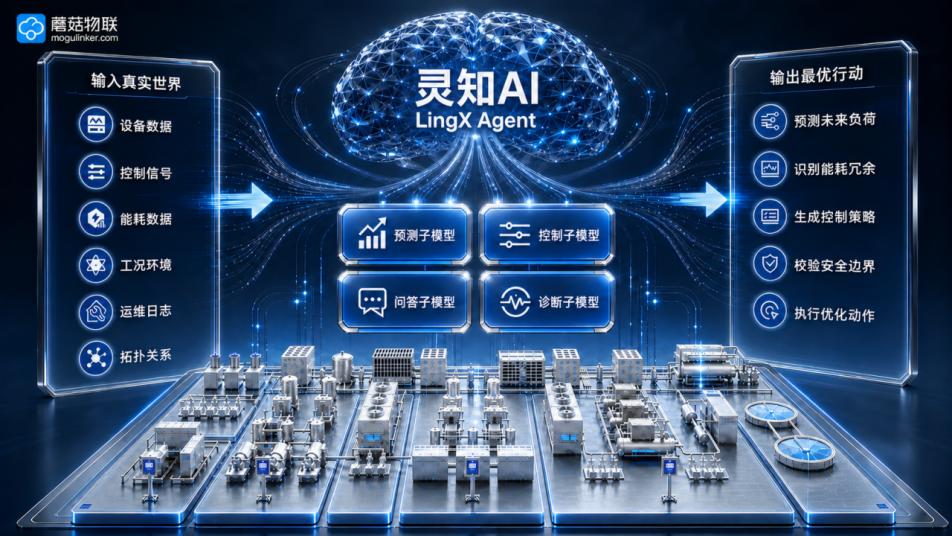
The reason why Lingzhi AI is positioned as a "multi-source vertical model" is that it "digests" three types of data: text, time series, and graphics. Behind this is a multi-modal database in the energy field: more than 30 types of equipment, 8 types of data dimensions, and 260,000 energy devices that are online in real time on the cloud — as the data flywheel rotates, the Matthew effect keeps expanding.
Mogu IoT started digging this "well" ten years ago. "In the early days of doing industrial SaaS, we insisted on public cloud deployment, while some peers chose private deployment just for short-term revenue." Shen Guohui said, "As a result? Their data is scattered in the hands of various customers, and now they can't buy it even if they want to spend money."
There is no doubt that some barriers cannot be bought with money, and "dark data" is exactly such a barrier.
More than that, when physical AI is truly rooted in energy control, safety compliance and controllable risk are also core capabilities. To this end, Lingzhi AI has built a unique three-layer fusion architecture: the first layer is the expression fusion layer; the second layer is the prediction fusion layer; the focus is the third layer, the decision execution fusion layer — an independent safety constraint mechanism is set up, and after completing rule check and boundary verification, the final implementable equipment control action is output to cut off the possibility of out of control.
Based on the Lingzhi AI model, Mogu IoT self-developed the LingX agent, superimposing two major industrial-grade control differentiated modules: one is safety and reliability gating (rule check, simulation trial operation, equipment interlock protection, boundary verification, etc.); the other is data support framework (standardization of heterogeneous data access, time series database, data lake and semantic index, etc.).
"Others are teaching AI to speak, we are teaching AI to work." Shen Guohui emphasized, "But when AI works, it must be 100% safe, verifiable and traceable."
Hard Core Commercial Implementation Achievements: 3.6 Billion kWh of Electricity and 6000 Enterprises
Commercialization is the soul test for every AI enterprise.
Shen Guohui mentioned a rule summarized by an industry expert: the industry generally follows the development path of Project (project-based) → Product (productized) → Platform (platform-based), but a large number of AI companies are trapped in the Project stage, falling into the dilemma of "revenue growth but no profit growth".
He pointed out sharply that energy control AI has two layers of standardization problems: product standardization and delivery standardization, and delivery is the watershed that really widens the gap. Many enterprises can output standardized products, but the delivery and commissioning links still highly depend on personalized senior engineers, and different people will get different delivery effects.
Mogu IoT's approach is to build a cloud-edge-end integrated product system: the cloud side is "data layer + Lingzhi AI/LingX + application layer", the edge side is "edge intelligent server to ensure low-latency real-time control", and the end side is "IoT gateway and inspection robot responsible for perception and execution".
Then how to make profits? At present, Mogu IoT has two charging modes: product-based charging "initial installation fee + annual operation and maintenance fee", and service-based charging "sharing based on energy-saving effect or AI trusteeship". Relying on the cloud-edge-end integrated standard product system, Mogu IoT has taken the lead in running through the commercial closed loop: serving more than 6,000 enterprises, saving more than 3.6 billion kWh of electricity cumulatively, and releasing nearly 20% more energy-saving space compared with non-AI energy saving — in the entire AI track, very few players in the energy control field can deliver such a report card.
With the continuous evolution of AI, the value of energy control AI lies not only in energy saving, but also in unattended operation.
This huge value is also seen by investors. Zhu Bin, partner of Yuanhe Origin, said that Mogu IoT is a representative enterprise of Physical AI in the energy control field, which has built the industrial physical intelligent closed loop of "perception-decision-execution". "Benefiting from the massive real-time physical data of energy equipment such as air compression stations and refrigeration stations accumulated in the IoT era, plus the wide application of Lingzhi vertical large model on the client side, Physical AI has made its entry into new quality productivity so concrete for the first time, and the measurable value created for customers is more trustworthy."
Shen Guohui can't help but think of a very vivid implementation scenario — it was 3 a.m. in the deep night, the equipment disinfection operation started in the CR Sanjiu Pharmaceutical factory, and two employees were on duty all night. After Mogu IoT completed the unattended transformation, there was only AI in the station room in the early morning, which completely solved the problem of all-night shift and improved employees' sense of happiness.
From the pilot of the air compression station in Guanlan base of Shenzhen, to the energy saving rate of more than 15% in the refrigeration station, after two rounds of verification, CR Sanjiu decided to purchase the group-level energy AI management platform, and replicate it in batches to national bases such as Zaozhuang and Chenzhou. This story was written into CR Sanjiu's ESG report, and also included in the case compilation of state-owned enterprise reform by the State-owned Assets Supervision and Administration Commission.
It is reported that Mogu IoT will also explore a Token-like API call charging mode in the future, "As customers' awareness of the value of unattended operation increases, the acceptance of this charging mode will become higher and higher."
Why Did Japan's Mitsubishi Choose Chinese AI and Start Its Global Expedition
At present, a consensus is gradually forming in the venture capital circle: going global is the second growth curve for AI companies, and also the largest testing ground.
Talking about this point, Shen Guohui's judgment is very straightforward: domestic customers have weak willingness to pay; in developed markets such as Japan, Europe and the United States, enterprises are more willing to pay a premium for AI. Serving the Southeast Asian market cannot be regarded as going global in the true sense, which is essentially equivalent to doing the domestic market.
In July this year, Mogu IoT ushered in a key node — it reached a strategic cooperation with RYODEN, the core listed company under Mitsubishi Group, and the two sides carried out dual cooperation in technology and market around physical AI control in the energy efficiency field. This is the first joint development cooperation of physical AI control technology in the energy efficiency field between Chinese AI technology enterprises and global leading automation giants. Obviously, this cooperation is of great landmark significance.
