Breaking! Gemini 3.8 takes the top spot, Google has taken a major leap forward in RSI.
Just now, Google is back with a vengeance!
Tonight, Google officially released Gemini 3.8 Flash, as well as Gemini 3.8 Flash Cyber, a model specially tailored for cybersecurity scenarios.
This is the third consecutive Flash version launched by Google in just six weeks.
The first two updates seemed to be nothing more than warm-ups, because this time, Google has pushed cost-effectiveness to the absolute forefront —
The single-task cost is only $0.58! The input cost is merely $0.75 per million Tokens!
This small model with an extremely low price has nearly touched the performance threshold of the world's top flagship models Opus 5, GPT-5.6 Sol and Grok 4.6 in multiple core benchmark tests.
Yao Shunyu, a top researcher at Google DeepMind, commented: For the model itself, this is just a small step; but for RSI, this is a huge leap forward.
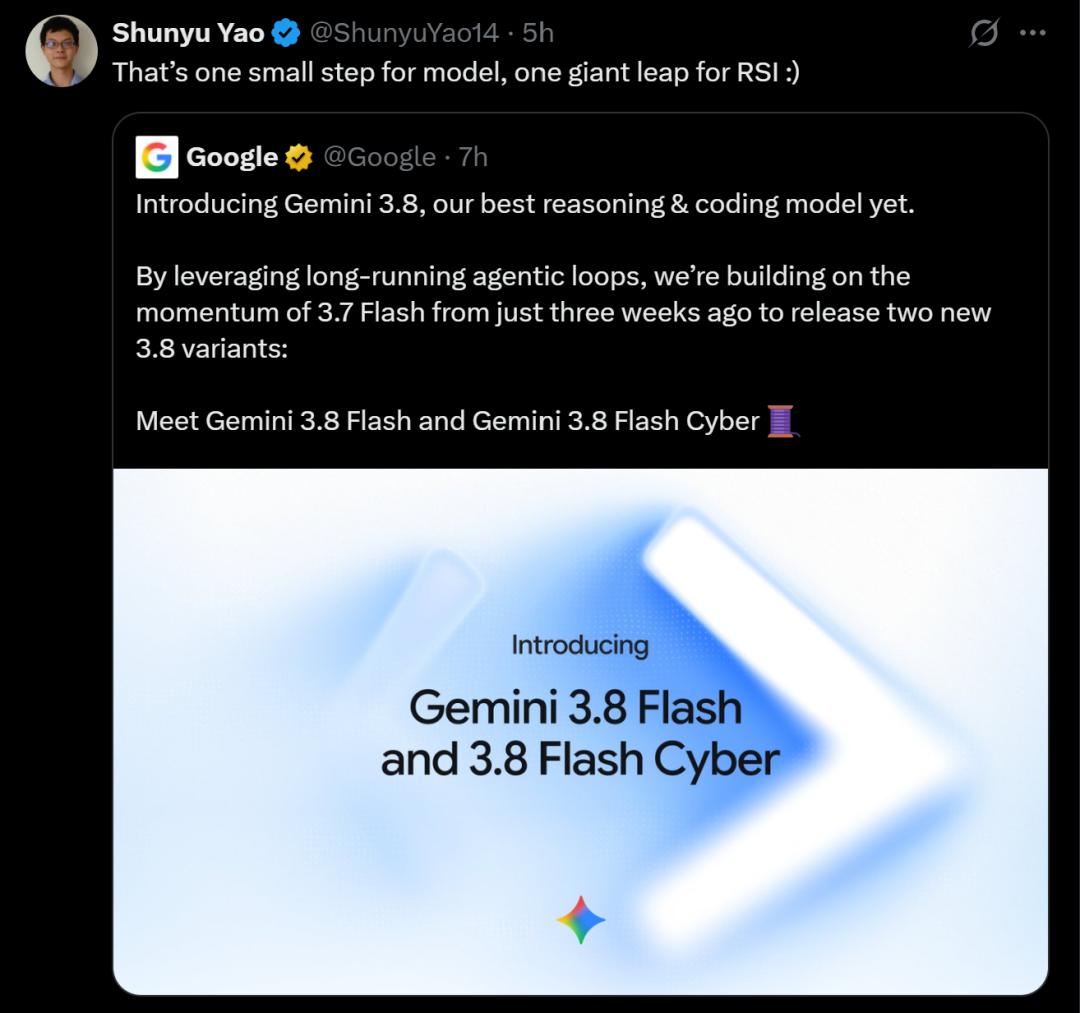
On X, developers have been completely blown away.
After actual testing, someone raised a pointed question: "Good heavens, did Google send the wrong product? This is clearly the long-unreleased Gemini 3.5 Pro! It delivers Pro-level performance at Flash-level prices!"
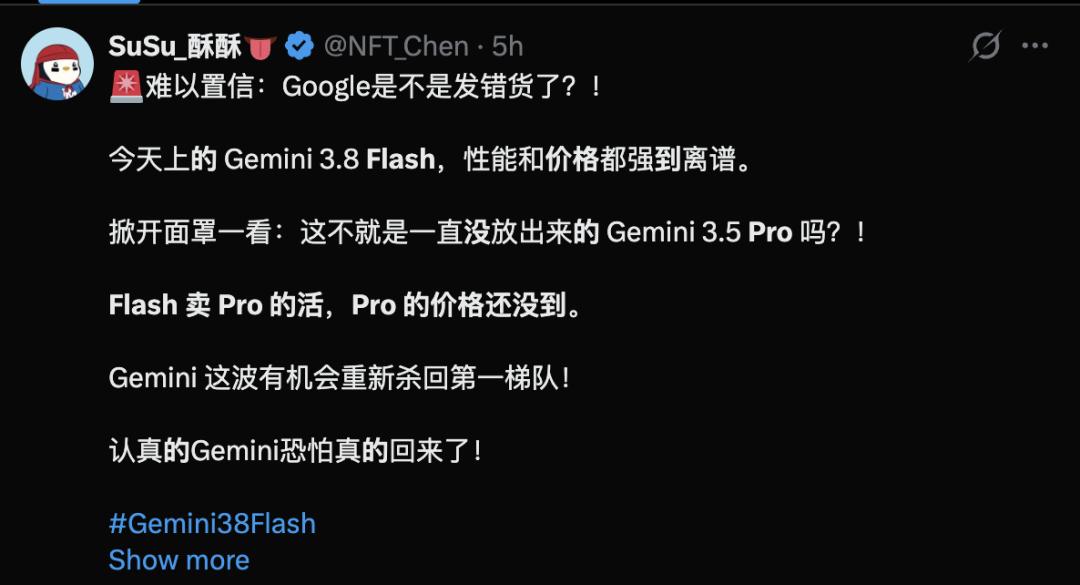
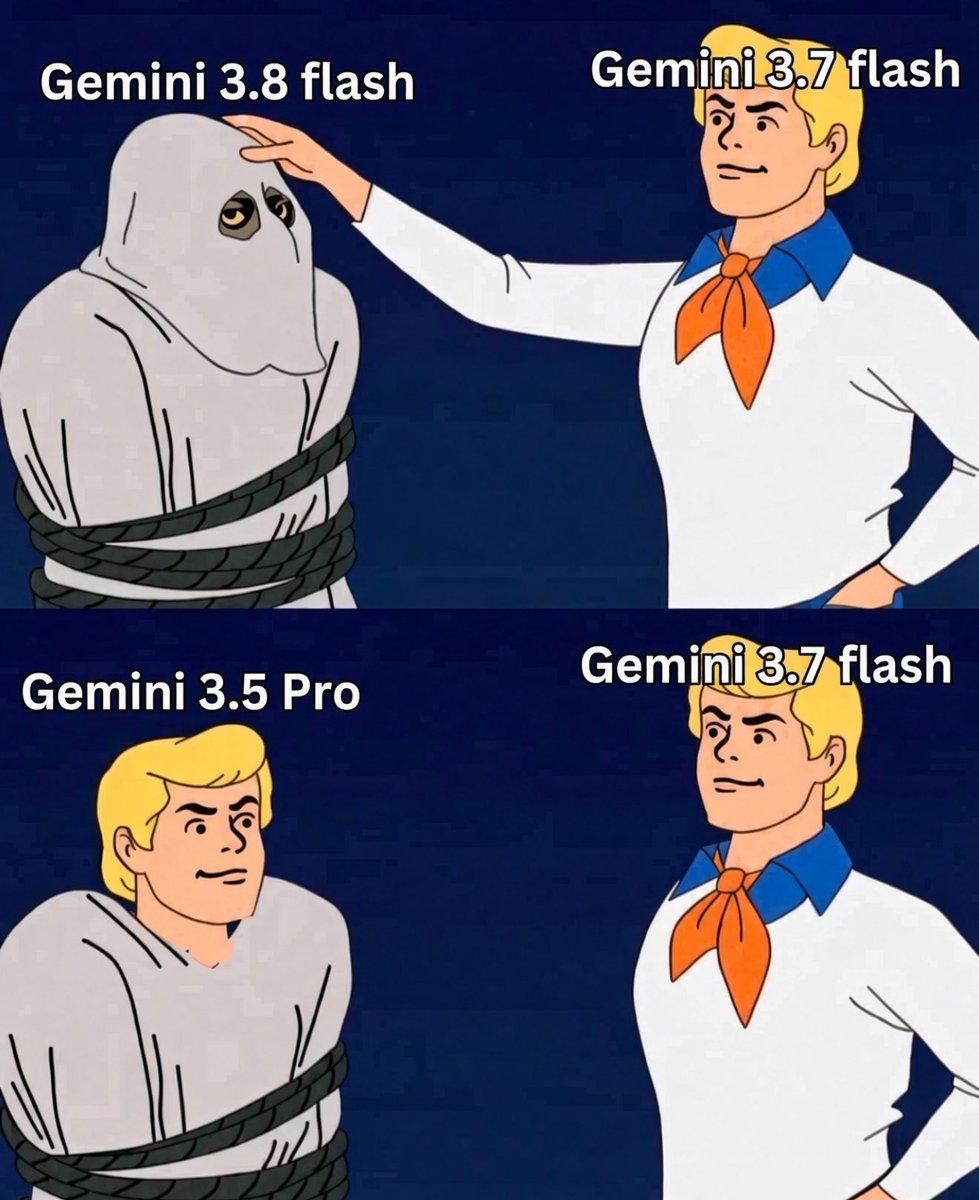
"Some people on the DeepMind team probably haven't closed their eyes since July."
While everyone is still digesting the Fable 5.1 release, Google has overturned the entire game board once again.
Google, the king of relentless iteration, is back: the king of cost-effectiveness
After a long period of silence, Google announced to the world in an extremely competitive way: the dominant player is back.
To understand the shock brought by Gemini 3.8 Flash, we must first look at the current landscape of the AI market.
Originally, the Artificial Analysis test had formed an extremely strict barrier. If you want to obtain top-tier intelligence (with an Intelligence Index of around 60 points), you have to pay a high Token cost.
As a result, Gemini 3.8 Flash is like an assassin that completely breaks the unwritten rules of the industry.
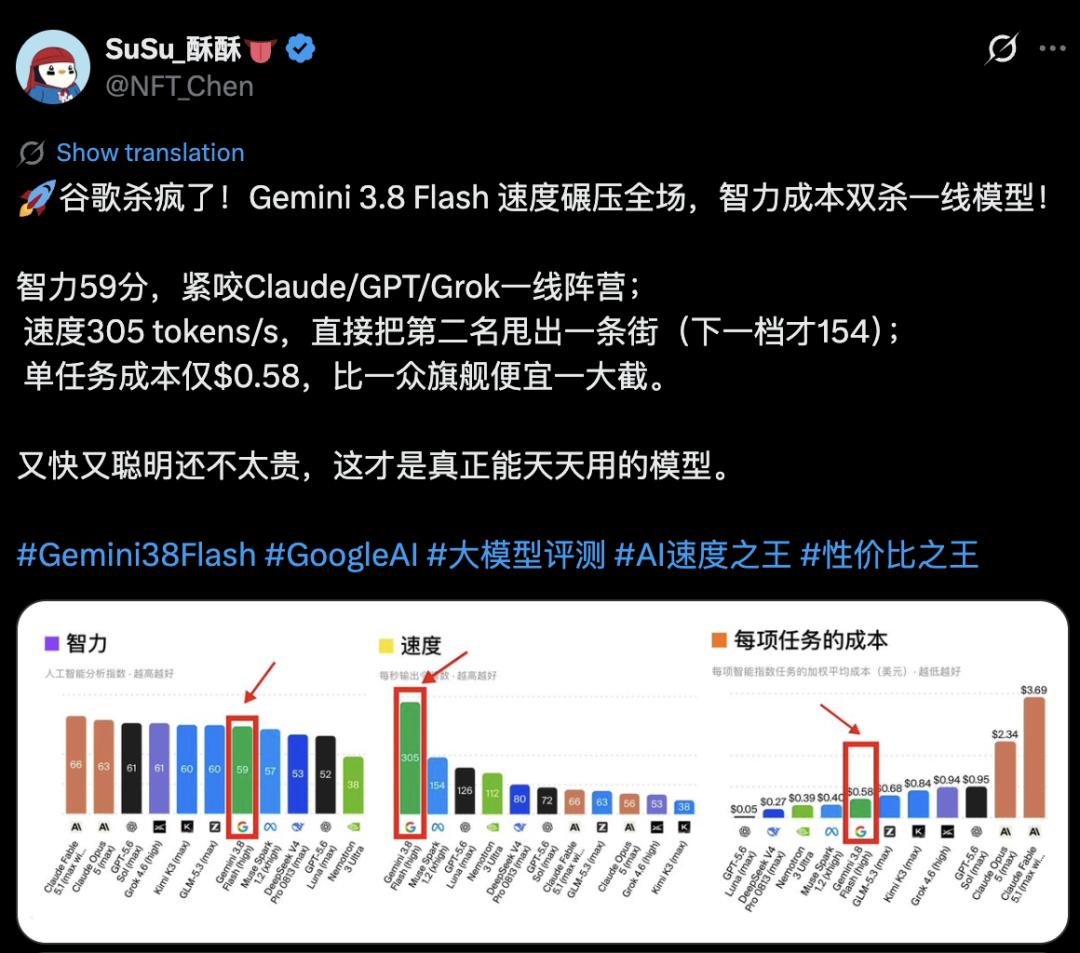
Under the high-inference mode of Artificial Analysis, the intelligence index of Gemini 3.8 Flash has soared to 59 points!
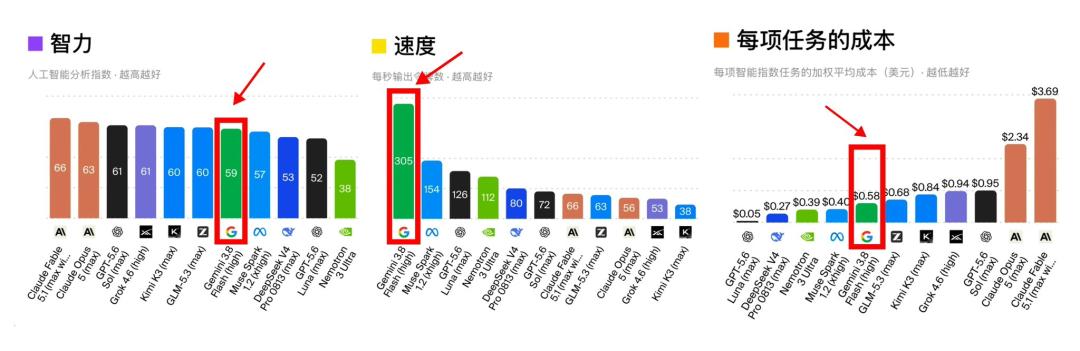
What does this mean? It is only one step away from the top-tier GPT-5.6 Sol and Grok 4.6, and even surpasses Claude Opus 5 in some dimensions!
And what is the cost of achieving all this? Its single-task cost is only $0.58.
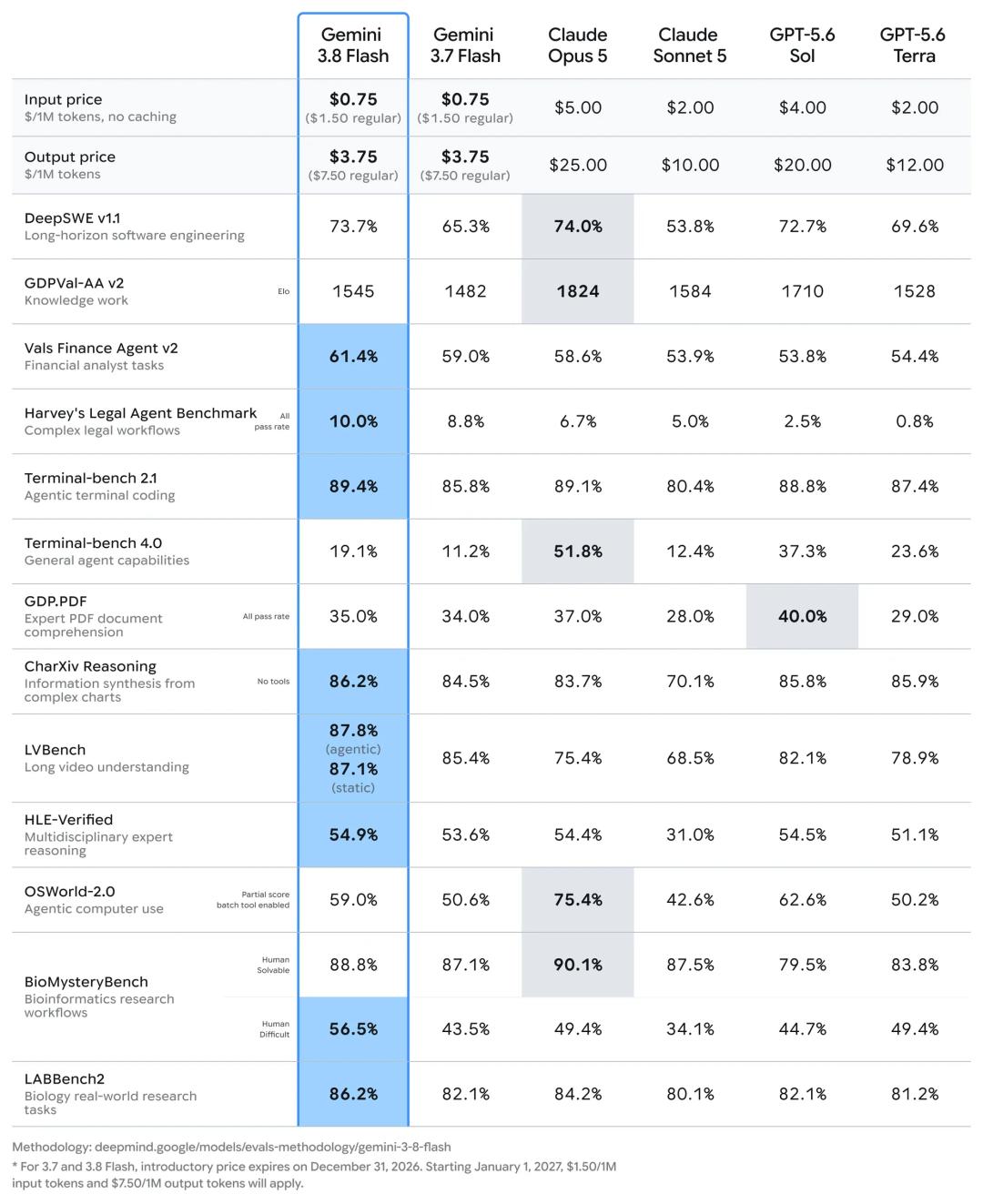
Specifically, the input cost remains at $0.75 per million Tokens, and the output cost is $3.75 per million Tokens.
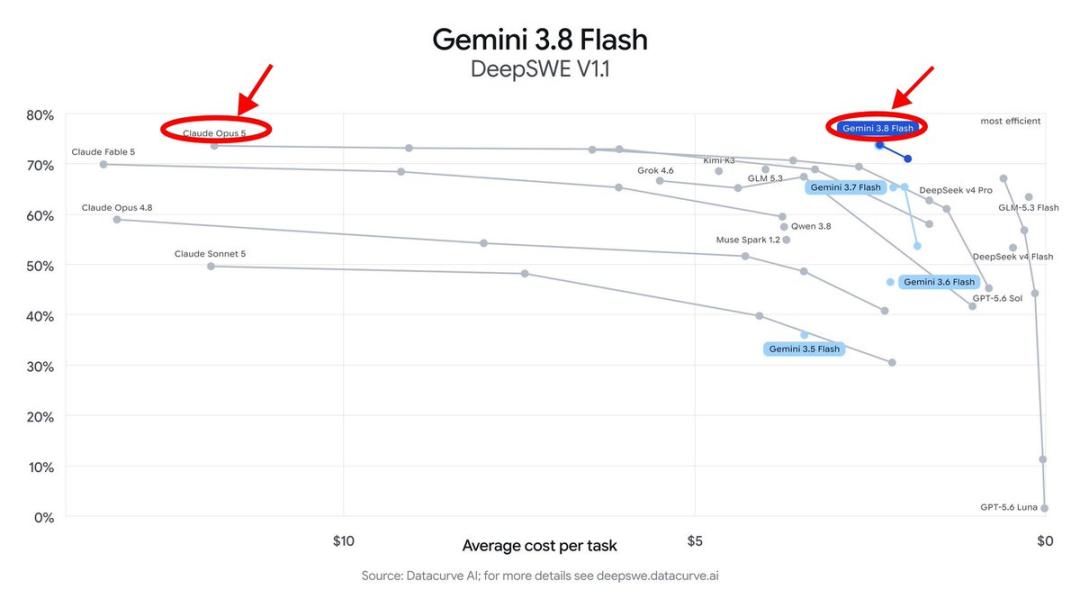
Google has produced a diagram: on the Pareto frontier of intelligence and cost, the blue dot representing "highest efficiency" of Gemini 3.8 Flash is located at the upper right corner of the software engineering benchmark DeepSWE, leaving the second place far behind.
Gemini 3.8 Flash is not only smart, but also incredibly fast. Its generation speed reaches an astonishing 305 tokens/s, while the next tier of models can only barely run at 154 tokens/s.
"Fast, smart, and so cheap that it feels almost free, this is the model that humans can truly use every day."
Especially on the long-cycle software engineering benchmark (DeepSWE v1.1), 3.8 Flash achieved an astonishing score of 73.7%.
In this test that requires AI to independently solve complex engineering problems and write code end-to-end, it not only surpasses most expensive cutting-edge large models, but its cost is only a tiny fraction of the latter.
It should be noted that this is only the "Flash" version, not the "Pro", let alone the "Ultra".
This time, Google once again allows small models to take jobs that originally belonged to flagship models.
Some people personally tested Gemini 3.8 Flash and Opus 5 to complete the same task.
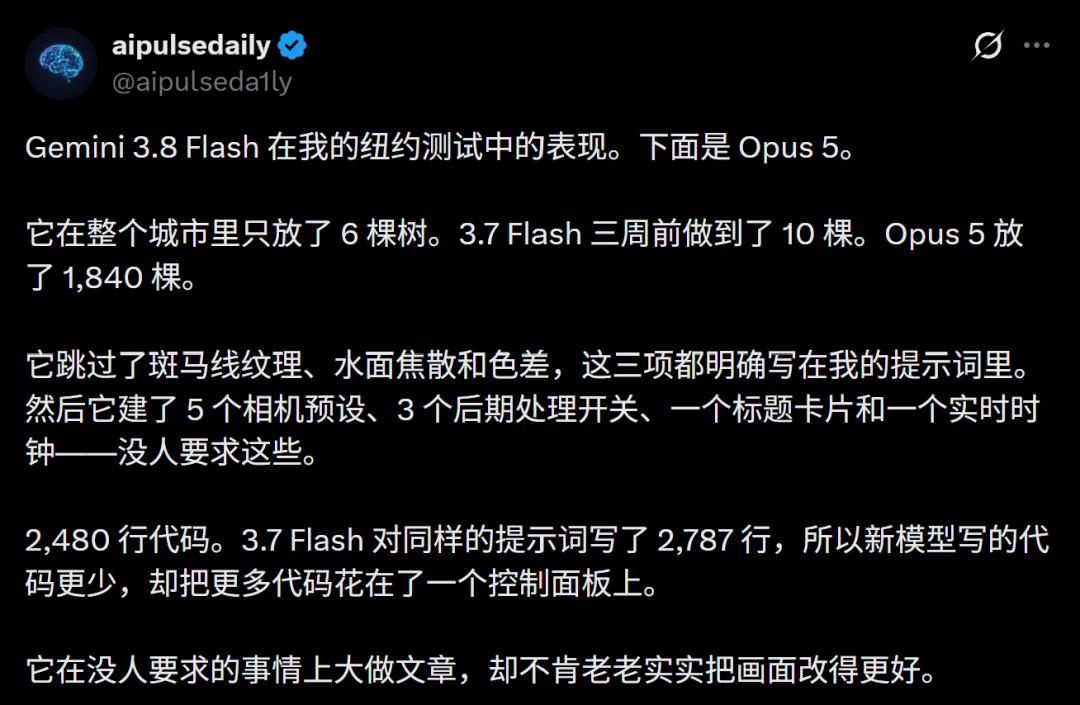
This substantial leap in programming capabilities is by no means accidental.
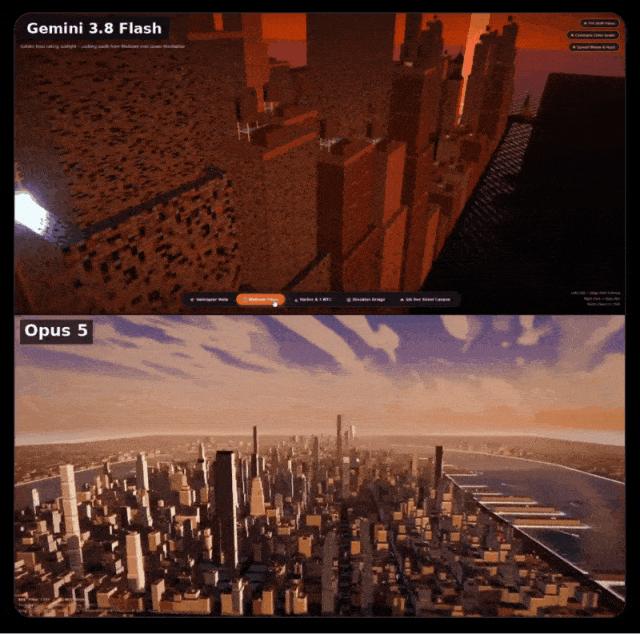
This substantial leap in programming capabilities is by no means accidental.
It is reported that in tests of Google's internal code tool Jetski, Google engineers even prefer to use 3.8 Flash instead of Anthropic's Opus model.
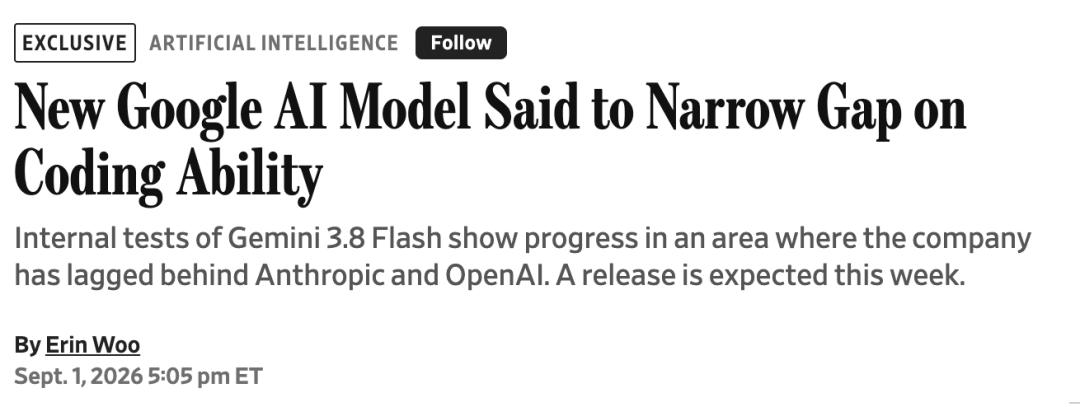
Behind this is Google's massive investment in reinforcement learning since the beginning of the year — that is, the "post-polishing" stage of model training, allowing the model to truly learn to work through trial and error.
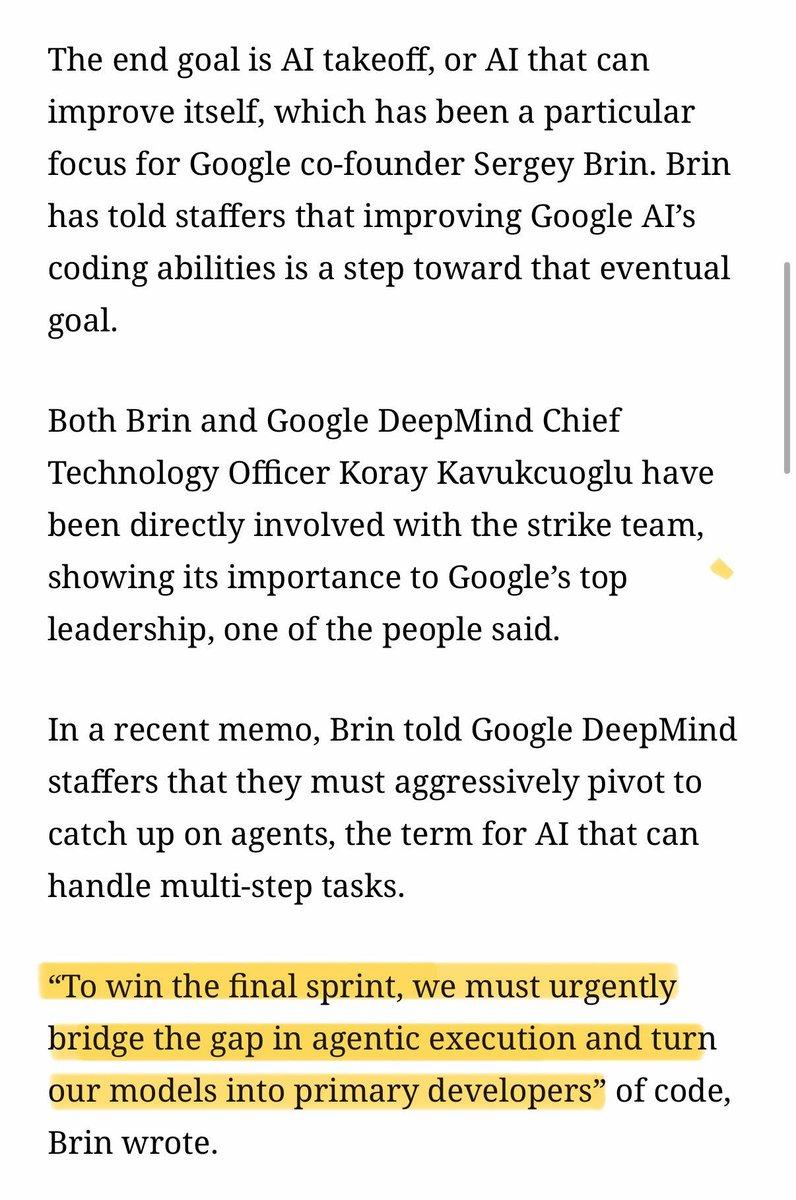
Google DeepMind has formed a code assault team focused on improving the capabilities of programming models. This team is led by the DeepMind CTO and directly supervised by co-founder Sergey Brin.
Their goal is to force recursive self-evolution, transform programming models into fully automatic AI researchers, and completely close the entire R&D loop.
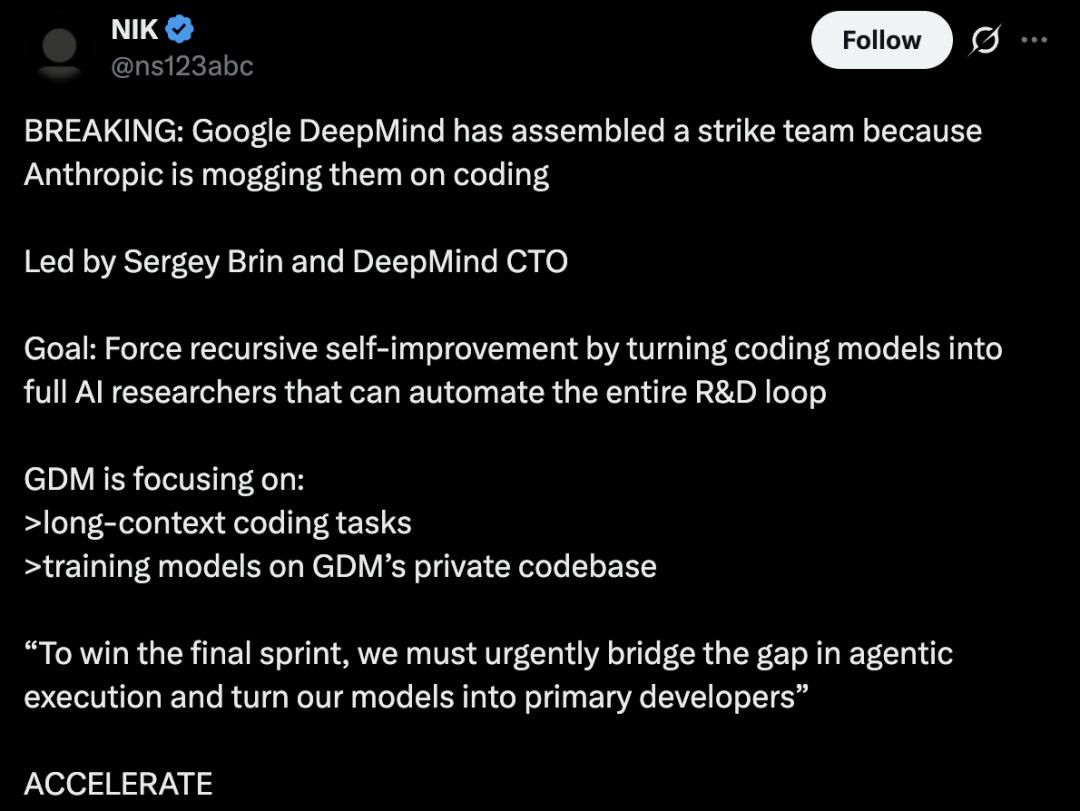
In its internal memo, Google stated directly:
To win the final sprint, we must urgently close the gap in agent execution capabilities and turn our models into mainline developers.
In addition, Google has hired Barret Zoph — co-founder of Thinking Machines Lab, former head of post-training at OpenAI, who now serves as Vice President of Research, in charge of reinforcement learning and post-training directions. This move clearly shows that Google is determined to go all out.
Last month, co-founder and Nobel laureate Demis Hassabis stepped down as CEO, and his successor Koray Kavukcuoglu immediately stated: Speed up, speed up, and speed up again.
Are the benchmarks inflated, or is the model truly exceptionally powerful?
However, amid all the praise, Google is widely accused of celebrating too early.
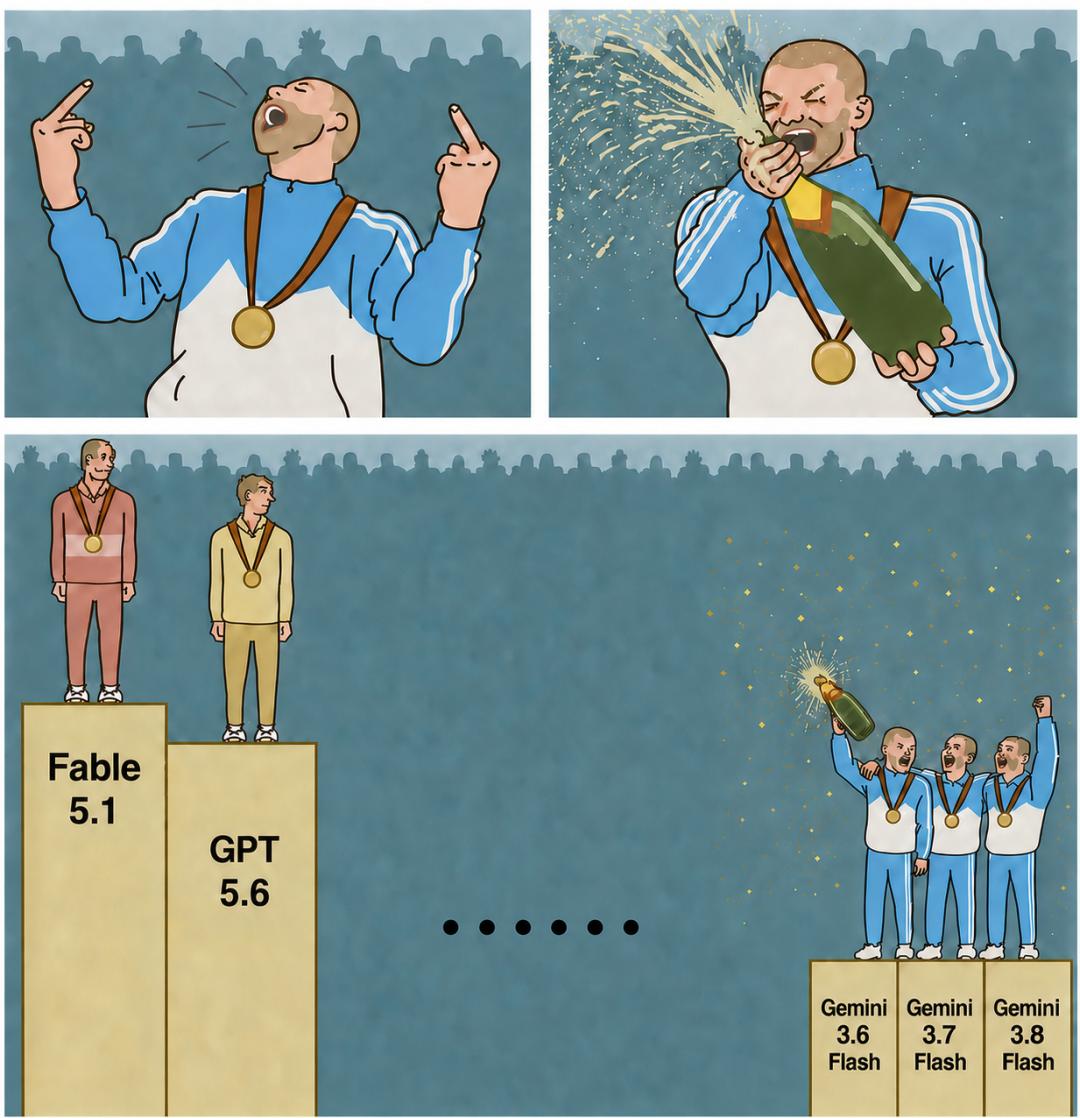
The most dissatisfied party is Meta —
Meta's Muse Spark 1.3 and Gemini 3.8 Flash have met head-on. The former scored 62 points on the Artificial Analysis intelligence index, tied with Claude Fable 5, and entered the top tier.
The input cost of Muse is 8 times lower than that of Fable 5, and the output cost is nearly 12 times lower, achieving maximum cost-effectiveness.
Meta's Chief AI Officer Alexandr Wang directly made a sarcastic comment: On the Artificial Analysis intelligence index, Gemini is nothing, and can only eat the exhaust fumes of other models.
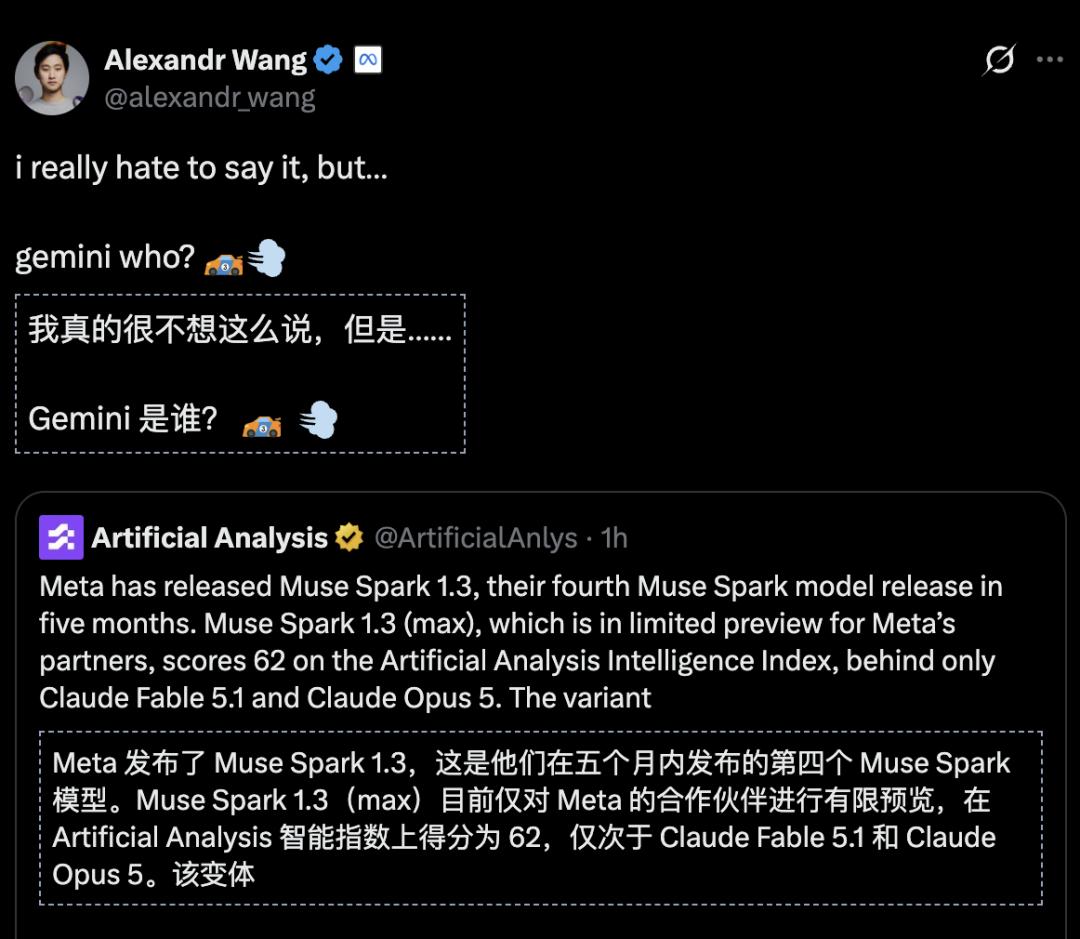
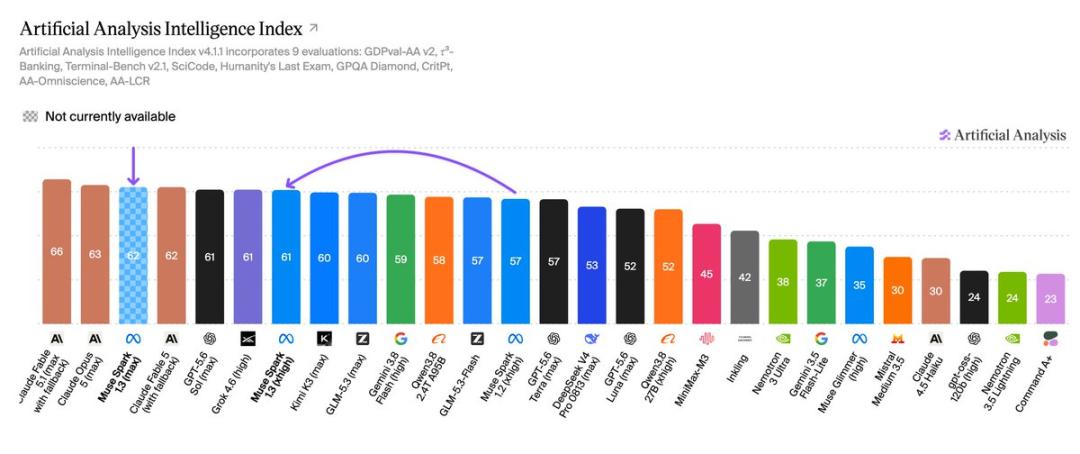
Muse Spark 1.3 scores higher than GPT-5.6 Sol, Grok 4.6 and Gemini 3.8 Flash, but it is currently only available in limited preview.
Some people point out that although the benchmark test results of 3.8 Flash look good, it may not perform so well in actual combat.
Indeed, Gemini 3.8 Flash has surpassed GPT-5.6 Sol and Opus 5 in tests such as Terminal-Bench 2.1 and HLE, but the huge score gap between TBench 2.1 and TBench 4 exposes that there may be a certain degree of "benchmark gaming" involved.
In other words, when faced with unfamiliar real-world zero-shot challenges that are not included in the training set, 3.8 Flash is most likely still inferior to parameter giants like Opus 5.
But Google's solution is extremely smart — diligence can make up for shortcomings.
As Google stated in its official blog: "These performance improvements stem from core design choices: 3.8 Flash works harder."
When facing complex tasks, 3.8 Flash is designed to perform additional reasoning steps and continuously iteratively call tools. When encountering problems it does not understand, it will not give up directly, but consume more Tokens to conduct high-speed internal self-verification and reflection.
Even if it consumes more Tokens through multiple cycles of thinking, because its basic unit price is extremely low ($0.75 per million tokens), the total cost is still much cheaper than calling GPT-5.6 directly once!
This strategy directly breaks the past single-dimensional competition logic that "large parameters equal strong capabilities".
It proves that in a perfect Agent loop, speed and extremely low inference cost are themselves a form of powerful intelligence.
Why release Flash? The "rejected" Pro version
Did Google really not ship the wrong product this time?
Gemini 3.5 Pro has not shown any trace so far. The next-generation flagship Gemini 4 has very good pre-training data, but it has not completed the post-training stage yet.
