A Tour of the Splendid Beijing: Experiencing Cultural Heritage and New Knowledge in Fangshan District
On September 2, the "Vast Scenery of Chinese Path to Modernization" Beijing Tour for Internet Influencers, hosted by the Cyber Social Work Bureau of the Cyberspace Administration of China and the Beijing Municipal Cyberspace Administration, and undertaken by The Beijing News Shell Finance, kicked off in Fangshan District. The internet influencers successively visited Yunju Temple, Zhoukoudian Peking Man Site, and the National University Regional Technology Transfer and Transformation Center for Green Energy (Beijing), experiencing the long-standing cultural heritage and the emerging technological vitality of Fangshan.
Carved Stones at Yunju Temple, Listening to the Millennium Cultural Context
On the early morning, Yunju Temple is shaded by ancient trees. The group of internet influencers stopped in front of the Northern Pagoda of the Liao Dynasty. Following the direction pointed by the commentator, they raised their cameras to look for a pattern shaped like a "little Dumbo" among the layers of brick carvings — this little elephant, with its legs spread out and running forward, has a cute and naive image, and has now become the mascot of Yunju Temple.
Yunju Temple was first built in the late Sui and early Tang dynasties. From the Sui and Tang dynasties to the Ming and Qing dynasties, 14,278 stone-carved Buddhist scriptures were inscribed over nearly a thousand years, which is known as the "Great Wall of Stone Scriptures". The stone scriptures, paper scriptures and wooden scriptures are collectively referred to as the "Three Wonders" of Yunju Temple.
The birth of a stone scripture is no easy task. According to the commentator, most of the stone materials used for carving scriptures were taken from the area around the Dashiwo Village in Fangshan District. After the stone was mined, it had to go through transportation and polishing before being carved character by character by craftsmen. Paper, bamboo slips and silk are easily destroyed by fire, water and wars, but stone is more durable and can preserve and record texts better. Therefore, the Yunju Temple stone scriptures are called a "stone-carved library". Nowadays, with the continuous updating of cultural relic protection methods, the thousand-year-old cultural memory has been more completely and permanently preserved.
Walking into the rubbing experience area, the internet influencers tried woodblock printing by themselves. Covering the paper, pressing, applying gold powder, and then carefully lifting it up, patterns with blessings appeared vividly on the paper.
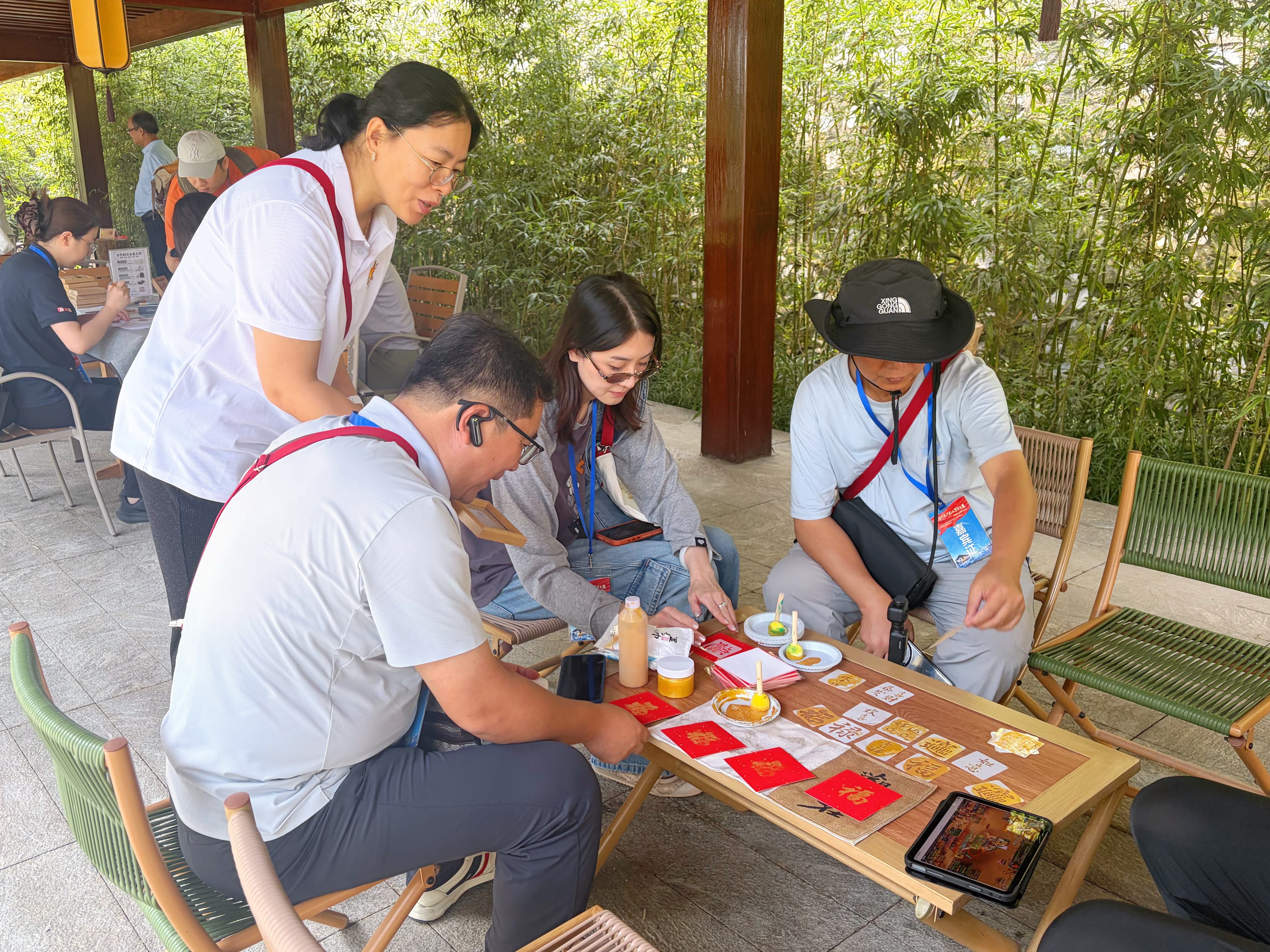
(Photo shows internet influencers experiencing rubbing making)
Searching for Traces at Longgushan, Exploring the Origin of Mankind
Walking up the steps at the Zhoukoudian Peking Man Site and entering the "Ape Man Cave", a huge cave that was cleared layer by layer by archaeologists comes into view. It was originally a natural limestone cave, which was gradually filled with gravel, soil and remains left by ancient humans after it collapsed. After that, archaeologists excavated from the top of the mountain downward, identified 14 horizons from the deposits, and a large number of fossils and stone tools were unearthed one after another. In 1929, the first complete fossil of the "Peking Man" skull was unearthed from one of the strata in the Ape Man Cave.
In the Zhoukoudian Site Museum, fossil specimens slowly unfold the survival picture of hundreds of thousands of years ago. The huge skeleton of the spotted hyena from China, as well as animal fossils of wild boars, wolves, leopards and giant pandas are arranged in turn, attracting internet influencers to observe carefully in front of the exhibition cabinets. Learning that many of the animal fossils in front of them are original specimens, everyone asked about the body shape and living environment of the animals while raising their cameras to record.
In the exhibition about the Upper Cave Man, a tiny bone needle and ornaments made of animal teeth, bone tubes, shells and other materials are particularly eye-catching. The bone needle shows that humans at that time were already able to sew clothes, and ornaments such as necklaces and bracelets reveal the sprout of aesthetic consciousness.
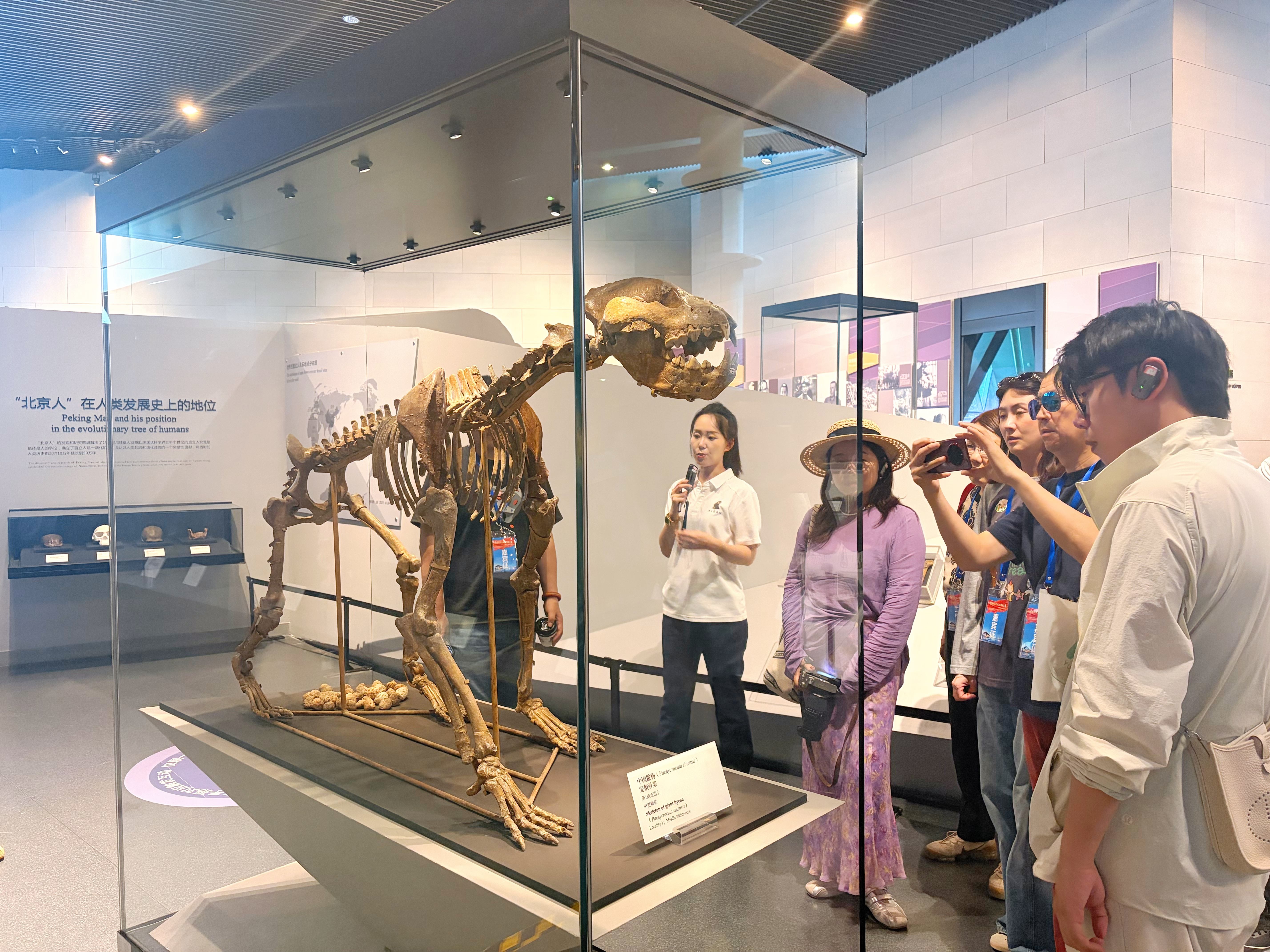
(Photo shows internet influencers visiting the skeleton of the Chinese spotted hyena)
Exploring New Innovations in the University Town, Looking Forward to a Green Future
Ancient people left their traces on bones, and craftsmen carved characters into stones. Today, what will we leave to the future? This stop in the afternoon gives an answer.
After driving to Liangxiang University Town, the group of internet influencers arrived at the National University Regional Technology Transfer and Transformation Center for Green Energy (Beijing). In the exhibition hall, achievements such as solid-state batteries, modular energy storage cabinets, and gel cold storage materials are on display. The commentator introduced that the center was approved in 2025 and is the only university regional technology transfer and transformation center in China that focuses on the green energy field.
A scientific research achievement often has to go through multiple hurdles such as technical verification, product trial production, capital investment and market docking before it can be transformed from the laboratory to the market. What the center is doing is to break through these hurdles one by one: on the one hand, it collects the bottlenecks and demands encountered by enterprises in production, and on the other hand, it connects with university scientific research teams to find cooperation opportunities for both sides. Since its operation one year ago, more than 80 achievements have been incubated and implemented for transformation.
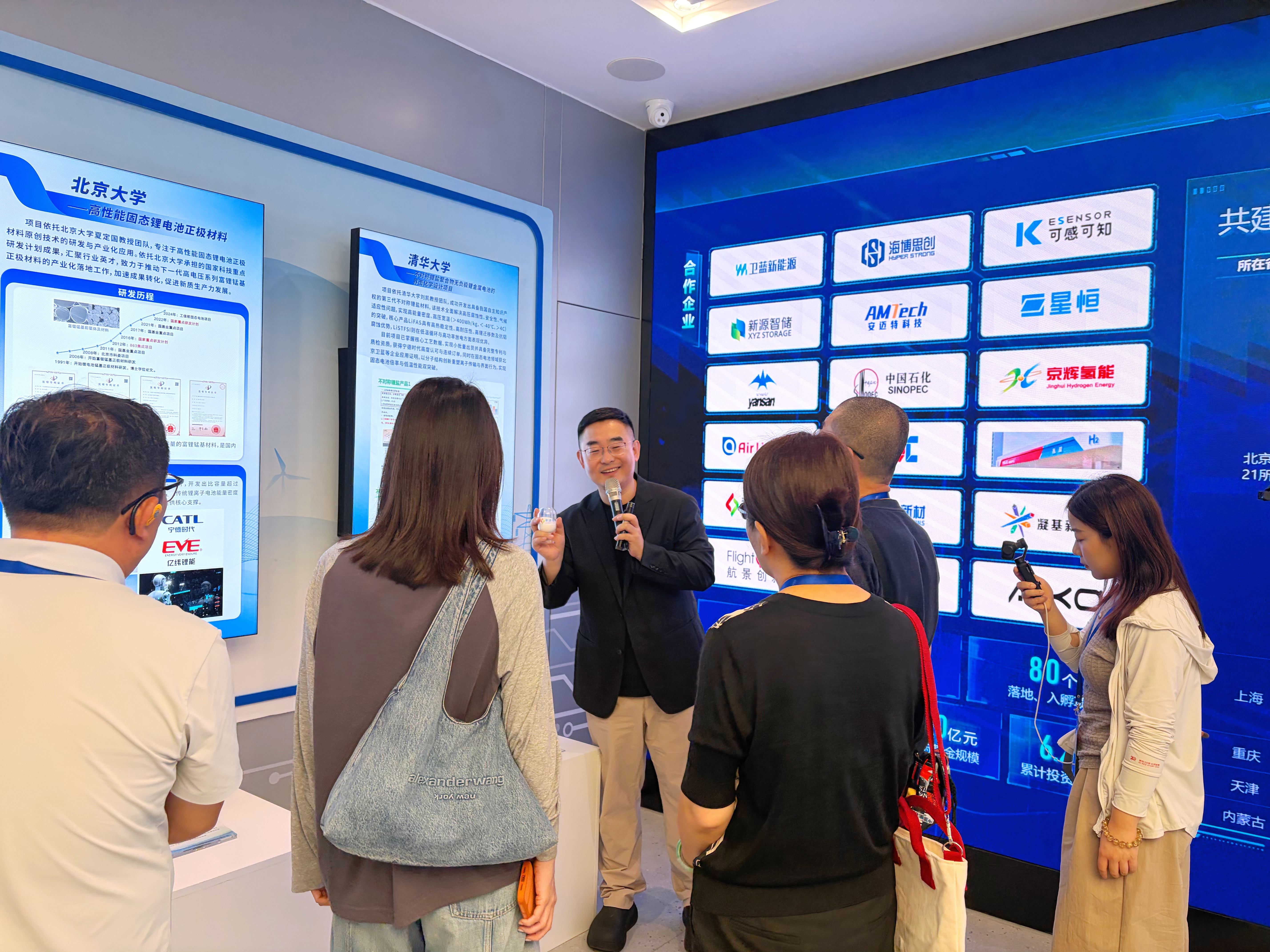
(Photo shows internet influencers visiting the National University Regional Technology Transfer and Transformation Center for Green Energy)
Entering Beijing Ningji New Material Technology Co., Ltd., a gel cold storage material shaped like a polar bear stands in the exhibition hall. The internet influencers reached out to touch it, feeling the coolness like ice. But this material is not ice at all. Even if it is placed in a room at normal temperature, it will not melt into water or change its original shape. The company's staff introduced that this material has a water content of more than 90%, and uses a nano-scale polymer network to lock water in it, so that it can maintain a solid state when the temperature changes. From a formula in the university laboratory to the mass-produced product today, the development path of Ningji New Material just provides a tangible sample for the green energy transformation center.
Inside the office of Ningji New Material, there is also a small curling experience area, and the bottom is made of their self-developed cold storage material. The internet influencers took turns to play, leaning down and pushing the curling stone, intuitively experiencing the application of this technology in the relaxed interaction.
The historical cultural context is continued in protection, and innovation achievements are implemented in transformation. Fangshan District is glowing with new vitality at the intersection of ancient and modern, unfolding a vivid page of the Chinese path to modernization.