The domestically developed universal immune priming therapy has officially launched its clinical program, targeting the "cold tumors" that PD-1 therapies fail to effectively tackle.
Recently, a new advance in the field of tumor immunotherapy has pushed the concept of "Immune Priming" back to the center of the industry's attention.
In August 2026, Moderna and Merck unveiled the results of the Phase III INTerpath-001 study investigating the combination of the personalized neoantigen therapy V940 and KEYTRUDA. The study achieved the primary endpoints of Relapse-Free Survival (RFS) and Distant Metastasis-Free Survival (DMFS) in patients with resected high-risk melanoma, delivering new clinical evidence to support the "Immune Priming + PD-1" combination strategy.
The underlying logic of V940 is straightforward: a personalized neoantigen vaccine is first administered to induce the patient to generate more tumor-specific T cells, followed by a PD-1 inhibitor to remove immune suppression and further amplify the existing anti-tumor immune response.
However, this is not the only path to implement "Immune Priming".
If V940 focuses on how to further enhance anti-tumor responses on the basis of pre-existing immunity, another line of thinking is to develop Immune Priming itself as an independent therapeutic modality — especially for "cold tumors" with weak tumor immunogenicity and limited PD-1 inhibitor efficacy, to address the core issue of "whether there are sufficient tumor-specific T cells" first.
Multiple domestic enterprises have already started advancing along this developmental path.
Recently, Artery Network learned that KMV002, the prostate cancer immune priming candidate independently developed by Chimigen Bio, has officially entered the Sino-Australian clinical development execution phase.
In July, KMV002's US IND application was approved by the FDA within less than one month of review, and the company is simultaneously preparing for the launch of its Phase I clinical trial in Australia. In August, an early-stage clinical study of KMV002 at West China Hospital of Sichuan University was also initiated, focusing on evaluating its safety, tolerability, and PAP-specific immune responses.
It is worth noting that KMV002 adopts a frontline treatment add-on clinical positioning: it is administered on the basis of standard ARPI therapy and does not require combination with PD-1 inhibitors. From a commercialization perspective, aligning the drug with frontline treatment scenarios means it is positioned for first-line use from the moment its clinical development is approved, paving the way for subsequent market access in advance.
From an industry perspective, although V940 and KMV002 have selected different tumor types, product forms and clinical pathways, they point to the same major trend: Tumor immunotherapy is evolving beyond simple immune suppression removal, extending further upstream to the Immune Priming stage.
For Chimigen Bio, the entry of KMV002 into clinical development also marks the first transition of its proprietary SynNeogen® Immune Priming platform from preclinical research to human validation.
The question it aims to answer is one of the most fundamental challenges for immunologically cold solid tumors: For immunologically cold tumors that lack sufficient tumor-specific T cells, can the immune response be actively reconstructed from the upstream level?
01 The Immune Dilemma of Cold Tumors: Before Releasing the "Brake", T Cells That Can Be Mobilized Must Exist First
Over the past decade, immune checkpoint inhibitors (ICIs) such as PD-1 inhibitors have continuously expanded the boundaries of tumor immunotherapy, but this path has not achieved satisfactory outcomes for metastatic castration-resistant prostate cancer (mCRPC, also referred to as mAPMR per the latest international PCWG4 guidelines), and no universal benefit applicable to a broad patient population has been established.
The objective response rate best illustrates this gap. In the KEYNOTE-199 study (n=258), the objective response rate (ORR) of pembrolizumab monotherapy in mCRPC patients was only 5%, while the ORR in advanced melanoma reached approximately 33% (KEYNOTE-006).
Larger-scale Phase III studies have further confirmed this trend.
In KEYNOTE-921 (n=1030), the combination of pembrolizumab and docetaxel did not significantly improve overall survival (median OS: 19.6 months vs 19.0 months, HR=0.92) or radiological progression-free survival (median rPFS: 8.6 months vs 8.3 months, HR=0.85).
In KEYNOTE-641 (n=1244), the combination of pembrolizumab and enzalutamide also failed to meet the primary endpoints of OS and rPFS, and the median OS of the combination arm was even lower than that of the placebo arm (24.7 months vs 27.3 months, HR=1.04), leading to the early termination of the study for exceeding the futility boundary.
All these data lead to the same conclusion: PD-1 inhibitors show extremely limited efficacy in typical "immunologically cold" tumors such as mCRPC.
PD-1 inhibitors exert their therapeutic effect mainly by relieving the immune suppression imposed on T cells. However, for "immunologically cold tumors", relying solely on downstream immune suppression removal without modifying the tumor microenvironment is still insufficient to generate effective anti-tumor immune responses.
Therefore, these results cannot be simply interpreted as "the PD-1 mechanism is ineffective for prostate cancer", nor can they be attributed to a single biological factor. Instead, they define a clear developmental challenge: although PD-1 inhibitors remove the "brake" suppression on T cells, if the tumor microenvironment lacks sufficient functional tumor antigen-specific T cells, removing only downstream suppression is still unlikely to produce sustained therapeutic efficacy.
In addition, in some immunologically cold tumors, the function of CD4⁺ helper T cells is suppressed, and the antigen presentation capacity of dendritic cells (DCs) is also impaired. The immune synergy that should be generated through intercellular communication is further blocked by the immunosuppressive tumor microenvironment.
Ultimately, antigen presentation efficiency decreases, T cells cannot be fully primed, and effective anti-tumor immune responses and prognostic benefits are difficult to achieve.
This means that for this type of tumor, simply removing the suppression on T cells is not enough.
Therapeutic intervention needs to move further upstream: it should not only remove immune suppression, but also enable the immune system to effectively recognize tumor antigens and actively generate new antigen-specific T cells.
This is exactly the problem that "Immune Priming" aims to solve.
02 Why PAP: Clinical Relevance Has Been Verified, and Product Form Can Still Be Reconstructed
Looking back at the mCRPC field, Provenge (sipuleucel-T) has provided an important clinical precedent. As the first therapeutic tumor vaccine approved by the US FDA, it uses Prostatic Acid Phosphatase (PAP)-GM-CSF to ex vivo activate the patient's autologous peripheral blood "monocytes" for the treatment of asymptomatic or minimally symptomatic mCRPC, and has demonstrated overall survival benefits in randomized studies. It proves that active immune intervention targeting PAP has clinical value.
However, Provenge also has two structural limitations.
On one hand, its individualized cell therapy model requires processes including patient cell collection, ex vivo manipulation and reinfusion, which makes production and treatment workflows highly complex and limits its large-scale application.
On the other hand, its antigen presentation efficiency is constrained: it uses patient peripheral blood PBMCs, in which DCs account for less than 0.1%, leading to limited antigen presentation capacity.
Thus, a new technical question arises:
Is it possible to retain the clinically validated foundation of PAP immune intervention, while transforming the therapy from an individualized cell product into a standardized, scalable, and repeatable universal molecular drug?
03 SynNeogen®: Enable Tumor-Associated Antigens to Be Recognized by the Immune System More Effectively
Chimigen Bio's answer to this question is the SynNeogen® platform.
In terms of technical logic, SynNeogen® adopts a different path from personalized mRNA neoantigen vaccines: based on tumor-associated antigens (TAAs), it uses engineered Fc fusion proteins to deliver antigens to dendritic cells (DCs) in a targeted manner, and then primes antigen-specific T cells through cross-presentation.
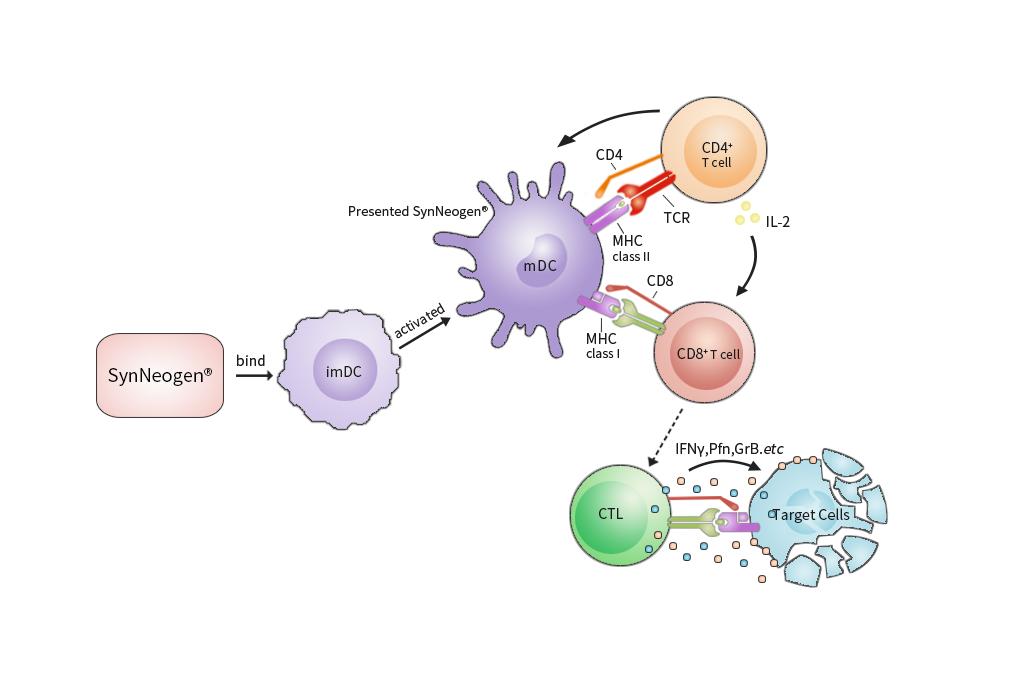
(Schematic diagram of the SynNeogen® mechanism)
If we break down this process in detail, SynNeogen® actually addresses three consecutive core issues.
First, can the antigen be delivered to the correct location.
Traditional antigen delivery is not as simple as injecting antigens into the body. The effective uptake of antigens by DCs is the first step for subsequent immune priming. SynNeogen® binds to receptors such as FcγR through its engineered Fc domain, to achieve more directional uptake by DCs.
Second, can the antigen be effectively presented to T cells.
Entry into APCs does not guarantee the formation of effective immunity. Antigens need to be processed and presented before they can be recognized by T cells. Therefore, SynNeogen® is further designed for dual-path presentation via MHC-I and MHC-II, aiming to elicit both CD8⁺ and CD4⁺ T cell responses simultaneously.
Third, can this mechanism be developed into a standardized drug.
This is also one of the key differences between Chimigen Bio's approach and the individualized therapy route.
For personalized neoantigen mRNA therapies, each patient needs to go through tumor sample collection, sequencing, neoantigen prediction and screening before individualized manufacturing; KMV002, by contrast, adopts a unified molecular configuration, with the goal of scalable production and off-the-shelf availability.
What SynNeogen® truly aims to solve is far more than "how to deliver an antigen". It strives to address the core challenge: how to deeply activate antigen-specific immunity, and transform individualized therapies into standardized, replicable molecular drugs.
04 KMV002: Starting from PAP, Immune Priming Enters mCRPC Clinical Development
The ultimate validity of the platform still needs to be verified by its pipeline products.
As the first oncology pipeline from the SynNeogen® platform to enter clinical development, and the project that received FDA IND approval this time, KMV002 selects PAP as its antigen, and targets patients with metastatic androgen pathway inhibitor-resistant prostate cancer (mAPMR) as its first clinical scenario.
This selection is supported by two clear rationales. The first is unmet clinical need: mCRPC is a typical "cold tumor" with limited PD-1 efficacy, existing therapies cannot solve the problem of missing T cell substrates, and there is a clear demand for Immune Priming. The second is target validation: the druggability of PAP is supported by the existing clinical data of Provenge, so KMV002 does not start with a completely unvalidated antigen.
From submission to approval, the FDA IND review of KMV002 took less than one month. This rapid approval is related to the pre-existing clinical validation of the PAP antigen, as well as the mature underlying technologies including Fc fusion and insect cell expression. These "pre-established foundations" reduce the uncertainties at the target and process stages, and explain why a novel mechanism therapy can obtain regulatory clearance at a relatively early treatment stage.
However, fast approval does not mean the project has been clinically validated. Whether KMV002 can finally prove the validity of the Immune Priming path depends on its clinical data.
If the study proceeds as planned, Chimigen Bio expects to obtain the first batch of patient immune response readouts in the first quarter of 2027 — the truly noteworthy outcomes are not the timing of PFS/OS events, but:
- • The proportion of patients who develop PAP-specific responses
- • Whether the magnitude of the response is biologically meaningful
- • Whether the response covers both functional CD4⁺ and CD8⁺ T cells
- • Whether the response can be maintained after repeated administration
- • Whether there is interpretable reproducibility across patients with different HLA backgrounds
If these signals are confirmed, it will directly demonstrate whether KMV002 can generate reproducible and quantifiable PAP-specific T cell responses in patients. This will mitigate the key risk of translating the SynNeogen® platform from preclinical mechanisms to human applications, and provide a basis for subsequent dose optimization, patient stratification, and combination with downstream effector therapies such as CPIs and TCEs. However, this readout is not a pre-proof of therapeutic efficacy or regulatory success.
KMV002 is validating a complete causal chain starting from clear clinical needs, covering target antigen identification, targeted delivery, dual-path presentation, and human immune response induction.
05 From a Single PAP Product to a Replicable Platform
The extensibility of the platform has seen initial deployment. Chimigen Bio has expanded the SynNeogen® platform to the chronic hepatitis B field — SN2001 is also designed based on this platform, which received FDA IND approval in 2025 and has initiated Phase I clinical trials in Australia.
The same core logic of "antigen delivery → APC uptake → T cell priming" is being tested for cross-disease reuse, from oncology to viral infections. Cross-disease application can demonstrate the platform's engineering capabilities, but cannot replace the patient data of KMV002 itself.
From an industry perspective, tumor immunotherapy is entering a more refined stratification stage. For "hot tumors" with pre-existing immunity, checkpoint inhibitors can amplify the existing immune response; but for "cold tumors", the lack of T cell substrates is the fundamental bottleneck, which requires a new path — not to amplify existing immunity, but to build new immunity from scratch.
The question raised at the beginning will ultimately be answered by clinical data. Starting from a single PAP project and evolving into a replicable universal Immune Priming platform, the SynNeogen® story has only just begun.
And for tumor immunotherapy, this means not only releasing existing T cells, but also enabling the previously missing immune substrates to be fully established.
This is the direction Chimigen Bio is working to validate, and it is also the most promising industrial direction in this track.
This article is from the WeChat official account "Artery Network" (ID: vcbeat), author: Huang Yurou, published with authorization from 36Kr.