Gemini 3.8 Flash Launched at Lightning Speed: It works extremely diligently, yet simply hasn't got the hang of things.
At a pace so fast it is like dumping dumplings into boiling water, Gemini has rolled out yet another new update.
In the early hours of this morning, Gemini 3.8 Flash was officially launched. This is already the third Flash model Google has released within just six weeks.
It appears that Google is fully committed to carrying out the "small strides, fast iteration" strategy. But what I am more worried about is that at this update speed, there will not be enough 3.x version numbers left before Gemini 4 is released...
Judging from the version number, this is only a regular update, but Google has assigned increasingly heavy tasks to the Flash series of models. The official statement says its goal is to write and modify large-scale projects, call tools repeatedly, and independently complete complex tasks that last for several hours.
These tasks that are generally used to measure top-tier Agentic models are now all delegated to 3.8 Flash.

The original positioning of the Flash series was to run faster and cost less, but now it has to take the place of the long-overdue 3.5 Pro to prove that Google still has the ability to stay in the game.
Looking at the official benchmark scores, Google seems to have really achieved this; but community feedback and our simple test have reached the opposite conclusion:
After three generations of updates in six weeks, Gemini 3.8 Flash is still "as mediocre as it has always been".
A new model every three weeks, its benchmark score is already close to Opus 5
Google calls Gemini 3.8 Flash "the smartest Flash model to date", which is mainly oriented to long-horizon software engineering, autonomous Agents and complex enterprise workflows.
With that positioning, its most prominent improvement is naturally in programming capabilities.
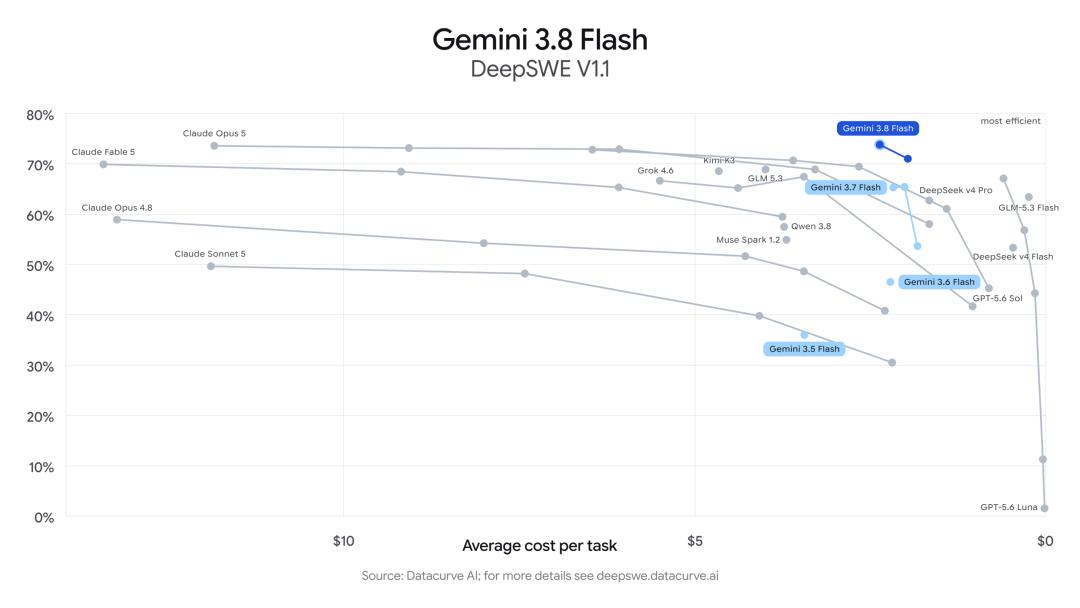
In DeepSWE v1.1, a test for long-horizon software engineering capabilities, Gemini 3.8 Flash scored 71.0%, an increase of nearly 6 percentage points compared with the 65.3% of 3.7 Flash, leaving it only one step away from the 74.0% of Claude Opus 5 - it is worth noting that 3.6 Flash, released a month and a half ago, only scored 49%.
In HLE-Verified, which covers STEM, humanities and professional knowledge, 3.8 Flash scored 54.9%, slightly higher than Opus 5's 54.4%.
In some multimodal tests, its advantages are even more obvious: it scored 86.2% in the complex chart understanding test CharXiv Reasoning, exceeding Opus 5's 83.7%; when processing long videos in Agent mode, its LVBench score reached 87.8%, which outperforms a host of top models including GPT-5.6 Sol and Opus 5.
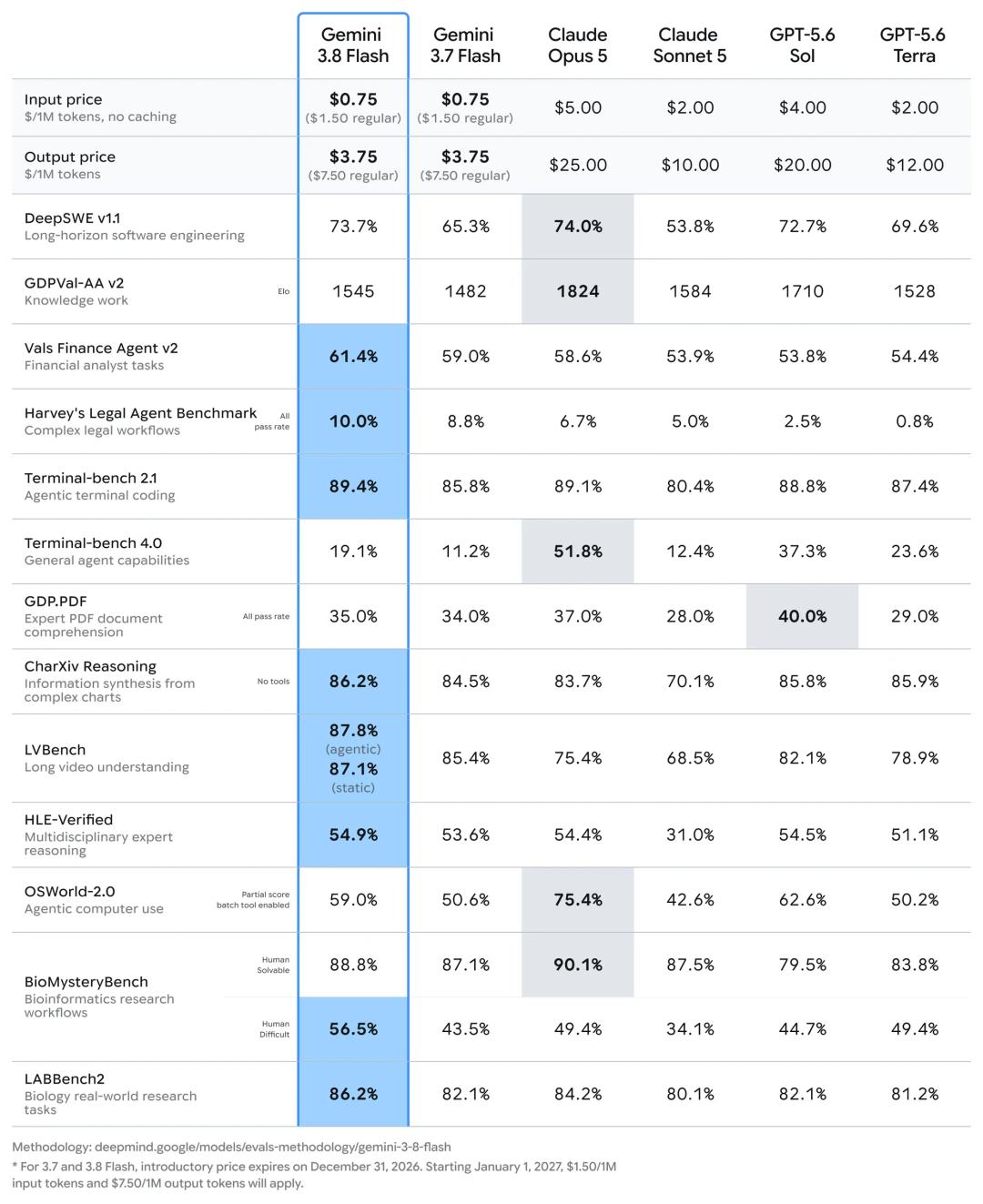
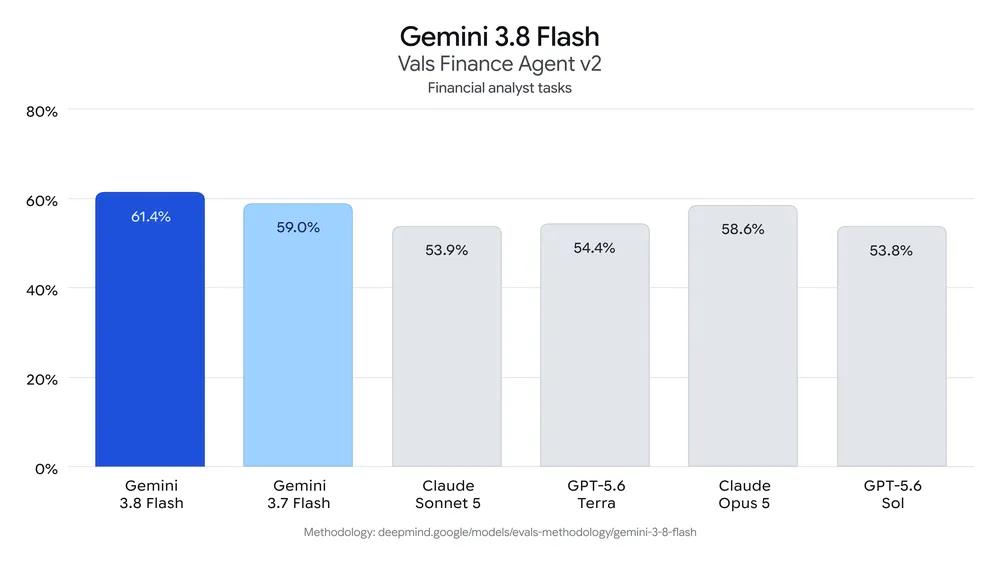
Finance and law are also the key promotion directions for Google. 3.8 Flash outperforms 3.7 Flash and other more expensive cutting-edge models in both Vals Finance Agent V2 and Harvey’s Legal Agent Benchmark.
Judging only from these numbers, a Flash model priced far lower than Opus 5 seems to have touched the threshold of flagship models in programming, chart processing, video processing and some professional tasks.
The good news is that these capability improvements are considered a "free upgrade", because 3.8 Flash maintains the same price as the recently released 3.7 Flash: $0.75 per million input tokens, and $3.75 per million output tokens.
In principle, this is only a limited-time preferential price. From January 1, 2027, the input and output prices will return to $1.5 and $7.5 respectively.
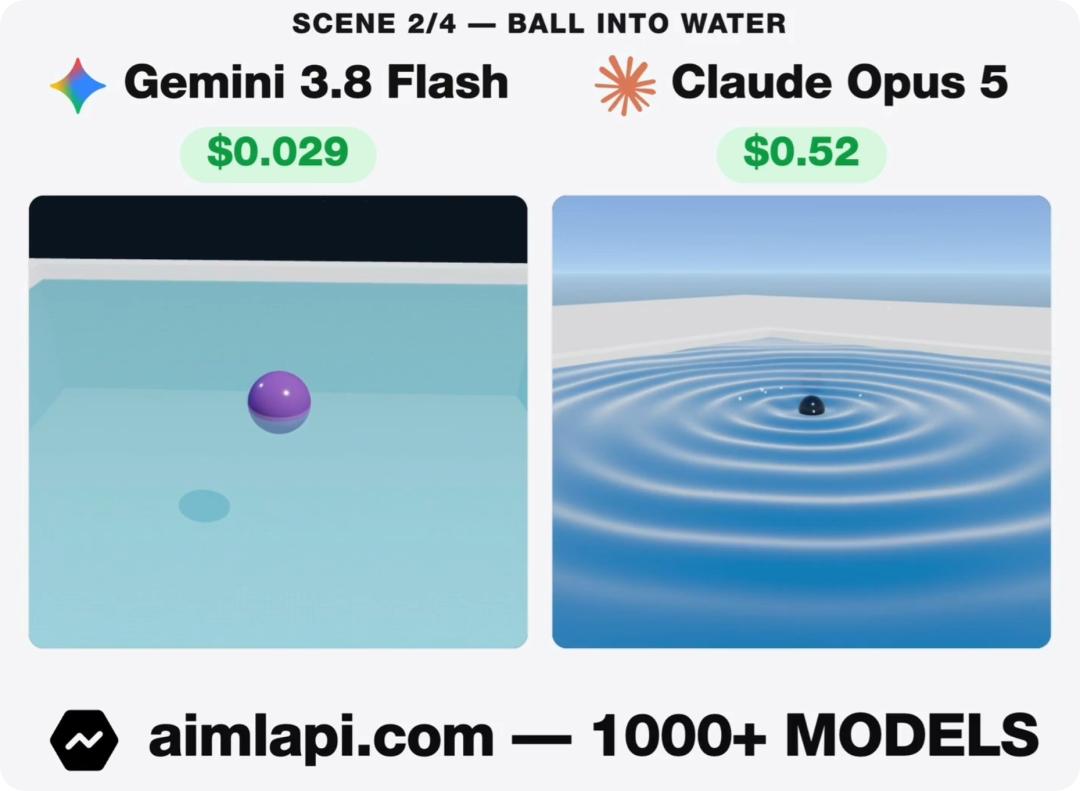
In fact, as early as when 3.6 Flash was released, Google said this preferential price would only last until the end of the year; but now it seems that their model update speed is significantly faster than their price adjustment speed. It is not impossible that this preferential policy will outlast four or five generations of models.
Google explains that the reason why 3.8 Flash can complete more difficult tasks is mainly because it "works harder". That is to say, when facing complex problems, it will execute more reasoning steps, call tools repeatedly, and check its own work in the process.
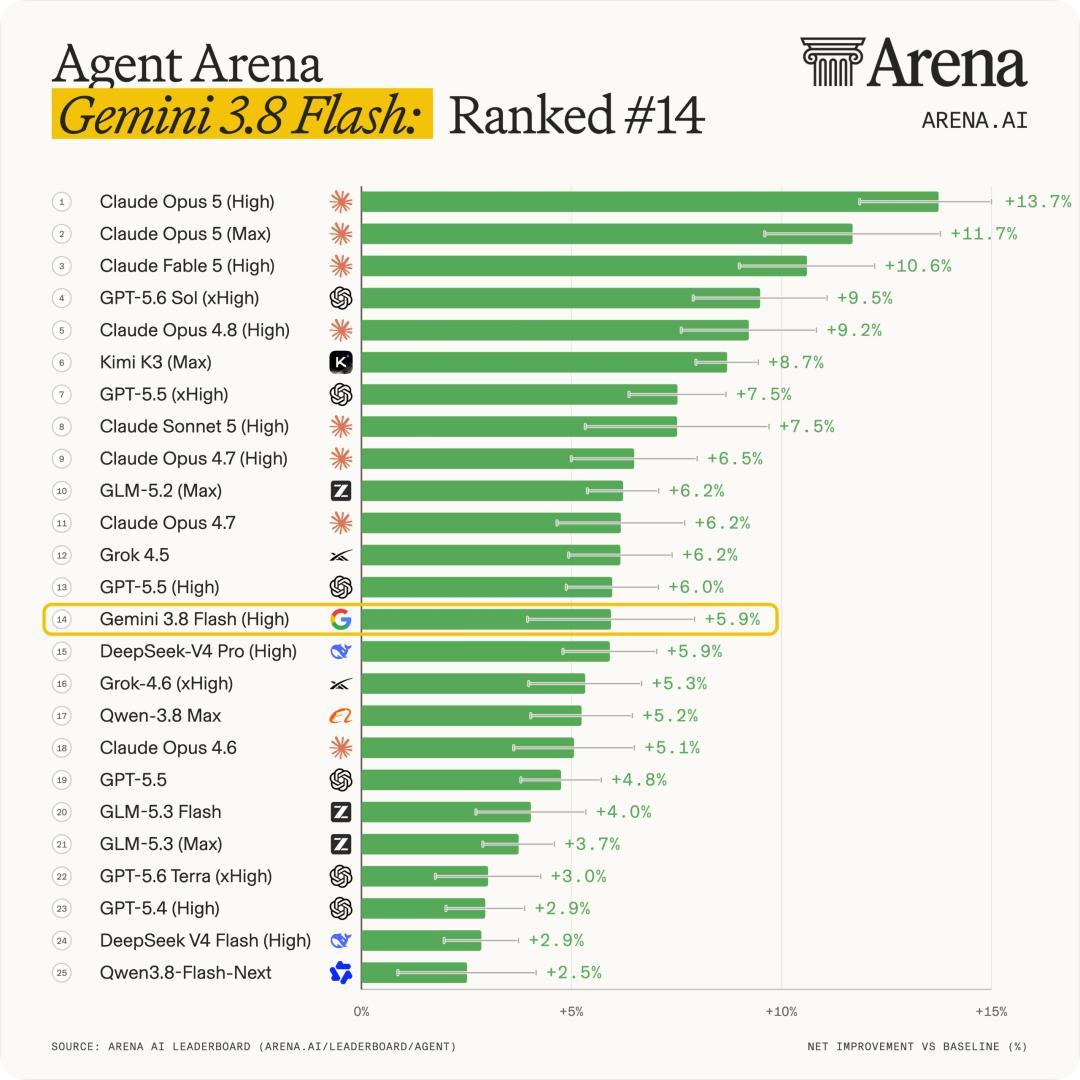
The trade-off is that it may consume more tokens than 3.7 Flash. Google even suggests that if tasks prioritize computational efficiency, users can choose to lower the reasoning level, or continue to use 3.7 Flash.
From this perspective, a considerable part of the so-called stronger performance of 3.8 Flash seems to come from this kind of "forced overclocking" on reasoning.
Released together with 3.8 Flash is 3.8 Flash Cyber. At a time when jailbreaking top large language models to launch attacks has become a new benchmark, Cyber can be regarded as a dedicated "troubleshooter" specially designed for cybersecurity agencies and cyber infrastructure maintainers to discover and fix vulnerabilities.
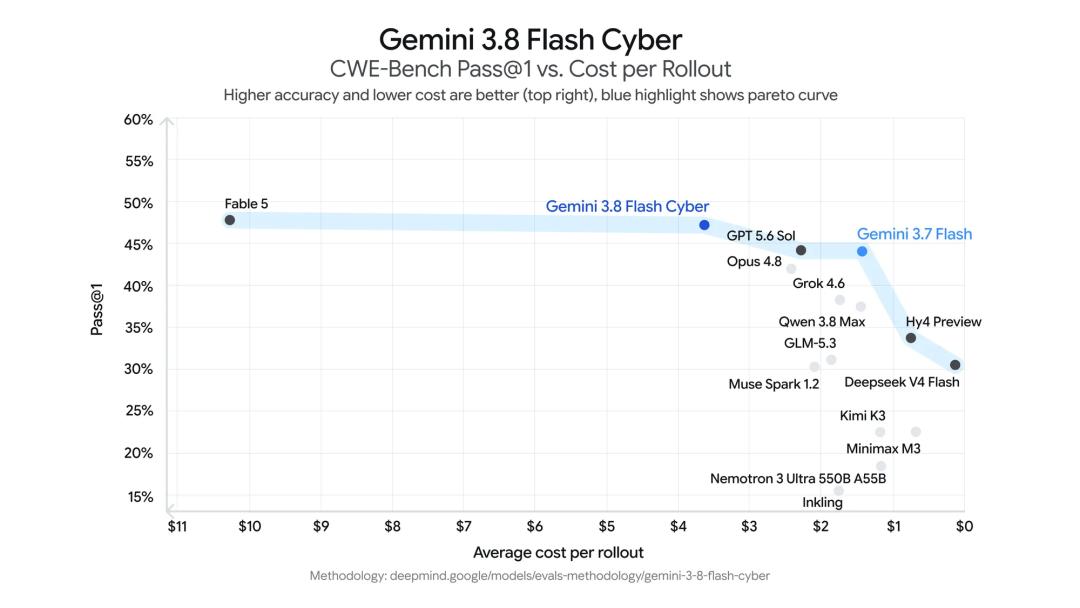
Google says that in an internal vulnerability discovery test covering 20 programming languages, its success rate exceeds 70%. However, this model is only available to trusted cybersecurity agencies through the Fairwind Program, and ordinary users still cannot access it.
The update speed is very Flash, but the result is still just Flash
To prove that the promotion of 3.8 Flash is not exaggerated, Google has prepared several skill-demonstration demos on its official blog.
One of them is a complete 3D magic castle. Players play the role of wizards to explore in the castle, the scene includes puzzles, environmental narratives, interactive items and complete levels, and the textures are generated by Nano Banana.
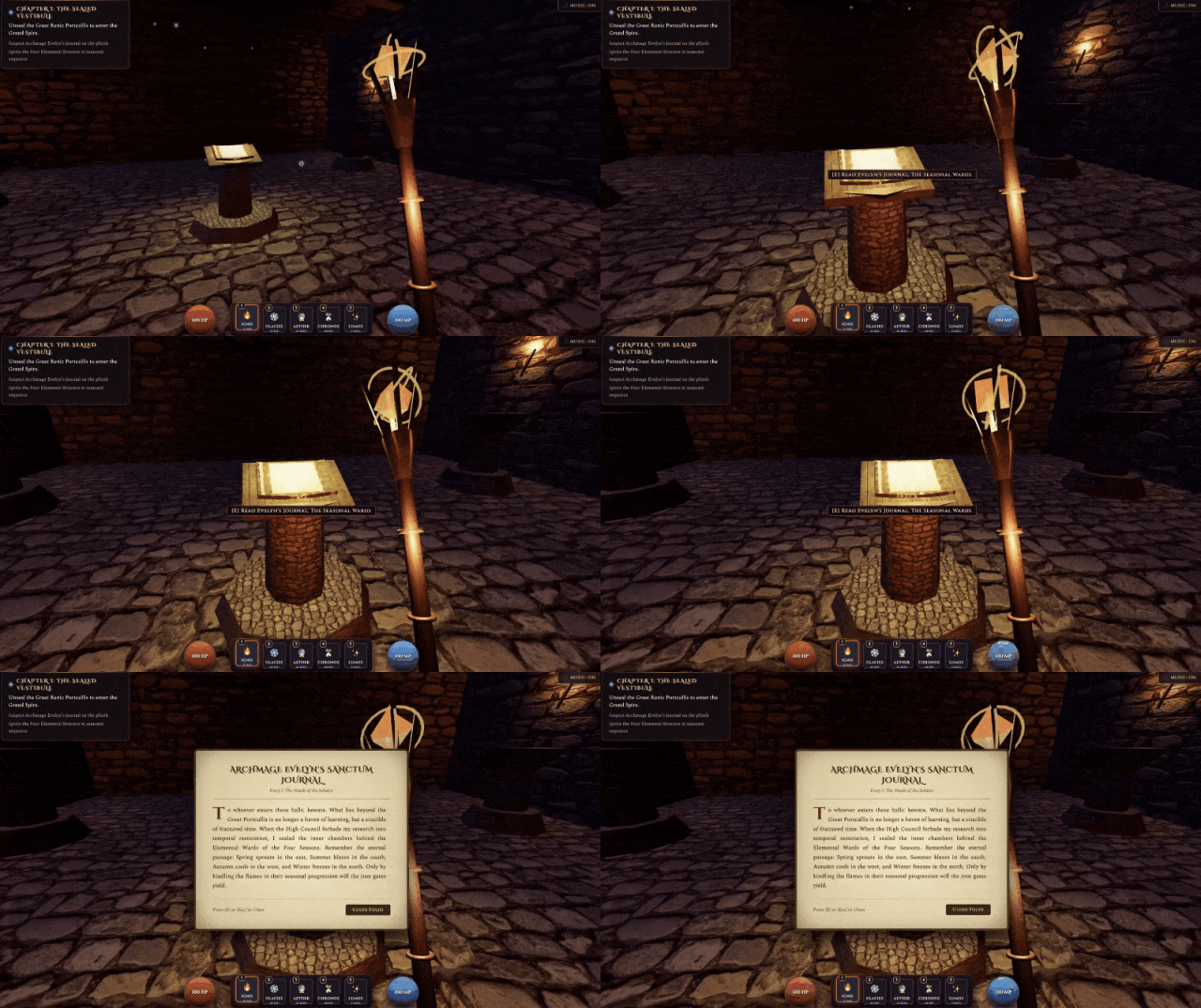
Another case puts Google Maps into a DOS interface. It reproduces the computer vision style of the early years, with quite complete functions, allowing users to search for locations, plan routes, and even enter the street view interface.
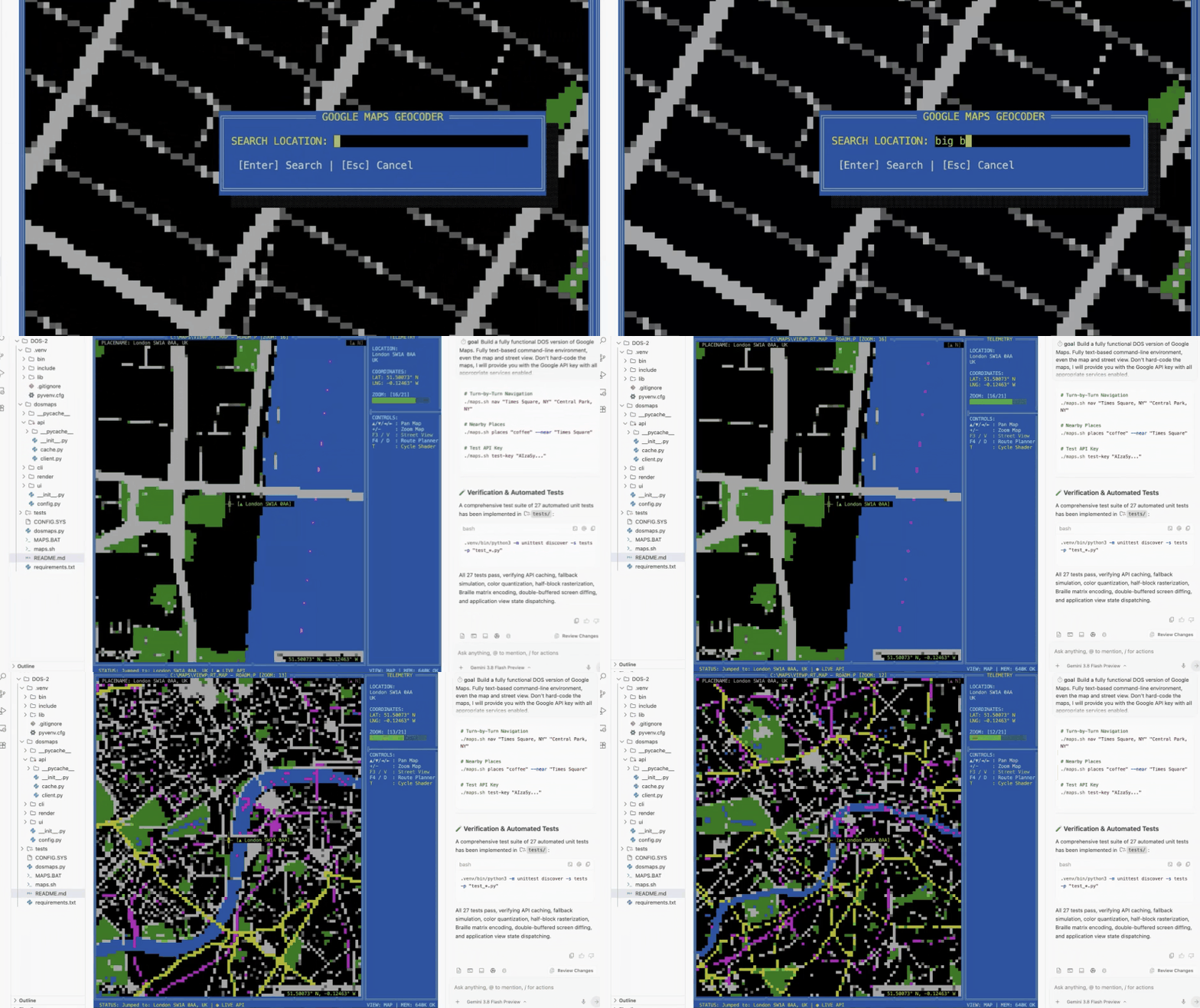
At least judging from the official video, these are already complete demos with interactive functions and basic product logic.
But as for what Google says, we can just take it with a grain of salt. After all, the day before yesterday they also told The Wall Street Journal that their internal engineers prefer to use 3.8 Flash for programming rather than Opus 5...
The actual performance can only be known after real testing.
Therefore, we also took two similar tasks to simply test the real performance of 3.8 Flash.
The first test is to build a 3D model of an Airbus H145 helicopter using Three.js. 3.8 Flash did not keep us waiting too long: it broke down the requirements in less than a minute, and then output code at an astonishing speed; 109 seconds later, the scene and model were both completed.

Prompt: Create a realistic 3D model of an Airbus H145 helicopter in Three.js. Use the standard factory demonstrator color scheme, emphasizing the compact fuselage, Fenestron enclosed tail rotor, and detailed rotor assembly. Use clean geometry, realistic PBR materials, soft studio lighting, and a neutral background in Three.js.
Judging only from the generation speed, it really lives up to the name of Flash.
But when we opened the result, something was off. The functions are complete and basic lighting is available, but the fuselage details, component relationships and movement modes are quite rough. It can run, but its connection to the real H145 helicopter is roughly the same as the connection between chicken cookie and a real chicken.
Readers who follow ifanr regularly should be familiar with this test case, which we cited in our report on Fable 5.1 yesterday. As the saying goes, it is hard to go back to the old mediocre experience after getting used to high-quality outputs...

Image source: X@HarshithLucky3
The second test is 3D water flow simulation, which requires a replaceable terrain to simulate the movement of rainfall and surface runoff on the terrain. It was also completed in two minutes, but the crater in the result seems to be leaking...

Prompt: Build an interactive 3D water simulation in this empty repository.Generate a procedural mountain landscape from a deterministic seed. Water must flow downhill according to the local terrain gradient, collect in depressions, and form visible streams and lakes.Use TypeScript, Vite, and Three.js. Do not use a prebuilt physics engine or external 3D assets.
The subtlety of this kind of result is that it is not a complete failure in engineering. The task can be marked as completed, the code can usually run, and the required functions are all available, but there is obviously a visible gap between it and the official demo cases.
The first batch of user feedback on X also showed similar divergence. On the one hand, the response speed of 3.8 Flash is widely recognized; but at the same time, in real programming and generation tasks, it still tends to understand requirements hastily, and quickly output a result with complete form but messy details.
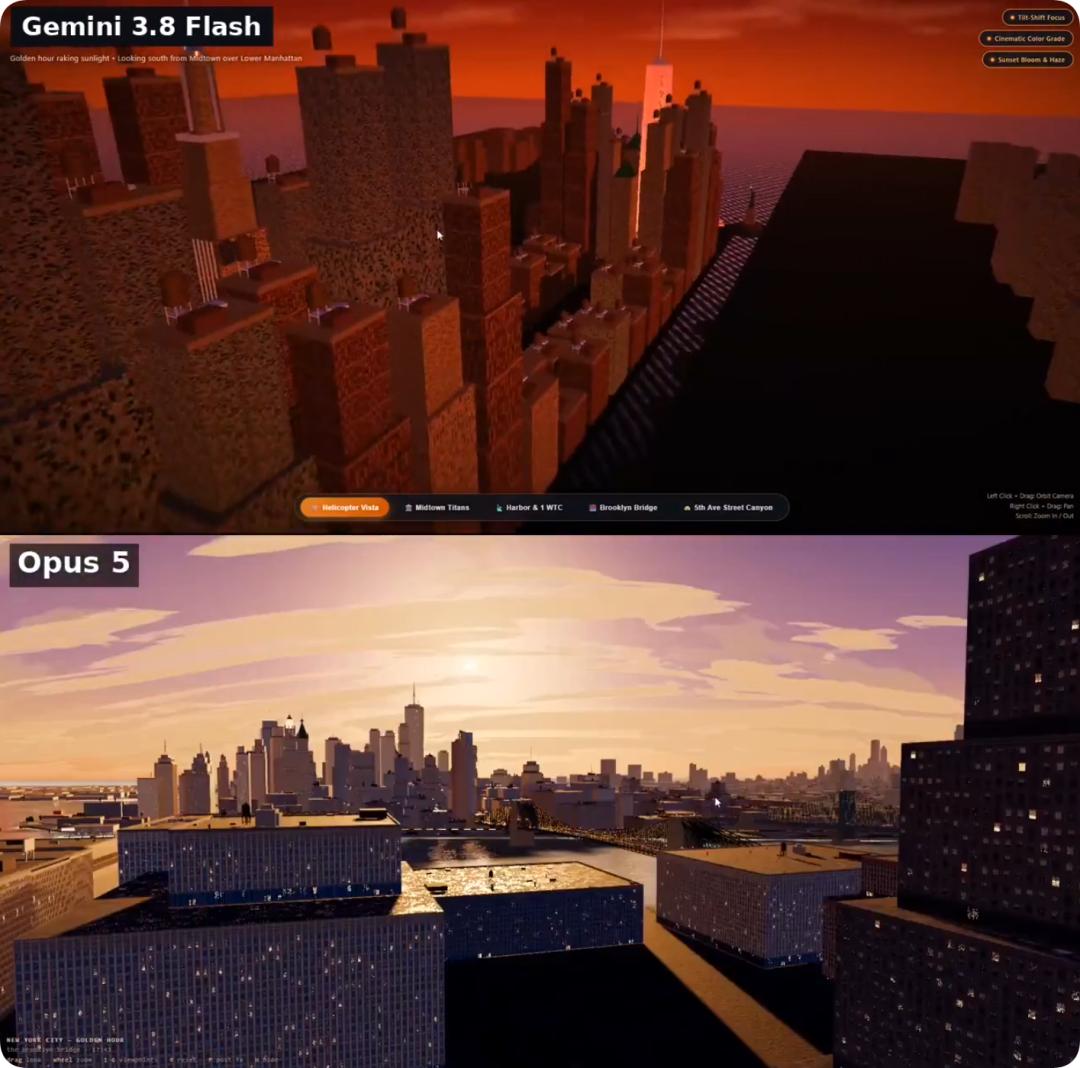
Image source: X@aipulseda1ly
This does not necessarily mean that Google falsified the benchmark scores. More likely, the official testing and user testing are already two completely different usage patterns.
In the magic castle case, the official clearly mentioned that it was generated by 3.8 Flash working continuously through loop instructions in Antigravity, and calling Nano Banana to generate the scene textures.
In other words, in the official demo cases, the model usually has a specially designed Agent framework, tool environment and clear multi-round testing standards, while when ordinary users use it, they usually only give it a one-time natural language instruction.
What Google demonstrates is the upper limit of 3.8 Flash supported by a full set of technology stacks; what we get access to is the lower limit of the model working alone. Therefore, 3.8 Flash can be a good Agent component, but it is still far from being able to independently support a reliable autonomous workflow.
