With the implementation of the new national standard, enterprises are obligated to recognize all commitments made by AI customer service.
You are selling your idle graphics card on a second-hand trading platform. The platform informs you that AI-hosted service can boost the transaction rate, but after you agree to enable the AI hosting, the AI arbitrarily sells your graphics card at a 50% discount. When you raise an objection to the order, the platform's AI customer service only repeats the same meaningless lines over and over, and you can find no way to contact a human customer service representative at all.
The case mentioned above is not a made-up joke, but a real incident that happened to a netizen. Ever since AI large model technology was applied to robot customer service, AI customer service has quickly become a "nightmare" for the vast number of consumers. Although issues including untrue commitments from AI customer service and difficulty in accessing human customer service have been repeatedly pointed out by media outlets and the China Consumers Association before, enterprises still refuse to correct their mistakes despite repeated admonitions.
Nowadays, consumers who have been tortured by AI customer service's irrelevant and off-topic replies can finally get relief. Starting from September 1 this year, the national standard "Specification for Customer Contact Service: Synergy Requirements between Artificial and Intelligent Customer Service" has been officially implemented.
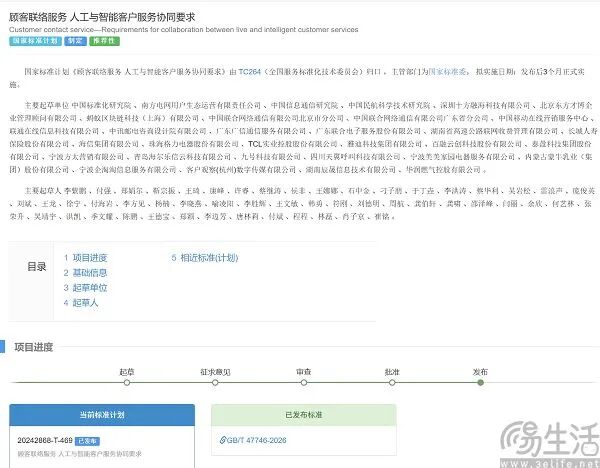
The new regulation clearly states that the service scopes of intelligent customer service and human customer service shall be allocated scientifically and reasonably, that is, "intelligent customer service gives priority to handling standardized issues, while human customer service gives priority to handling complex, safety-related and other issues". In response to problems such as the hidden "transfer to human service" entrance at multiple levels and poor user experience, the new regulation requires that the switch between intelligent customer service and human customer service "shall provide a convenient entrance and ensure smooth connection", and after the switch, "customer information shall be synchronized and no repeated inquiries shall be made". In addition, operators cannot simply refuse to fulfill their commitments on the grounds that "algorithm-generated content has no legal effect".
In short, this new regulation puts forward clear requirements for widely criticized problems of AI customer service such as "false commitments" and "difficulty in accessing human customer service". It is worth noting that the "Specification for Customer Contact Service: Synergy Requirements between Artificial and Intelligent Customer Service" is a recommended national standard, which is not equivalent to a legal basis for punishment, but its introduction can greatly change the current abnormal phenomenon of AI customer service.
How could a tool that was supposed to improve efficiency become a prop to "tease users"? The root cause is that the original intention of AI customer service has long been distorted. Many enterprises do not use it to serve users, but to drain users' energy and patience. Making a large number of users who are not willing to pursue accountability give up halfway is the unspoken secret that many enterprises are reluctant to admit.

Human customer service has problems such as slow response, limited service hours, unguaranteed service standardization, high staff turnover and high training costs, so large technology companies prefer to set up their customer service teams in regions with lower labor costs. However, no matter how much cost is reduced, the salary and available service hours of human customer service are far inferior to those of non-stop AI customer service.
Compared with the annual cost of 50,000 to 60,000 yuan per human customer service agent, the AI customer service provided by domestic SaaS vendors such as NetEase 7yu and Lingyang only costs about 10,000 yuan per agent seat. Under the current technical conditions, the hybrid mode of AI customer service plus human agent seats is the most appropriate option: AI first answers standardized inquiries (logistics query, order status, return and exchange policies), while complex complaints, disputes and personalized inquiries are transferred to human service.
However, quite a number of enterprises have chosen a solution with only AI and no human backup. It is not that they do not know the superiority of the hybrid mode, but they have calculated a clear account. In addition to the intuitive operating cost reduction, the repetitive meaningless replies of AI customer service will make a large number of users choose to "let it go", which enhances the robustness of the customer service system and obviously brings additional benefits.

However, even with the new regulation, people should not have too high expectations for the "transfer to human service" function. After all, there is still a huge vague zone in the rule that "simple issues are handled by AI, and complex ones are transferred to human service". For example, what kind of situation counts as complex and what kind of issues have standard solutions, the full discretion is in the hands of enterprises.
In fact, the real pain point that this new regulation can solve is that enterprises need to be responsible for the reply content of AI customer service. For example, CCTV News once reported a case where a food delivery rider was fined by the platform. When he contacted customer service to appeal, the AI customer service agreed to refund the fine, but after the human customer service intervened, he was told that the reply from the AI customer service was for reference only.
However, the AI customer service is built by the enterprise, and the knowledge base is also provided by the enterprise. But when it comes to taking responsibility, the AI suddenly becomes a so-called AGI, as if it has independent consciousness overnight. How can consumers accept that? Before the implementation of this new regulation, in domestic and even global judicial practice, AI is basically not regarded as a civil subject.

In addition to preferential intensity and after-sales policies being key factors affecting purchase decisions, in order to improve user experience and due to the inherent defects of Reinforcement Learning from Human Feedback (RLHF) technology, AI will cater to user inputs and follow what users say. Combining the two situations, when the AI customer service identifies words such as "preference" and "discount" in the user's wording, it will naturally choose the expression that is most likely to satisfy the user, that is, offer an amazingly low price.
However, enterprises will not do business at a loss under normal circumstances. When the user places an order with the low price promised by AI, he will naturally feel fooled. In other words, when AI customer service has the permissions comparable to human customer service, such as querying information, creating work orders and confirming orders, users may develop reasonable trust in it when it makes random promises. But after users pay, enterprises can refuse to honor the promise on the grounds of AI hallucinations and other reasons.
It is acceptable if the AI customer service gives irrelevant replies or cannot solve the problem, but if the enterprise refuses to recognize the commitments made by AI, users will suffer real economic losses after being fooled. When enterprises are required to be responsible for the replies of AI customer service, the situation will naturally change dramatically. Following what users say is the instinct of large AI models based on RLHF, and it is difficult for enterprises to avoid AI customer service talking nonsense. Especially when users actively "tune" the model, the probability of AI making inappropriate remarks will become even higher.

At this time, AI customer service will no longer be an all-purpose "scapegoat", but become a "bomb" that enterprises have to hold carefully, so that they can no longer use it unscrupulously. In this case, enterprises need to implement the hybrid mode of AI customer service plus human agent seats, and human customer service cannot be just a decoration, but play the role of a "safety barrier".
This article is from the WeChat Official Account "San Yi Life" (ID: IT-3eLife), the author is San Yijun, and 36Kr publishes it with authorization.