After outperforming humans, humanoid robots have set their sights on racket sports.
Serving, moving, and returning the ball, humanoid robots can now achieve fully autonomous racket hitting matches.
At the opening ceremony of the 2nd World Humanoid Robot Games, the two demonstration events of tennis and table tennis received high attention. Facing renowned tennis player Zheng Jie and table tennis Olympic champion Ding Ning, the tennis robot from Galaxy Universal and the table tennis robot from the SMASH team of the University of Hong Kong responded calmly, performing autonomous serving, pace adjustment, forehand and backhand returns smoothly, and can also complete technical movements such as retrieving the ball and lobbing, with their performance nearly reaching the level of human beginners.
Apart from the exhibition matches, table tennis was also included in the official events of the World Humanoid Robot Games for the first time. The competition adopted the 11-point system, and two humanoid robots completed full matches fully autonomously. A total of 12 teams from universities including Peking University, Tsinghua University, the University of Hong Kong, Shanghai Jiao Tong University, University of California, Berkeley, and enterprises competed for the championship. In the end, the joint team of Peking University Institute of Intelligent Computing won the championship, the SMASH Hyperdimensional team of the University of Hong Kong won the runner-up, and the joint team of Shanghai Jiao Tong University / Shanghai Zhichuang College won the third place.
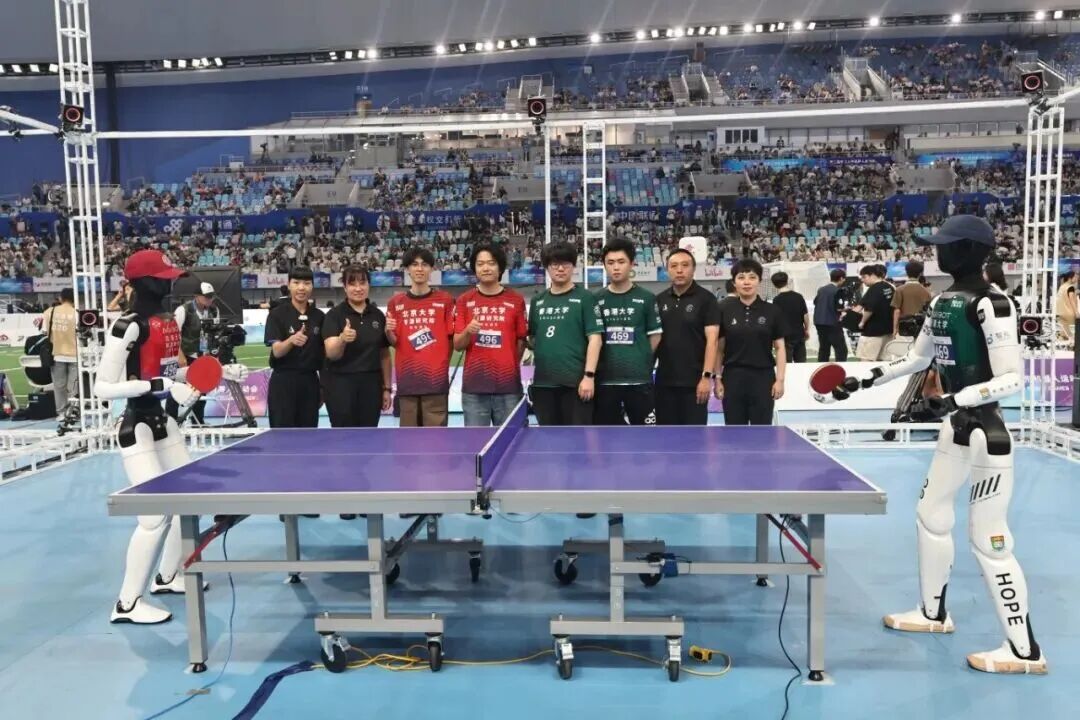
At the 2026 World Robot Contest that just concluded in Yizhuang not long ago, table tennis has become an important window for manufacturers to demonstrate their technologies —— Hyperdynamics, Dongyi Technology, Jiashi Vision, and Unitree Robotics all set up table tennis human-robot interaction areas at their booths, attracting a large number of audiences to interact.
Racket sports are becoming a new technical arena in the field of humanoid robots, attracting more and more university research teams and robot manufacturers to enter the layout.
Why racket sports?
According to reports from China New Economy Media, Zhang Haiwei, founder of Qingtong Vision, divides the sports that robots can achieve into three categories: routine sports (such as dancing), single-player adversarial sports (such as tennis, table tennis, badminton) and team adversarial sports (such as football, basketball).
Zhang Haiwei further pointed out that current routine sports can be realized through pre-programming with relatively mature technologies; single-player adversarial sports such as racket sports require robots to have real-time perception and decision-making capabilities, and have made preliminary progress; team adversarial sports involve complex collaboration and game mechanisms, and are still in the exploration stage.
At this World Humanoid Robot Games, a total of 11 events were set up, including track and field, gymnastics, table tennis, martial arts, and free combat. In events such as gymnastics, martial arts, and sports dance, humanoid robots can already complete difficult movements such as front and back flips, and can also perform smooth dance performances along with music; in events that test underlying motion control capabilities such as running and high jump, the results of humanoid robots have repeatedly surpassed the world records previously created by humans.
And racket sports are the next mountain that humanoid robots need to climb now. It requires humanoid robots to achieve visual capture, trajectory prediction and reaction decision-making of high-speed moving spheres in a very short time, while coordinating the movements of the whole body and maintaining their own balance. As Zhang Shanghang, a researcher at the School of Computer Science of Peking University, said in an interview with *The Beijing News*, "When a robot plays table tennis, what it tests is the collaboration of eyes, brain and body. The 'eyes' capture the movement trajectory, the 'brain' makes rapid prediction and decision-making, and then mobilizes the whole body to execute precisely."
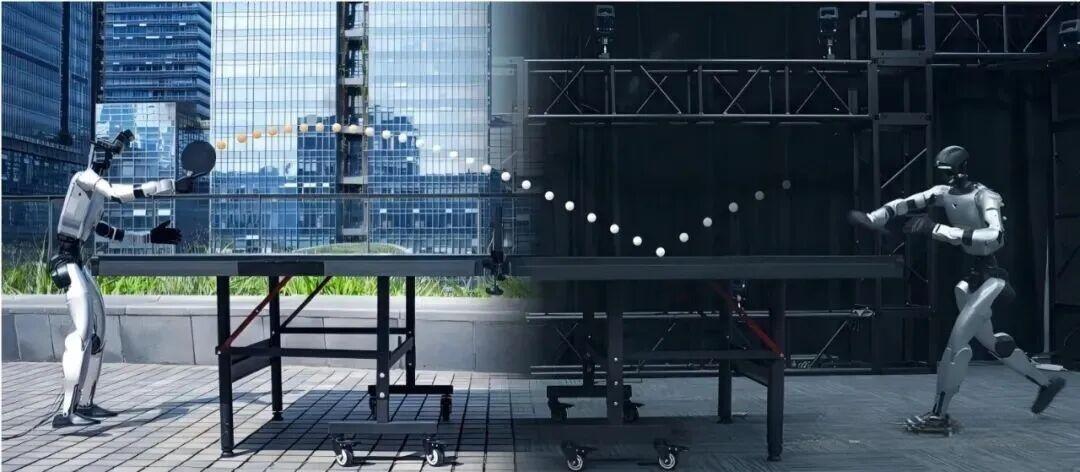
This capability highly matches the needs of the real world. For humanoid robots, the "perception-decision-execution" closed loop trained in millisecond-level time in racket sports is consistent with the underlying logic of real scenarios such as industrial sorting and home services —— perceive the environment first, then make judgments, and finally execute.
"The perception decision-making, motion generalization and motion control capabilities exercised by humanoid robots in table tennis events essentially have very strong transferability," Li Yinghui, captain of the SMASH Hyperdimensional team of the University of Hong Kong, told Lanxiong Sports. When humanoid robots perform tasks in real life scenarios, such as picking up garbage, they also need to locate the target object first, then plan the movement path, and finally execute precisely.
Where are the difficulties?
For humans, facing an incoming ball and hitting it back with a racket is almost an instinct. But for humanoid robots, behind this is a huge amount of engineering and a series of technical difficulties that need to be overcome.
Racket sports are highly dynamic sports, with extremely high requirements for perception. It takes less than 0.15 seconds for a table tennis ball to go from serving to crossing the net, and the ball speed can exceed 15 m/s; the speed of a tennis ball is often as high as hundreds of kilometers per hour. The ball is small, fast, and spinning, and traditional visual solutions are prone to image blurring or perception delay under high-speed movement.
The current main solution is to install an external visual perception system. At this Humanoid Robot Games, multiple motion capture cameras are installed in both the table tennis and tennis courts, which can lock the coordinates and motion trajectories of the ball and the robot in millisecond-level time, providing real-time data for subsequent decision-making.
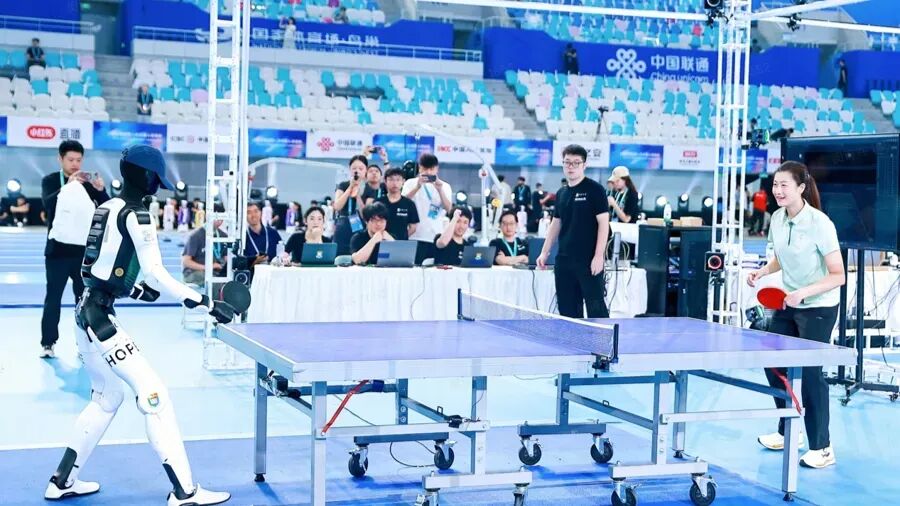
In daily training, the SpikePingpong algorithm of the Peking University team integrates high-frequency pulse vision up to 20kHz (20,000 times per second) with imitation learning strategies, enabling the robot to capture the precise trajectory of the ball in real time, compensate for interferences such as air resistance, and achieve millimeter-level prediction of the ball-racket contact point.
Clearly seeing the incoming ball is only the first step. The real challenge lies in decision-making and execution. In current humanoid robot research, "brain + cerebellum" is a common framework for understanding this process: the so-called "brain" is mainly responsible for judgment and decision-making; the "cerebellum" is responsible for motion control, converting decisions into movements of various parts of the body. The collaboration of the two can enable the robot to achieve a higher degree of whole-body coordination and complete continuous and stable dynamic tasks.
On the table tennis court, the "brain" must complete trajectory prediction, landing point judgment and hitting strategy generation in millisecond-level time, and the "cerebellum" synchronously converts it into precise whole-body motion control. The table tennis event uniformly uses the Ubtech robot as the ontology, and the core competition is the algorithm capability of each team.
In terms of the collaboration mode of "brain + cerebellum", each team has chosen different technical paths. In the special research report on humanoid robots released by Industrial Securities in April this year, the mainstream frameworks are divided into two categories: layered and end-to-end. The layered architecture adopts the division of labor of "brain - cerebellum - limb"; the end-to-end architecture directly maps from human instructions to robot movements, with higher integration.
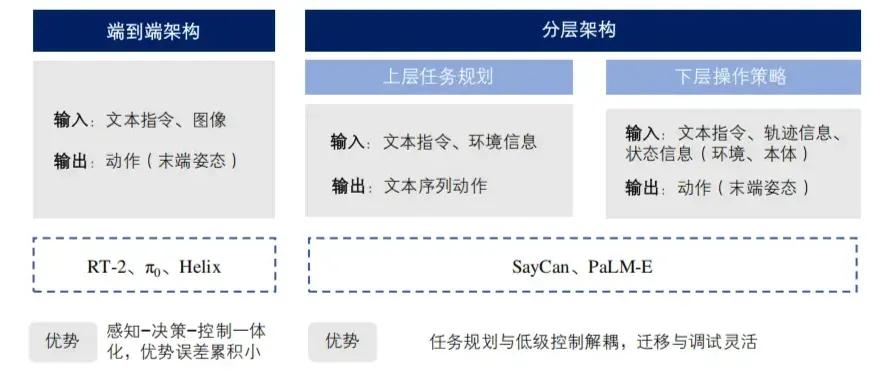
Types of embodied intelligence large model architecture
Both the UC Berkeley team and the University of Hong Kong team adopt a layered architecture, with a model-based planner in the upper layer responsible for ball trajectory prediction and calculation of hitting position, speed and timing; a reinforcement learning-based whole-body controller in the lower layer responsible for converting the planning target into coordinated arm and leg movements.
The University of Hong Kong team also integrated a large amount of human motion data into the lower-layer learning, collected two months of hitting data of human table tennis players before the competition, covering the entire table range, and finally realized "precise hitting on the basis of human-like movement" through motion database matching, and can now complete technical movements such as near-table flick, far-table smash, and ball retrieval. Li Yinghui revealed to Lanxiong Sports that her team will evolve to the end-to-end mode in the later stage.
The iPingPong team of Tsinghua University chose a more challenging end-to-end model. Team leader Zheng Zi'ang explained to *Beijing Daily*, "This mode has difficult algorithm design and training, but has a high performance ceiling. For example, it can learn technical movements such as backhand powerful smash similar to professional athletes, which is impossible for traditional layered solutions, but the training difficulty will be greatly increased."
Apart from decision-making and execution, the hardware ontology also determines the upper limit of motion. The UBTECH Walker A3 uniformly used in this event is 1.73 meters high and weighs only 55 kg. Cao Xu, Vice President of Universal Business Department of UBTECH, said to *The Beijing News* that when the robot has great strength and light weight, the movement speed will be very fast, and the robot joint has a peak torque of nearly 400 Nm, with strong instantaneous explosive power.
Commercial prospects in sports scenarios
At present, the performance of humanoid robots in racket sports is still at the level of human beginners —— they can catch the ball, but there are still deficiencies in pace, prediction and handling of complex ball paths.
Commercialization in sports scenarios is still in the verification period. On the one hand, the technology is not yet fully mature, and it is still far from stable commercial deployment, and many manufacturers are still waiting and seeing. Humanoid robots still have much room for improvement in the use of dexterous hands, handling of spinning balls, and running across the whole court.
On the other hand, the current cost is still high. Whether it is the deployment of motion capture systems or the manufacturing of robot ontologies, it is difficult to support large-scale promotion. Taking the perception solution as an example, a single OptiTrack optical motion capture camera sells for tens of thousands of yuan, and at least 6 to 8 units are required for one venue to achieve effective identification and coverage. Coupled with the robot ontology of hundreds of thousands of yuan, the deployment cost of the whole system remains high.
In response to this, the SMASH team of the University of Hong Kong is exploring a pure vision solution based on on-board cameras, gradually getting rid of the dependence on external motion capture systems. At the Shandong Table Tennis Cultural Tourism Carnival this year, the team has achieved table tennis matches with Olympic champion Chen Meng outdoors with its self-developed autonomous perception system. Li Yinghui told Lanxiong Sports, "For humanoid robots to enter thousands of households, they must rely on their own vision and take a low-cost path. We hope that after mass production, the robot only has its own hardware cost."
Once this direction is opened up, it will greatly lower the deployment threshold and pave the way for robots to enter more application scenarios. In Li Yinghui's view, "As the industrial chain becomes more and more mature, hardware costs will continue to be compressed. In the future, humanoid robots can achieve a price that ordinary families can afford, which may be as low as cars, or even lower."
In specific sports scenarios, some manufacturers are already conducting market verification. In July this year, Dongyi Technology set up the "Go-C Badminton Hall" in Guangzhou —— an immersive experience space with humanoid robots autonomously playing badminton as the core, which has been in normal operation for nearly a month. It achieved a peak of more than 1,000 people in a single day and a total of nearly 10,000 visitors, providing preliminary verification for the commercial scenario of humanoid robot racket sports.
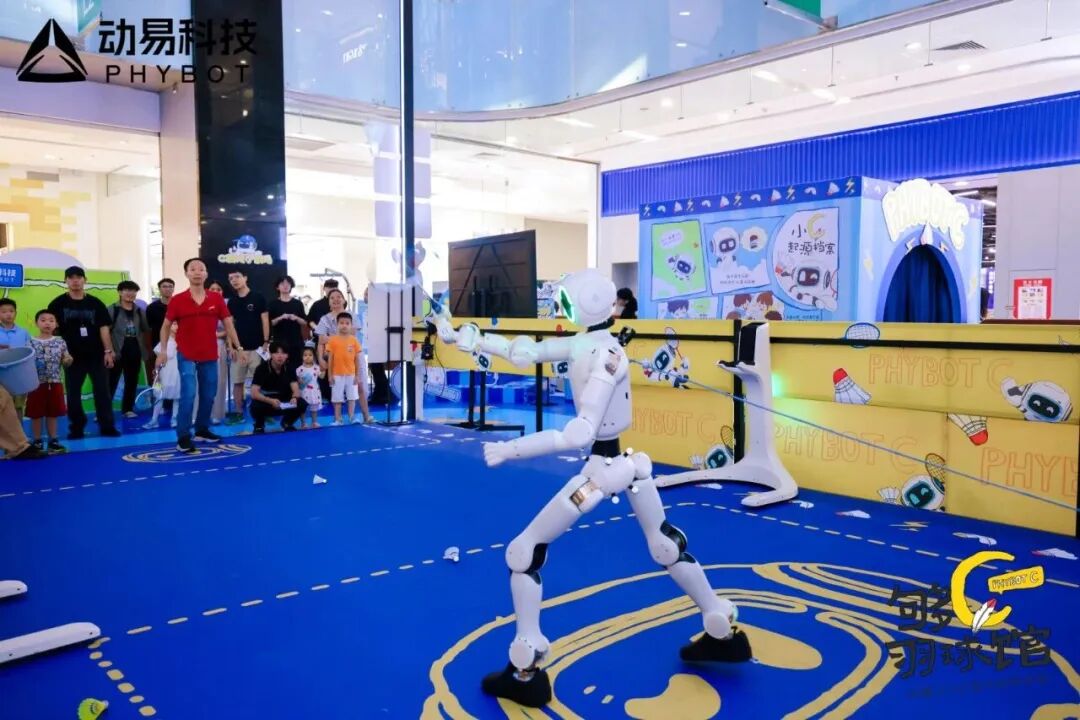
Dongyi Technology "Go-C Badminton Hall"
Apart from public experience, humanoid robots also have application space in the professional sports field. The humanoid robot has a body structure similar to that of humans, which enables it to reproduce the data and playing styles of specific athletes, providing customized training support for professional players. After the opening ceremony tennis exhibition match, Zheng Jie expressed this idea to Kang Hui, the host of China Media Group: "I hope that in the future, humanoid robots can provide customized training for our professional athletes. For example, I am afraid of receiving Serena Williams' serve. If it can simulate a similar serve, it can play a very good auxiliary role in my training."
Regarding the timetable for commercial implementation. Li Yinghui judged that it will take about 2 to 3 years for humanoid robots to achieve commercial implementation in the field of table tennis, and by then the robots are expected to reach the level of sparring partners. Wang He, founder of Galaxy Universal, is more optimistic. He said in a group interview that in the next one or two years, humanoid robots are likely to reach the expert level in the field of tennis, and even challenge world champions.
After running, humanoid robots have begun to explore new capability boundaries. There is obviously still a long way to go before they really enter factories and homes. But starting from a high-speed flying ball, humanoid robots are already learning the next lesson, and their learning speed is equally amazing.
This article is from the WeChat official account "Lanxiong Sports" (ID: lanxiongsports), author: Su Yang, authorized for release by 36Kr.