Two post-2000s generation members supply data to NVIDIA, with a valuation of 21.5 billion.
Zhidx, September 2 news. Today, citing two people familiar with the matter, Forbes reported that U.S. AI training data startup AfterQuery has reached a valuation of $3.2 billion (equivalent to about RMB 21.5 billion). A source familiar with the matter said the company is already profitable and has identified a lead investor for a new round of financing. The specific financing amount and the identity of the investor have not been announced, and AfterQuery declined to comment on this.
Five months ago, AfterQuery's valuation was only $300 million (equivalent to about RMB 2 billion), and its valuation has increased by about 10 times in five months. AfterQuery was selected for Y Combinator's 2025 Winter Startup Accelerator Program. YC partner Gustaf Alströmer said that the company took only about 18 months from its founding to become a unicorn, making it the fastest-growing startup in YC's history to achieve this milestone.
AfterQuery was founded in February 2025, headquartered in San Francisco, USA, and selected for the 2025 YC Winter batch. Its co-founders Spencer Mateega and Carlos Georgescu were still in college when they founded AfterQuery. After trying to develop financial Agents for a period of time, they pivoted the company to focus on providing expert reasoning data, reinforcement learning environments and model evaluation services for cutting-edge large models.
AfterQuery claims that its platform has gathered nearly 100,000 professionals. In July this year, Mateega posted on X that the company's annualized revenue scale has reached several times the $100 million (equivalent to about RMB 672 million) disclosed in April this year.
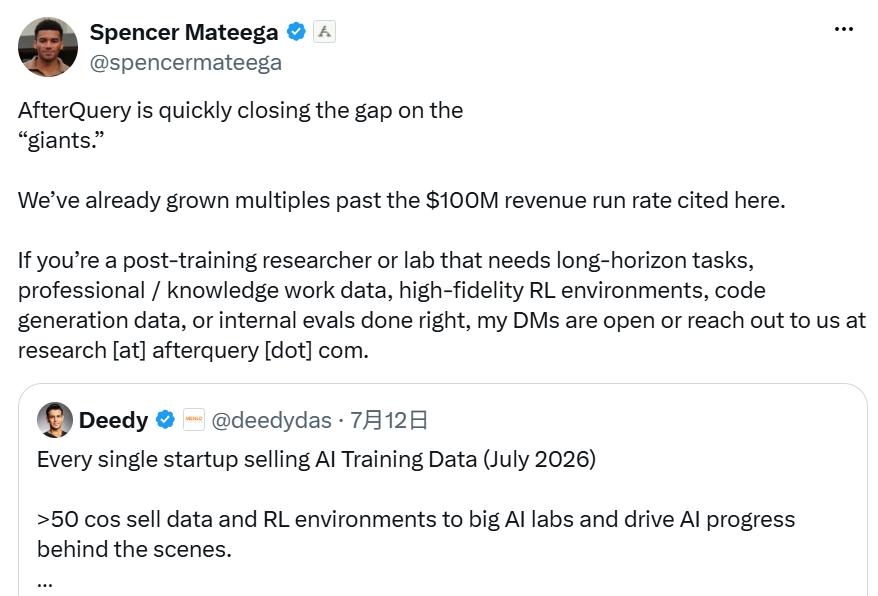
▲ Mateega posted that the company's revenue has reached hundreds of millions of dollars (Source: X)
According to Forbes, AfterQuery's data has been used for NVIDIA Nemotron 3 Ultra model training, and the company also cooperates with Thinking Machines Lab, legal AI firm Legora and some Chinese AI laboratories.
From a YC project founded by two college students to a unicorn with a valuation of RMB 215 billion, AfterQuery's rapid growth reflects the changes in the AI training data market: the demand of large model companies is shifting from simple basic labeling to complex task data provided by professionals.
01 Met in high school, interned at Meta together, pivoted from financial Agent to large model training data
AfterQuery's two co-founders, Spencer Mateega and Carlos Georgescu, are 23 and 22 years old respectively. They were still in college when they joined YC, with neither a product nor a clear specific entrepreneurial direction at that time.
After the transformation, AfterQuery positions itself as an applied research laboratory serving foundational model development, which mainly provides reasoning data, reinforcement learning environments and model evaluation services created by professionals for cutting-edge large models, instead of traditional data labeling business. AfterQuery currently has a team of about 30 people.
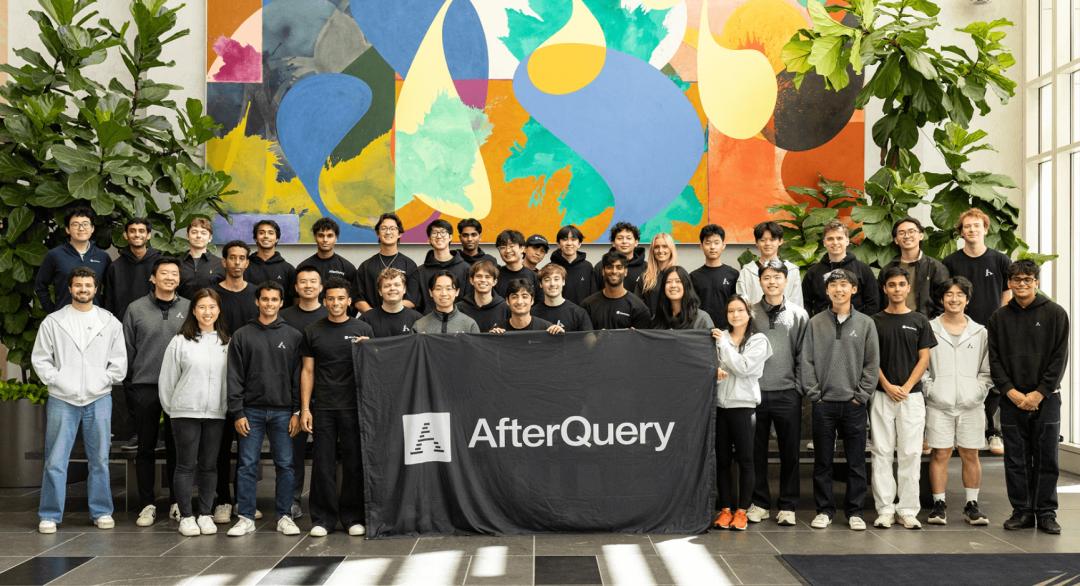
▲ Members of the AfterQuery team (Source: AfterQuery)
The two core founders of AfterQuery met in high school. At that time, the two participated in the computer science summer program held by Google, and then went to intern at Meta together.
Mateega, co-founder and CEO of AfterQuery, used to work as a software engineer at Meta and Google, and also interned in the technology investment banking department of Morgan Stanley and private equity firm Silver Lake. He obtained a bachelor's degree in finance and statistics from the Wharton School of the University of Pennsylvania, and also a master's degree in computer science from the University of Pennsylvania.
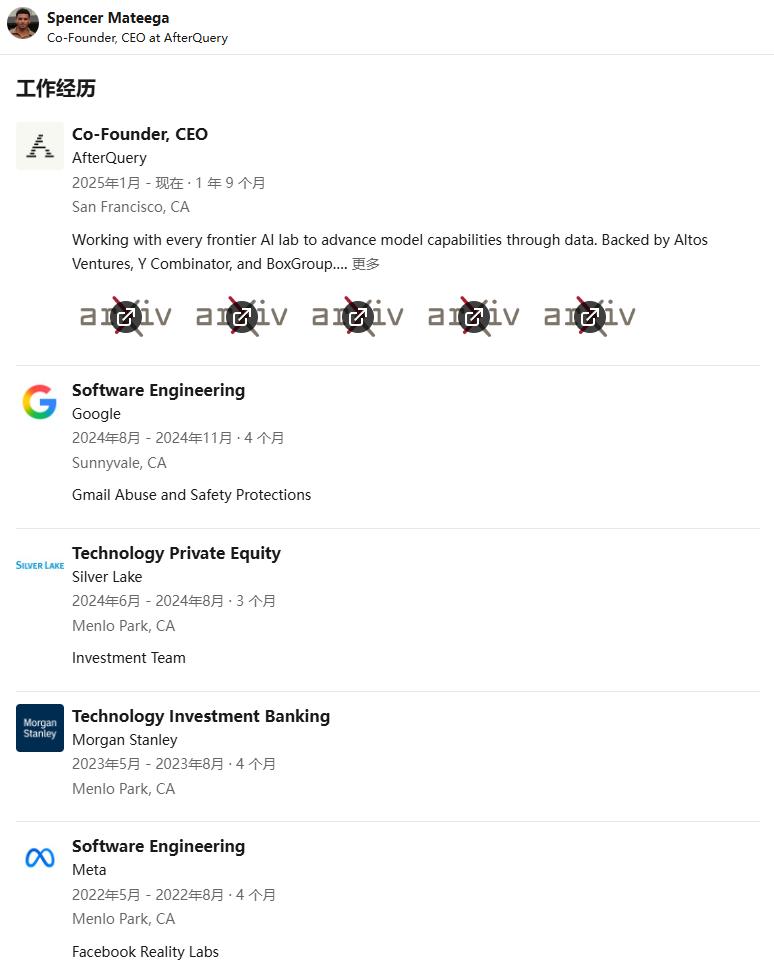
▲ Work experience of co-founder and CEO Mateega (Source: LinkedIn)
Georgescu, co-founder and CTO, studied computer science at the University of British Columbia, Canada. During his time in college, he founded and sold an edtech company, worked as a software engineer at Meta, and interned at quantitative trading firm Citadel Securities twice. After joining YC, Georgescu, who still had one year of unfinished studies, decided to drop out of school to start a business.
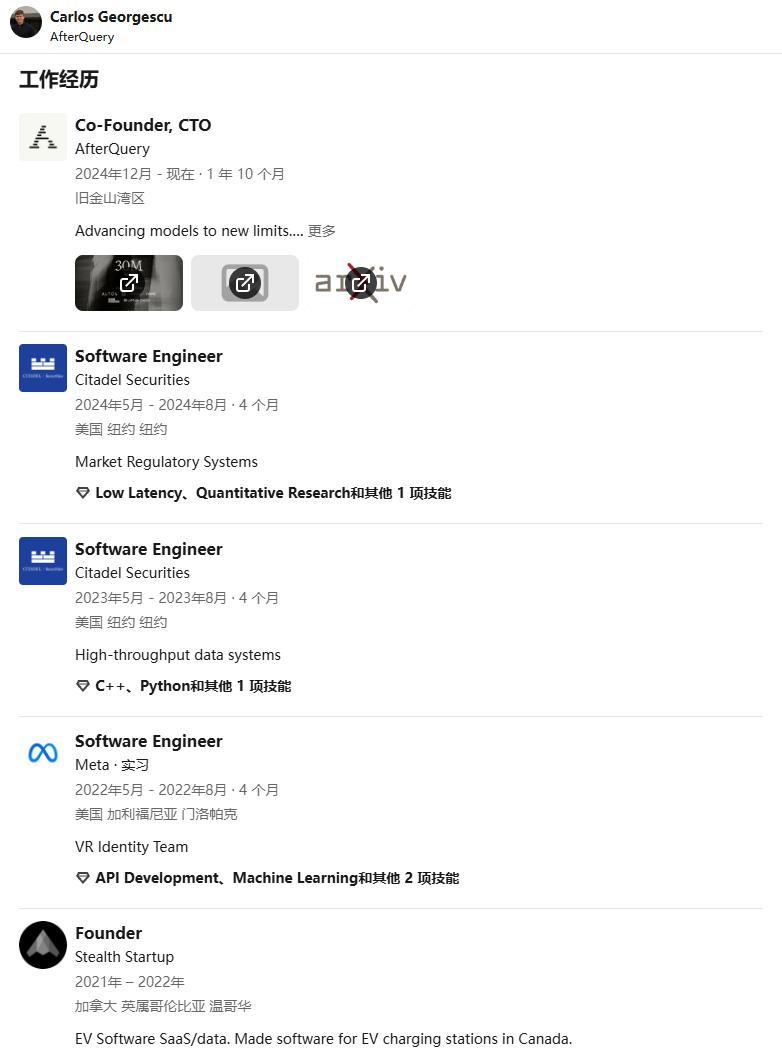
▲ Work experience of co-founder and CTO Georgescu (Source: LinkedIn)
According to Forbes, in early 2025, the two submitted their materials in 48 hours before the YC application deadline. At that time, they had no products and no clear entrepreneurial direction, only confirming that they would go to San Francisco to enter the AI industry. After being selected for YC, the two first tried to develop AI Agents for the financial industry, hoping to let the model automatically complete professional work such as investment analysis.
However, during the testing process, they found that even the most advanced large models at that time still failed frequently in complex white-collar workflows. The problem was not entirely in the model architecture, but that the model had not received sufficient professional work training, and did not know how practitioners deal with tasks with incomplete information, vague standards, or tasks that require judgment based on experience.
The two therefore decided to pivot, no longer directly developing financial applications built on top of large models, but providing underlying training data for large models. They began to collect the judgment processes and step-by-step reasoning data of experts in finance, software engineering, law, medical care and other fields, hoping to transform the tacit knowledge accumulated by professionals over a long time into materials that models can learn from.
02 Huge demand for high-quality data, valuation increased 10 times in five months
In April this year, AfterQuery completed a $30 million Series A financing, with a post-investment valuation of $300 million (equivalent to about RMB 2 billion). This round of financing was led by Altos Ventures, with participation from The Raine Group, Y Combinator, BoxGroup and Latitude Capital, and the investors also include individual investors from Google DeepMind, OpenAI, Anthropic, Meta Superintelligence Lab and Microsoft AI.
If the $3.2 billion valuation disclosed by Forbes this time is confirmed, it means that AfterQuery's valuation has increased by about 10 times in five months.
Driving the rapid growth of AfterQuery is the demand of cutting-edge AI companies for high-quality training data. General large models have digested a large amount of publicly available text, images and codes on the Internet, and synthetic data generated by models also has quality boundaries.
In order for models to complete professional tasks such as financial analysis, software development, legal review and medical judgment, AI laboratories need to further obtain the complete process of professionals making judgments, handling exceptions and using software tools in real work.
As a result, data labeling that used to rely mainly on a large number of low-cost personnel has gradually transformed into a "reasoning data" business involving professionals such as software engineers, lawyers, financial analysts and doctors. What data vendors sell is no longer just simple classification labels, but the thinking process, operation trajectory, judgment criteria and feedback results of experts when dealing with complex tasks.
Human data has thus become one of the fastest growing valuation directions in the AI entrepreneurship field. Alexandr Wang, founder of Scale AI, once became the world's youngest self-made billionaire relying on the data labeling business. The three founders of another AI data company Mercor later refreshed this record at the age of 22. According to The Information's report in August, Mercor is in talks with NVIDIA for a new round of financing, with a target valuation of $20 billion (equivalent to about RMB 134.4 billion).
03 Gathered nearly 100,000 professionals, verified data with customized software systems
AfterQuery claims that its platform has gathered nearly 100,000 verified professionals covering engineering, medical care, law, finance and other fields. These practitioners are responsible for providing professional judgments, operation processes and task feedback, helping models learn practical work experience that is difficult to master only through public network data.
The company's products include supervised fine-tuning and human feedback reinforcement learning data, tool invocation and computer operation reinforcement learning environments, as well as customized training sets and model evaluations. For example, AfterQuery can build a training environment based on real APIs, MCP servers and development tools, allowing AI Agents to learn to call tools, handle errors and complete multi-step tasks.
In an interview with Forbes in April this year, Mateega said that the difference between AfterQuery and peers such as Mercor is that it uses a customized software system to verify human-generated data. The system will conduct multiple rounds of checks to keep the task difficulty in a moderate range: it can pose challenges to advanced models, but not so much that the model cannot answer at all.
AfterQuery will also run the post-training process by itself before delivering the data, to observe whether the data can improve the model's benchmark test scores. Mateega said this allows customers to judge the data quality through the change of model performance before viewing the data.
04 Used in NVIDIA large model training, legal evaluation set covers 5161 cases
AfterQuery's data has entered the actual training process of cutting-edge models. The technical report of Nemotron 3 Ultra released by NVIDIA in June this year shows that it used the office and workplace task data provided by AfterQuery to train the model, and the relevant data covers file-based reasoning, professional deliverable generation, multi-step analysis and result evaluation. AfterQuery claims that they are the only named data partner in this technical report.
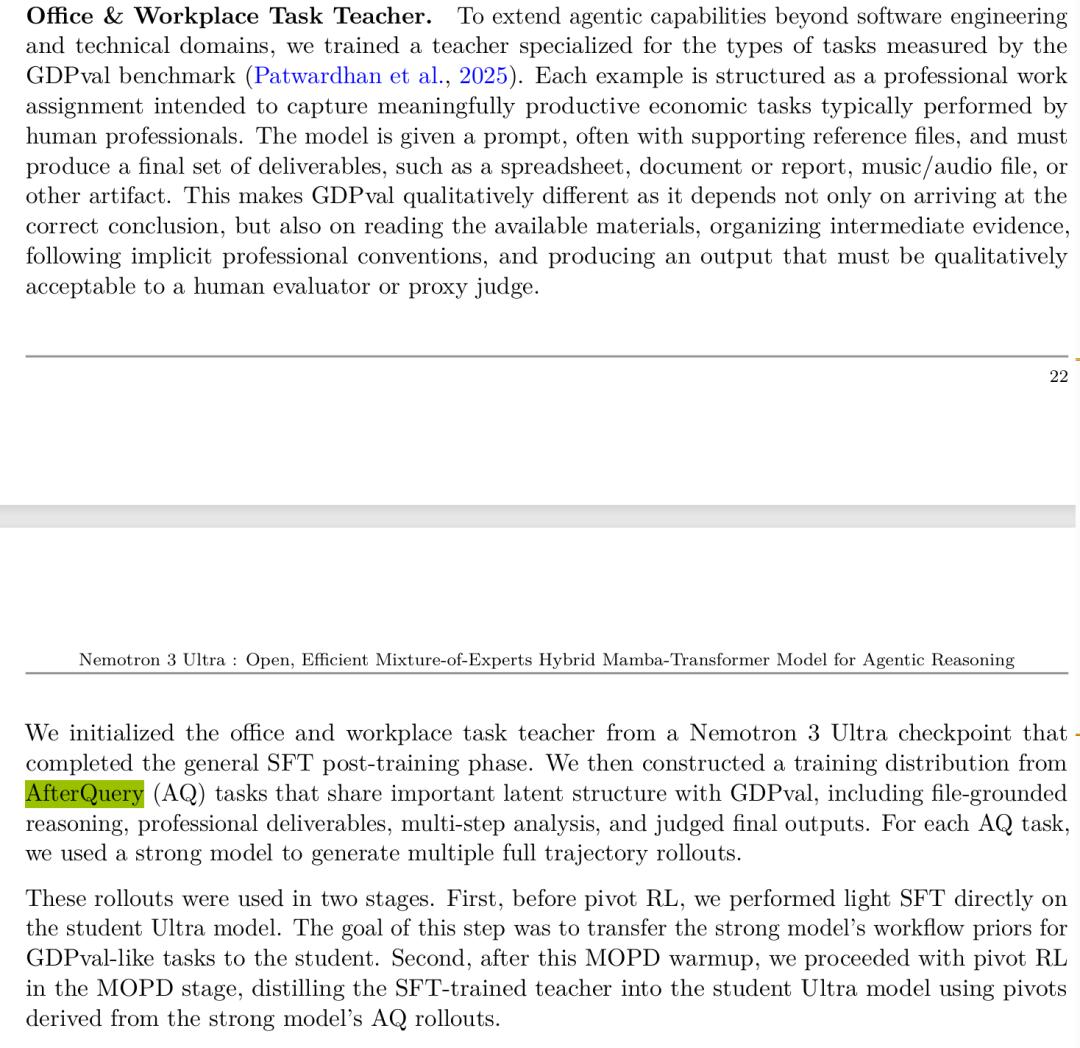
▲ Data provided by AfterQuery was used in part of the training of NVIDIA Nemotron 3 Ultra (Source: NVIDIA)
AfterQuery said that in an ablation experiment by NVIDIA, after adding relevant preheating training, the score of Nemotron 3 Ultra on the real professional task evaluation set GDPval increased from 35.3 points to 46.7 points. GDPval covers the nine industries with the largest GDP in the United States, 44 occupations and 1320 real work tasks.
In the legal field, AfterQuery and legal AI startup Legora jointly developed BAR, an Agent reasoning evaluation benchmark. This evaluation set contains 5161 cases and 11075 source files in 28 legal business fields, which is used to test whether AI Agents can complete end-to-end legal work in Legora's tool environment. Legora said that after adjusting the system according to the problems found in this evaluation, the output quality of its product on the same model increased by 5% within one month.
According to Forbes, AfterQuery once cooperated with Thinking Machines Lab founded by Mira Murati, former CTO of OpenAI. Different from some American AI data suppliers, AfterQuery also maintains close cooperation with some Chinese AI laboratories.
05 Conclusion: Data labeling is shifting to "expert experience engineering"
The change of AfterQuery's valuation shows that the competitive focus of the AI data industry is changing. As the value of public Internet data is gradually tapped, data suppliers have begun to shift from providing large-scale basic labeling to collecting the judgments and tacit experience of professionals, and further providing reinforcement learning environments and model evaluation systems.
However, a high valuation does not mean that a solid moat has been established. The data demand and supplier list of AI laboratories may change rapidly. Whether AfterQuery can continue to maintain growth ultimately depends on whether it can stably obtain the supply of professionals, control data quality with software, and continuously prove that these data can bring quantifiable capability improvements to the models.
This article is from the WeChat official account "Zhidx" (ID: zhidxc om), author: Yang Jingli, published with authorization from 36Kr.