Quantum computing is kicking off the "doomsday countdown" for people like Sun Yuchen.
There are three long-standing running jokes in the tech industry: controlled nuclear fusion, quantum computing, and artificial general intelligence. Internet users often joke that these three technologies are always stuck in the state of being "only 10 years away" from commercialization.
But now it seems that "quantum computing" may take the lead to break through.
Commercial-grade quantum computers have been deployed in cloud computing data centers, and the practical threshold of 100 logical error-correction qubits will be crossed as early as next year.
Once quantum computing is commercialized, fields including drug R&D, materials science and financial modeling will embrace qualitative leaps. However, there is one industry that will only get a chill down the spine upon hearing this news: cryptocurrency.
Because the elliptic curve cryptography that protects the private keys of Bitcoin and Ethereum is exactly what quantum computers are best at cracking.
When the quantum computing that people thought "will never arrive" suddenly becomes accessible next year, the coins in the wallets of those crypto scammers may be in great danger.
Why Quantum Computing Is Suddenly "Going to Be Available Next Year"
Writer Thomas Black said that quantum computing is still in the "pre-ENIAC" stage, but an important milestone is close at hand, and dozens of large enterprises are preparing for this moment.
The so-called ENIAC refers to the world's first programmable general-purpose electronic computer born in 1946. It weighed about 30 tons, had 18,000 vacuum tubes, filled an entire room, could only perform 5,000 addition operations per second, and cost the equivalent of about 9 million US dollars at current price levels. Now, an ordinary laptop can complete billions of calculations per second.
The "important milestone" Thomas mentioned refers to "logical qubits".
The bit of a classical computer is either 0 or 1; a qubit can be in the state of 0 and 1 at the same time, and can also entangle with other qubits, carrying far more information.
But qubits are extremely fragile. Vibrations, heat, even a passing cosmic ray hitting them will cause their quantum state to collapse immediately, leading to calculation errors.
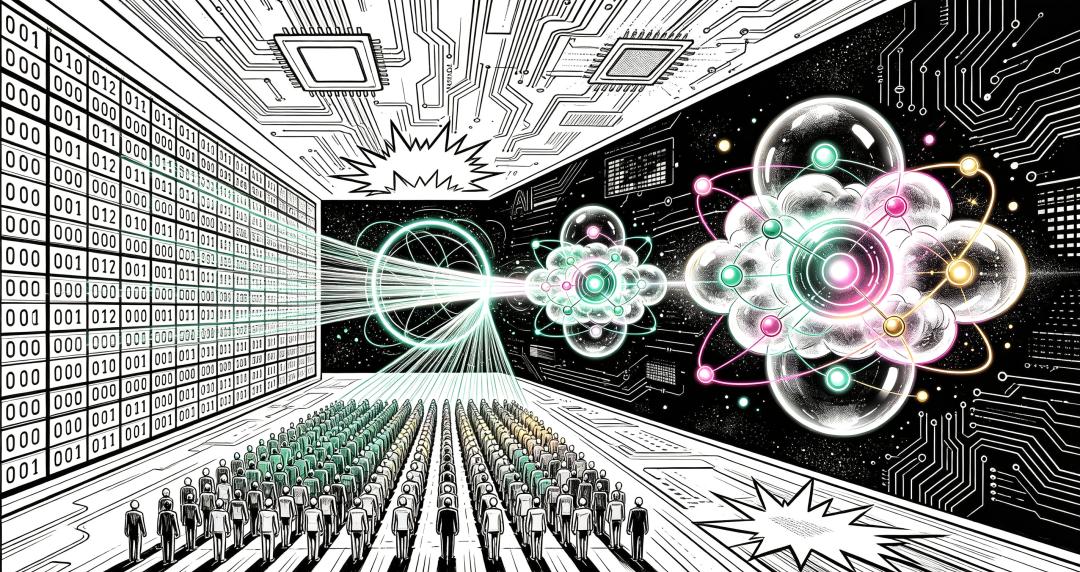
Therefore, the common practice in the industry is to encode information on a large number of physical qubits for redundancy, eliminate error parts, and "synthesize" logical qubits.
For example, there are 100 employees, each of whom only remembers a small fragment of information, and no one remembers the full content. These people have agreed on a complete set of corresponding rules. Once someone makes a mistake, we can accurately locate the wrong person by checking whether he conforms to the pre-set corresponding relationship with several people around him, and then correct his mistake.
These employees are called physical qubits, and the combination of these 100 employees forms a logical qubit.
Thomas believes that to realize the commercialization of quantum computing, 100 logical qubits are required. As long as a quantum computer crosses this threshold, it will be able to solve problems that classical computers cannot handle, such as simulating molecular structures, designing new materials, and optimizing complex systems.
Thomas further stated that the most ideal scenario is to achieve 100 logical qubits next year.
The current leader in this track is the company Quantinuum. Its Helios machine already has 98 physical qubits, can generate 48 logical qubits, and achieves a two-qubit gate fidelity of 99.921%.
On August 11, Quantinuum officially announced its cooperation with Oracle, deploying Helios to an OCI AI data center located in the United States. This is the first time that a quantum computing system has been physically placed in the AI computer room of a mainstream cloud vendor. Oracle plans to use this quantum computer to run AI training and inference tasks next year.
Quantinuum's next-generation machine named Sol, which is scheduled to be released in 2027, is specifically designed to break through the 100 logical qubits threshold.
Another major player in quantum computing is IBM. In July this year, IBM cooperated with the University of Chicago and achieved 70 logical qubits in an experiment.
IBM officially stated that the calculation results generated by this 70-logical-qubit quantum computer cannot be reproduced even by the most powerful supercomputers on the market, and the quantum computer only took about 15 minutes to complete the whole process.
Another company Infleqtion that follows the neutral atom route also plans to break through 50 logical qubits at its quantum park in Illinois next year.
The CTO of Infleqtion said: "Only when you reach 100 logical qubits can you start to solve those important problems in materials science and chemistry that cannot be solved by classical computers."
Companies like IBM, Google and Rigetti use mechanical qubits etched on chips, which are easy to expand but have high error rates; the other school follows the natural particle route, which traps atoms with magnetic fields and manipulates them with lasers, or manipulates photons with beam splitters and phase shifters.
Infleqtion uses electrically neutral atoms, Quantinuum uses charged ions, and PsiQuantum uses photons.
This is just like the large model track: DeepSeek adheres to open source, while Anthropic and OpenAI stick to closed source. They are just different modes, all their models can write code and solve mathematical problems.
No one knows which route will win at present, and it is even possible that multiple routes will coexist.
In May this year, the US Department of Commerce invested in 9 quantum computing companies at one go, approving 2 billion US dollars in subsidies. The list includes IBM, Rigetti, Quantinuum, Infleqtion and PsiQuantum, covering representatives of all mainstream routes without missing any one.
Then what exactly makes quantum computers better than ordinary computers?
In 2025, D-Wave once released a demonstration that used a quantum computer to simulate a magnetic material. The reason why magnetic materials are magnetic is that the spin of each electron in the material is like an extremely small magnetic needle, some pointing up and some pointing down. These small magnetic needles interact and pull with each other, and flip back and forth with the change of temperature and external magnetic field.
D-Wave let the quantum computer calculate how thousands of tiny electron magnetic needles in this material flip over time, interact with each other, and finally present what kind of magnetism under the quantum rules.
It may sound unremarkable, but classical supercomputers would take about millions of years to complete this calculation, while the quantum computer finished it in a few minutes. The relevant paper was published in *Science* magazine and passed independent verification.
Thomas said that logistics enterprises have begun to use quantum algorithms for route planning, fleet scheduling and inventory management, and the efficiency has increased by 15% to 30% in pilot projects.
JPMorgan Chase, Goldman Sachs and HSBC also used quantum computing very early to carry out risk modeling, option pricing and portfolio optimization. IBM's modular system Kookaburra has connected more than 4,000 physical qubits, and the open source quantum computing framework Qiskit has now gathered more than 600,000 developers.
On August 24, Japan also launched its first full-stack neutral atom quantum computer Shunkai, officially joining this quantum competition.
The three lines of technology, business and capital are tightening at the same time. Quantum computing is really going to change from "10 years away" to "launched next year".
Quantum Computing Will Destroy Cryptocurrency
While quantum computing brings benefits to all walks of life, it will deal a devastating blow to the cryptocurrency industry.
In principle, the private keys of current cryptocurrencies such as Bitcoin and Ethereum are essentially random numbers. The public key is generated from the private key through the Elliptic Curve Cryptography (ECC) algorithm, and the wallet address is obtained by hashing the public key.
The public key is equivalent to the bank, and the private key is equivalent to your signature and password. Only your signature and password can withdraw your money.
Deriving the private key from the public key is an "impossible task" for classical computers. It is estimated that even with the best supercomputers in the world, the required calculation time is longer than the age of the universe.
However, for future quantum computers, this may only take a few hours.
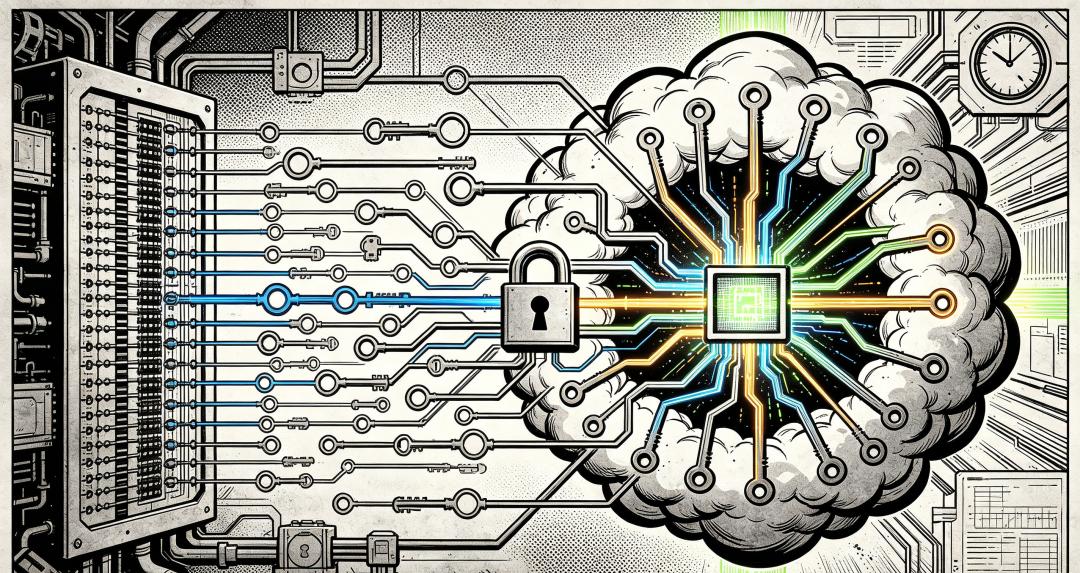
Cracking the private key with a classical computer is like trying one key after another from a bunch of keys. It is possible that the first key is the right one, of course, but the more keys there are, the less likely this situation is. A quantum computer is directly equipped with a master key, which can explore multiple possibilities at the same time.
In 1994, mathematician Peter Shor proposed a quantum algorithm that can factorize large integers and solve elliptic curve discrete logarithms in polynomial time, which is exactly used to crack the two major encryption systems RSA and ECC.
However, since this algorithm was published, almost no one has verified it. The industry's view on this algorithm is that "the theory is beautiful, but the machine is far away". But once a quantum computer with more than 100 logical qubits is built, this algorithm will no longer be just theoretical.
In March, Google published a paper stating that the industry previously estimated that cracking the elliptic curve encryption of Bitcoin would require about 9 million physical qubits, but in fact it only needs less than 500,000.
The aforementioned several hours of cracking time is shortened to tens of minutes.
What is more exaggerated is that almost at the same time, the California Institute of Technology and a startup company named Oratomic published a paper stating that theoretically, only more than 10,000 physical qubits are needed to break ECC-256 in about ten days. Every once in a while, this threshold will drop significantly.
One logical qubit is equivalent to dozens or even hundreds of physical qubits, so according to Oratomic's paper, once the number of logical qubits exceeds 1000, no cryptocurrency will exist anymore.
Therefore, the strategy adopted by attackers now is "Harvest Now, Decrypt Later" (HNDL).
They will store all large-value addresses, transaction records and encrypted communications on the chain right now, and carry out batch backtracking cracking as soon as possible when quantum computers are mature.
After all, the data on the chain is public and stored permanently, and the collection cost is almost zero.
Google's paper also wrote that about 6.9 million Bitcoins, equivalent to 30% of the total supply, are stored in wallets whose public keys have been exposed.
There is also a concept called "transaction front-running". Because quantum computers can calculate the private key in a few minutes, and the confirmation time of one Bitcoin block is about 10 minutes, attackers can completely transfer the coins away before the transaction is confirmed after it is broadcast.
The "immutability" that the blockchain is most proud of will completely fail in front of quantum computers.
Even if you transfer coins to the so-called "quantum-secure wallet" now, it is useless. The old addresses and old transactions have been permanently recorded on the chain, which cannot be modified or deleted.
But the market does not need to wait until someone really cracks the private key. Once the consensus that "it will most likely be cracked within one or two years" is formed, institutional funds will withdraw in advance, the price will collapse first, and the avalanche will come first. The reason why those crypto scammers go bankrupt is not that their coins are stolen, but that the coins become worthless first.
Cybersecurity Cannot Keep Up With The Development Speed of Quantum Computing
As mentioned earlier, quantum computers not only threaten cryptocurrencies, but also all current cybersecurity systems.
All parties in the United States are rushing to replace the country's entire encryption system with new algorithms that "even quantum computers cannot crack" before the arrival of quantum computers.
On June 22 this year, the United States signed Executive Order No. 14412, requiring federal agencies to migrate all high-value systems to Post-Quantum Cryptography (PQC) by the end of 2030 at the latest, complete the migration of the digital signature system by the end of 2031, and contractors must also comply by the end of 2030.
The National Institute of Standards and Technology (NIST) under the US Department of Commerce officially released three post-quantum cryptography standards as early as 2024. The National Security Agency (NSA) requires that starting from January 1, 2027, all newly procured national security systems in the United States must support post-quantum algorithms.
Our current encryption, such as RSA and ECC mentioned earlier, relies on "mathematical problems", such as decomposing large prime numbers and solving elliptic curve discrete logarithms. Classical computers cannot solve them efficiently, so they are secure.
The idea of post-quantum algorithms is to replace them with a new set of mathematical problems that "even quantum computing cannot solve", such as lattice cryptography.
In layman's terms, it is to give the computer a bunch of messy points and ask it to find "the point closest to a certain marked point". If you know the hidden rule, just like you know your bank password clearly, you can find that point in an instant. But if you don't know the rule, even a quantum computer can only wander around aimlessly among these points without any rules.
In order to prevent quantum computing from cracking the company's confidential information, Google set the internal migration deadline at 2029.
But here comes the problem, the migration on the defense side takes about 5 to 10 years, while the breakthrough on the attack side may only take 1 to 2 years.
Why is the migration so slow? Because post-quantum encryption is far more complicated than just "changing a password".
It involves the full replacement of the entire certificate system, software signatures, supply chain trust, and IoT devices. Every place that uses old encryption is unsafe.
Once the quantum era comes, these devices will be nodes that are permanently "exposed" on the network. Attackers do not even need to break into your host, as long as they find a device that has not been patched for ten years in the corner, they can use it as a springboard.
Even for large enterprises, it takes 12 to 24 months just to "inventory how much encryption they are using".
What is more troublesome are those embedded devices whose firmware can never be updated once they leave the factory. They have no upgrade channel, so they can only be eliminated, or continue to operate with security risks.
At the same time, the existence of HNDL makes this matter more urgent. The data transmitted in encrypted communications now may have been quietly stored by the opposing side.
Even institutions like Google that have resources, motivation and started preparing very early have to delay the migration to 2029. Let alone ordinary enterprises and ordinary people.
The cybersecurity expert group of the G7 sent a coordination roadmap to banks, insurance companies, exchanges and regulatory agencies earlier this year, urging the financial industry to speed up PQC preparation and promote the work in six stages.
Europol also released a report in January, specially providing a set of frameworks for financial institutions to deal with quantum threats.
Crisis is also business opportunity. SandboxAQ, spun off from Google, whose main business is to help enterprises and governments complete post-quantum migration, has a valuation of more than 5 billion US dollars. Before quantum computers are actually put into use, the business of countering quantum threats has already made profits.