Why did the 9.9-yuan phone top-up offer suddenly disappear?
After achieving the freedom of affordable milk tea, will we still have the freedom of low-cost mobile top-up and data traffic in the future?
A lot of people are asking this question.
Starting from August, major telecom operators have suspended the agency card-selling services on third-party online platforms. All of a sudden, the "god-tier" SIM cards with monthly rent as low as more than 10 yuan and hundreds of GB of ultra-large traffic are no longer available on most platforms.
Even earlier, last year, the 10-yuan and 20-yuan small-amount mobile top-up services bound to third-party platforms such as WeChat had already disappeared.
The "freedom of topping up phone bills and using data traffic" seems to be a thing of the past.
What on earth does the gradual disappearance of more and more small-denomination and low-price services mean?
Will the freedom of mobile top-up and data traffic still exist at all
In fact, the inconvenience of small-denomination top-up has shown signs long ago.
Since last year, most payment platforms that support mobile top-up, such as WeChat, Alipay and UnionPay QuickPass, no longer provide 10-yuan and 20-yuan small top-up options. The top-up page directly starts from 50 yuan, and some even set the minimum top-up limit at 100 yuan.
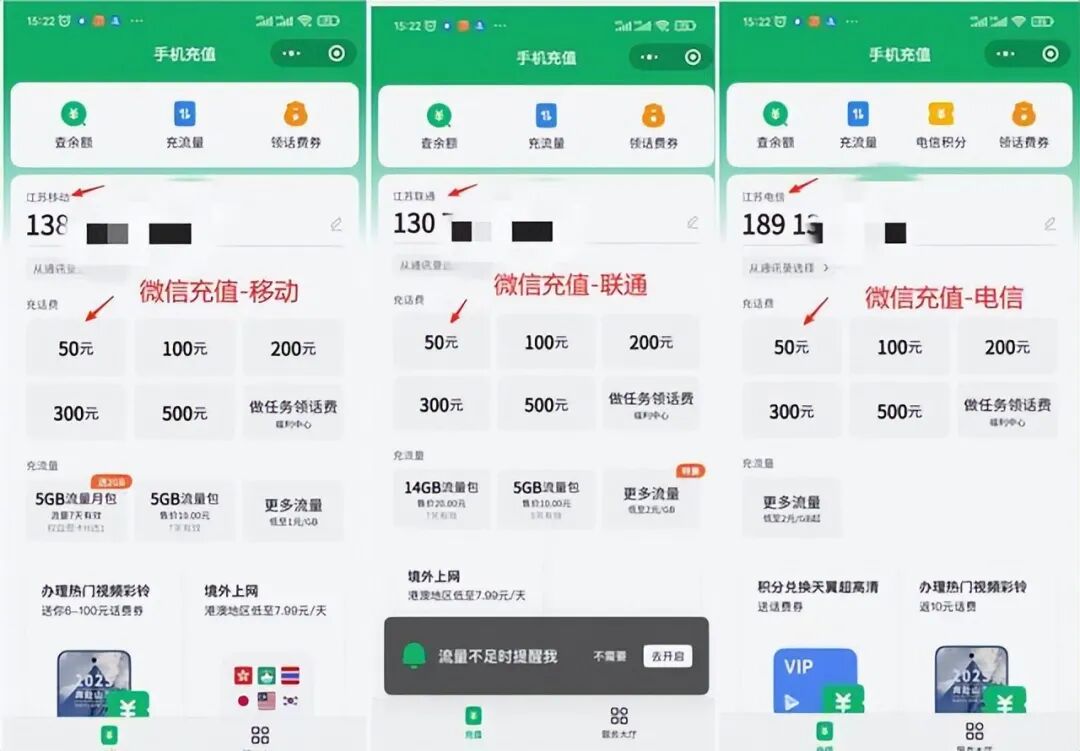
Changes of top-up denominations on service platforms
For example, if your monthly phone bill is 80 yuan, you used to be able to top up 50 yuan plus 30 yuan on WeChat to cover the full amount, but now that the combined small top-up options are gone, you have to top up 100 yuan directly, which is 20 yuan more than you actually need.
Similarly, the suspension of third-party card-selling services by telecom operators in August this year is essentially the same case.
Compared with the past, the most intuitive change brought by the implementation of this new regulation is that the scenarios for ordinary users to apply for SIM cards and top up their accounts will be reshaped.
It should be noted that before this, third-party platforms such as Taobao, Pinduoduo and short video live streaming rooms were the core distribution centers of low-price data SIM cards. All kinds of ultra-large traffic packages priced at 19 yuan or 29 yuan emerged in endlessly, which were far lower than the official packages sold by operators. With abundant choices and extremely low thresholds, these platforms were also the main way for the public to access low-cost internet services.
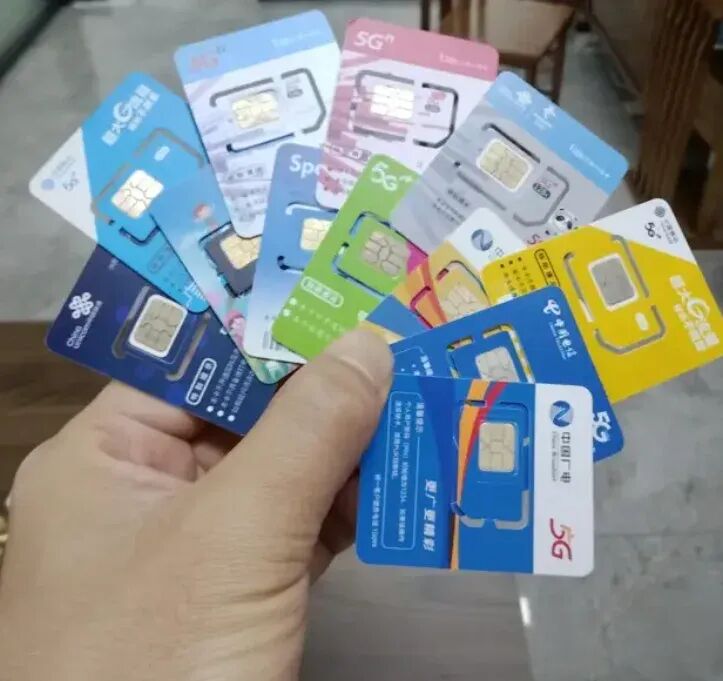
A wide variety of low-price data SIM cards
If these low-price data SIM cards on the internet really disappear, many people will seem to lose an invisible welfare benefit.
The reason is not hard to understand. The officially sold packages have unified pricing and higher thresholds. Compared with the various low-price large-traffic packages on third-party platforms in the past, although we have more package choices now, the cost-performance advantage no longer exists.
For example, a data SIM card with an original monthly rent of 59 yuan and 235GB of data per month can reduce the monthly cost to 19 yuan after using coupons and combining discounts. But at the same price, on the official websites of some operators, the monthly rent packages of 19 yuan and 29 yuan may only provide 2GB to 35GB of data (including 30GB of exclusive traffic).
In addition, if you need to buy extra data in the future, the price will not be very cheap indeed.
Some users said that the lowest package they have used for more than ten years really starts at 69 yuan, with only 10GB of data. At the current 5G speed, the data will be used up in two or three days when going out. If you want to purchase extra data, 10 yuan or 20 yuan can only buy a few GB of data, and the data must be used within a limited time.
Therefore, it is not difficult to understand why the disappearance of small-denomination third-party top-up channels and low-price data SIM cards has sparked heated discussions.
Some people say their rights and interests are affected, while others emphasize that this is not a big deal and there are still other channels for convenient top-up.
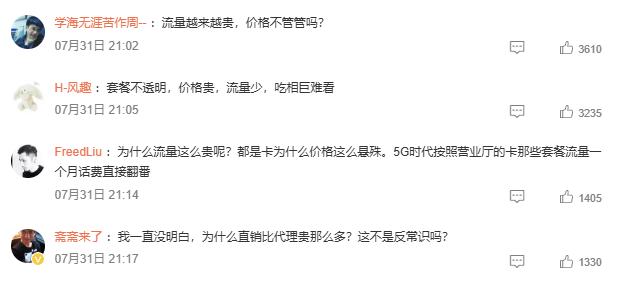
But behind these controversies, why do people react so strongly to this matter, and even many netizens raise doubts?
Because for a long time, there is a very special phenomenon in the communication service market, that "cheap products do not necessarily have poor quality".
This is contrary to the consumption logic of "good price guarantees good service" in our daily life.
Theoretically, the data SIM cards and small-amount mobile top-up services on third-party channels are not low-quality services. Instead, they accurately meet the rigid needs of a large number of niche user groups.
Many people only have a small balance left in their mobile accounts and do not want to top up a large amount of money, so the small-amount fast top-up service perfectly adapts to their fragmented needs. For students, elderly users, users of standby SIM cards used in different places and other people who choose low-price packages, third-party services solve the pain points of high premium, high threshold and poor flexibility of official packages. Gradually, these services have become one of the few low-cost digital benefits for the public. Now that low-price services are gone forever, it is really distressing for many users.
This is enough to show that third-party low-price communication services are not dispensable auxiliary functions, but rigid needs that fit the daily life of ordinary people. This is also the inevitable result of the huge perception gap of the public after the implementation of the new regulation.
In that case, it is necessary for us to ask a deeper question: Has the freedom of mobile top-up and data traffic really disappeared?
In fact, it has not.
It has just been hidden from public view.
Actually, we checked the top-up interfaces of telecom operators and found that what has disappeared is the previous freedom of topping up any amount as you like on non-official platforms. But the minimum top-up denomination is still available on the operator's App, and you can even customize the top-up amount. So the freedom of mobile top-up and data traffic has not disappeared at all.
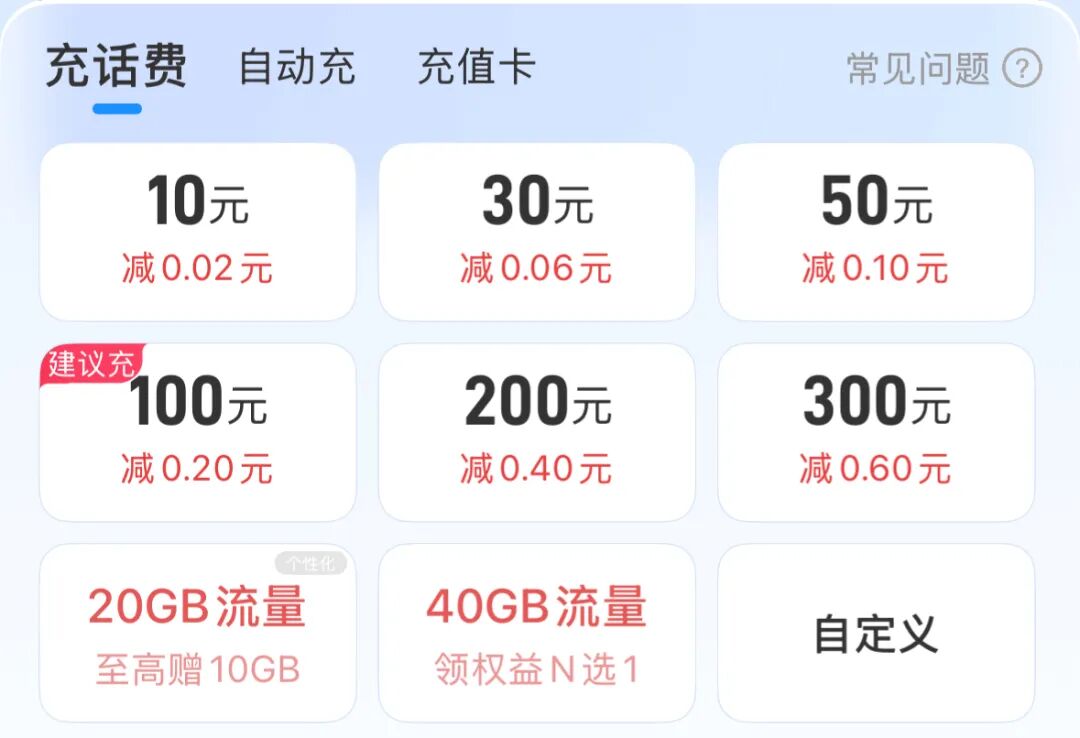
The top-up interface of a certain operator's App still supports customizing the top-up amount
As for low-price data SIM cards, after the new regulation was implemented on August 1st, theoretically, all online SIM card services have been taken back to official channels. Does this mean that users can no longer get data discounts at all?
Not exactly.
Now when users want to apply for a new SIM card and choose a data package, they can only operate through the official channels of China Mobile, China Unicom and China Telecom, but there are still preferential benefits such as points redemption. I have used points to redeem phone bills and data before.
In addition, operators have also launched various data package options for different time periods and different rights and interests on their official interfaces, and these packages are more flexible in form and choice.
So the conclusion is, "The minimum mobile top-up and low-price data SIM cards on some platforms are indeed disappearing, but the freedom does not cease to exist". The remarks claimed by some self-media and reports that "the freedom of mobile top-up has completely withdrawn from history" are not true.
Then another question comes up: What is the real reason for the disappearance of third-party minimum mobile top-up and low-price data SIM cards?
The exit of third-party low-price services is far more complicated than it seems, all parties have their own considerations
Now there are two explanations for the disappearance of third-party minimum-denomination top-up and third-party data SIM card selling services. One is various official formal responses, while the other explanation is more worth thinking about, which involves many aspects such as industry development and market operation, and we will elaborate on it later.
The so-called official explanation is naturally a response to everyone's doubts and complaints.
Some operators responded that they closed the small-amount top-up channels on third-party platforms mainly to ensure account security, and suggested that users use the official App for top-up.
Some other operators said that the closure of 10-yuan and 20-yuan top-up services on third-party platforms is mainly because the small-amount top-up cooperation agreements with some third-party platforms expired last year and have not been renewed for the time being, so the minimum top-up level has been raised to 50 yuan.
However, many third-party top-up platforms said that the top-up denominations are set by the three major telecom operators.
Each party gave a different reason, and it even feels like they are passing the buck to each other.
Similarly, operators have their own explanations for suspending third-party internet channel SIM card services. For example, chaos frequently occurs in third-party card-selling channels, some illegal businesses falsely sell cards in the name of authorized operators, illegally collect users' ID card, facial and other private information, which gives rise to risks such as telecom fraud, information leakage and the circulation of black SIM cards.
It is true that these chaos exist objectively, but is regulating low-price services only for these reasons?
It should be noted that these third-party services have existed for quite a long time, and various problems are unlikely to be discovered only now. In fact, the exit of third-party low-price data services is superficially due to regulatory norms, but in essence it is the simultaneous adjustment of multi-stakeholder interests and development logic, which is not caused by a single factor.
On the one hand, apart from compliance factors, from the perspective of business logic, it is very difficult to obtain new customers relying on small-amount phone bills and data SIM cards, so the exit of low-price fragmented services is an inevitable trade-off for enterprises.
In the early stage of internet popularization, operators needed to rely on third-party channels to quickly expand customers, cover sinking users and seize market share, so they acquiesced in the existence of various low-price packages and agency distribution models.
But now the total number of mobile phone users in China has exceeded 1.8 billion, and the popularization rate of mobile phone users is becoming saturated. Continuing to rely on third-party low-price fragmented packages to acquire new users has extremely low cost performance. For operators, scattered small orders and services with ultra-low customer unit price occupy system resources and human resources, but cannot contribute effective profits, and no longer adapt to the needs of large-scale development.
On the other hand, in recent years, the traditional services of operators are under pressure, and their business focus is gradually shifting to new businesses such as computing power.
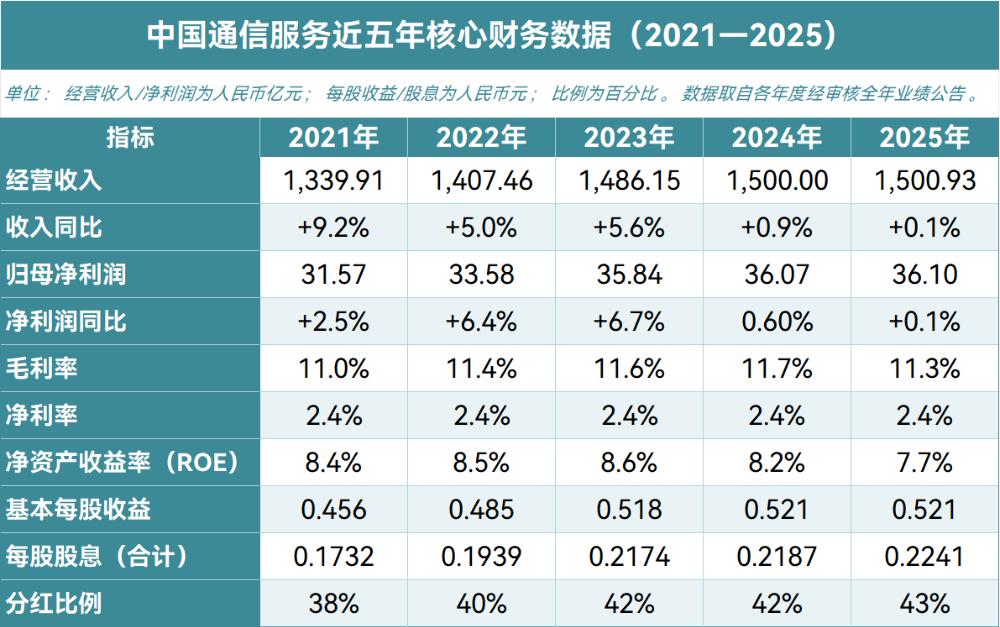
Statistics show that in the first half of 2026, the cumulative revenue of China's telecom business reached 887.3 billion yuan, down 2.1% year on year. Considering that the revenue growth rate of the three major operators generally dropped to around 1% in 2025, the traditional business showed the trend of "increasing volume but not increasing income". In the first quarter of 2026, affected by the combination of policy factors and the peaking of traditional business, the profits of the three enterprises all declined collectively, so the operation needs higher-quality development.
Therefore, emphasizing supervision is an important reason for adjusting the mode of low-price services, but there is another point: the growth mode is shifting.
Now the total capital expenditure of the three major operators in the first half of the year has exceeded 100 billion yuan, and their focus has shifted from communication data to computing power services. Third-party platforms also have a similar tendency.
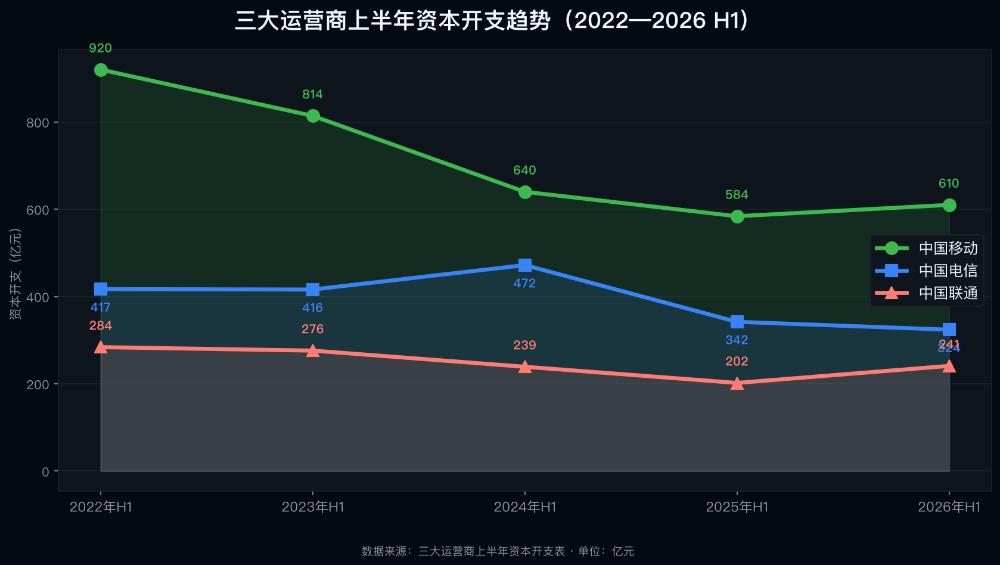
Capital expenditure of telecom operators
Take China Mobile as an example, the revenue related to computing power in the first half of the year accounted for 22.58% of the total main business revenue. Among them, the revenue of computing power services reached 52.9 billion yuan, a year-on-year increase of 14.0%. In this context, the Token economy has become a hot trend, and operators are all following this path. For example, China Telecom previously launched three tiers of Token Plan: Light Enjoyment version, Enjoyment version and Exclusive version, with monthly tariffs of 9.9 yuan, 29.9 yuan and 49.9 yuan respectively, corresponding to 10 million Tokens, 40 million Tokens and 80 million Tokens per month.
Essentially, the development of computing power, Token and other new businesses, does it have a necessary logical connection with the disappearance of the third-party low-price services we mentioned earlier?
Operators are indeed adjusting their business strategies, focusing on new resources and reducing unnecessary maintenance costs. One operator once mentioned that "stabilizing and enhancing user value has become the key to increasing revenue and profit".
This well explains the question mentioned earlier, why can 10-yuan and 20-yuan top-up only be operated on the operator's App now?
Because compared with the monthly active data of head Apps that are as high as 700 million or 800 million, although some operators have more than 1 billion users and some have more than 400 million users, the monthly active scale of their Apps does not rank in the top 10 in the field of application software.
Obviously, operators want higher-quality user stickiness, and these users will become the foundation for operators to provide more value-added services for users in the AI era in the future.
As for the external third-party platforms, their idea is that they are also unwilling to maintain low-profit businesses. After all, for them, low-amount phone bills and low-price SIM cards are typical businesses with low gross profit, high after-sales cost and low income. This kind of business has a large order volume, many customer complaints and meager profits, which may consume a lot of operating manpower. Under the trend of refined operation