Runway has eliminated coding, launching the first interface world model where the UI grows organically on its own.
Just now, Runway officially released the first "Interface World Model" — Solaris!
Solaris is a "brand new operating system" that generates interactive interfaces frame by frame in real time without writing a single line of code.
Just click and drag, and it will generate the next frame based on the current screen and operation.

Moreover, it delivers extremely strong performance. In blind tests, the generated UI effect completely outperforms Claude Opus 5.
Cristóbal Valenzuela, co-founder of Runway, defined the "Interface World Model" at the first time —
In the future, video will be the universal interface.
Eventually, all UIs will support chat and gesture input, as well as chat and video output.
Solaris is only the first step towards this vision.
Most importantly, it also provides a brand new way to train Agents, which can generate dynamic environments easily.

From today on, a fundamental rewrite of the software interface is underway.
Eliminate Codes, Let the UI "Grow" Naturally
In the past few decades, from early terminals to Linux and then to macOS, every OS has followed the same underlying logic:
Design an interface, translate it into code (HTML/CSS/JavaScript), and then it can run.
However, this kind of "code translation" is lossy compression. During this translation process, the richness of interaction is forced to be compromised:
Reduced visual fidelity: To make the interface respond quickly, complex light and shadow effects and physical dynamics are often simplified.
Locked interactive space: Before the software is released, its interactive behaviors (where to click, what to trigger) have been fixed by hard coding.
In other words, once the design is simplified into code, the interface responds faster but loses the rich details of the original design.
Every interaction and feedback of every button has been pre-written into the code.
The moment the software is delivered to users, all its possibilities are "frozen".
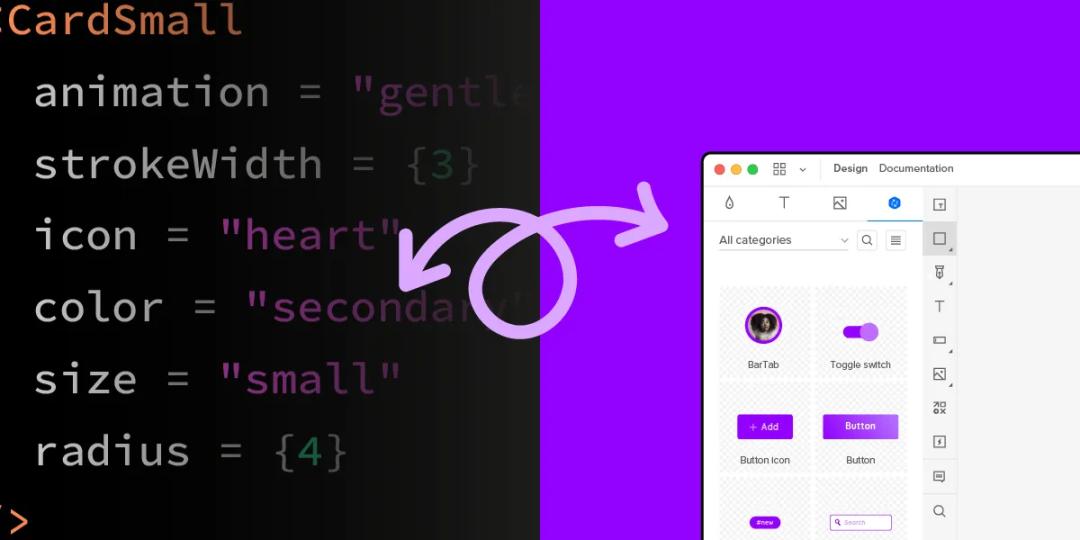
To solve this problem, Runway put forward a bold idea: embed the video model directly into the operating system.
Solaris, the debut work of the "Interface World Model", removes the intermediate code layer and combines "rendering the picture" and "responding to operations" into one single process.
Three Core Capabilities
With Solaris, software interaction is no longer rigid menus and buttons, which directly brings three unprecedented revolutionary experiences.
- Entirely Visual: The ultimate form of what you see is what you get
Traditional interfaces hide complex code logic, but the interface of Solaris is a pure image layer.
Imagine that you are browsing a virtual clothing store, and the fitting room itself is the "interaction interface":
Upload a photo as a reference, take a shirt from the hanger, and drag it directly onto your body to try it on. Everything is as natural as in the real world.

- It is Alive: Evolve in real time following personal intentions
The interface is rendered continuously and in real time, and it is "evolving" all the time.
Its light, shadow and reflection will change naturally with the environment, and objects will also respond to people's operations in line with the laws of physics.
"Move the table away to show me the effect" or "Change the color of the sofa" can be achieved with just one sentence.



Even for the same starting frame: an X-ray of a hand, Solaris may produce two completely different responses to the same drag operation
- Open-ended: Say goodbye to drop-down menus
Traditional interfaces can only complete actions "preset" by programmers.
Solaris breaks this workflow. It is driven by the underlying "world model", which can give brand new responses in real-time scenarios according to operations.
Want to make a salad? There is no need to frantically check boxes in the menu, just drag the ingredients into the bowl on the screen, and the AI will respond naturally.

Behind the Scenes: How Real-time Interaction Is Achieved?
Digital UI interfaces have always been supported by two systems.
One set "knows things": search engines and AI assistants understand your questions, but only give static answers; the other set "responds in real time": JavaScript in web pages and game engines can display dynamic pictures and support interaction.
The Interface World Model requires the combination of the two: it not only understands your intentions, but also continuously draws an interactive world around these intentions.
However, to achieve both at the same time, the following three major engineering problems need to be overcome:
The first is speed. Once the interaction has a delay of more than half a second, users will not feel the "interaction" experience. Generating a short video with a video diffusion model takes several seconds or even minutes, which is enough for content creation but too slow for interface operation.
The second is consistency. Consistency has always been the most difficult part to stabilize in video generation. The third is cost. Each frame needs to be generated on the spot, which puts forward high requirements for operating costs.
To achieve real-time interaction, the official blog revealed the technical principle behind Solaris —
It is built on Runway's Gen-4.5 video model and follows the route of the GWM-1 world model.

Solaris takes user input (click, drag, type) as the "condition" for generating the next frame.
During the training process, the model observed and learned a huge number of causal relationships between "interaction and visual results".
Therefore, even without pre-programming, the AI knows how the physical form and visual feedback of an element should change when it is clicked or dragged.
Runway also transformed Solaris into an extremely fast real-time engine with three layers —
The first layer is "Autoregressive Generation". Solaris generates frame by frame based on the frames that have appeared, relying only on the historical state, so new actions can enter the generation link in time.
The second layer is "Distillation". The original dozens of denoising steps of the diffusion model are compressed into a small number of steps, so that the faster student model approximates the output of the original model, pushing the speed to the interactive range.
The third layer is "Continue training with the model's own output".
The longer the autoregressive system runs, the more likely small errors are to accumulate, leading to object deformation or layout drift. Letting the fast model adapt to its own generation distribution can reduce this offset and improve the stability of long sequences.

Moreover, Solaris is a "dual-brain system".
The LLM is responsible for reasoning — understanding user requests and deciding how the scene should evolve; Solaris is responsible for rendering, determining how the generation behavior should be presented visually.
The combination of the two perfectly separates "reasoning" and "rendering".
Outperforming Claude, Dimensionality Reduction Striking Traditional UIs
How much information will be lost when translating the interface into code?
To find out, Runway conducted a series of rigorous tests. The first set of tests required the multimodal large model to reconstruct web pages based on screenshots, covering 30 types of interfaces.
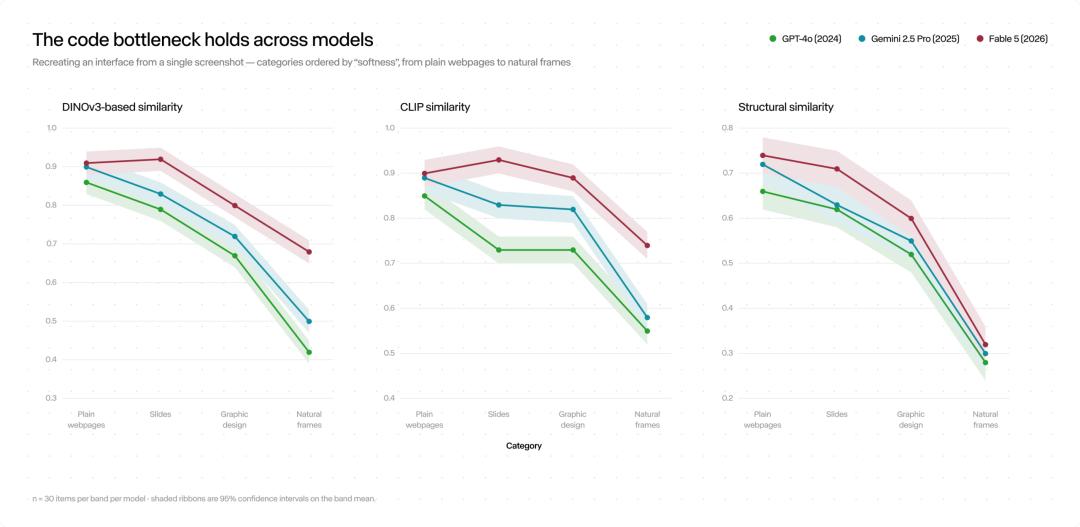
Reconstruction fidelity varies with the increase of visual complexity. Even with the continuous improvement of multimodal language models, the reconstruction quality will continue to decline as the visual complexity increases, which reveals the information loss when the interface is translated through language.
The results show that with the increase of visual complexity, even the most powerful large models (including Fable 5) will experience a cliff-like decline in reconstruction quality.
The rich visual details in natural images cannot be accurately expressed with language and code at all.



In the real dynamic interaction blind test, Solaris even staged a "dimensionality reduction strike".
The second set of tests directly compared the code interfaces generated by Solaris and Claude Opus 5. In a blind test with 250 participants and nearly 7500 pairwise comparisons:
Instruction compliance rate: Solaris won an absolute victory with a 61% success rate, far exceeding the 24% of the code interface.
Natural fluency: Solaris achieved an overwhelming advantage of 71% versus 21%.
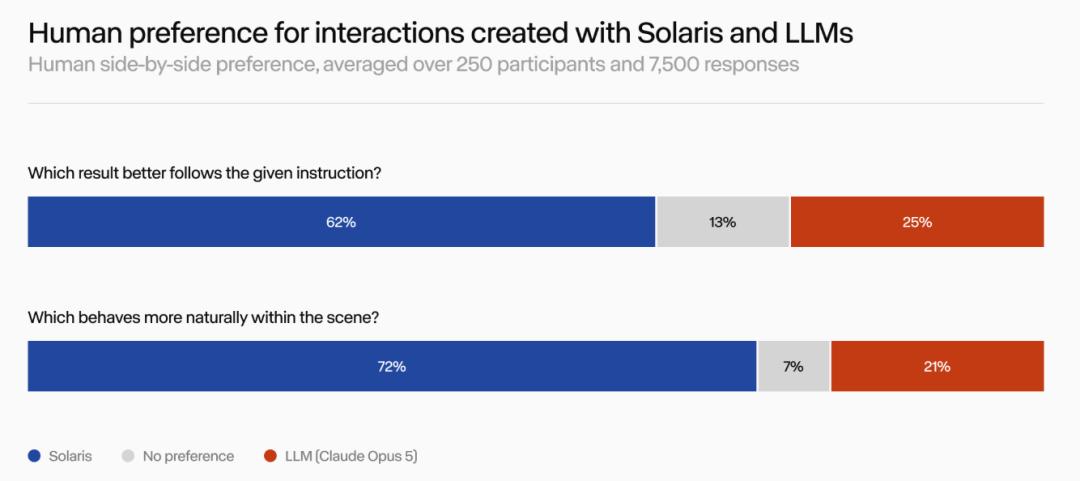
In the two sets of horizontal reviews provided, the smoothness of the interactive effect generated by Solaris can be clearly seen.