The servers were completely overwhelmed and crashed on the very day of its launch, and Tencent's AI has finally delivered an impressive strong performance.
Tencent AI has become an absolute hit.
On August 28, Hunyuan Hy4 Preview was first launched and integrated into Tencent's AI office platform WorkBuddy. On the first day of its release, the task queue was already full of pending requests; three days later, Tencent announced an urgent expansion of its inference cluster, and extended the free trial period of Hy3 to September 30 to divert part of the demand.
Even so, queuing during peak hours is still unavoidable. According to the current actual experience, after selecting Hunyuan Hy4 Preview on WorkBuddy, tasks that are supposed to be completed in 2 minutes on regular days now often take more than 5 minutes.
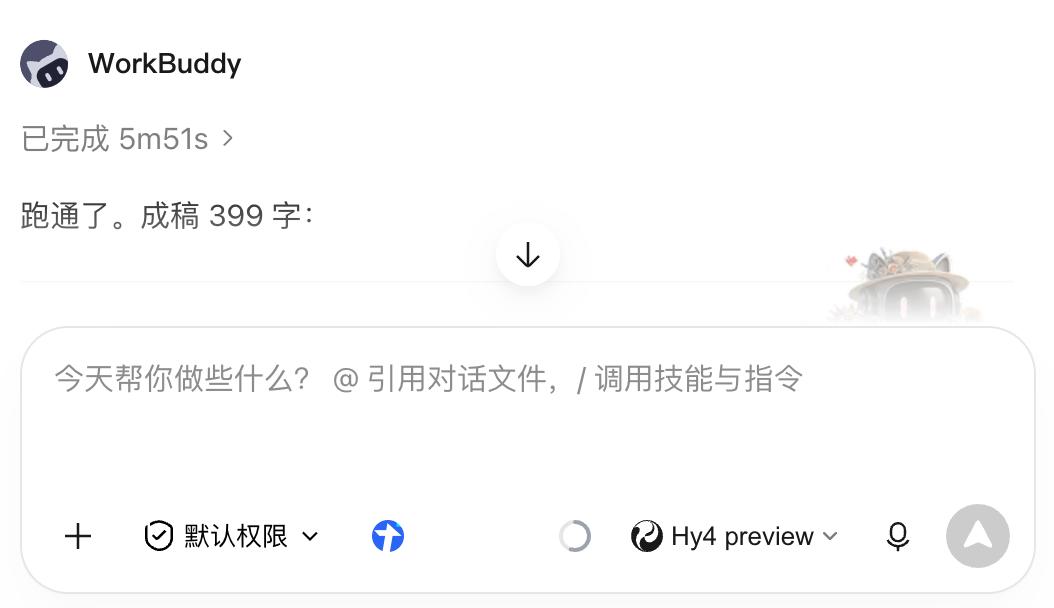
The running speed is still relatively slow
Users' enthusiasm for Hy4 Preview remains high, and the queuing situation has not improved. This unprecedented grand occasion is indeed quite rare for Tencent AI. Some may say that the limited-time free access of Hy4 Preview leads to queuing during peak hours, but obviously this is only one of the contributing factors.
Performance is a more critical factor. You can tell that by looking at the "profile information" of Hy4 Preview:
It is a pure large language model, with major upgrades focused on Agent, software engineering and office tasks: the total number of parameters has increased from 295B of Hy3 to 770B, the activated parameters have risen from 21B to 49B, and the context length has been expanded from 256K to more than 1 million Tokens.
With larger parameters, longer context, and more accessible capabilities, Tencent is very confident in this new model and labels it "Built for Productivity".
This time, has Tencent really caught up?
One of the old "top three" is back
Hy4 Preview still adopts the MoE architecture, but the model scale is completely different.
The total number of parameters has increased from 295B of Hy3 to 770B, and the context window has been directly expanded from 256K to 1M. Although the total parameters have more than tripled, only 49B of parameters are actually involved in each inference calculation, and there is no need to call all 770B parameters.
In short, Hy4 can load more knowledge and capabilities into the model, and only mobilize the parts related to the current task when actually answering questions. This not only expands the upper limit of capabilities, but also prevents the inference cost from growing synchronously with the total parameter scale.
According to the officially released performance results, this "enhancement" is mainly focused on software engineering and Agent tasks.
Terminal-Bench 2.1 simulates AI completing real tasks in the terminal: it needs to understand requirements, input commands, install dependencies, troubleshoot errors, and finally run the entire task successfully. Hy4's score in this test has increased from 70.8 of Hy3 to 85.4.
DeepSWE and SWE-bench Pro are closer to the daily work of programmers. They require the model to not only write a piece of code, but also understand the entire code repository, locate problems, modify multiple files and pass tests.
Hy4 scored 64.3 on DeepSWE, up from 28.0, and 65.7 on SWE-bench Pro, which has entered the competitive range of GLM-5.3, Kimi K3 and GPT-5.6 Sol.
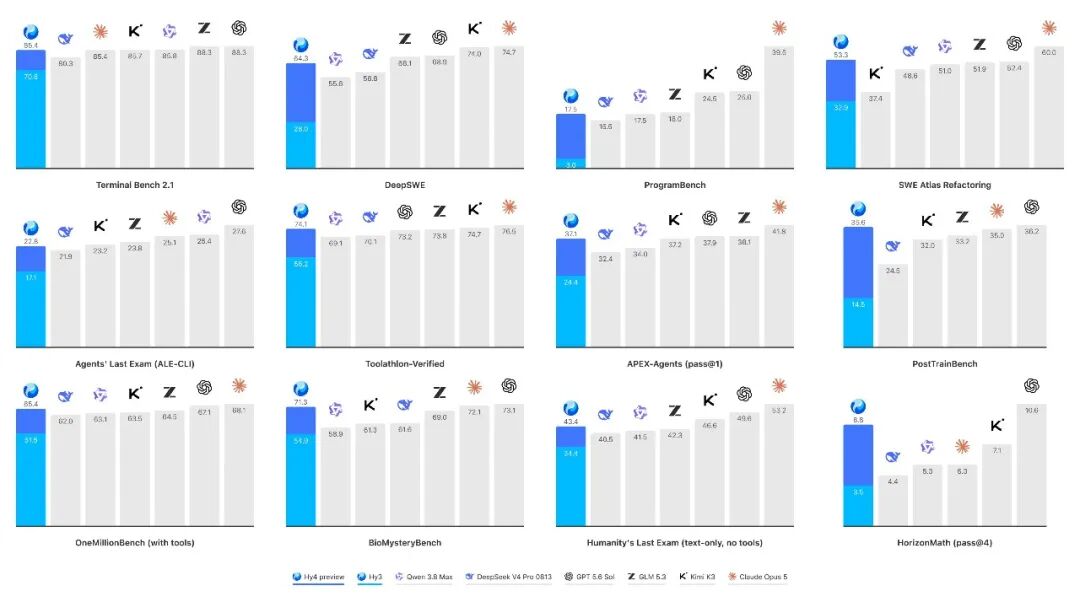
The benchmark performance is quite impressive Source: Official Hunyuan Account
In terms of tool calling, Hy4 scored 74.1 on Toolathlon-Verified and 37.1 on APEX-Agents.
Tencent also organized 163 internal experts to conduct blind tests with 203 real engineering tasks. Hy4 scored an average of 2.99 points, slightly higher than Kimi K3's 2.94 points and GLM-5.3's 2.92 points.
Although these results are all from official disclosures and cannot directly replace the actual user test effects, they can at least prove one thing: Hy4's progress is concentrated in coding, tool adjustment and completing long-process tasks, and Tencent has brought Hunyuan to the first echelon of open-source models.
This also explains why Hy4 emphasizes "Built for Productivity".
Productivity Agents actually have very little room for error. Most people assign a task to it, then leave it aside to do other things, and come back to check the results after a few hours.
This means that once the Agent makes a mistake in any of the dozen steps, all the previously completed searches, analyses and operations may be wasted. Therefore, whether the model can run through the entire task chain is more important than giving a single beautifully written answer.
On the other hand, in addition to the focus of model capabilities, the pricing of Hy4 Preview is also clearly more oriented towards actual productivity scenarios.
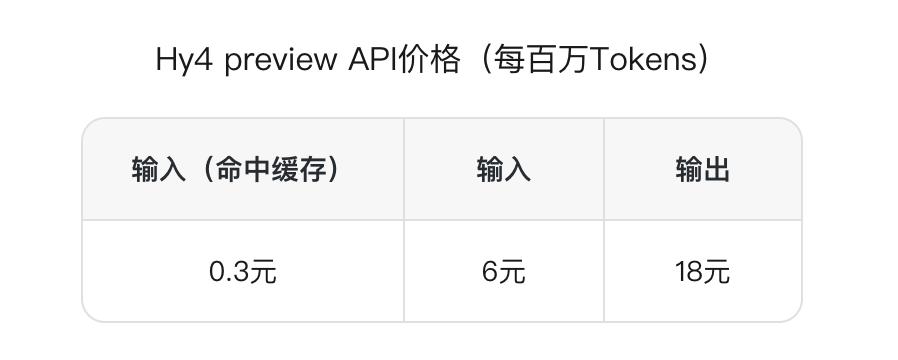
The input price of Hy4 Preview is 6 yuan per million Tokens, and the output price is 18 yuan per million Tokens.
The most critical point is that the cache hit price is only 0.3 yuan per million Tokens, which is 1/20 of the regular input price.
Cost-effectiveness Source: Official Hunyuan Account
This is especially important for Agents. For a long task of hundreds of thousands of Tokens, the model often repeatedly reads the same batch of documents or codes in multiple rounds of operations, and the proportion of repeated calls is very high. A sufficiently low cache hit price can significantly reduce this part of the cost.
Although the input and output prices of Hy4 are not the lowest in the market, they are in a relatively affordable range. Coupled with the cache hit price as low as 0.3 yuan, the overall cost for developers to run long-context, multi-round Agent tasks will be easier to control.
For this reason, from parameters, benchmark scores and internal blind tests to overall pricing, Tencent has now caught up with the head competition tier.
Now here comes the question:
There is only one generation apart from Hy3 to Hy4, what magic trick does Shuyao Yao have to make such huge progress for the model?
Tencent has found the right way to catch up
The reason why Tencent can catch up quickly between two generations of models is also related to its reorganized model R&D approach.
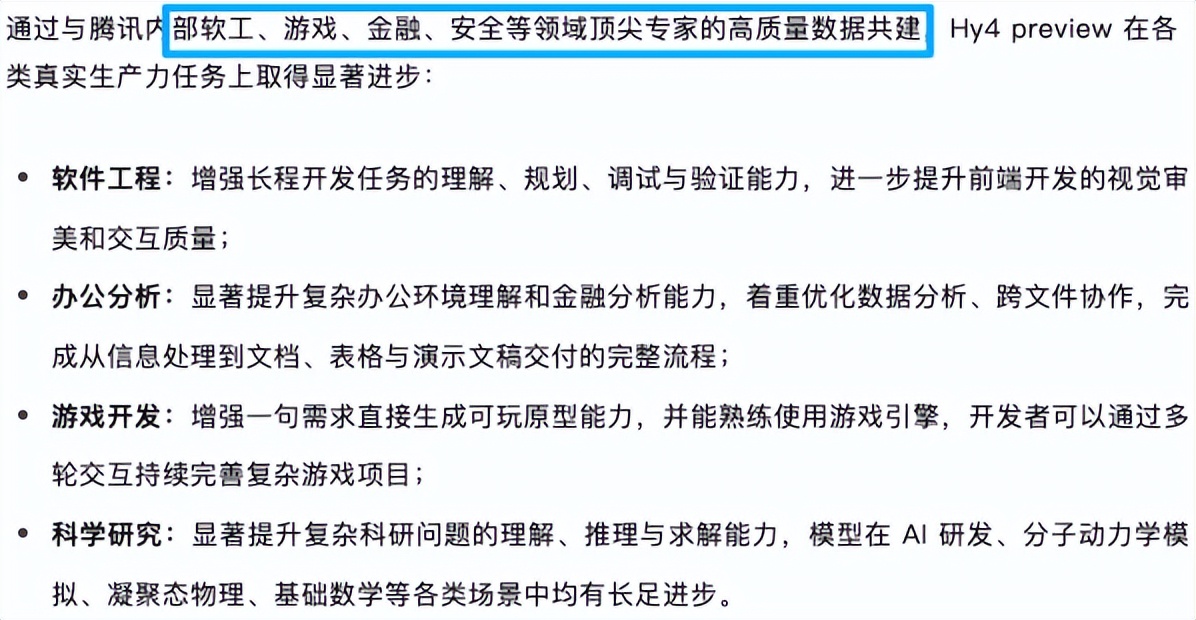
This time, Tencent did not only let the model team prepare data around public leaderboards. The high-quality training data of Hy4 is also co-developed by internal Tencent business experts from software engineering, gaming, finance, security and other fields.
The tasks assigned to the model by these departments are more valuable than simply "writing a piece of code".
The software engineering team will require it to understand long code repositories and complete planning, debugging and verification; the finance team will ask it to analyze multiple documents and complex data; the gaming team will test whether it can start from a single requirement, call the engine and produce a modifiable prototype.
Internal Tencent co-construction of data Source: Official Hunyuan Account
After finally integrating these requirements into WorkBuddy, the tasks will evolve into sorting out materials, analyzing spreadsheets and generating PPTs.
Therefore, Tencent's internal businesses have become the first batch of test users of Hunyuan. At which step the model gets stuck, what kind of files it cannot understand, and why it interrupts when calling tools, all of these can be turned into problems to be solved in the next round of training and evaluation.
This is the Co-design that Shuyao Yao has always emphasized.
The model first enters CodeBuddy and WorkBuddy to complete real tasks, the product side collects users' usage patterns and failure cases, and then feeds these feedbacks back to the data, training and evaluation links. Back in the Hy3 era, Tencent had already run this cycle between the model and its products.

Tencent's product data loop
In addition, Hy4 has another R&D link, the so-called "self-evolution".
According to Tencent, Hy4 has already participated in the automatic optimization of large model training methods, data strategies, evaluation systems and underlying operators. The model can propose solutions, run experiments, and then continue to modify based on the results; the code, logs and feedback generated by the experiments will become the basis for the next round of attempts.
Finally, WorkBuddy and CodeBuddy are responsible for bringing real demands and tasks to the model, telling the R&D team where the model does not work well; the automated R&D involving Hy4 helps the team try solutions faster.
The former provides problems, the latter speeds up problem-solving.
Furthermore, in July this year, Tencent merged the Hunyuan large language model department and the multimodal model department into the Foundation Model Department, under the unified management of Shuyao Yao. The language, multimodal and AI Infra capabilities that were previously advanced separately have begun to converge into the same R&D system.
Therefore, the current viral popularity of Hy4 means far more than a better-looking transcript.

Users' positive feedback on Hy4
Tencent has gradually connected internal experts, real products, model training and infrastructure into an iterative loop, which is equivalent to laying a solid foundation for subsequent model training.
Tencent has finally found a catch-up approach that is more suitable for itself.
Tencent has finally "boarded the ship"
At Tencent's general meeting of shareholders in May this year, Pony Ma once said a sentence:
"A year ago we thought we had boarded the ship, but later found that the ship was leaking. We then changed to another ship, and now we feel we are standing firmly on it, though we can't sit down yet, and we still hope the ship can go faster."
Now that Hy4 Preview has been released and remains extremely popular, it seems that the fast-moving ship that Pony Ma wanted to stand on has arrived.
The only problem is that there are far too many people who want to board the ship.

The popularity is extremely high
Perhaps this is the fate of a hit domestic large model. It is hard not to remind people of early 2025, when DeepSeek-R1 suddenly became a smash hit, and "Server busy, please try again later" once became the most familiar prompt for users.
Some users refreshed the page repeatedly, some switched to third-party platforms integrated with DeepSeek, and others specifically waited until late at night to use it.
To some extent, this can even be regarded as a short-term medal of honor. Only when users are truly willing to use the model, the server has the chance to be overloaded.
But this medal of honor also has a shelf life.
When DeepSeek first became popular, "server busy" could be understood as the result of rapid user growth. As time goes by, being unable to access or run tasks will change from a sign of "being too popular" to users' complaints.
It just so happens that Hy4 is targeting productivity scenarios. Users hand over work to Agents precisely to save time; if they have to queue up every time, the thing that is supposed to save time ends up wasting more time, which may turn a pleasant Agent experience into a reason for users to churn.
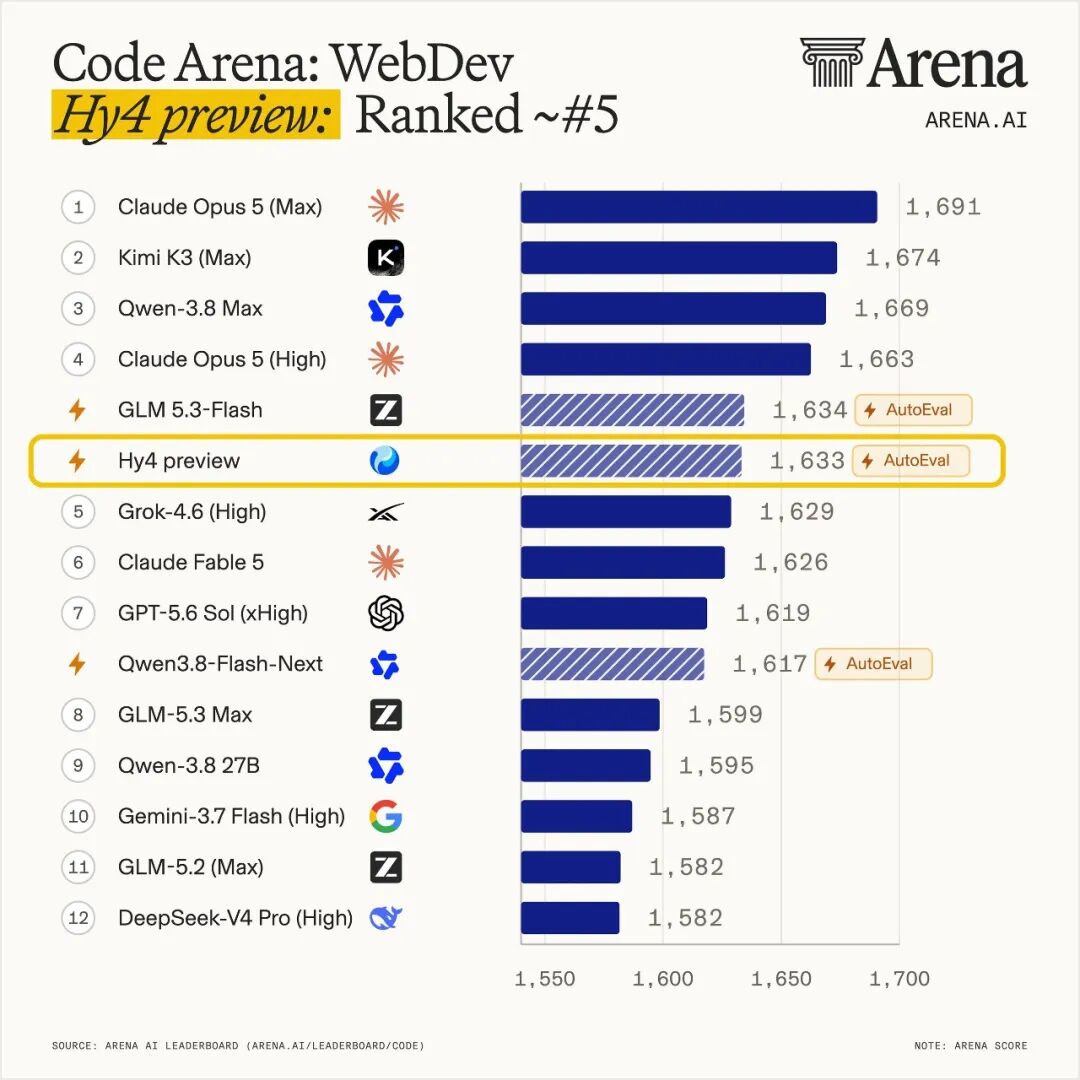
Source: Arena
After all, even on WorkBuddy there are so many options, users don't have to stick to the same model all the time.
Fortunately, Tencent has far more resources to solve this problem than DeepSeek.
Tencent owns its own cloud services and inference infrastructure. Its capital expenditure in the second quarter of 2026 reached 52.78 billion yuan, a year-on-year increase of 176%, a large part of which was invested in AI infrastructure. After the queuing problem of Hy4 appeared, Tencent responded very quickly by expanding the inference cluster and dynamically allocating resources.

Some expectations from users
The queuing phenomenon proves that Hy4 has made a good start, and the next step is to make this "medal of honor" disappear