CUDA's 20-year moat has been shattered, with zero code and zero human involvement, AI has manufactured a real chip in 14 days.
Just now, OpenAI engineers admitted that they can no longer understand the code written by AI.
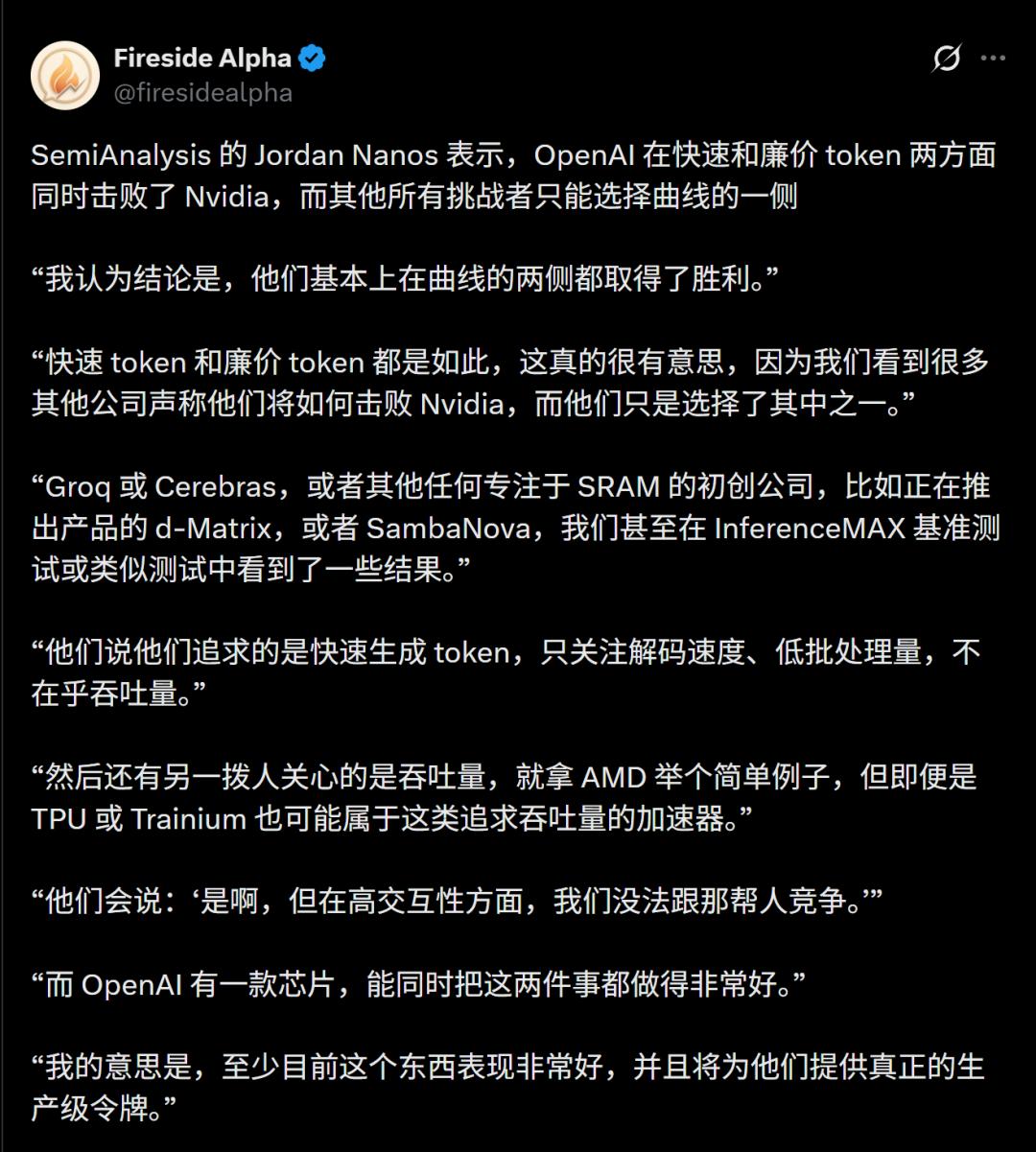
SemiAnalysis broke the news that when reviewing the low-level code of its self-developed chip, OpenAI engineers reluctantly admitted that humans have been completely unable to understand AI-generated code.

Even more astonishing, almost at the same time, the team of Silicon Valley's Architect Labs released a paper that could disrupt the entire semiconductor industry:
Two human engineers only wrote high-level specifications in natural language, and the AI generated a real chip hardware capable of running large models from scratch within two weeks with zero human intervention!
NVIDIA's CUDA moat has been directly breached.
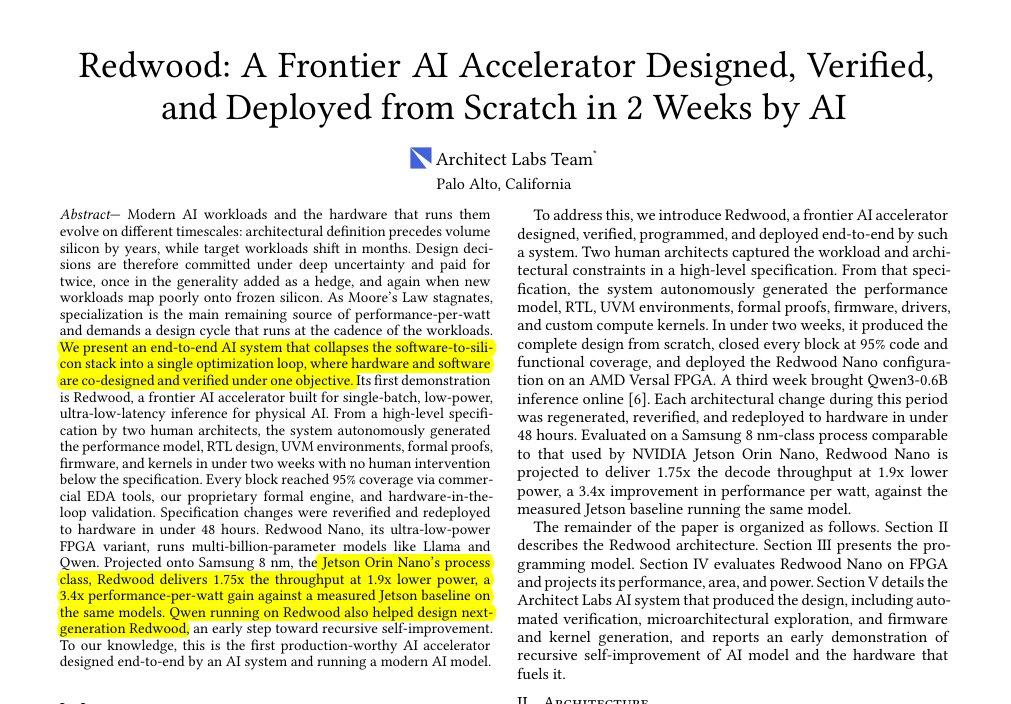
Title: Redwood: A Frontier AI Accelerator Designed, Verified, and Deployed from Scratch in 2 Weeks by AI
Preprint: https://arxiv.org/abs/2608.26418
Modifying the architecture specification once, the AI only takes 48 hours from code refactoring, re-verification to deployment back to the hardware.
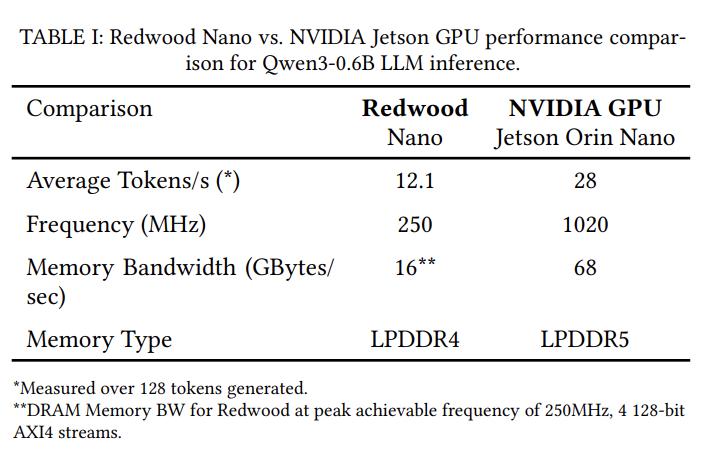
Moreover, this chip has successfully run open-source large models on FPGA, and the measured inference energy efficiency ratio is 3.4 times higher than that of NVIDIA Jetson!
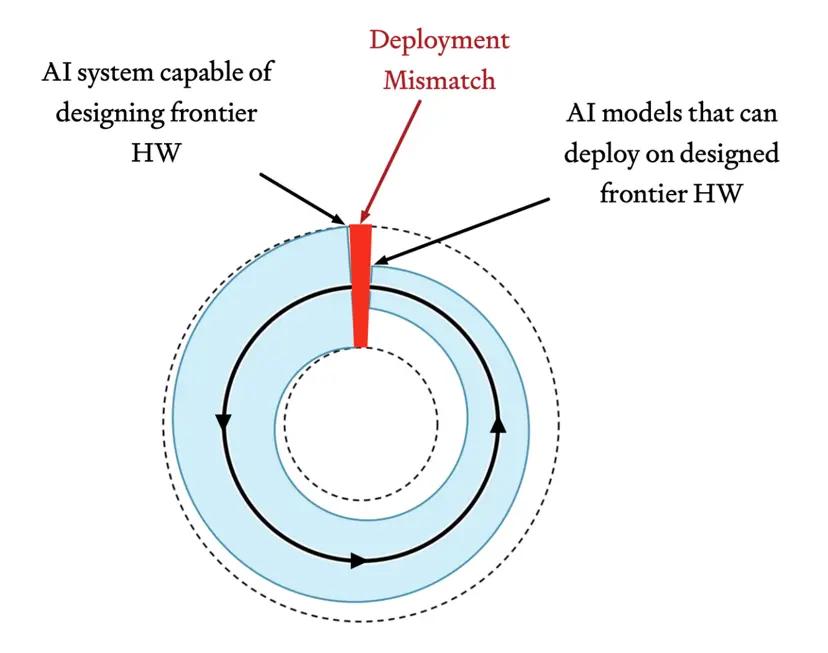
The most shocking thing across the entire network is: the AI running on this first-generation chip has already started designing its next-generation chip.
OpenAI Engineers Confess: "We Can No Longer Understand AI Code"
In an interview, an expert from SemiAnalysis pointed to a section of code and asked: "How exactly do these lines of assembly logic mobilize the hardware units?"
Several top OpenAI engineers present looked at each other, then shrugged and frankly admitted:
"To be honest, we have no idea what each line of it is doing. But that doesn't matter — the AI understands it, the AI has tested it, and it runs extremely fast with explosive performance."
According to the heavy disclosure of SemiAnalysis expert Jordan Nanos, when OpenAI was developing the core low-level acceleration operators for its self-developed chips, the underlying assembly-level code has been completely handed over to AI.
On top of Triton, the OpenAI team built a low-level kernel programming language called Gluon.
And all the complex hardware instructions in Gluon are automatically generated by AI in a short period of time.
"Code does not need to be understood by humans. As long as the AI understands it and the AI verifies it, it is correct."
This is the most drastic paradigm collapse in the more than half a century since the birth of software engineering.
Why hand over the low-level code to AI?
Because only in this way can we break through the defense line of the computing power empire built by Jensen Huang.
According to SemiAnalysis's disclosure, OpenAI's secretly developed self-developed AI chip has outperformed NVIDIA in both generation speed and operating cost!
Even more fatal, it is directly disintegrating the "CUDA moat" that NVIDIA has relied on to dominate the world for two decades.
The core reason why NVIDIA is irreplaceable is that millions of developers and hundreds of thousands of enterprises around the world are bound to the CUDA ecosystem. But OpenAI has proven with practical actions that:
When low-level software and hardware co-optimization is completely taken over by AI, humans no longer need to adapt to the complex CUDA library. The AI can directly generate the optimal low-level assembly automatically for the hardware architecture
The Chip Development Cycle Is Broken! 2 People + AI Make Real Hardware in 2 Weeks
Meanwhile, this landmark paper just published by Architect Labs has completely overturned the semiconductor hardware design industry.
Paper address: https://arxiv.org/abs/2608.26418
In the traditional semiconductor industry, what does it mean to build a dedicated acceleration chip?
Team size: It often requires hundreds of top chip architects, verification engineers, and back-end teams;
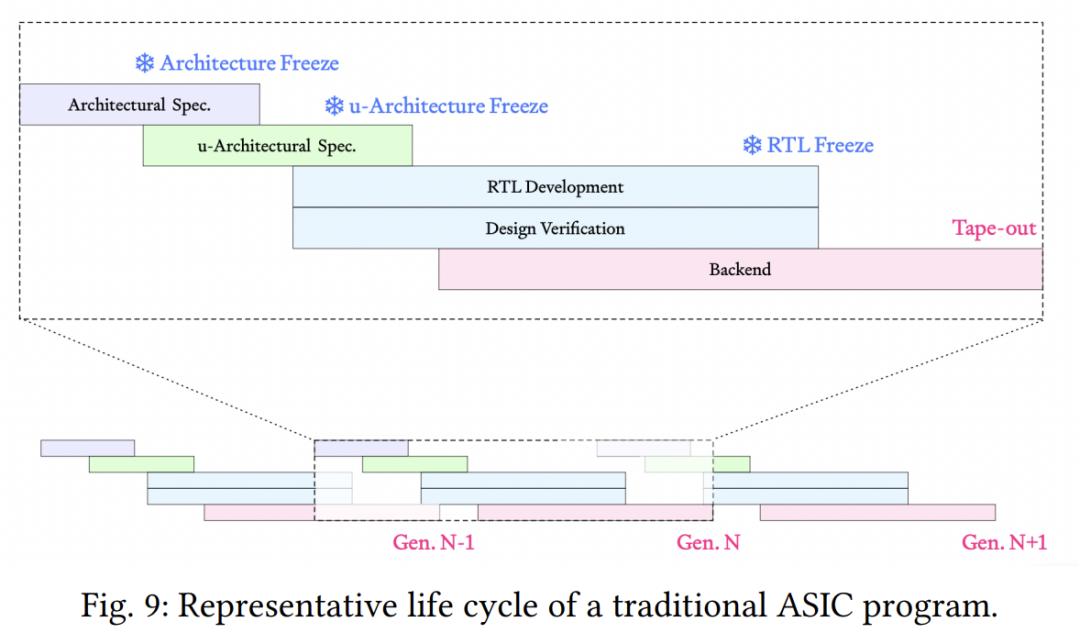
R&D cycle: From project initiation, architecture design, RTL coding to tapeout verification, it usually takes 18 to 24 months;
Capital cost: Tens of millions or even hundreds of millions of dollars, with an extremely low fault tolerance rate, one wrong step leads directly to bankruptcy.
What Architect Labs did has astonished the entire industry:
Only 2 human engineers wrote the top-level functional specification in natural language, and the AI generated the complete hardware design in two weeks.
Below the specification, the whole process has zero human intervention!
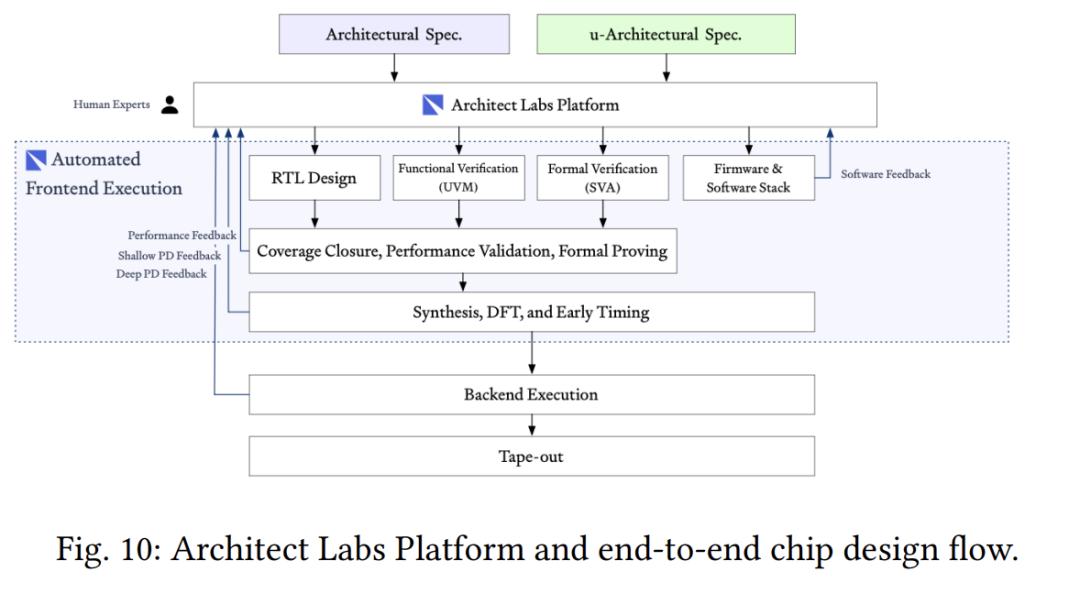
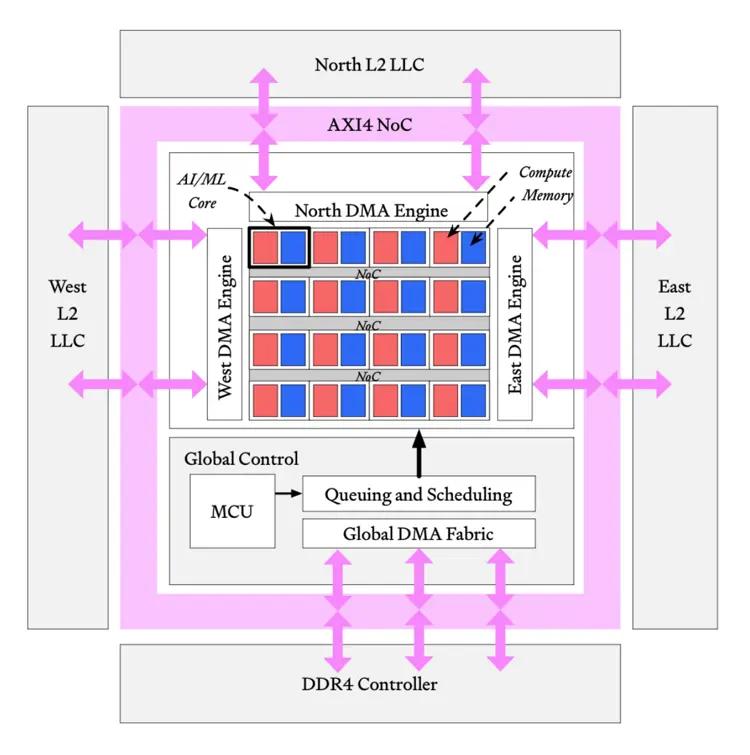
Without using any off-the-shelf commercial accelerator IP on the market, the AI system automatically generated the full set of register transfer level code, hardware verification suite and supporting low-level firmware in just two weeks.
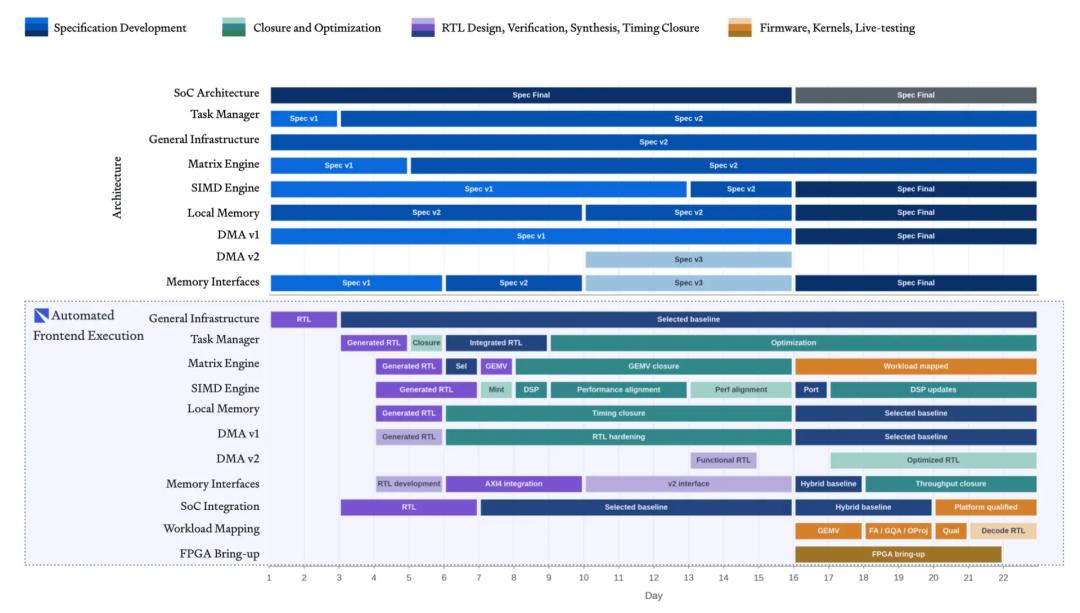
The most feared thing in traditional chip design is changing requirements, as modifying one module may take months to re-run simulation and verification.
But in Architect Labs' AI system, after modifying the specification document, the whole process of AI regenerating, verifying and deploying back to the real hardware only takes 48 hours.
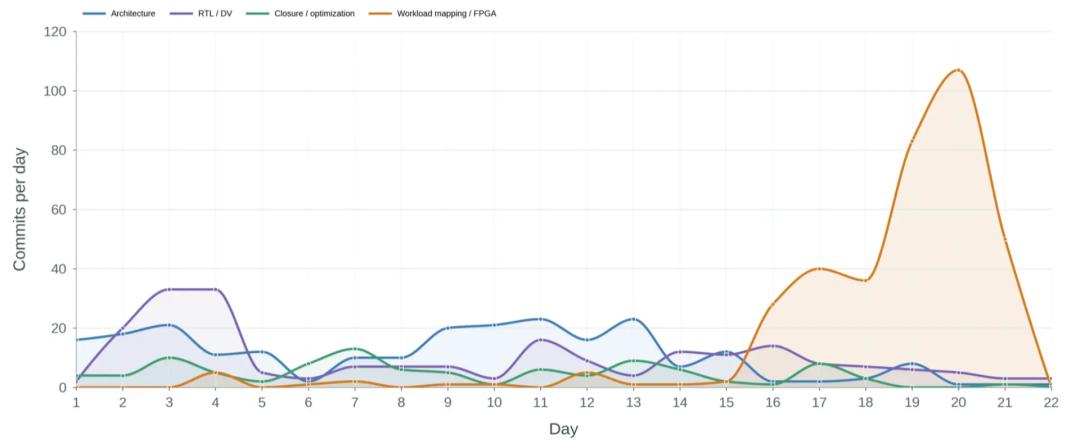
At the peak of R&D, the system can automatically merge 115 hardware modifications in a single day, with a module coverage rate of up to 95%, and the first version is delivered with 0 Bug!
This chip, named Redwood, is by no means a theoretical toy.
It is directly deployed on AMD Xilinx Versal FPGA hardware, and actually runs open-source large models.
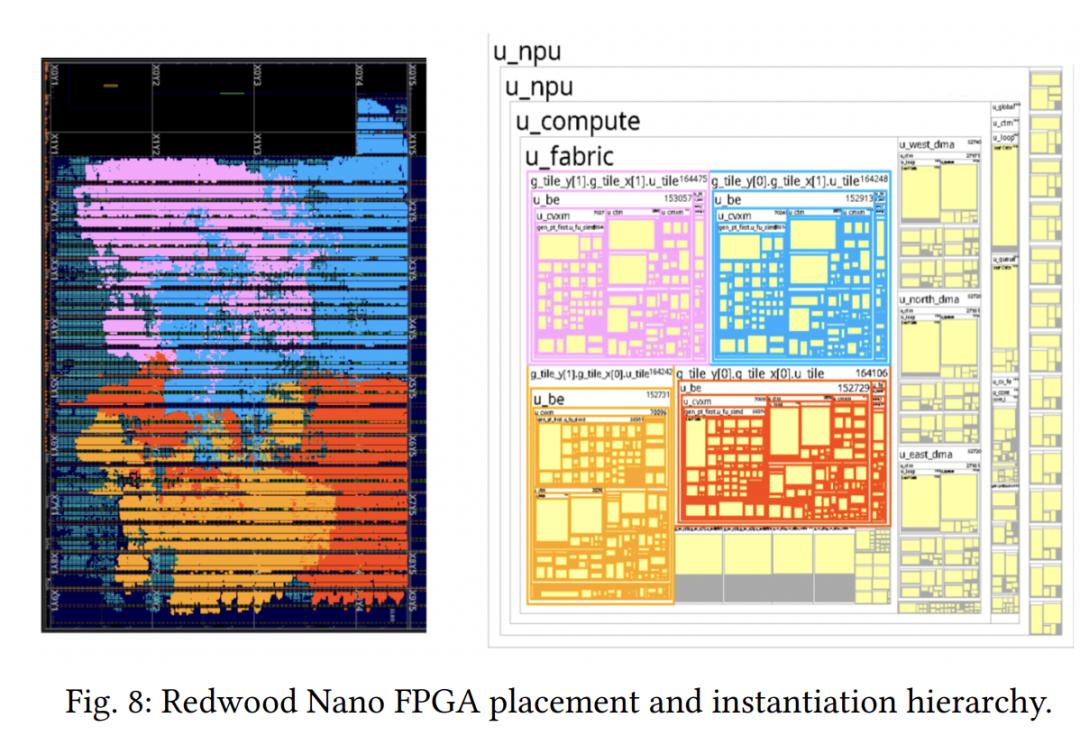
According to estimates, if Redwood is converted into an ASIC chip of the same process, its energy efficiency ratio in edge-side Physical AI and low-power scenarios will directly reach 3.4 times that of NVIDIA's flagship edge computing Jetson!
The "hardware R&D cycle law" that the chip industry has followed for half a century has been completely broken through by AI at this moment.
AI Is Designing the Next Generation of Chips on Its Own
If you just think this is another case of "AI reducing costs and increasing efficiency", you will completely underestimate the huge storm behind this incident.
In the corner of this paper, there is a description that makes all computer scientists' hair stand on end:
"The open-source large model running on the first-generation Redwood chip has fully participated in the architecture design and code generation of the next-generation chip."
Please stop and think carefully about this sentence.
This is the ultimate concept that the computer science community has deduced for decades: recursive self-evolution of hardware.
In the history of human evolution, it took millions of years to go from stone tools to iron tools, and two hundred years from the steam engine to integrated circuits. Because humans are limited by their physical bodies, their brains cannot directly iterate the material carriers of survival.
But the silicon-based world does not have this limitation.
When a smarter AI designs a more efficient chip, this chip in turn runs a larger AI with 3 times the computing power and a 48-hour iteration speed, so as to design the next generation of chip...
Once the flywheel starts to spin, its iteration speed will not be linear, but an exponential surge.
Humans are being marginalized.
Programmers and Engineers Are Becoming Feeders for the "Creator"?
Nowadays, for the first time, the complexity of technology has exceeded the brain bandwidth of its creators.
At the software level, the traditional meaning of "programming" is dying. The future of software development is to constrain the intent of AI and evaluate the output results.
At the hardware level, the tens of billions of thresholds for chip design are collapsing. The semiconductor empires once monopolized by giants may be defeated by countless "AI + 2-person teams".
The underlying hardware and core operators supporting the future global computing power network are turning into black boxes that humans cannot see through.
We can only stand outside the black box, watching AI build a kingdom beyond human comprehension.
Perhaps, a brand new silicon-based civilization that humans will eventually be unable to understand and control has arrived?
References:
https://x.com/firesidealpha/status/2092421779008766021
https://x.com/firesidealpha/status/2093860831595499892
https://architectlabs.com/blog/redwood
https://arxiv.org/pdf/2608.26418
This article is from the WeChat official account "AI Era" (ID: AI_era), written by Aeneas David, published with authorization from 36Kr.