VAST has raised approximately 5 billion yuan in financing within half a year: the once non-consensus player has become "the cornerstone of the world" | Exclusive Premiere of Intelligence Emergence
Having founded the business for 3 years, even after experiencing the full growth cycle of the large model track from its budding stage to rapid expansion, Song Yachen, Founder and CEO of VAST, still describes the latest development speed as "exceeding expectations" — the industry consensus on world models and UGC interactive content platforms has formed at an unprecedentedly fast pace. In his initial assumption, "it might take another 10 years for 3D technology to mature, so that the public could gradually understand what this technology is all about."
Recently, VAST, the artificial intelligence company founded by him, has completed its Series B and Series B+ financing rounds, with a total funding amount of around 3 billion RMB, led by Matrix Partners China.
The rest of the investors include leading industrial capital players such as Perfect World, BlueFocus, Core Dynamic Investment, Yiqu Games, ThunderSoft, State Administration of Radio and Television Investment, 37 Interactive Entertainment, as well as leading financial investors including CDH VGC, CICC Capital, CMC Capital, Ameba Capital, Sanzheng Healthcare Investment, Zhongping Capital, Fujian Industrial Investment Fund, Fujian Venture Capital, Zhuoyuan Asia, Jiangxi Financial Control and others.
At the same time, existing shareholders Dawn Capital, Primavera Capital, 4399, Muhua Tech Venture, Oasis Capital, InnoVision Capital and Huakong Fund continued to make over-subscribed follow-on investments.
In less than half a year, VAST has raised a total of about 5 billion RMB in financing, setting a new record for financing amount in the AI 3D sector.
Behind the aggressive financing pace, a notable point is that the backgrounds of VAST's investors have become more diverse in recent months — capital from multiple industrial sectors including automotive, e-commerce, gaming, consumer electronics, XR, film and television, advertising, cultural tourism and others have all increased their bets on this track.
Just as Salesforce invested in Anthropic and integrated Claude into its ecosystem, and BMW increased its stake in Figure AI to introduce robots into its production lines, the increased investment from downstream industrial capital usually means that technological development has entered a new stage: technology has evolved from "usable" to "user-friendly", and the huge commercial returns brought by technology have also changed from numbers on business plans to tangible benefits that industrial players can directly observe.
What industrial capital first values is VAST's technical capabilities.
In August, VAST just launched its latest generation of AI 3D foundational model Tripo P2.0 Preview, which is the world's first 3D large model capable of generating high-quality quad meshes in just a few seconds.
Compared with the previous version P1.0, P2.0 has achieved qualitative leaps in capabilities including generation accuracy and polygon count range — the upper limit of single-side polygon count has been increased from 20,000 triangular faces to 50,000 triangular faces, while a native quad mesh topology mode is newly added, supporting up to 25,000 quad faces.
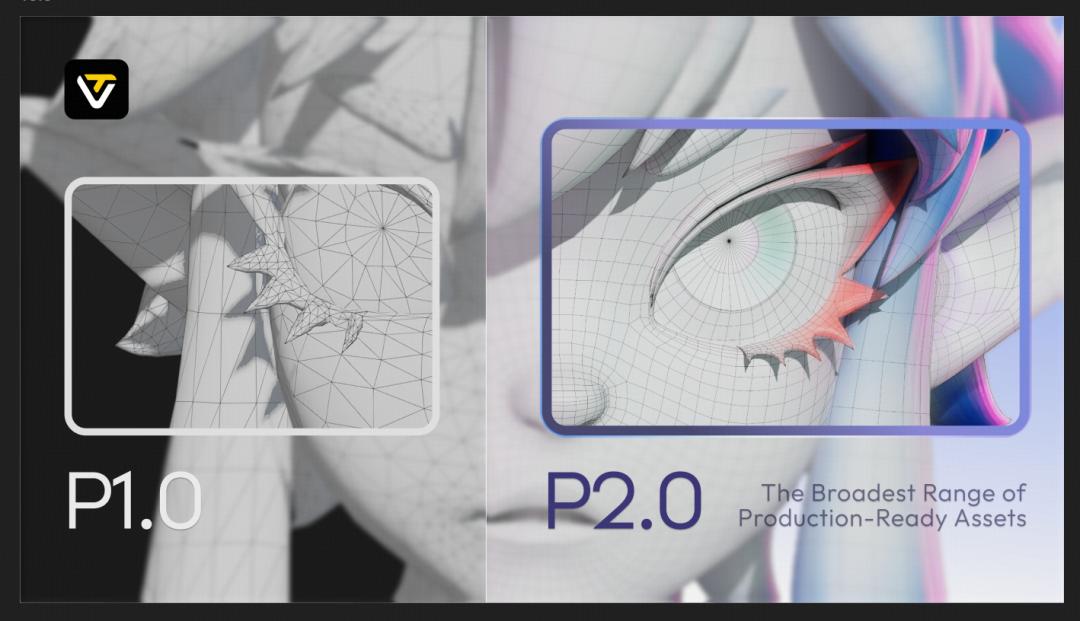
△Tripo P1.0 vs P2.0. Source: Provided by VAST
The other side of the real-money bets from industrial players stems from VAST's outstanding implementation and commercialization achievements.
At present, VAST is one of the few AI startups that both has self-developed foundational models and has delivered commercial results in vertical sectors. Its core product Tripo Studio has served tens of millions of users worldwide, and Tripo, the 3D-native foundational model, has been integrated into the workflows of domestic and international companies including NetEase, Tencent, ByteDance and Microsoft.
"3D is the native representation of the world," Song Yachen once stated. The fact that VAST is now highly sought-after also comes from its exact alignment with the current beliefs of investors: the next-stage leap of large models will take place in the understanding, simulation and interaction of the physical world.
To maintain leading position in every stage, both models and applications must be prioritized — foundational models define the boundary of implementation scenarios, while the platform will carry applications and commercialization.
However, VAST has no intention of portraying a fairy-tale growth script for itself. Previously, Song Yachen admitted on several public occasions that right after the company was founded, it tried to build a UGC interactive content platform immediately, but soon found that the "mobile camera" for the 3D sector had not been invented yet — in an era where the technology and products of the whole track are far from mature, it is difficult for a single company alone to push 3D UGC content to achieve commercial closed loop.
After realizing this point, Song Yachen led the team to complete the "two-step" strategy from model to platform: the first step is to solve the problems of foundational models and new productivity, so that everyone can create content with zero threshold, zero cost and in real time; the second step is to build a platform, distribute content and experiences to end consumers, and realize commercialization.
Song Yachen believes that AI 3D will bring new platform-level opportunities, and its potential market size will be much larger than the content platforms we are familiar with today.
"Let AI adapt to human industrial standards, not the other way around"
"If someone tells you that you can generate 100,000 assets a day, what will you do?" This is a question that Cao Yanpei, Chief Scientist of VAST, has been thinking about frequently for a period of time.
This assumption sounded like a fantasy only half a year ago.
In the traditional 3D industrial pipeline, time-consuming retopology and rigging contain very little artistic creativity, which are essentially complicated manual labor — manually retopologizing a single asset takes hours to days, making it the biggest manpower bottleneck in the entire production pipeline. Once the process is stuck in topology and rigging, the overall production pace will be slowed down.
To enable AI-generated 3D assets to enter the production pipeline more directly, native mesh generation needs to be realized, which means directly generating 3D assets with reasonable polygon count, regular structure and proper split on the mesh representation.
After the era of large models arrived, no one has never tried to solve this problem.
Back in 2024, the particularly popular technical consensus in the AI 3D track was Auto-Regressive.
The huge success of the autoregressive paradigm in large language models has deeply influenced the 3D sector. Many researchers tried to serialize 3D representations — meshes that originally have no natural linear order are encoded into ordered tokens, and then predicted one by one just like generating sentences.
In the past two or three years, the autoregressive route has indeed brought tangible benefits to the industry. Practices of projects including MeshGPT and MeshAnything have proved that based on the autoregressive route, 3D models can generate native meshes with low polygon count, compact structure and certain production value.
However, VAST realized very early that what autoregression brings to native mesh generation is a kind of "false prosperity". Forcibly fitting meshes into serialized representations will cause information loss, and once a higher upper limit is pursued, problems such as error accumulation will be exposed intensively.
"This is actually taking a very long detour between the original data and the final assets we want," said Cao Yanpei, Chief Scientist of VAST.
This industry-leading judgment comes from the principle that VAST has adhered to since its establishment: "Generated assets are ready for use". In Cao Yanpei's words, "We need to let AI adapt to human industrial standards, not the other way around."
"To generate high-quality meshes within seconds, it is impossible to take the autoregressive route — with current computing power and paradigm, to generate tens of thousands of faces, it is impossible to generate tens of thousands of tokens in one second," Cao Yanpei said.
This forced VAST to take a more challenging end-to-end route: train directly on the most primitive mesh data of 3D models, and generate the whole content at one go — this is also the core training idea of VAST's current foundational model Nexus.
To achieve this goal, VAST has reconstructed the entire model and data pipeline, including a large-scale global 3D native data asset library, as well as self-developed training and inference infrastructure. Meanwhile, the team has also built an engineering system that pushes research prototypes to robust and efficient online services, which means that the technology developed in the laboratory can finally be implemented into products that users can use stably.
The inflection point of model capability iteration started from VAST's exploration of the self-developed algorithm framework Nexus.
Compared with the linear generation autoregressive route, Nexus decouples the generation of vertices and topology, uses layered diffusion to generate vertices globally from coarse to fine, and then encodes arbitrary topology through "spatiotemporal interval". In simple terms, generate the whole first, then add details.
Based on this path, Nexus has realized native mesh generation that does not require sorting at all for the first time based on diffusion models. Relevant papers have been included by SIGGRAPH, the top international conference on computer graphics.
The first-mover advantage in the diffusion route, sharp know-how, and continuous investment in training resources have allowed VAST to maintain the position of global SOTA in algorithms in the AI 3D sector — Tripo P1.0 is the world's first 3D large model that can output production-grade meshes in a few seconds, which is 100 times faster than other solutions on the market; since the P series was launched in March this year, no model product in the industry has achieved the same effect.
The underlying algorithm advantage brought by Nexus was soon verified on the P2.0 Preview launched in August this year.
For a long time, quad meshes have been the industrial standard for production in sectors such as gaming and film and television. However, multiple traditional retopology routes cannot balance the generation speed and quality of quad meshes.
Under the Nexus framework, the generation of different face types (order of faces) has become an inherent capability of the model; at the same time, there is no need to go through the lengthy process of generating a high-poly model first and then converting it, and polygon meshes can be directly produced in one generation — this makes Tripo P2.0 the world's first 3D native foundational model that realizes native quad mesh topology, and the generated 3D assets can directly meet industrial production standards.
This is the victory of non-consensus thinking, and also the victory of the first principle.
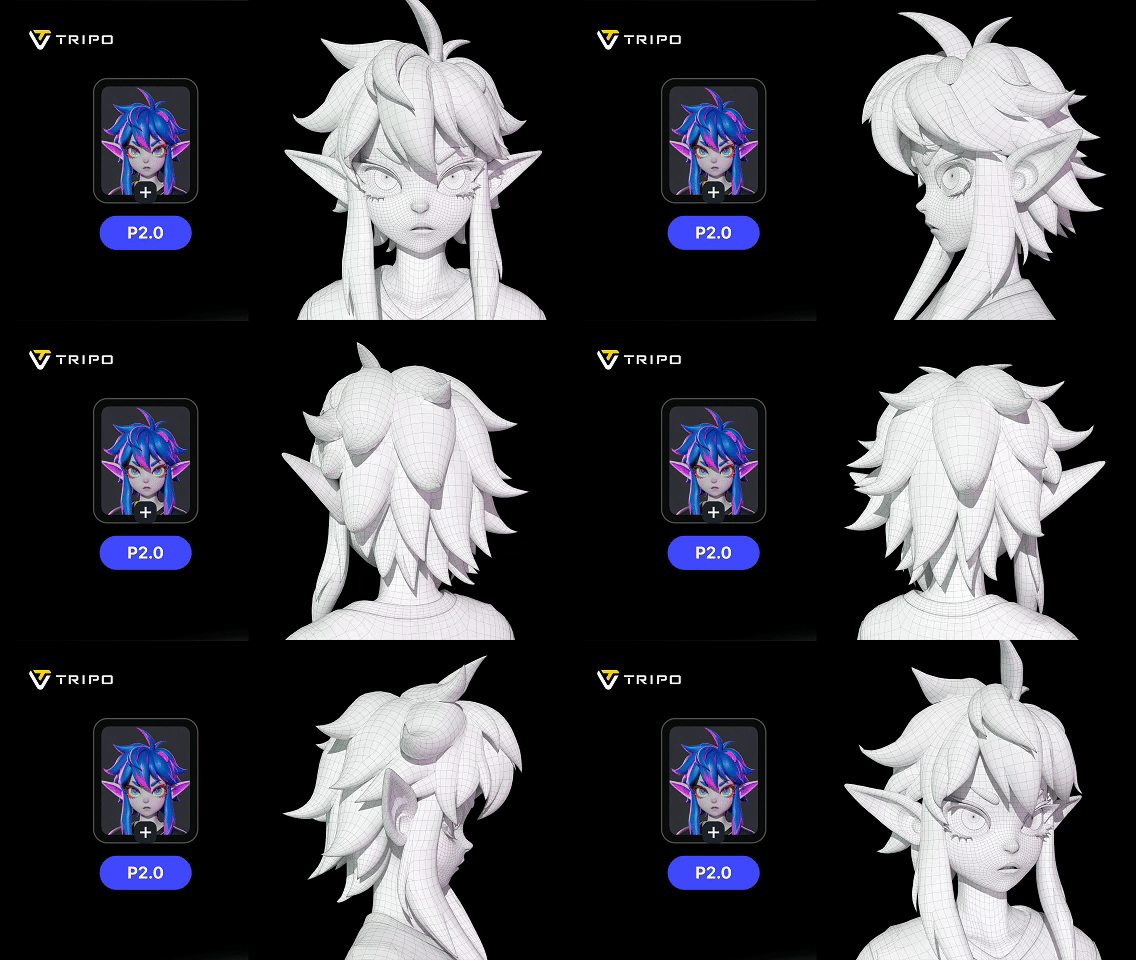
△Tripo 2.0 Preview. Source: VAST WeChat Channel
The boundary of model capabilities defines the boundary of world creation
In Cao Yanpei's view, the progress of model capabilities in the past three years has essentially been solving the problem of 3D asset supply on the model side. Compared with the situation that it used to take half a month to get a single protagonist asset, "once the content production capacity is improved, content consumers will make very different choices", which will bring qualitative changes to the production paradigm and ideas in the content sector.
On the C-end, the practices of model vendors in video creation and Vibe Coding have proved that model capabilities define the boundary of demand. This rule has also been verified in the AI 3D sector.
Since the launch of the Tripo P series, more and more developers around the world have begun to develop web pages, games and other products containing 3D interactive content through "prompt-based coding" based on the model's coding capability.
For example, overseas independent developer @thebuggeddev has created multiple high-quality 3D interactive web pages based on Tripo, as well as coding models such as Claude Code and Codex. From 3D asset generation, web page construction, to Three.js coding and rendering, the entire creation process does not rely on traditional professional tools such as Blender, and developers can complete the construction from model to interactive web page only through natural language and code.
Recently, the 3D human anatomy interactive application he posted on X was reposted by Greg Brockman, President of OpenAI, and the original post received more than 10,000 likes. The production process of this high-quality web page is not complicated: first use GPT Image 2.0 to draw the design draft, generate organ images one by one, then use Tripo to convert them into 3D models, and finally hand them over to Codex to write codes for assembly.

△Greg Brockman reposted the 3D interactive web page developed by @thebuggeddev via Tripo vibe coding. Source: X
For many C-end creators, the Tripo P series models, especially the newly released P2.0, feature fast generation, clean topology, and split parts that fit the semantic structure, which exactly meets the requirements for agents to understand and edit 3D assets — this also makes Tripo P2.0 the most suitable 3D native foundational model for Vibe Coding so far.
More sweeping qualitative changes are taking place in thousands of downstream industries.
At present, the capability leap of the Tripo P series allows AI-generated 3D assets to be directly accepted by the production pipelines of various industries without manual rework for the first time. Even for novice users, "getting results exactly as you say" has become a reality: without learning complex modeling and rendering, users can get high-precision white models that can be used for further processing with just one sentence.
Helping downstream content industries improve efficiency is the first step of VAST's implementation.
Gaming is one of the earliest sectors where AI 3D was implemented and deeply penetrated. Today, AI has entered two channels at the same time: the art production pipelines of large manufacturers, and the creation toolboxes for players themselves.
On the B-end pipeline, Tripo Studio has been integrated into the art production processes of teams including NetEase, Tencent and Microsoft, for concept generation, rapid scene asset construction, level prototype verification and multi-scheme comparison. There was once a game company that used 2.5 people on average for 2 weeks to complete the large-scale scene construction that originally took several months.
On the player side, NetEase's *Eggy Party* reached a strategic cooperation with VAST back in 2025. In July 2026, Eggy Workshop joined hands with Tripo again to launch the 3D model split function — AI-generated models can be split from a whole into multiple editable and combinable parts.

△The 3D model split function launched by Tripo on Eggy Workshop. Source: Provided by VAST
Furthermore, as the real-time interactivity of 3D AI generation further improves, it will become the game gameplay itself.
After NetEase's *Where Winds Meet* launched the "All Things Tai Chi" function based on the Tripo API, players can upload a photo, and the system will generate the corresponding 3D realistic model in real time. Players can truly "build a bridge when encountering a river, and build a tree when encountering an enemy". The generated 3D content will directly change the terrain and interaction methods, and become part of the game's open world.
The same logic is being repeated in industries beyond gaming. In Tripo's practices, AI 3D has been able to fill the extremely difficult gap "from idea to usable 3D model" in the core workflows of multiple industries.
3D printing is a typical example.
If hardware breakthroughs and price drops have ignited the first big growth wave of the 3D market — data from market research institution CONTEXT shows that in the first quarter of 2026, the global revenue of 3D printing equipment increased by