This agent aims to be the "job-hunting buddy" for tens of millions of graduates | Underwater Project
"You send out 100 resumes, and 90 of them may get no response at all. You have no idea why, nor how to improve them," said Wang Xiangdao.
Wang Xiangdao is the founder and CEO of MoSeeker, an AI digital recruitment solution provider. With over a decade of experience in the recruitment industry, he has deep insight into the long-standing structural contradictions in recruitment scenarios: "HR staff are numbed by going through piles of resumes, while job seekers are worn out by mass applications to the point of self-doubt. Both sides are suffering from inefficiency, yet the information gap between them is extremely hard to bridge."
This summer, 12.7 million college graduates stepped out of campus to face new challenges in their lives. On the other side of reality, the *2026 Campus Recruitment White Paper* released by 51job in July this year shows that 65.3% of enterprises had introduced AI tools into campus recruitment in 2025, up 12.7% from 2024.
Both the supply and demand sides are being reshaped by technology. At present, most AI recruitment products target enterprise clients, while the supply of tools for job seekers lags far behind. "That's why we want to create an Agent that acts as a 'job-hunting buddy' to help people solve difficulties in finding jobs," said Wang Xiangdao.
He revealed that MoSeeker will soon launch Zhiya, an AI recruitment Agent product targeting young job seekers including fresh graduates, to help users optimize their resumes, analyze job matching degrees, conduct mock interviews, and recommend positions, "making it easier for young people to find their ideal jobs." The product is currently in public beta on iOS, and the Android version is scheduled to be launched within this year.
MoSeeker, the company behind Zhiya, was founded in 2014 and headquartered in Shanghai. It is a leading domestic AI recruitment system provider with footprints in many regions across the Asia-Pacific, serving more than 1,000 clients including over 100 large enterprises and Fortune Global 500 companies, covering leading players in various sectors such as Disney, Mars, and Shanghai Metro. The platform can reach more than 30 million potential candidates, with over 5 million mini-program members on WeChat and over 100 million job page views.
Why would a company that has been doing B2B business for more than 10 years turn around to develop C-end products?
Wang Xiangdao's logic is that over the past 10+ years of serving enterprises, MoSeeker has accumulated two core competencies: first, in-depth understanding of the demands on both ends of recruitment, knowing well what kind of talents enterprises want and what difficulties job seekers are facing; second, process data formed by millions of real recruitment cases on the platform. "These two assets are what give us the confidence to build Zhiya."
Build a "job-hunting buddy" that truly stands with users
The "difficulty in finding employment" is essentially a macro supply-demand issue that goes beyond the capability boundary of any single company. From Wang Xiangdao's perspective, existing platforms on the market are essentially intermediaries that charge enterprises by leveraging traffic and information asymmetry, which makes it almost impossible for their product design to truly solve the dilemmas of job seekers. "To some extent, the confusion of job seekers and the inefficiency in their job hunting process are the very source of profits for traditional platforms."
Therefore, Zhiya is positioned as a "job-hunting buddy" that truly stands on the side of candidates, and returns to focus on people's actual needs: including who the job seeker is, what skills they have, what kind of job they want to do, and where their confusion lies, so as to help them find suitable career directions and positions, and reduce information gaps and ineffective work in the job hunting process.
"We hope Zhiya will become a one-stop career Agent for job hunting," Wang Xiangdao said, "which can help people avoid many detours in their job search."
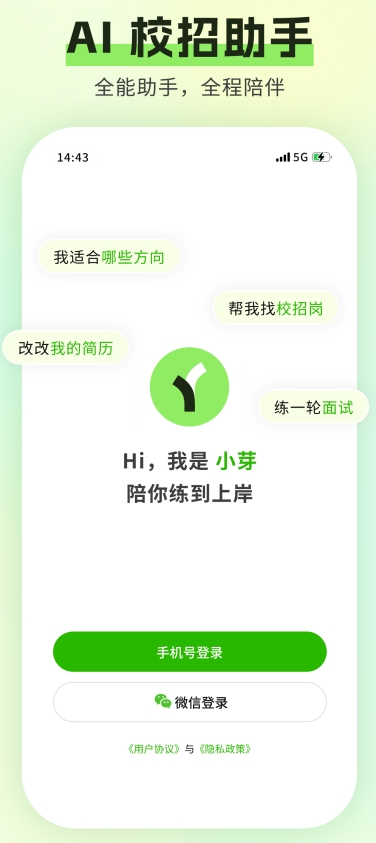
AI recruitment Agent product "Zhiya"
In terms of specific product functions, after users upload their resumes, the Zhiya Agent will automatically extract users' skills, work experience and background information, and provide feedback and optimization suggestions. When users put forward demands in natural language, such as "recommend some positions that suit me", the Agent will match jobs across the whole internet based on the resume profile and analyze the matching degree.
A typical scenario is AI-powered mock interview: after users select their target positions, the Agent will generate a set of interview questions in real time, with a digital human acting as the mock interviewer. After the interview, it will generate an evaluation report and optimization suggestions, detailing which questions were answered well, where the logic was unclear, and how to improve next time.
How to ensure the Agent's responses do not cause counterproductive results?
Just like all Agents for vertical scenarios, Zhiya can deliver high-quality interactive services only when it has sufficiently in-depth industry know-how at the algorithm level.
According to Wang Xiangdao, this is exactly MoSeeker's differentiated advantage. Over the past few years, the MoSeeker team has served more than 1,000 enterprise clients covering fast-moving consumer goods, beauty, semiconductor, pharmaceutical and many other industries, and interviewed massive candidates with AI tools, accumulating a large number of real cases and experience for the talent models required by different types of positions, as well as the problems that job seekers most need help solving.
Process data covering the entire recruitment scenario behind these cases, including what positions a candidate applied for, the resume passing rate and evaluation, whether they entered the interview, and whether they were finally hired, forms the underlying capability of Zhiya's matching algorithm.
However, the MoSeeker team has also encountered new practical challenges in the transformation from B-end recruitment systems to C-end job-hunting Agents.
The first is the huge difference in product design ideas. "Iteration of B-end products aims to meet clients' demands, while for C-end products, we need to analyze users' usage data to proactively understand the demands behind their behaviors." Wang Xiangdao gave a typical example: the early version of Zhiya once launched a "job square" function, allowing users to search, flip pages and filter suitable positions from tens of thousands of jobs.
"But we found that this function reduced the interaction frequency between some users and the Agent, which negatively affected the job success rate and user stickiness," Wang Xiangdao analyzed. The usage logic of the job square is still the same as that of traditional recruitment applications, which essentially deviates from the core value of Agents to efficiently obtain information through interaction, "so we firmly removed this function." This decision that goes against market consensus can be regarded as an exploration of the "native Agent" product by the MoSeeker team.
Another more subtle challenge is how MoSeeker can balance the conflict of "fighting against its own business" when shifting from serving employers to standing on the side of job seekers?
Wang Xiangdao did not avoid this issue. In his view, in the face of the game between candidates and employers, the platform needs to continuously maintain dynamic balance through product iteration and algorithm optimization, which can not only improve the job hunting performance of the former, but also allow the latter to see the real level of job seekers. This is also the reason why Zhiya is independent from other previous businesses of MoSeeker and only targets C-end users.
The most fundamental value of the platform still lies in bridging the information gap and expression gap between the two sides.
"AI is not designed to help job seekers disguise themselves. We even need to effectively identify cheating behaviors through product design. AI is meant to help them better understand themselves and express themselves, making the entire matching process more efficient," Wang Xiangdao said. Employers can also express their talent demands more clearly and naturally through the Agent.
Let Agents do the matching, and humans make decisions
When recruitment applications were first launched, they usually faced the classic "chicken or egg" dilemma: the algorithm matching can only be more accurate with sufficient user data; and the algorithm can only retain more users when its matching is effective enough.
Over the past year, various vertical industry Agents have emerged rapidly around the world. HR management work such as recruitment, which has a large number of highly standardized and repetitive tasks, is widely recognized as one of the vertical fields suitable for large-scale Agent implementation.
The *2026 Campus Recruitment White Paper* by 51job shows that 65.3% of enterprises had introduced AI tools into campus recruitment in 2025, 12.7 percentage points higher than that in 2024. Leading industry players including LinkedIn, Workday and BOSS Zhipin have successively launched their own AI recruitment assistants or Agents, and this trend is still accelerating.
Facing the emergence of more similar products in the future, what is the competitive barrier of Zhiya?
Wang Xiangdao believes that the "innate advantage" for Zhiya to acquire users lies in MoSeeker's existing B-end resources, including the campus recruitment channels of thousands of enterprise clients, and the cooperation with more than 100 universities across the country in areas such as AI interview systems, which allows Zhiya to reach a large number of students and fresh graduate users at low cost, and build a good reputation with a free model first, without the need to "burn money" for marketing promotion.
"As long as the tool is really easy to use, the word of mouth spreads very fast among students. When the user scale reaches a certain level, we will launch multiple paid models for the demands of different groups," Wang Xiangdao said.
For the ultimate future of the recruitment Agent industry, Wang Xiangdao envisions an "Agent to Agent" mode: the job seeker Agent knows what kind of job the user wants to find, and the enterprise-side Agent understands what kind of talent the company needs, and the two Agents complete the matching and initial communication on their own.
"But this does not mean that the role of humans disappears," Wang Xiangdao said. After the Agent filters out a large amount of invalid noise in the procedural work in the early stage, the truly matched talents can have more efficient and valuable communication with the enterprise. "And it should always be humans who make the final decisions. Human in the loop is a very important standard in AI ethics."