A heavily refitted decommissioned spy satellite has been launched into space, and everyone is applauding for NASA.
What would it feel like to fit a wide-angle lens on the universe?
The Roman Space Telescope: Thanks for the question, I'm already in space, just got off the Falcon Heavy.
Just yesterday, a major event took place in the aerospace community: SpaceX's Falcon Heavy rocket sent an extremely precious giant device into deep space.
It is called the Nancy Grace Roman Space Telescope (referred to as the Roman Telescope).
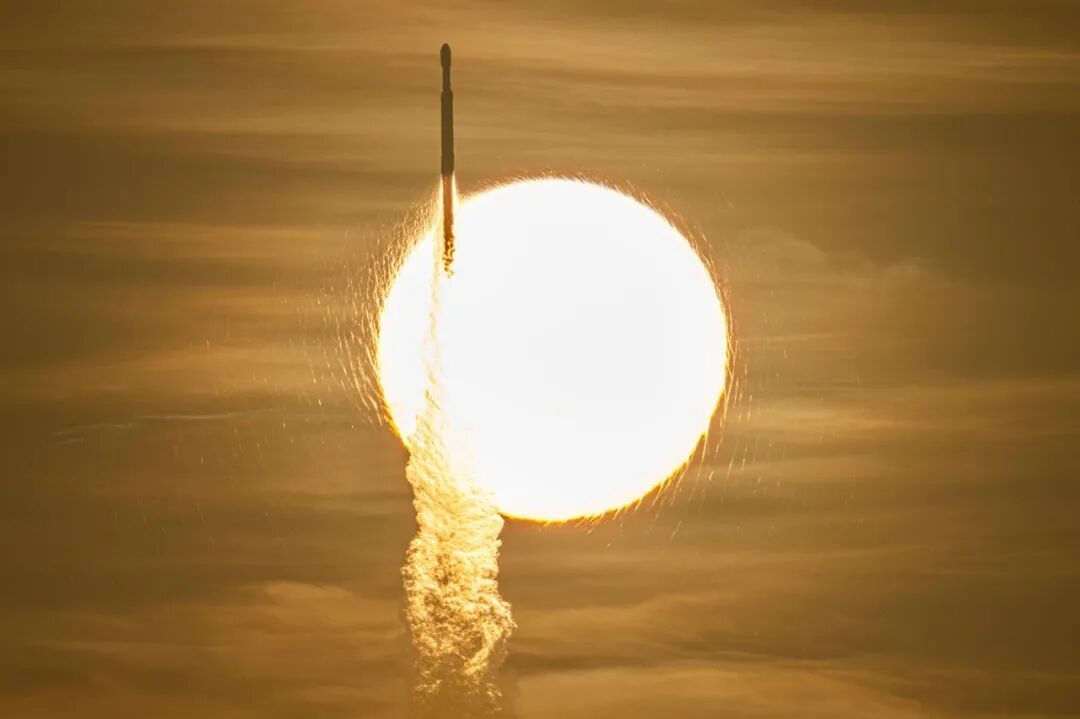
This device is not only NASA's next flagship space observatory following Hubble and Webb, but more surprisingly, in the aerospace industry full of repeatedly delayed projects, it was launched 9 months ahead of schedule without exceeding the budget.
You can get a glimpse of why the Roman Telescope is called a flagship just by looking at the origin of its name.
The Roman Telescope was officially named in 2020 to commemorate Nancy Grace Roman, the driving force behind the veteran Hubble Telescope and NASA's first Chief Astronomer.

Looking at its specifications, you will better understand how many new miracles it will bring to humanity in the future.
The Roman Telescope has a primary mirror with a diameter of 2.4 meters, the same as Hubble's, which seems relatively modest compared to Webb's 6.5-meter primary mirror.
But its truly remarkable feature is not the size of its mirror, but the width of its "field of view".
Its core component is a wide-field instrument stitched together from 18 custom infrared detectors, all of which have 4K resolution, giving the Roman Telescope a pixel count of up to 300 million.
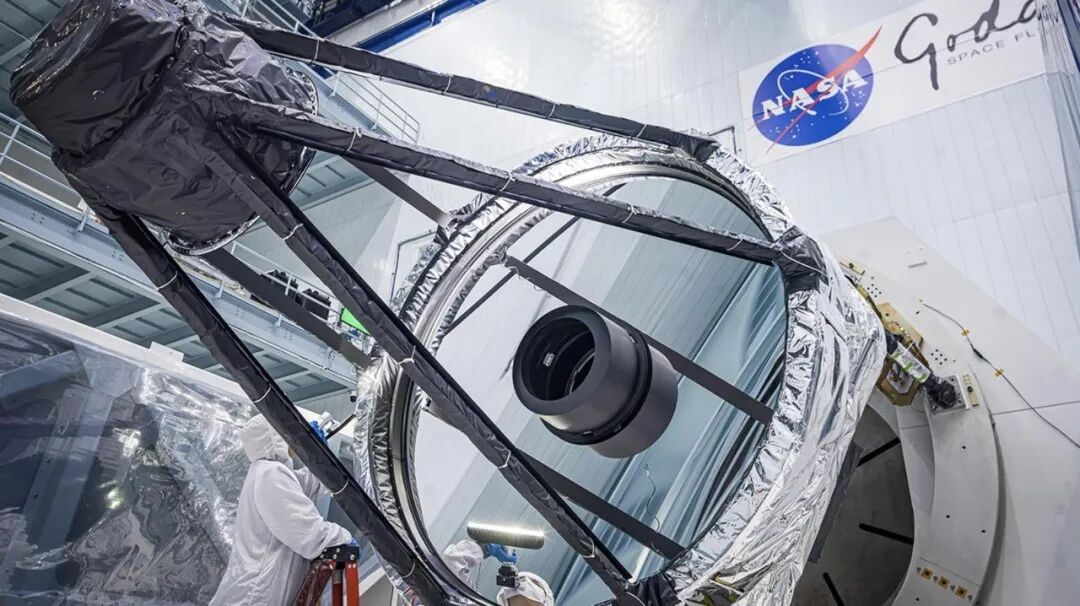
Some people might argue that it's no big deal to send a 300-megapixel camera into space, since the phones in our pockets already come with 100-megapixel or even 200-megapixel sensors.
But you must have heard the saying that a larger sensor beats everything else, and the sensor of the Roman Telescope is roughly the sum of the size of 9 15x17 IMAX film negatives.
You might still find this hard to visualize. During a live broadcast earlier, NASA staff specially compared the camera sensor of the Roman Telescope with that of an ordinary smartphone.
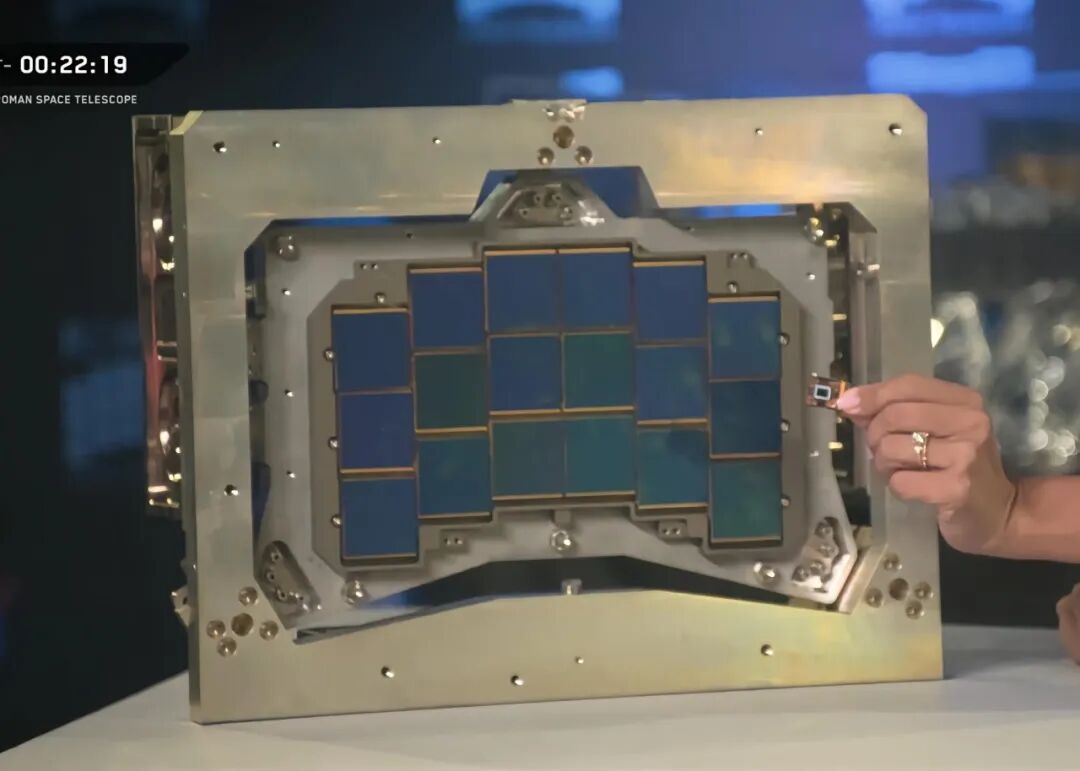
Note: The small one held in hand is the camera sensor of our ordinary smartphone
Even Dominic Benford, the project scientist of the Roman Space Telescope, said in on-site comments:
"The smallest photos taken by Roman are all gigapixel-level, there is not even a screen large enough on Earth to display all its pixels."
NASA officials also compared Roman with its predecessors: its infrared field of view area is 100 to 200 times that of the Hubble Telescope, and its sky survey speed is more than 1000 times faster than Hubble's.
In this regard, Hubble is more like a macro lens with an ultra-telephoto focal length, which can only lock onto an extremely tiny area of the universe at a time. If Hubble were to shoot the area that Roman can capture in one shutter press, it would need to work nonstop for decades.
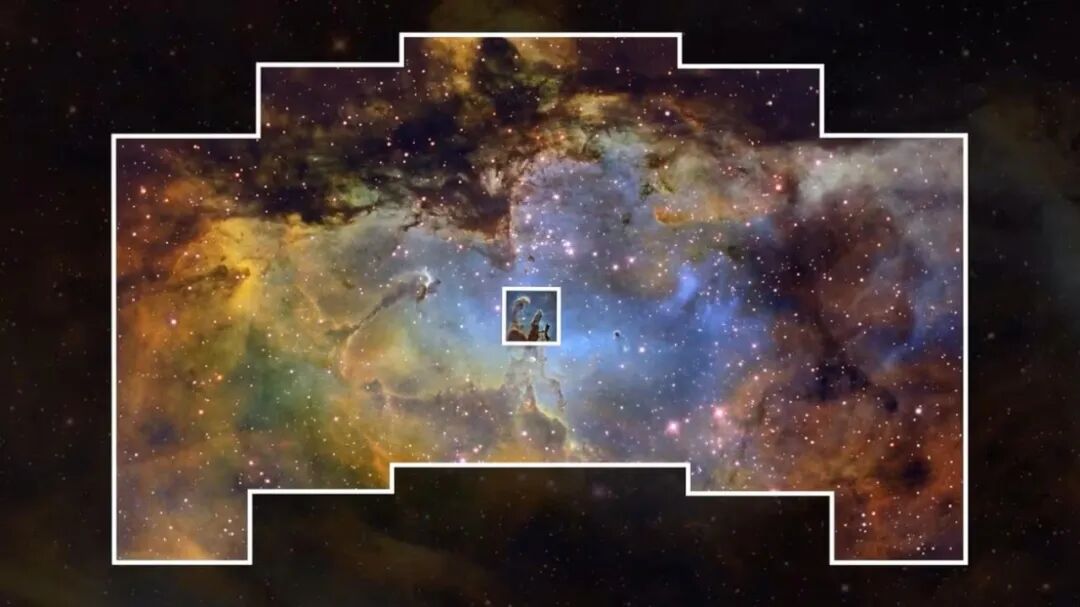
What does this feel like? You must have seen the famous image of the Pillars of Creation.
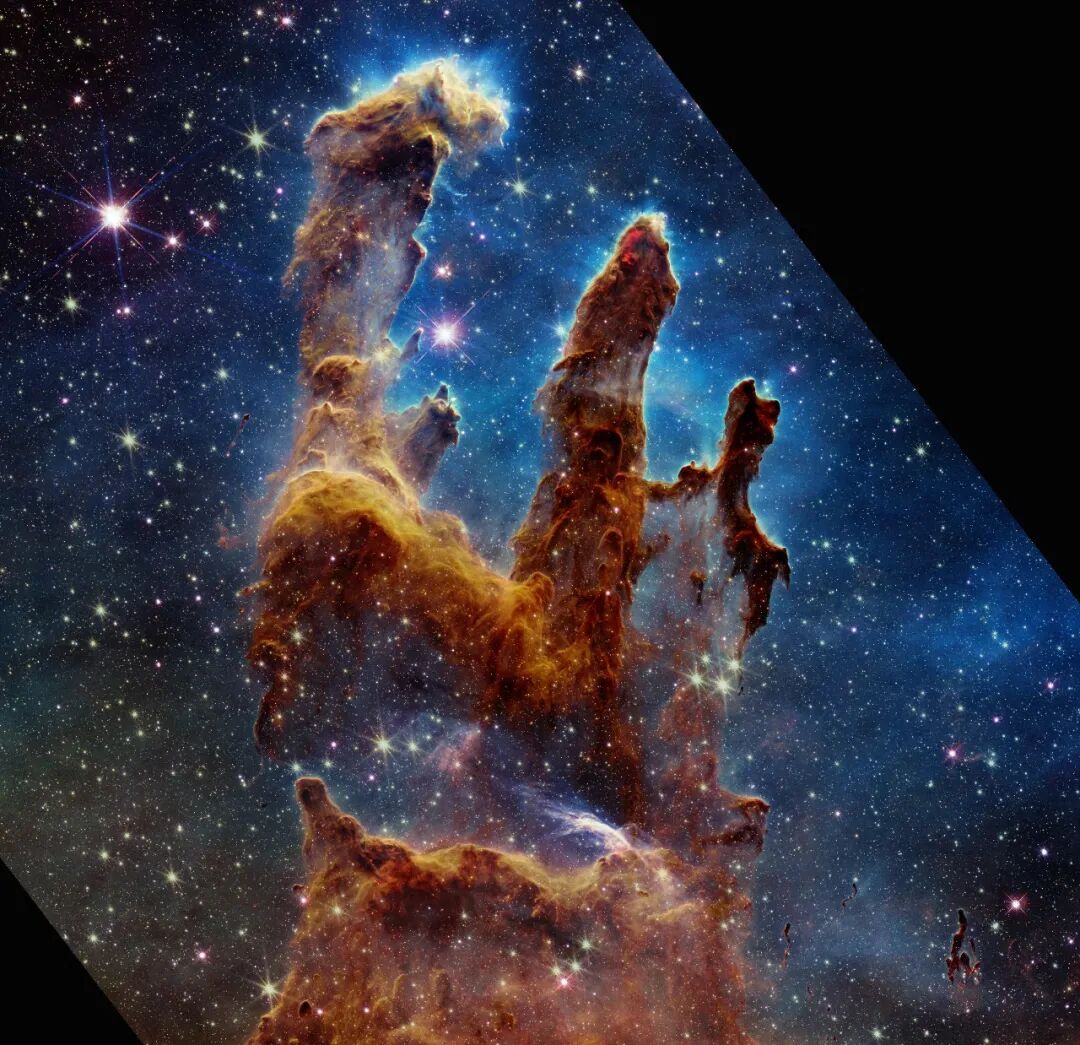
For the Hubble Telescope, each of its photos roughly covers the inner frame area in the following image, while the Roman Telescope can capture the entire outer frame in one shot.
The gap is far larger than the difference between regular IMAX and 70mm IMAX theaters in Nolan's *Odyssey*.
With such powerful specifications, the Roman Telescope naturally undertakes important missions for human space exploration.
Simply put, just by looking at its several core missions, it is almost certain that it will completely change humanity's understanding of the universe.
First of all, the most important mission of the Roman Telescope is to study dark matter and dark energy.
The former is like an invisible gravitational glue that holds galaxies and stars together, while the latter is considered a mysterious repulsive force that keeps driving the accelerated expansion of the universe. According to current scientific estimates, the two together make up 95% of the total composition of the universe.
This means that even in 2026, humanity still knows very little about the components that make up 95% of the universe.
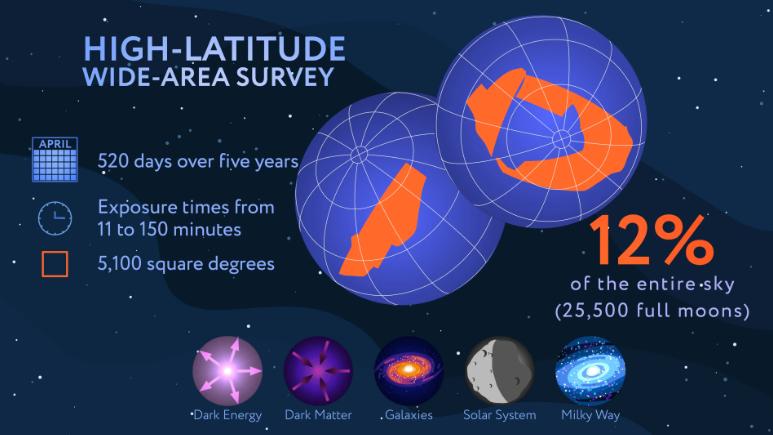
The main reason is obvious: as the name suggests, neither of these two substances emits light, so they cannot be directly observed by conventional means.
When the light from distant galaxies travels through the universe to reach the Roman Telescope, dark matter clumps along the way generate huge gravitational fields that distort the light like a magnifying glass, causing tiny changes in the shape of background galaxies.
With its far superior performance over Hubble, the Roman Telescope can measure the degree of shape distortion of hundreds of millions of galaxies at a time. With these data, scientists are expected to draw a 3D distribution map of dark matter in the universe and understand how it "glues" galaxies together.
At the same time, through large-scale sky surveys with the Roman Telescope, scientists can observe and calculate the spatial distribution distance and aggregation patterns of galaxies in different historical periods of the universe, and reconstruct the changes in the expansion rate of the universe.
Then scientists can use distant supernova explosions to measure various data, calculate the distance between these stars and the Earth, and the expansion rate of the universe in different periods, which may eventually reveal part of the properties of dark energy.
Another key mission of the Roman Telescope is to take a full "family photo" of the core of the Milky Way, the galaxy where our solar system is located.
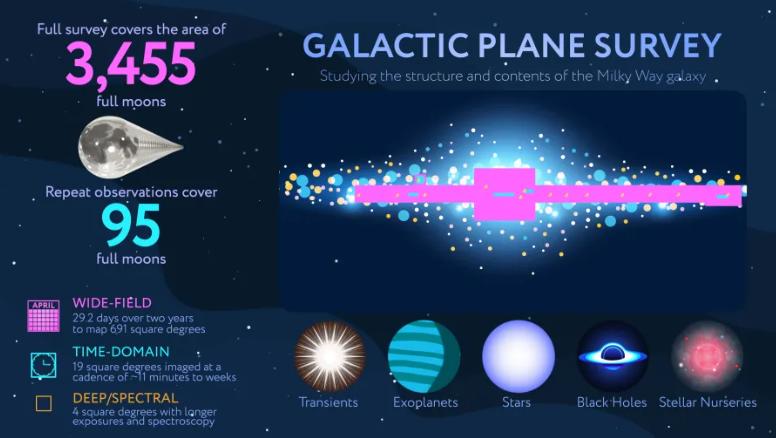
During its mission cycle, it will map the positions of up to 20 billion stars in the Milky Way, taking a photo roughly every 12 minutes.
Previous space telescopes mainly rely on the "transit method": they wait for a planet to pass in front of a star and block a small amount of light to confirm its existence.
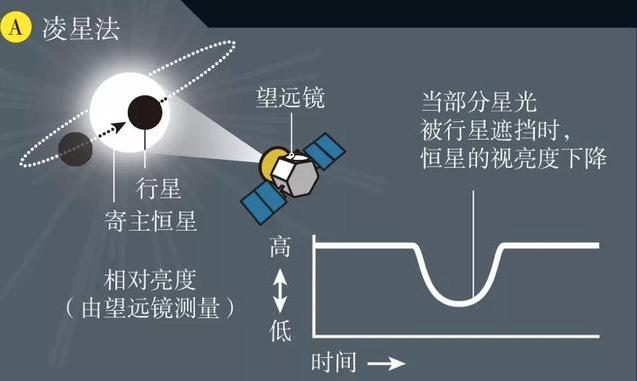
But Roman has a more capable approach: it can not only detect conventional planets, but also spot "rogue planets" that do not orbit any stars and wander freely through the universe.
These planets do not emit light on their own and have no companion stars, so they cannot be detected by traditional methods. But once they wander through a dense background of stars, their gravity will distort the starlight behind them like a magnifying glass (this is called a microlensing signal), which can be exactly captured by the Roman Telescope.
In addition, Roman is also equipped with the first high-contrast direct imaging device for exoplanets in space: a coronagraph.
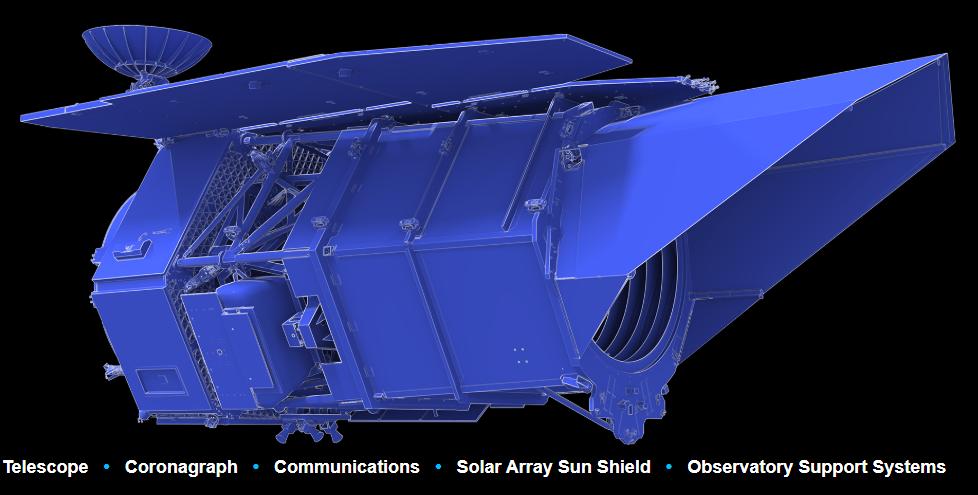
It can use a complex active wavefront control system in space to directly block the dazzling light of stars, so as to directly capture extremely faint exoplanets next to the stars.
If the technical experiment succeeds, this will be the first time humanity has directly photographed an exoplanet in the visible light band.
According to NASA's estimates, this method can not only screen out about 100,000 transit planet candidates, but also detect more than 1,000 rogue planets.
Interestingly, the Roman Telescope, which carries so many human exploration missions, almost got canceled before it was completed.
Back in 2010, this project was only a planned small-aperture telescope with a 1.3-meter diameter, far from the flagship telescope that can now change human cognition.
Then in 2012, the U.S. National Reconnaissance Office very casually donated two unused reconnaissance satellite optical assemblies to NASA.

At that time, Paul Hertz, NASA's Director of Astrophysics, felt that the good fortune came too suddenly, and even joked to the public that "we do not expect to have enough money to use both telescopes at the same time for now."
And he was right. After you learn about the rough development history of the Roman Telescope, you will understand why the other reconnaissance satellite optical assembly is still stored in a NASA warehouse to this day.
In reports from 2012, you can still see that the predecessor of the Roman Telescope was fully covered with mosaics.
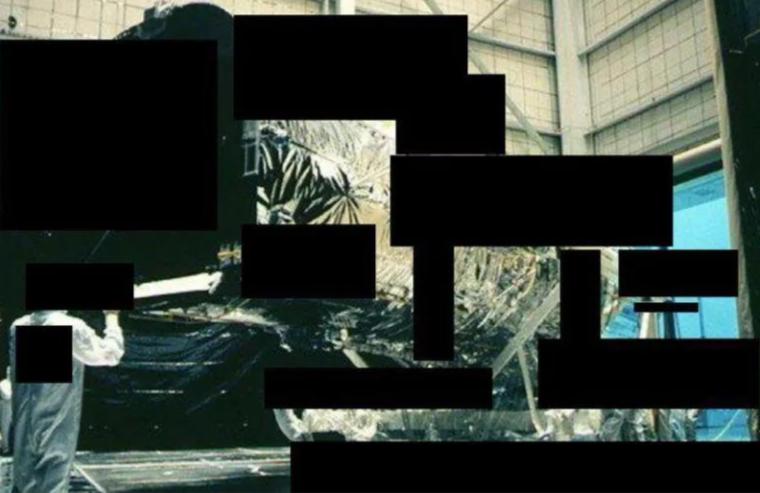
These lenses were originally intended for spy satellites in low Earth orbit to peer at the Earth's surface, and their aperture reached 2.4 meters, the same as Hubble's.
NASA scientists suddenly realized: If we turn this thing around to point at deep space, won't it become an invincible wide-field sky survey tool?
Due to the unexpected increase in aperture, the light intake of the telescope increased dramatically. As the light intake rose sharply, the project team simply added an extra coronagraph to the platform, the instrument mentioned earlier for directly observing planets.
But even with this unexpected gift, when NASA actually started to build the telescope, it found itself still short of funds and technology.
So NASA started to gather partners around the world: on one hand, it invited industrial giants such as BAE Systems and L3Harris to be responsible for core R&D, on the other hand, it brought in space agencies from Europe, Japan, France and other countries to join the project with their own funds and technology.
After gathering funds and technology from all these international partners, the project was officially approved in February 2016, entering the substantive development stage from the drawing board.
Even so, the Roman Telescope was almost canceled halfway, because the Webb Telescope next door had severe cost overruns, forcing the U.S. government to divert funds from other projects to cover the shortage.

For three consecutive years from 2019 to 2021, the Trump administration, when drafting the federal government's budget bill, pushed to cancel the project directly.
This issue was finally resolved through the joint counterattack of the U.S. Congress and the scientific community, who believed that canceling a project that could change humanity's view of the universe was unacceptable.
Every time Congress ignored the White House's proposal, and forced to allocate funds in the final budget to keep the Roman Telescope project alive.
Fortunately, the Roman Telescope has now officially got rid of all the disturbances on Earth, heading for the real sea of stars.
When the Roman Telescope starts working officially, it will turn into a terrifying "cosmic data production