A team with Chinese background has emerged as a "super dark horse" in the chip design industry in the AI era.
In just two years, ChipAgents has established partnerships with over 120 semiconductor companies, expanded its cooperation with NVIDIA, and recently completed a 900 million yuan Series A financing. What is more notable is that this new EDA force in the AI era is backed by a core team with distinct Chinese backgrounds.
Breaking into Chip Design from UCSB Lab
In 2024, ChipAgents was founded in an AI lab at the University of California, Santa Barbara (UCSB).
William Wang, Founder and CEO of ChipAgents, is also a professor of artificial intelligence at UCSB. In 2009, he obtained his bachelor's degree in computer science from the College of Information Engineering, Shenzhen University, then pursued further studies at Columbia University and Carnegie Mellon University, and earned his doctorate in computer science in 2016.

William has long been engaged in artificial intelligence research. Before starting his entrepreneurial journey in the industry, he had conducted in-depth research in generative AI, large language models and other fields for many years. In 2022, he worked as a visiting scholar at Amazon Web Services and participated in work related to Amazon Q.
Two years ago, a professor and several students began to think about a question: Can AI change the way chips are designed worldwide?
The answer from ChipAgents is to upgrade AI from an auxiliary tool to an intelligent agent that can truly perform chip engineering tasks.
The team that grew out of the UCSB lab also has distinct Chinese backgrounds. In addition to William Wang who graduated from Shenzhen University, Cindy Cui, who is in charge of global customer success, holds a master's degree in microelectronics from Tianjin University and has over 20 years of working experience in the semiconductor and EDA industries; Kexun Zhang, head of research, previously interned at Tencent Shenzhen and Microsoft Beijing, and now leads the core AI research of ChipAgents. Emily Yan, head of marketing, is bilingual in Chinese and English, has published works in domestic academic journals, and has previously worked on branding at Siemens and Synopsys.
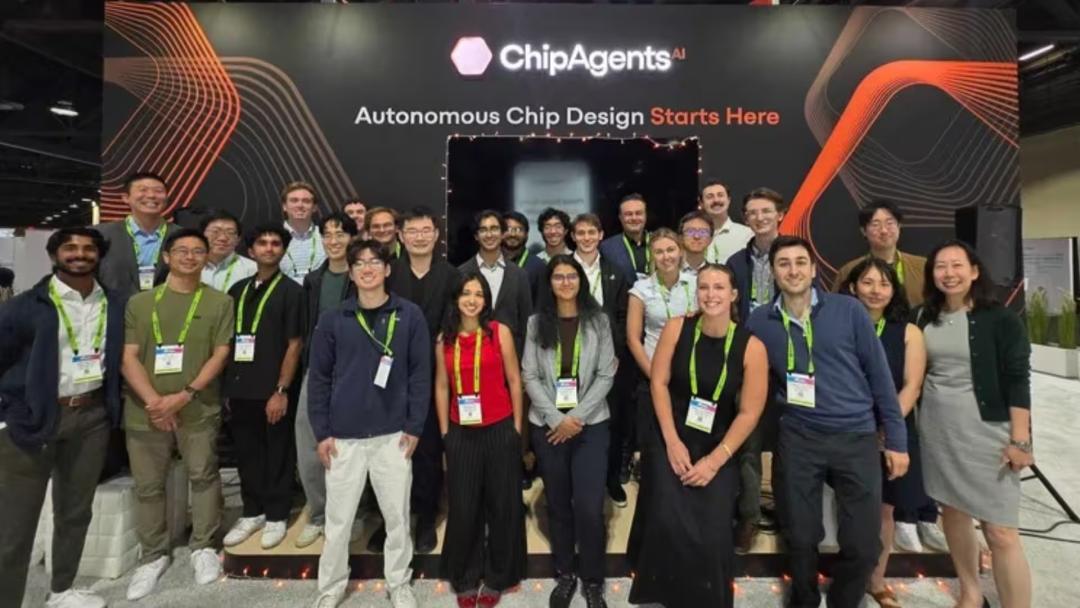
From AI Assistance to Autonomous Chip Design
ChipAgents believes that most of the applications of traditional AI in chip design are focused on specific tasks such as document processing, bug analysis, and test plan generation.
Greater opportunities lie in a closed-loop, autonomous engineering process: AI understands design intentions, performs reasoning between RTL and verification environments, generates and evaluates design outputs, invokes EDA tools, and continuously learns based on feedback to finally complete complex chip development tasks. This is also the difference between ChipAgents and ordinary AI copilots.
The direction proposed by the company is to enable AI Agents to independently plan and execute complex design and verification work. Starting from specifications, it generates synthesizable Verilog, SystemVerilog and testbenches, rather than only providing code suggestions for engineers.
Two years after its establishment, ChipAgents' multi-agent system has covered RTL design, verification, debugging and other work. In 2025, the company realized large-scale production deployment for many leading semiconductor enterprises, and the scope of application for a single customer even expanded from a pilot team to hundreds of engineers.
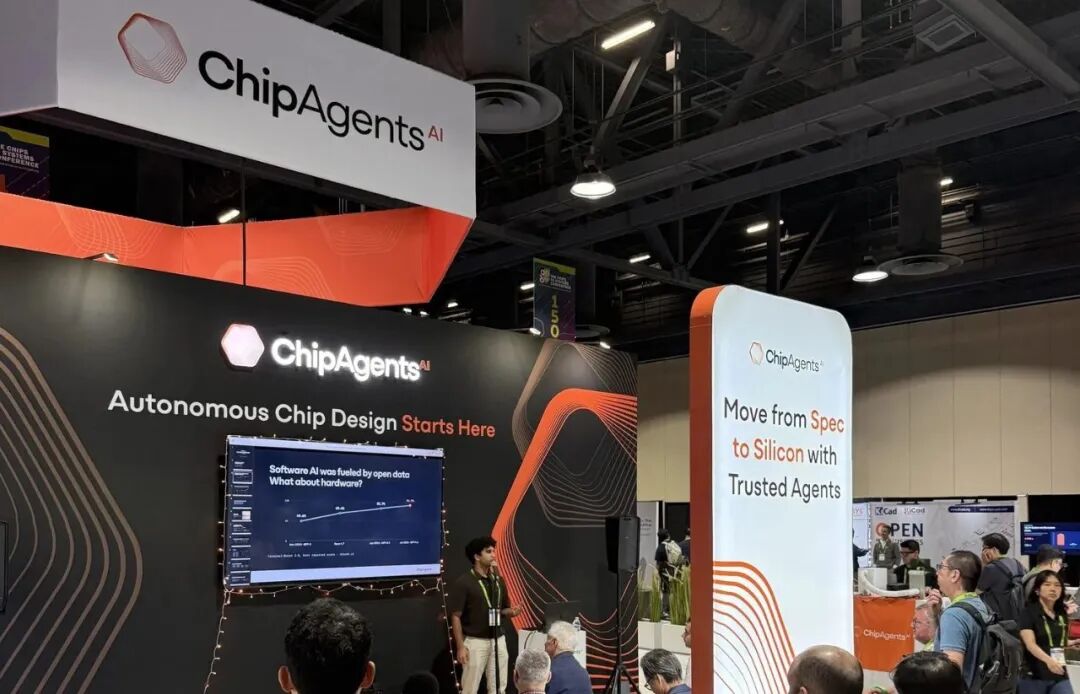
Self-developed Renoir Fills the Key Gap in Chip AI
In June this year, ChipAgents released Renoir, its first self-developed model. The company believes that there are two core problems when general large models are applied to semiconductor design: insufficient data and strict security requirements.
Software engineering has a large amount of public code, documents and technical discussions, but the most valuable engineering knowledge in semiconductor design often exists in internal design files, debug logs and tool data of enterprises, which cannot form public training corpora.
At the same time, chip design files and intellectual property are highly sensitive, and many enterprises cannot send such data to third-party cloud environments.
Therefore, Renoir has been optimized for chip design from the very beginning. This model is fine-tuned based on an open-weight mixture-of-experts large model, combining public semiconductor data and internal training data of ChipAgents, covering scenarios such as RTL generation, specification understanding, debugging, test generation and tool invocation.
More importantly, Renoir can run on the customer's own infrastructure without relying on external APIs. In the internal chip design benchmark test announced by ChipAgents, Renoir's performance is close to that of Claude Opus 4.6, while reducing the cost by more than half.
NVIDIA Joins to Further Accelerate Renoir's Development
On July 26, ChipAgents announced the expansion of its cooperation with NVIDIA to promote the development of Renoir.
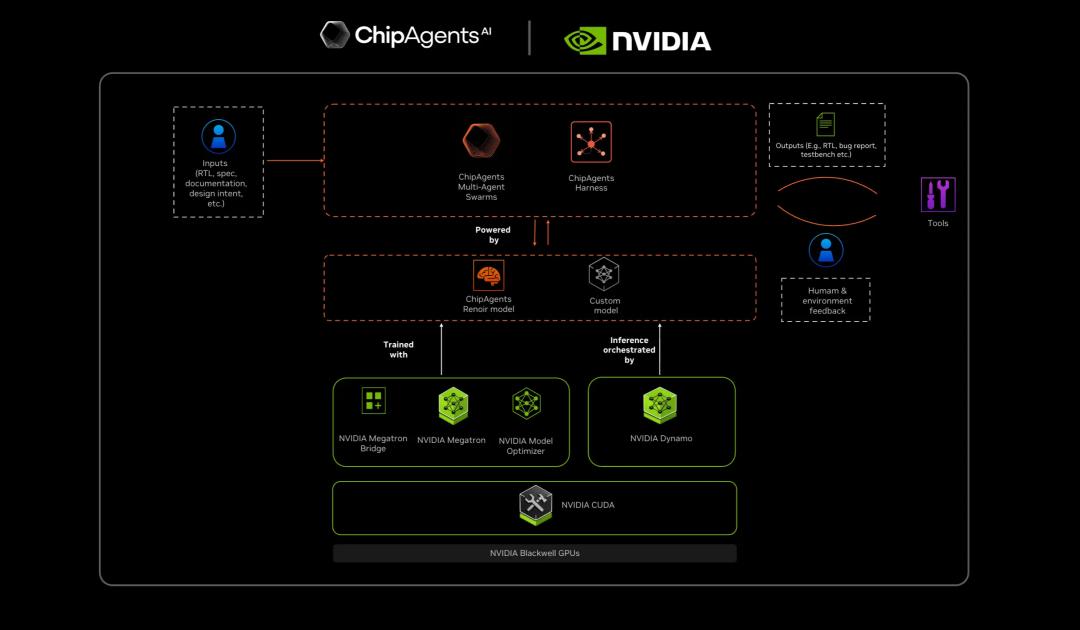
ChipAgents uses NVIDIA Megatron Core for large model training, uses NVIDIA NeMo Megatron Bridge to support training process and model format conversion, and uses NVIDIA Model Optimizer for model optimization such as quantization.
Kexun Zhang, Head of Research at ChipAgents, said that semiconductor design requires a system different from general AI, which not only needs to understand hardware design intentions, but also can perform reasoning across design and verification outputs within strict security boundaries, and has a cost structure that supports large-scale deployment in engineering teams.

ChipAgents hopes to leverage NVIDIA's AI software and accelerated computing infrastructure to speed up the training, optimization and deployment of Renoir, further moving from AI-assisted tasks to closed-loop autonomous engineering.
This article is from the WeChat official account "Kun Shao Says", written by Kun Shao, and published with authorization from 36Kr.