Amid the extreme urgency of power demand, Elon Musk starts to manufacture gas turbine blades.
It's absolutely wild… To develop AI systems, Elon Musk is even manufacturing gas turbine blades all by himself.
Everyone knows that computing power is in extremely tight supply, and every major AI enterprise is trying every means to obtain GPUs and build data centers.
No one expected that this time, Musk would not just build self-operated data centers or invest in power plants to break the power bottleneck, but go straight to a far more fundamental upstream link.
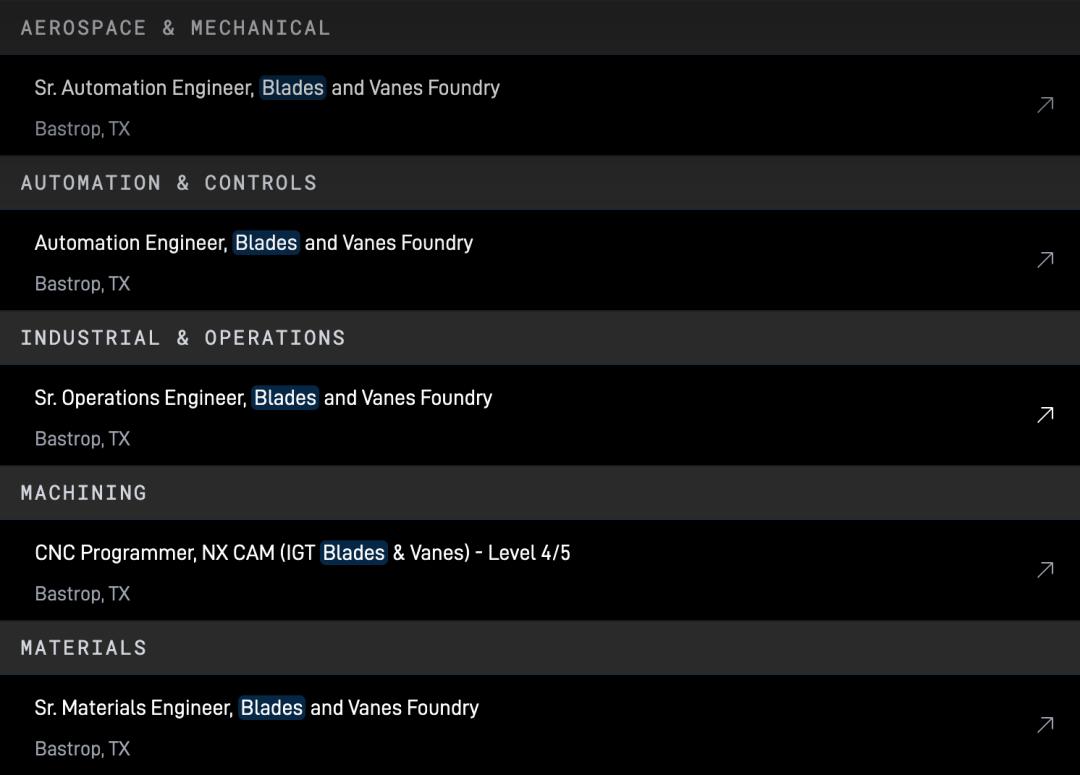
According to The Information, SpaceX is preparing to build a gas turbine blade casting factory in Texas.
Relevant recruitment positions have been posted on SpaceX's official website.
As soon as the news was released, Elon Musk himself quickly confirmed it, and also shared an even more staggering figure:
Around 15GW of the AI computing power to be manufactured in 2027 may not be able to go online at all in that year.
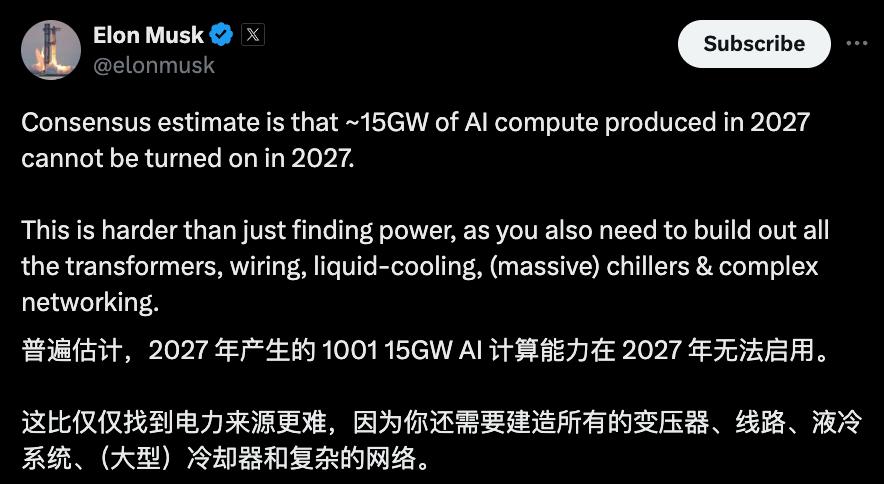
And behind the insufficient power supply, transformers, transmission lines, liquid cooling systems… all of these are bottlenecks. The production bottleneck of gas turbines in gas power generation "lies in the casting of blades and guide vanes".
Shorten the production lead time of gas turbines by 18 months
So let's sort out Musk's logic behind this move in detail:
AI faces computing power shortage → build data centers → data centers face power shortage → develop solar power generation.
But at the current stage, solar power can only be regarded as a longer-term solution:
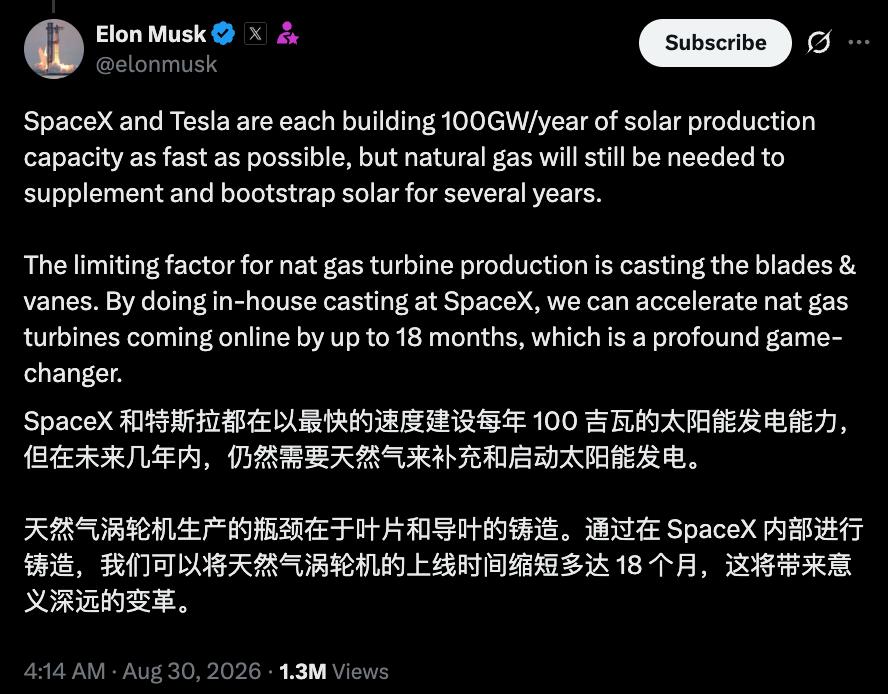
Both SpaceX and Tesla are building 100GW of solar production capacity per year at the fastest possible speed, but in the next few years, natural gas will still be needed to supplement and support the operation of solar power generation.
Musk can describe a grand future blueprint, but the AI industry is in urgent need of more power right now —
SpaceX estimated in the second quarter of this year that the company will have more than 2GW of online computing power by the end of 2026; by the end of 2027, the scale will be close to 10GW.
To keep all these GPUs running, SpaceX even plans to build a total of 20GW of power supply, cooling and electrical infrastructure projects. Musk himself estimates that even if a quarter of the projects are delayed, the actual online power generation capacity by the end of 2027 could still be close to 15GW.
The problem is that even if they deploy gas turbines on their own, the procurement process is extremely difficult!
Gas turbine giant GE Vernova disclosed in the second quarter of this year:
Gas turbine orders and capacity reservations have reached 116GW, and the figure is expected to reach at least 125GW by the end of the year. The company's production capacity has been fully booked up to 2031.
Its CEO also stated publicly earlier that by the end of 2026, GE Vernova will have sold out all its production capacity for 2030.
Further analysis shows that, as Musk himself said, the factor restricting the production capacity of gas turbines is the blade — all other components of a complete gas turbine can be obtained 12 to 18 months earlier than blades and guide vanes.
△
Make whatever you lack by yourself, that's very typical of Musk.
He also made a bold statement again:
By carrying out the casting process in-house at SpaceX, we can bring gas turbines online 18 months earlier, which will bring far-reaching transformative impacts.
Competition in AI infrastructure has gone far beyond GPUs
No one could have imagined that by 2026, the fierce competition in the AI industry has extended all the way to the fields of material science and precision manufacturing.
But Musk did not step into this field completely from scratch.
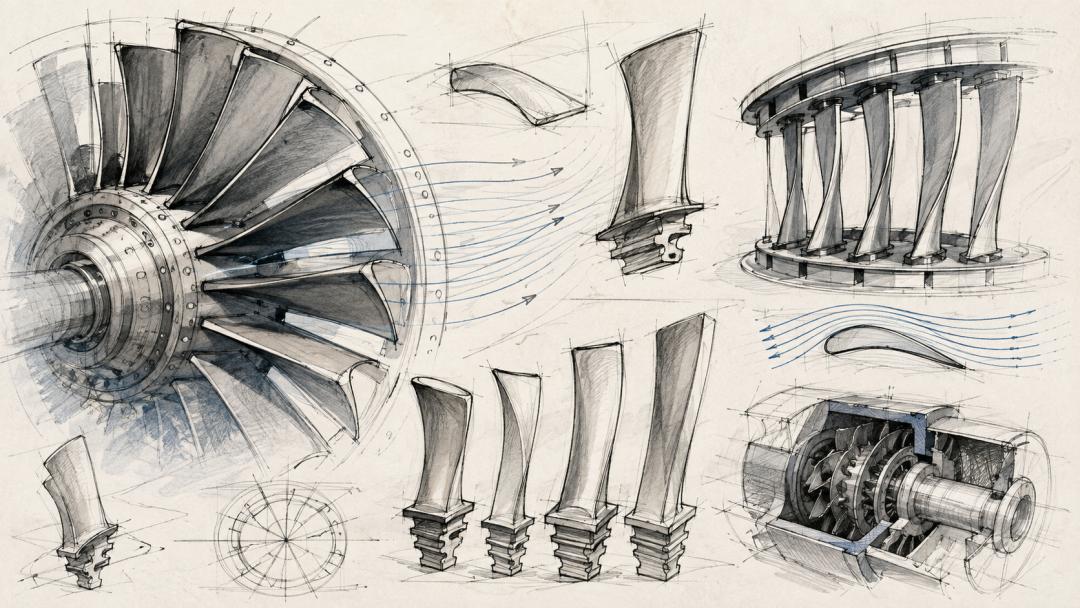
Blades and guide vanes are located at the position where ultra-high temperature airflow hits first, and they need to withstand both extreme high temperature and the mechanical stress brought by high-speed rotation.
This casting process is no easy task, but fortunately SpaceX already has experience in manufacturing turbomachinery that operates under extreme working conditions for its Raptor rocket engines.
In addition, some sharp netizens have already made a relevant connection:
Computing power requires power supply, power supply requires gas turbines, gas turbines require casting, and the casting yield rate is a problem that can be solved by machine learning.
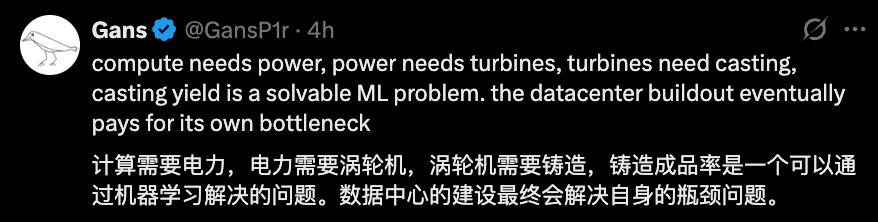
Wow, this is another self-reinforcing virtuous cycle that keeps growing exponentially.
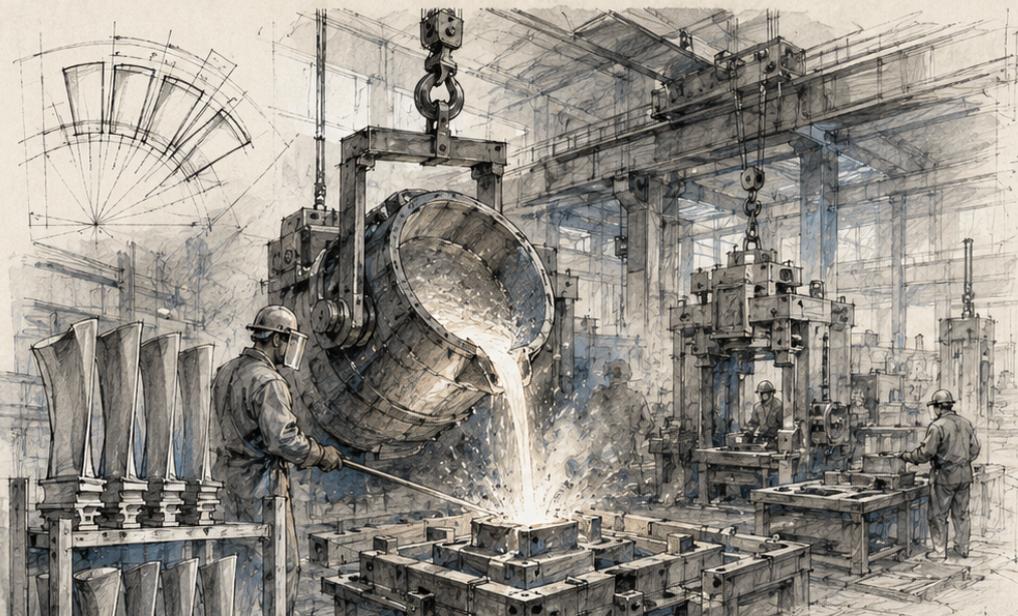
Judging from the current recruitment situation, this "Blades and Vanes Foundry" run by Musk in Bastrop, Texas covers positions across aerospace and mechanics, automation and control, operation, processing and materials, clearly aiming to build a full-fledged precision casting system.
But there is no evidence yet that this foundry has been put into operation.
△
It can only be said that the vertical integration of AI companies has gone far beyond GPUs and data centers.
As Musk said, GPUs, power generation, grid equipment, transformers, cables, liquid cooling systems, chillers, and networks… any single link that slows down will affect the final output of tokens.
Now, a single gas turbine blade, just like the latest AI chip, can determine how much usable computing power the AI industry will have in the next stage.
Reference links: [1]https://x.com/elonmusk/status/2093794565274669068[2]https://x.com/elonmusk/status/2093810234141634702
This article is from the WeChat official account QbitAI, the author focuses on cutting-edge technologies, and this content is republished with authorization from 36Kr.