OpenAI Executive: The end game of the integration of ChatGPT and Codex is personal AGI
ChatGPT and Codex will eventually merge into one single unified entity.
This is not packaging or shell wrapping, but sharing the exact same underlying technology, the same intelligent agent operation framework, and the only unified entry point.
OpenAI has named it: personal AGI.
The one who said this is Thibault Sottiaux, the head of ChatGPT and Codex, who is widely known as Tibo in the developer community.
Four years ago, sitting in his office at Google London, he watched a chat-enabled model lie idle on the internal network, with no one able to push it to the public.
Four years later, the company that first blazed this path broke down the three lines of ChatGPT, Codex and developer API, restructured them into a core product team, and handed it over to him.
He is solely in charge of nearly 1 billion weekly active users.
There is also a physical button on his desk: press it, and the usage quota for all developers across the network will be cleared and reset.
Yesterday, Tibo joined Matthew Berman's podcast, presenting a more concrete picture for this final destination:
You will use it, and your mother will use it too.
As for why the merger is inevitable, he said: It's not that we want to merge, it's that the future models expect us to merge.

Thibault Sottiaux, Head of Core Products and Platform at OpenAI
Codex is not a programming tool, but the "hands" of ChatGPT
When ChatGPT launched in 2022, Tibo flew to San Francisco.
Two years later, he joined OpenAI.
The first thing he did after joining was sticking to his old line of work: building tools for OpenAI researchers. A few months later, he started developing something that was later named Codex.
Tibo said that the growth curve of this product stayed flat for a long time at first, then suddenly shot up. On August 21, he announced that Codex had 20 million active users.
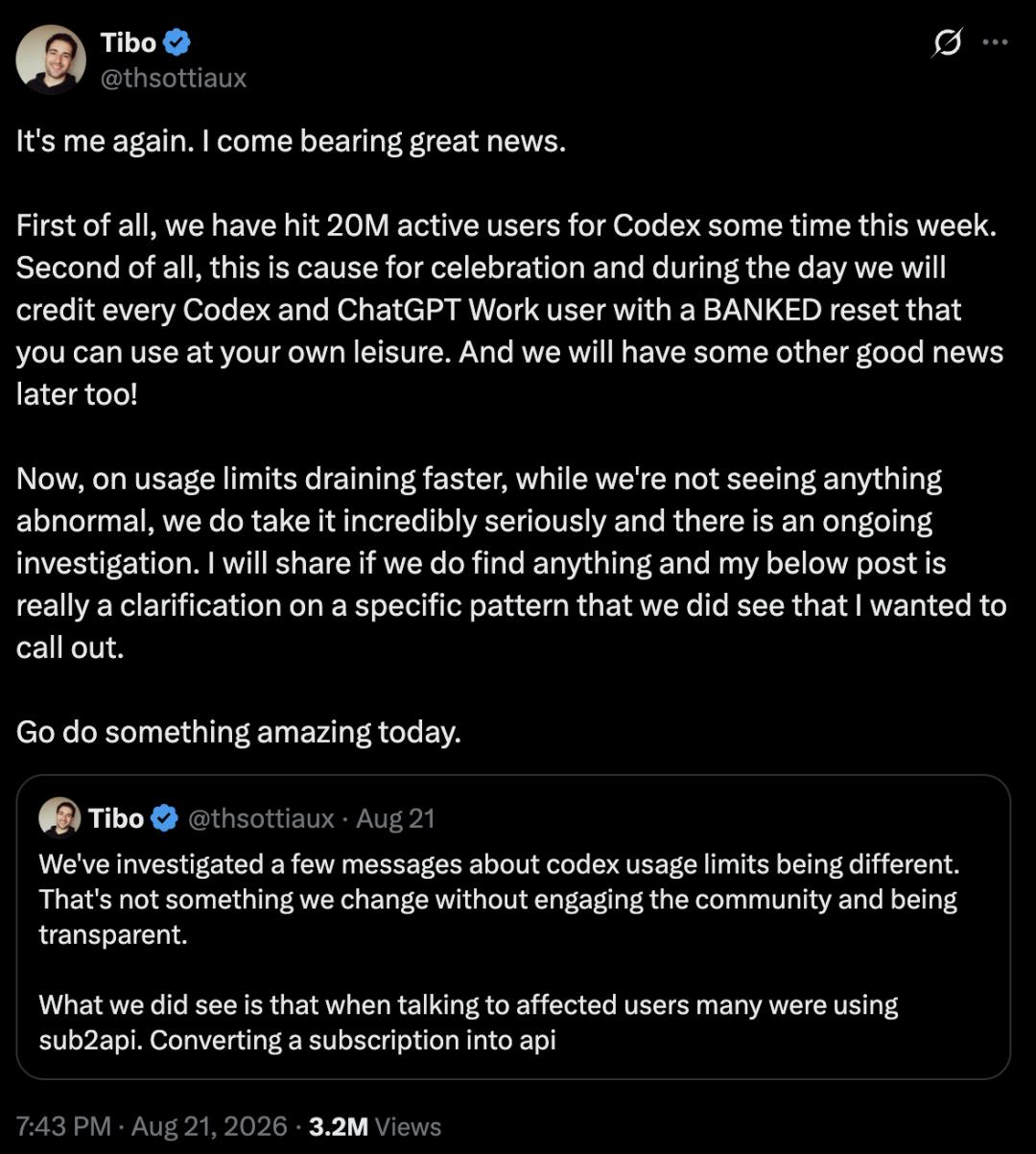
The real turning point came on July 9 this year.
The Codex application was integrated into the macOS and Windows desktop versions of ChatGPT.
It's an integration, not a disappearance.
Codex still retains its own programming interface and independent history records.
The current state is one single application with two working entries, not two separate products merged into one.
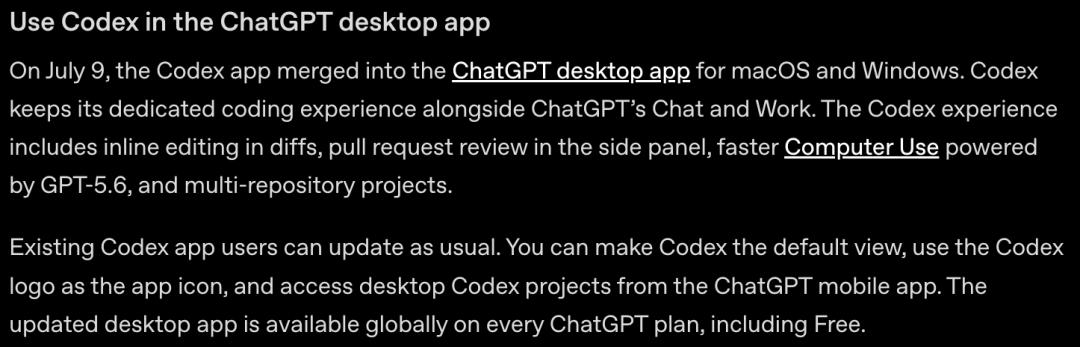
The Codex application is integrated into the macOS and Windows desktop versions of ChatGPT. Codex still retains its exclusive programming experience, juxtaposed with ChatGPT's Chat and Work modules.
Why is the merger inevitable?
The answer is that the "super app" OpenAI is building is mostly powered by Codex as its underlying foundation.
You might think that the value of Codex lies in writing code.
Tibo and his team judge that the truly valuable part of Codex is converting a human natural language sentence into a series of actions: writing code, calling APIs, opening browsers, and running cloud tasks.
One is a chat box that nearly 1 billion people open every week, and the other is a programming agent that 20 million developers focus on.
If ChatGPT cannot write code and run APIs on its own, it is nothing more than a fancy chat box; if Codex does not have the entry point of ChatGPT, it will forever be limited to the group of people who know how to use terminals.
Tibo breaks down the logic of the merger like this: first transform Codex into a general-purpose agent, then integrate this system into ChatGPT.
ChatGPT is responsible for understanding you, while Codex is responsible for executing tasks on your behalf.
The merger connects the comprehension capability and execution capability to the same pipeline.
The personnel restructuring happened even earlier than the product line adjustment.
According to WIRED's report in June this year, Tibo was already in charge of both ChatGPT and Codex at that time, reporting directly to Greg Brockman.
During the same period, OpenAI shut down several independent product lines including the video application Sora and an AI platform for scientists. Many leading executives of these teams have left, and resources are directly converged to the super application.
While shutting down redundant products, the two most competitive business lines are merged and handed over to the same person.
Behind this is the shift of the main battlefield of AI, which has long moved from the chat box to intelligent agents.
According to Fortune's citation of Ramp's AI Index for May 2026, Anthropic surpassed OpenAI for the first time in US enterprise adoption rate with 34.4% against 32.3%, and the driving force is exactly Claude Code.
This is not OpenAI's first attempt.
Neither Operator launched last year nor the later ChatGPT Agent achieved expected adoption.
Tibo's explanation is only three words: too early.
When the model is not reliable enough, you can only strictly limit the scope of tasks it can handle, to the point that no one is willing to use it in the end.
Now he says the technology is ready.
The ultimate integration of Codex and ChatGPT: personal AGI
Over the past six months, when these two products were being merged, the first reaction of users was almost uniformly resistant: why merge? Is it really necessary?
The models want to merge, so what does the final merged product look like?
Tibo described it in three layers.
The first layer: the same underlying technology, the same agent runtime framework, and the same product philosophy. It is highly multimodal with voice priority. It does not matter whether you can write code or not.
The second layer: the interface should not be chosen by you, but guessed by the product.
He does not agree with the division of "programmer interface" and "non-programmer interface".
Labels like software engineer, designer, and salesperson are abstractions invented by humans to cope with complexity, because the real world is too complex for our brains to process.
Real human users are scattered on a spectrum, each occupying their own position.
Therefore, the interface should actively adapt to the user, instead of requiring users to declare which category they belong to first.
In one sentence: humans should not adapt to technology, technology should adapt to humans.
The third layer: there will only be one interface left in the end: personal AGI.
The host pressed on: so there won't even be dropdown menus? It feels surreal to think that my mom might be using the exact same tool as me.
Tibo said yes, it is the exact same thing.
"It will be your personal AGI."
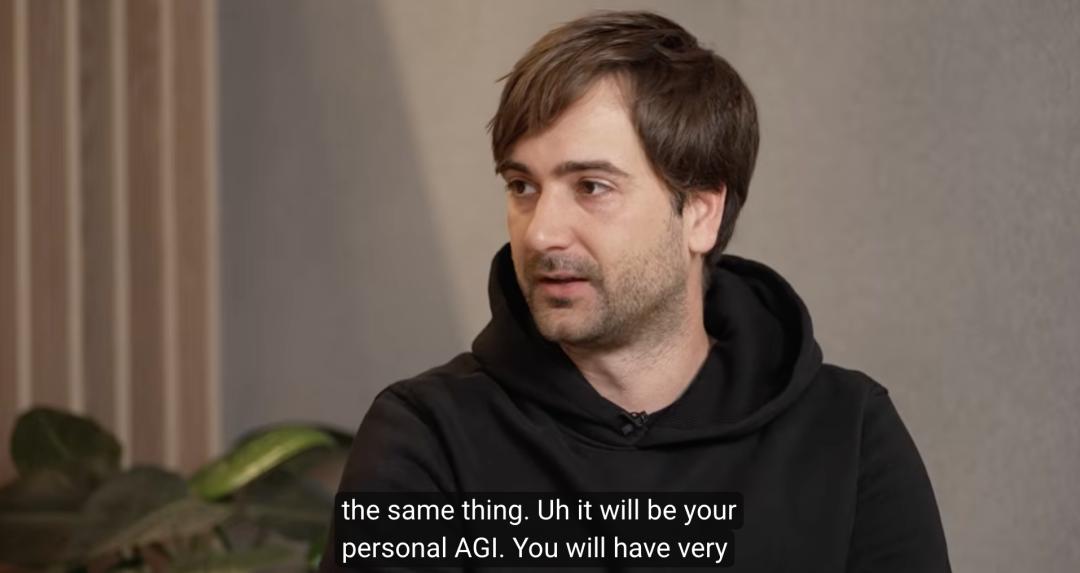
Although it is the same interface, you are connected to different tools, have different needs, and carry different requirements, so the product will grow and adapt to each of you respectively.
Tibo did not mention the concept of personal AGI for the first time.
At the VivaTech conference in Paris in June this year, he told Fortune that what they are building is a unified interface that allows you to communicate with, control and supervise your own personal AGI.
There is another detail that hides an even earlier signal.
After the new voice feature was launched, the volume of users interacting with ChatGPT purely via voice rose rapidly. Tibo's own usage habit is: sit down in the morning and speak a long string of instructions to his phone, then the model directly calls relevant tools to execute the tasks.
"This was impossible before, because there was no voice model good enough."
He said this completely changed his entire idea about the product.
Humans will always take the path of least resistance. Typing in a small box comes naturally to some people, but not to most people.
Therefore, AGI is unlikely to arrive in the form of a grand launch event one day.
It is more likely to look like this: entry points merge one by one, interfaces disappear one by one, and typing gradually gives way to voice interaction.
Until one day you come to your senses, it has already arrived quietly for a long time.
When you reach a certain threshold, the bottleneck is no longer the model
Talking about Ultra Fast, the host threw out a figure: it is 10 to 14 times faster than the original fast mode.
This figure is the host's summary of existing public data.
Tibo said that when the generation speed reaches a certain level, the bottleneck will no longer lie in the model, but will shift to tool invocation, network round-trip, and those unnoticed overheads across the entire technology stack.
The perceptual difference he described is very specific:
If you are prototyping a website or a small game and need the model to generate a large section of code, you can almost fully perceive the speed improvement; if you are running a series of tool invocation tasks where the overhead is stuck elsewhere, you will only feel a 3x or 4x speed increase.
In other words, the 14x speedup is conditional.
The host mentioned a familiar scenario that many people know: people open 10 to 15 agents to run in parallel at one go, because each task they throw out takes 30 to 45 minutes to complete.
But the cost of doing this is that your brain is constantly switching contexts, making you extremely exhausted.
The real reason for running a dozen agents at the same time is not efficiency, but waiting.
After the speed increases, this workflow will be completely reversed.
Instead of ten or fifteen agents, you may only need three or four. People will return to a real-time state: you think, it executes, you watch, and you adjust.
Tibo calls this design "taking care of your attention".
He said that the things we build are ultimately for human use, so they must be designed around how humans manage their attention.
When the model can keep up with your rhythm or even faster than you, you can always stay in the flow state, speaking while watching the prototype take shape in front of you.
In the future, you may even modify it together with the model on a shared canvas, switching between voice and text at any time.
Right now, Ultra Fast is not openly available to everyone inside OpenAI either. Most of its capacity is reserved for external customers, and internal usage is mainly limited to high-risk scenarios such as online failures, where every second counts in terms of revenue loss.
As for when everyone will be able to use it, Tibo's exact words are: In a year or two, this speed will likely become the default; even if it is not the default, it will be very close to the default.
At Google, he saw another ending of this story
Behind Ultra Fast, there is also a past story of missed opportunities.
Tibo's main job at DeepMind was researching infrastructure and R&D tools, which essentially means building roads and bridges for researchers, and he also participated in the toolchain for AlphaGo.
About a year before ChatGPT was launched, a project called LMChat emerged inside DeepMind.
After the team scaled up the language model, the results were surprisingly good. The next step that anyone would think of is: can we turn it into a conversational product?
Tibo said he felt it was very special at that time. For the first time he saw the model write coherent and useful text. At first it was mostly funny, but gradually it became really practical.
The internal team did have the idea of releasing it to the public, but nothing came of it in the end.
Tibo pointed out the exact reason why it failed back then: DeepMind was not an organization capable of launching products at that time.
Research is research, product is product, the two teams were not even at the same table.
Tibo criticized Google's organizational capability, and clarified another widely spread claim: Google executives did not ban DeepMind from releasing the product out of fear of impacting the search business.
Later, Jeff Dean confirmed this matter from another perspective.
Before ChatGPT, Google did have a chat system available for internal employees, but the team kept measuring it against search accuracy standards, and underestimated non-search use cases such as writing and summarization.
Even earlier, in September 2022, when ChatGPT was not even a concept, DeepMind publicly launched the conversational agent Sparrow, which can answer questions and call Google Search for evidence. The official positioned it as a research model and proof of concept.
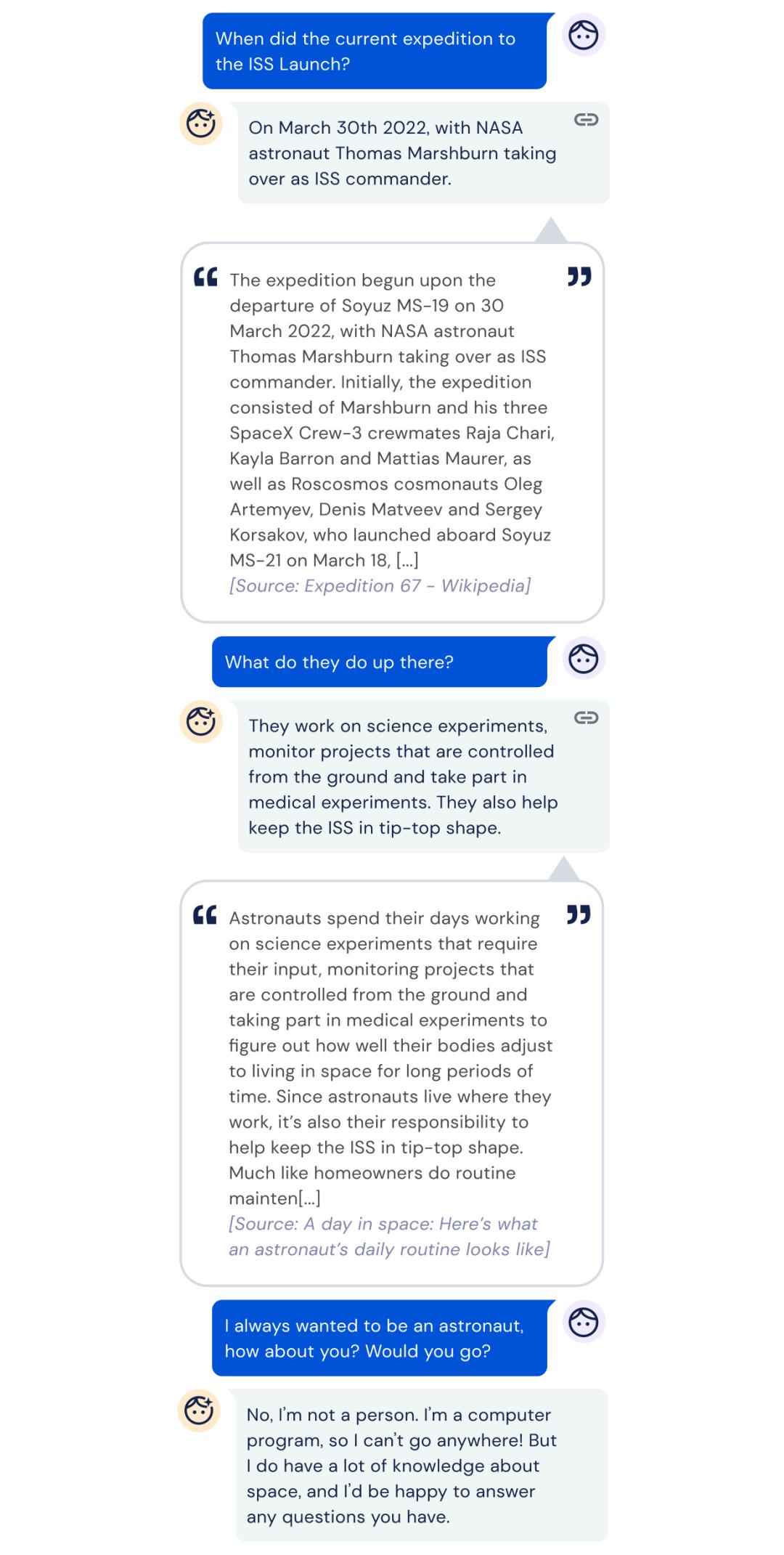
In September 2022, before ChatGPT was launched, DeepMind's public Sparrow was already able to answer follow-up questions with supporting search evidence. When asked if it could go to space, it replied that it was not a human being.
So what Google had a year earlier was a ChatGPT-like internal chat system, not a real ChatGPT product.
Organizational structure, accuracy standards, and concerns about existing business kept it trapped on Google's internal network.
Tibo said he often reviews this case to this day, keeping the good parts and avoiding repeating the mistakes:
Bottom-up development, less braking, and the courage to disrupt yourself when you are still making profits.
The Reset Master
Finally, let's talk about that physical button.
The quota reset feature for Codex was originally designed only as a compensation mechanism for users:
When the product is iterating rapidly, if we break something for half an hour, or misadjust a certain configuration, and the experience does not meet expectations while you are still using the product, we will give you extra quota as compensation.
Later this thing gradually took on a new meaning: the team also resets the quota when the product hits a milestone, or when a new feature is launched, treating all developers across the network to extra usage quota.
Tibo said this is not managed by the marketing department or the finance department: there is no approval process, I can press it whenever I want, as long as it feels right.
Now, there really is such a physical button.
