One of the major root causes of China's economic backwardness in modern times is the long-term differentiation of the employment structure between men and women.
✪ Yang Cheng | Renmin University of China
This article is excerpted from the book *Population Occupational Structure and the Great Divergence in China in the 18th-19th Centuries*
▍ The Heart of the Qing Empire — Beijing
Beijing was the final terminal city at the northern end of the Grand Canal, and also the capital of the Qing Dynasty with a highly centralized political system. It may not be representative of most cities in late Qing China, but it was a critical city in terms of the national economy. However, there are very few studies on the urban economy of Beijing in the existing literature on the "Great Divergence" debate and quantitative economic history research. Although the comparative real wage study by Allen et al. touched on this city, their observations on Beijing's wages were derived from a highly selected occupational group, and whether these groups were sufficient to represent the local labor force has never been empirically verified, and the evidence of this study is also fragmentary in time. In contrast, the "Xingke Tiben" (Homicide Case Memorials) dataset covers both male and female labor forces, including different occupational groups. Based on these data, we can construct a long-term trajectory of Beijing's occupational structure covering most of the 18th and 19th centuries.
In the late Qing Dynasty, cities and towns in China were generally administered by prefecture-level governments. Therefore, when handling homicide cases, relevant personnel sometimes omitted geographic information below the prefecture level for the sake of brevity, which made it difficult to distinguish whether cases occurring in a specific city and other cases occurring in the same prefecture were identical. However, Beijing was an exception. Perhaps for the purpose of political stability, a check and balance mechanism needed to be established for the administrative management of the capital, so the large prefecture in the surrounding area of Beijing (consisting of 24 counties) and the city of Beijing were set up as two independent administrative units: Shuntian Prefecture and the Imperial Capital (Jingshi). Therefore, I was able to access all available "Xingke Tiben" cases of Jingshi and create a complete sample library of "Xingke Tiben" for Jingshi (a total of 965 cases). Using this dataset, I was able to study the urban economic development of Beijing by estimating the long-term occupational structure of men and women, and the results are shown in Figure 7-1 and Figure 7-2.
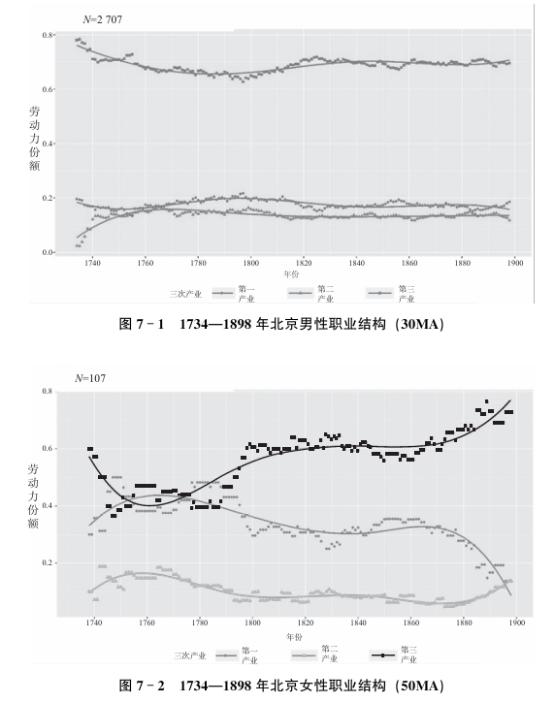
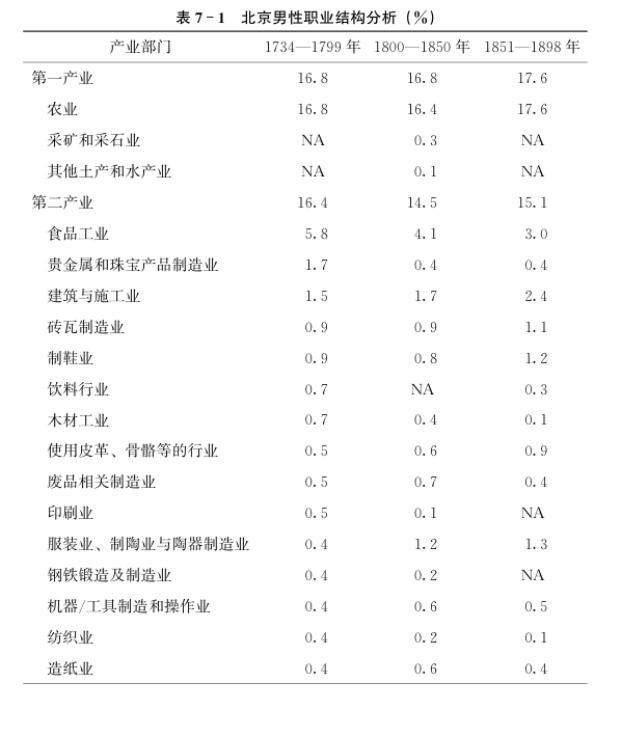
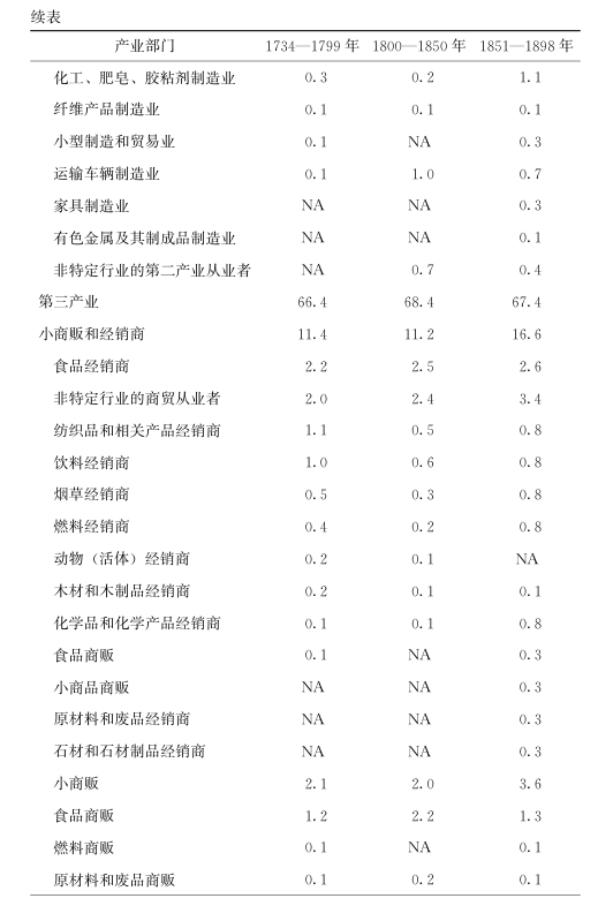
Among the male employed population in Beijing (see Table 7-1), the proportion of the tertiary industry is very high, about 68%; the proportion of the secondary industry is relatively low, about 15%; the proportion of the primary industry is also relatively low, about 17% (see Figure 7-1). In the tertiary industry, the proportion of military personnel is exceptionally high (21.2% from 1734 to 1799; 27.9% from 1800 to 1850; 24.7% from 1851 to 1898, of which 9.2% are officers). Compared with the national average (1.5% from 1761 to 1770), this feature is predictable, because as the political center of the Qing Dynasty, Beijing had an extremely high demand for garrison forces. The main purpose of building the Grand Canal was to transport important national resources (salt, grain and tax revenues) to Beijing and its surrounding areas for military use.
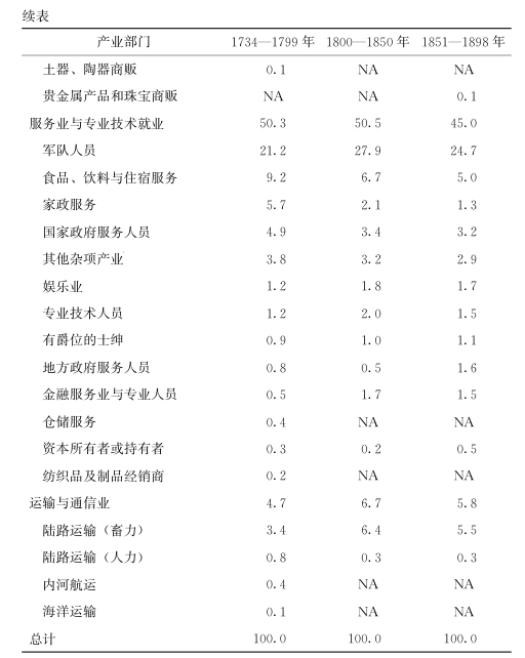
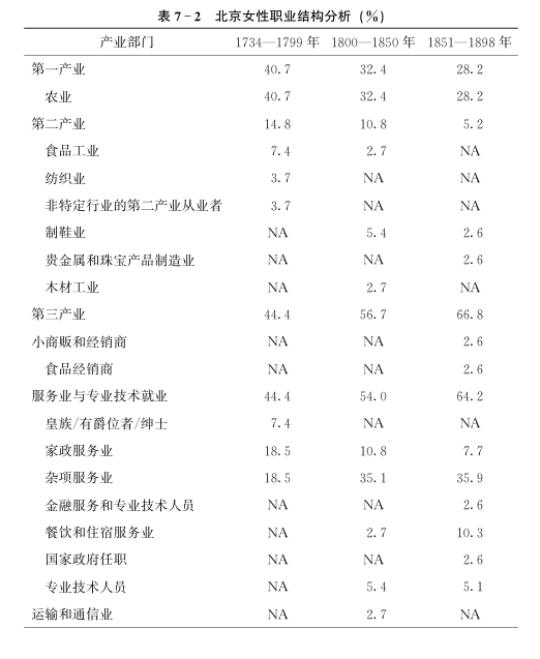
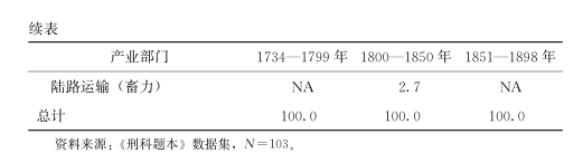
Except for a slight change in the large proportion of tertiary industry employment, the occupational structure of the male population in Beijing remained basically unchanged from the 18th to the 19th century. This forms a sharp contrast with the estimated results of the long-term occupational structure of women. Compared with the estimated results of the male occupational structure, the proportion of the female employed population in the primary industry was higher in the mid-18th century, while the proportion in the secondary industry was lower, and the proportion in the tertiary industry was also lower. In addition, contrary to the changing trend of the male occupational structure, the proportion of the female employed population in the primary industry continued to decline rapidly from 1760 to 1898; the proportion of the employed population in the secondary industry decreased from 1760 to 1800, then stagnated, and did not begin to rise until the last two decades of the 19th century; while the proportion of the employed population in the tertiary industry continued to rise rapidly for most of the period from 1760 to 1898. It is worth noting that compared with the period before 1860, after 1860, the proportion of the employed population in the primary industry declined faster, and the proportion of the employed population in the secondary industry began to rise again after a century-long stagnation.
Although there is a lack of further evidence or reliable information on the labor force participation rates of men and women, the occupational structure of men and women in Beijing is sufficient to indicate that the proportion of the tertiary industry employed population in Beijing's urban economy is larger than that of the secondary industry. This is in line with our expectation that Beijing served as a military center and widely assumed the function of tax redistribution. In addition, from the male employment data, Beijing's urban economy seemed to stagnate from the 18th to the 19th century, but the female employment data continued to change. The proportion of male tertiary industry employment was already very high and remained unchanged during this period. In contrast, the non-agricultural labor force accounted for a lower proportion of all female labor force than men, but gradually increased from the 18th to the 19th century, especially rising rapidly after 1860. Although due to the small total number of female samples (N=107), the estimated value of the female occupational structure has high uncertainty, considering that the existing trend is continuous and non-fluctuating, the direction of the change of the estimated value is likely to be close to the real situation. In general, the different trends of the long-term occupational structure of Beijing's men and women reflect the gender characteristics in the long-term urban economic development: women's non-agricultural employment opportunities are likely to increase over time. However, research on the employment status of women in this period still needs to explore more empirical evidence to provide a more solid empirical basis for the analysis of the causes of women's employment phenomena.
It is worth noting that the development trajectory of Beijing's female occupational structure after 1860 is completely different from that of the lower Yangtze River region (see Figure 6-8). This shows that in the second half of the 19th century, women in the two regions faced very different fates in terms of employment opportunities and overall economic life. Before the 1840s, both regions saw a substantial increase in the proportion of tertiary industry employment and a decline in the proportion of primary industry employment, but after the 1860s, the proportion of Beijing women employed in the primary industry continued to decline, and the decline was rapid; while in the same period, the proportion of women employed in the primary industry in the lower Yangtze River region rose rapidly. Although the mechanism behind the above opposite trends may be very complex, part of the difference is likely to be explained by a series of political and military events that took place in Beijing and the lower Yangtze River region from 1840 to 1860. As mentioned in the previous section, the First Opium War, the Taiping Rebellion, and the opening of treaty ports occurred in the lower Yangtze River region, which together led to a significant reduction in women's non-agricultural employment opportunities in the region. The rapid increase in the proportion of Beijing women's non-agricultural employment was accompanied by the Second Opium War (1856-1860), the reign of Emperor Xianfeng (1850-1861) and the rule of Empress Dowager Cixi (1861-1908), as well as a series of reforms led by the Qing government including the Westernization Movement. As the capital of the Qing Dynasty, Beijing was likely directly affected by these events and policy changes. However, in the absence of further evidence, it is difficult to find any clear or more direct connection in the changes of the characteristics of women's employment in the two regions. The significant difference between the estimated values of Beijing's female and male occupational structures, as well as the sharp contrast between the estimated values of Beijing's female occupational structure and that of women in the lower Yangtze River region, still need further exploration.
In addition to the long-term male and female occupational structure at the three major industrial sector levels, Table 7-1 and Table 7-2 also provide specific analysis of the male and female labor force at the sub-sector level. First, the results show that in the 18th century, a very wide range of handicraft industries already existed in Beijing. This indicates that although the secondary industry was not the main employment sector for Beijing's male labor force, Beijing still had the ability to produce a variety of manufactured products, rather than completely relying on the import of consumer goods from other regions in China. Second, although the proportion of male tertiary industry employment remained stable throughout the sample period, the proportion of small traders and distributors increased significantly in the second half of the 19th century, which indicates that the scale of trade in Beijing may have expanded during this period. Finally, the estimated results also show that, in the tertiary industry where the proportion of male and female employed population is quite large, trade and transportation are completely dominated by men, while service and professional technical employment are the main channels for women's non-agricultural employment. More specifically, miscellaneous services, catering and accommodation services, and domestic services are the main industries driving the increase in the proportion of women's tertiary industry employment. Therefore, focusing on the academic discussion of the above industries seems to be particularly important for further understanding the living standards of the labor force and long-term economic changes in the late Qing Dynasty in Beijing, a major city with a population of more than 20 million (the permanent resident population of Beijing was 21.832 million at the end of 2024).
▍ Important Transportation Hub and Treaty Port — Tianjin
The estimated results of the long-term male and female occupational structure in Beijing are very useful for studying the long-term economic changes in the Huangji (Yellow River-Ji River) region, allowing us to deeply understand the characteristics of economic changes in the core cities of the Huangji region. However, considering Beijing's large population, vast urban space, and unique political status as the national capital, it may not be representative of other cities in the region. Therefore, in order to make further analysis of the urban economy in the Huangji region, we need to study smaller cities in it. In addition, more importantly, the opening of China to Western powers as treaty ports in the 1840s had a crucial impact on the subsequent long-term economic growth. Therefore, in our exploration of China's modern port opening and its economic impact, understanding the economic changes of treaty port cities before and after the opening may be critical.
Tianjin is located in the Huangji region, and it is one of the first cities designated as treaty ports in the Huangji and North China regions (1860). Before the outbreak of the Opium War, Tianjin had become a core city in the region, an important seaport city, and the last stop of the Grand Canal leading to Beijing. Compared with Beijing, Tianjin is much smaller in scale, so it may be particularly suitable for further research on the urban economy of the Huangji region. Based on the analysis of all "Xingke Tiben" samples of Tianjin from 1741 to 1898, we can get the estimation of Tianjin's long-term occupational structure (see Figure 7-3). Unfortunately, due to the too small number of female samples (N=22), we cannot estimate the female occupational structure, so only the male occupational structure is shown in the figure.
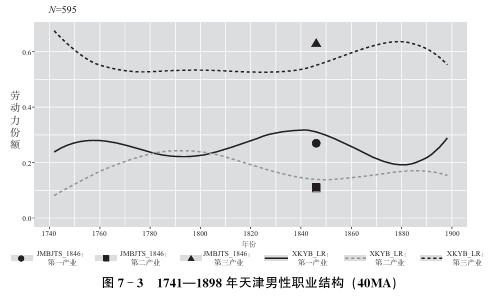
As shown in Figure 7-3, compared with Beijing, Tianjin has a slightly higher proportion of primary industry employment, a similar proportion of secondary industry employment, and a slightly lower proportion of tertiary industry employment. This indicates that in terms of the non-agricultural industry development of the urban economy, Tianjin lags behind Beijing, but the gap is not large. However, in the long run, the change range of Tianjin's occupational structure is much larger than that of Beijing. From 1741 to 1799, the proportion of Tianjin's primary industry employment slowly decreased by about 10%, the proportion of secondary industry employment rose rapidly by about 20 percentage points, and the proportion of tertiary industry employment slowly decreased by about 10 percentage points. From 1800 to 1840, the proportion of Tianjin's primary industry employment rose rapidly by more than 10 percentage points, the proportion of secondary industry employment fell rapidly by more than 10 percentage points, while the proportion of tertiary industry employment remained relatively stable. In the late 1840s, the proportion of Tianjin's primary industry employment decreased by about 15 percentage points, the proportion of the secondary industry remained stable, and the proportion of the tertiary industry rose by about 15 percentage points. Although there is no further evidence, this is sufficient to show that Tianjin experienced a stage of rapid economic growth characterized by the rapid growth of the secondary industry from 1734 to 1799; then it experienced a stage of economic recession from 1800 to 1861, highlighted by the decline in the proportion of secondary industry employment; after Tianjin became