In the AI era, social science research design is more important than ever.
When AI can scrape 100,000 pieces of social data in ten minutes, run complex regression models in three minutes, and even automatically generate the first draft of literature reviews, learners and researchers of social sciences are suddenly confronted with a sharp question:
What exactly is left of our core competitiveness?
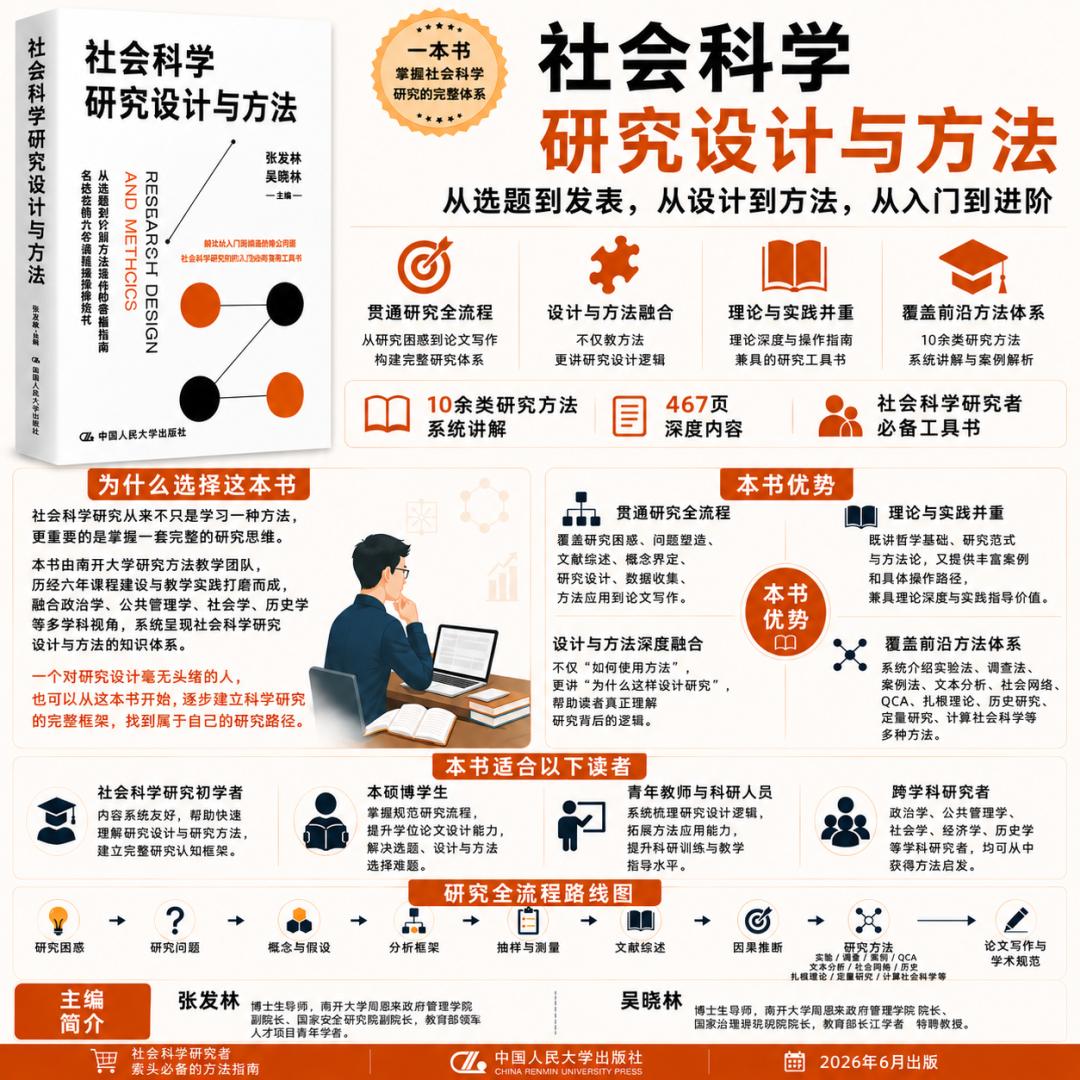
The answer lies in the core proposition of the book Research Design and Methods in Social Sciences — in today's era where AI is reshaping the scientific research ecosystem, research design is no longer a default step of research, but the soul skeleton that determines the value of research.

Research Design and Methods in Social Sciences
ISBN: 978-7-300-34680-9
Authors: ZHANG Falin, WU Xiaolin
Publication Date: June 2026
Publisher: China Renmin University Press
AI has indeed revolutionarily improved the efficiency of data collection and processing, but it is still unable to identify truly valuable empirical problems in the complex world of texts and numbers. In the past, researchers might spend half a year learning crawler technology and three months sorting out questionnaire data, but now AI can compress these tasks to a few days or even a few hours. However, without prior research design that locks in the problem value, data relevance, analysis logic and practical significance, no matter how massive the data is, it is just a pile of meaningless numbers. As this book repeatedly emphasizes, good research starts with "precise shaping of puzzles", while AI can only process well-defined problems and cannot help you extract the core propositions truly worthy of inquiry from the numerous and complicated social phenomena.
AI lowers the threshold for method application, making the critical significance of research design even more prominent. Methods such as quantitative analysis and text analysis that could only be skillfully applied by researchers with years of training in the past can now be quickly mastered by ordinary researchers with the assistance of AI. When proficiency in using methods is no longer the gap between different researchers, "whether you can select the right method and apply it properly" becomes the key. The most valuable part of this book is that it does not explain method operations in isolation, but takes "matching research problems with methods" as the consistent logic: what kind of puzzles are suitable for case analysis? What kind of problems require large-sample statistical verification? What kind of phenomena are more suitable for discovering rules through questionnaire surveys? This problem-based design thinking is precisely what AI cannot replace — it can provide you with a bunch of tools, but only research design can tell you which hammer to use to knock which nail.
The underlying logic of AI is formal logic deduction based on existing data, while empirical research in social sciences is essentially a dialogue with the vivid empirical world. AI can collect and analyze coded data for us, but it cannot perceive the scene on our behalf: the complex emotion when an interviewee suddenly falls silent during an interview, the unwritten implicit rule of a certain community in field investigation, these un-digitized "on-site warmth" are exactly the soil that breeds real problems. This book particularly emphasizes the irreplaceability of researchers, and research design is the bridge connecting "human perception" and "the empirical world" — it transforms those vague empirical feelings into an operable research framework, so that the real logic of the empirical world can be truly revealed through rigorous design.
When AI takes over all basic and technical scientific research work, research design capability is becoming the core variable that widens the gap between researchers. In the past, it was possible to produce medium-level research with "skilled methods and solid data", but now, only researchers who can raise real problems, build a stable analysis framework, and make AI tools serve their own purposes are more likely to achieve real academic breakthroughs. Underlying this kind of breakthrough, there is also an epistemological gap that AI cannot cross: Research Design and Methods in Social Sciences systematically sorts out multiple methodologies such as positivism, interpretivism and pragmatism. These research stances with philosophical background are the concentrated embodiment of researchers' subjective consciousness — whether you choose to verify laws through hypothesis testing or dig out meanings through in-depth interpretation, this kind of conscious methodology with temperature makes real social science research have its own unique features, while the outputs generated by AI are mostly stereotyped standardized products.
Of course, we do not deny the revolutionary value of AI. It has greatly promoted the progress of social science research, but it is not a substitute, but the most capable assistant. It can liberate researchers from tedious data processing, stimulate research inspiration, and even help us quickly implement preliminary design ideas. But no matter how powerful AI is, it is ultimately a tool without independent thought. In the foreseeable future, the soul of social science research will still be firmly in the hands of researchers who have design capabilities, conscious methodology awareness, and can conduct in-depth dialogues with the empirical world.
Social science research is never just about learning a certain method, more importantly, it is about mastering a complete set of research thinking.
Research Design and Methods in Social Sciences is developed by the research method teaching team of Nankai University after six years of curriculum construction and teaching practice. It integrates multi-disciplinary perspectives including political science, public administration, sociology and history, and systematically presents the knowledge system of social science research design and methods.
Have no idea about research design at all?
Start with this book, gradually build a complete framework for scientific research, and find your own research path.
This article is from the WeChat official account "Sociology Bar", authorized for release by 36Kr.