OpenClaw 2.0 has just arrived, with the Lobster Upgrade.
Just now, OpenClaw 2.0 is here.
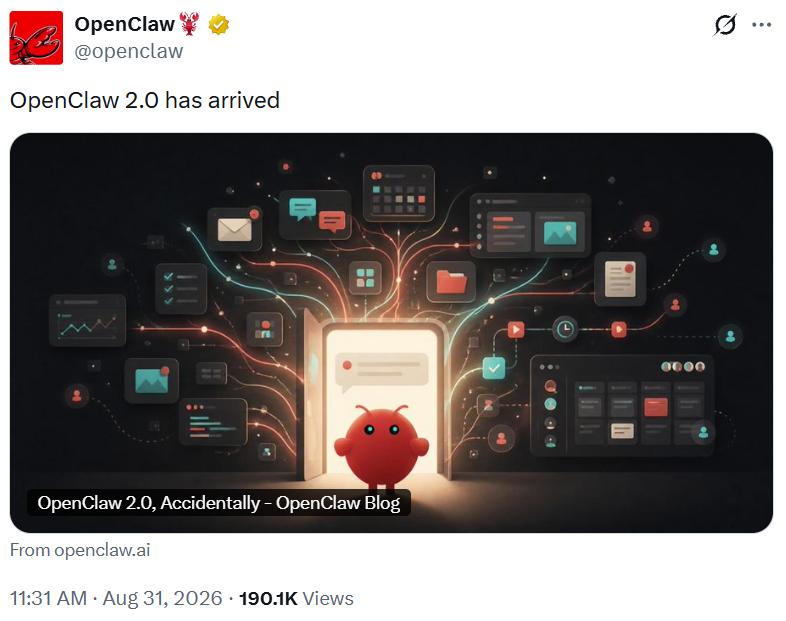
The official team also joked that it is faster than GAT 6:

According to the project's own statistics, this is its largest update ever, with 933 contributors participating, 569 of whom submitted code to the project for the first time, and more than 16,000 pull requests merged, which is roughly equivalent to half of the total merged volume of OpenClaw so far.
The release blog was written by team member Hannes Rudolph, with an interesting title called OpenClaw 2.0, Accidentally. According to him, the team originally only planned to do two things: simplify the installation process, and elevate the browser-side experience to a first-class citizen. As they worked on it, they found that the changes could not be finished partially, so they had to keep cleaning up the codebase, and eventually the work turned into a major version update.
Before this update, OpenClaw had not released a new version for nearly seven weeks. In the 230 days before that, it released 106 versions, with usually only one or two days between two releases. The blog explains that while the release rhythm slowed down, the development actually accelerated: the team expanded, and the workload and development speed both exceeded the capacity of the original code base and release process, so both parts had to be reworked.
What's Changed in Version 2.0
The installation process has been completely rebuilt. The new guided installation will first scan the existing AI access permissions on the local machine, allowing users to reuse their verified Codex, ChatGPT or Claude CLI login, accept API keys, follow the vendor's own login process, or detect locally installed Ollama and LM Studio models. It will first verify that the selected option can actually return a valid response, then store the model and credentials.
The newly configured OpenAI setup uses GPT-5.6 by default, while on the local side, node-llama-cpp is replaced by a hosted llama-server, and the default context length of llama.cpp is increased to 64K. A large number of configuration items have been removed or moved out of the first-time installation process, and the remaining parts can be completed through natural conversation between users and agents.
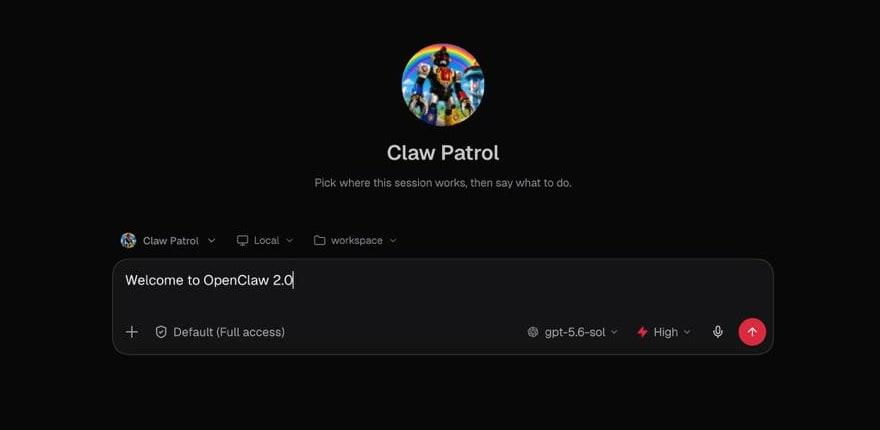
The rebuilt browser side directly opens as a chat interface
The browser-side Control UI has been rewritten to a chat-first architecture. The original Overview page is removed, sessions are moved to the sidebar, and the ongoing conversation is placed in the center. Files, approvals, terminals, Git changes, and a dockable browser panel are all arranged next to the conversation. Tool calls and their corresponding results are displayed in pairs, and file modifications show focused diffs. A command called /btw can open an independent multi-turn side conversation for asking questions that users do not want to pollute the main session records. The official performance data comes from a simulated test environment (mocked Gateway, 50ms HTTP/1.1 latency): JavaScript requests are reduced from 140 to 45, and the startup time is reduced from about 1.6 seconds to 575 milliseconds.
The underlying storage has also been replaced. Sessions and transcription records are migrated to SQLite, at the cost that downgrading is no longer seamless: before rolling back to the old file storage version, users must use the current CLI to restore the archived old-format transcription files, and sessions created after the migration will not appear in the old version at all. The official recommends making a verified backup before upgrading.
The most product-oriented change is the shared cloud session. Rudolph said this feature came from the team's own usage: during the development of 2.0, they increasingly assigned work to their own Claw, and then found that when they wanted to share tasks with colleagues, collaborate on processing or even fully hand over the work, OpenClaw had no way to add another collaborator without losing context. Now the session owner or administrator can decide whether other users have read-only access, can make suggestions, work in drafts, or participate directly.
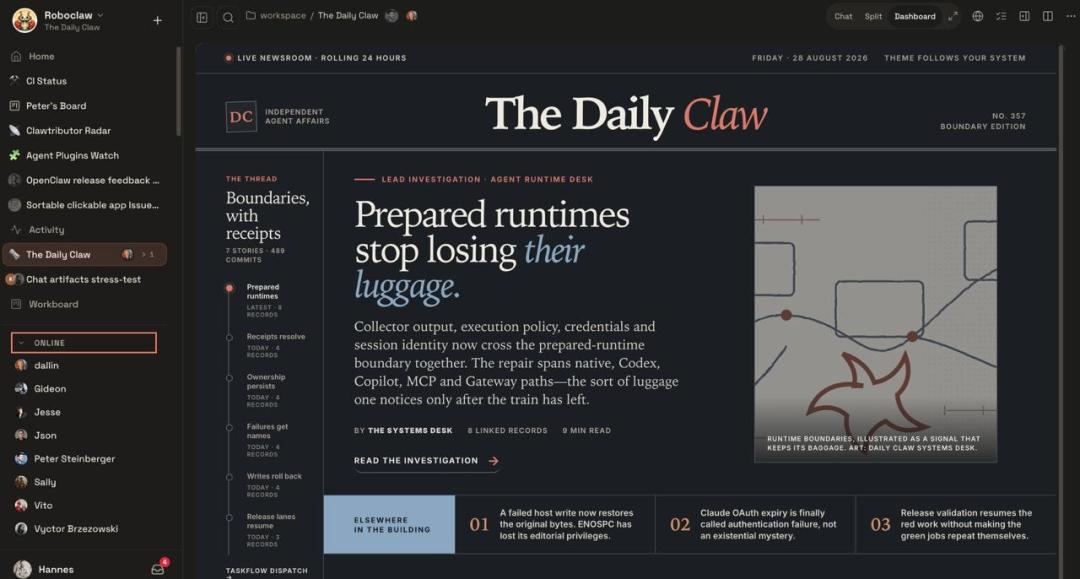
User-built dashboard in the shared multi-user OpenClaw workspace
It is worth noting that the documentation describes the self-imposed limitations of this feature very clearly: these permission controls are not tenant isolation, nor do they constitute a security boundary. After permissions are revoked, the interface may still display as available for a short time before refreshing. Incognito mode is off by default: conversations only stay in the process memory, are not written to disk transcription and automatic memory, and disappear once the Gateway restarts, but messages are still sent to the model vendor, and tools can still write files and affect external services.
In the security section, Gateway binds to loopback by default. Most chat channels return a pairing code to unknown private message senders. The `openclaw security audit` command is used to check inbound access, tool impact radius, network exposure, browser control exposure and plugin whitelist. The documentation regards model selection as the first mitigation measure against prompt injection, citing a set of 2026 crowdsourced attack arena data: 272,000 attacks across 41 agent scenarios, counted as successful only when the agent performs harmful operations and conceals it from the user. Claude Opus 4.5 has a compromise rate of 0.5%, Sonnet 4.5 1.0%, Haiku 4.5 1.3%, and Gemini 2.5 Pro 8.5%. The same page also states that in the face of adaptive human attackers, the probability of the best existing defense being breached still exceeds 80%, so tool policies, execution approval and sandboxes are the real mandatory layers.
Conclusion
This is a technically very solid version, but the timing of its release is more noteworthy than the content itself. Over the past six months, the most common keyword for this project in both Chinese and English communities is "Is it dead?". After all, the popularity of OpenClaw has actually faded a lot recently. Many users have left, and the enthusiasm of developers and contributors is not as high as when it was first released.
With this 2.0 update, it seems that OpenClaw is intended to evolve into a truly usable productivity tool. Reusing existing login credentials, moving sessions to SQLite, adding 30-day history for approval requests, writing the destructiveness of the downgrade path into the warning box, and proactively stating "This is not a security boundary" in the multi-person collaboration document... These are the things a project will spend effort on when it transitions from a demo to a production tool, and they are exactly what it lacked the most during the frenzy from January to March.
As for whether 2.0 can bring users back, let's wait and see.
This article is from the WeChat official account Synced (ID: almosthuman2014), author: Yang Longxia De, published with authorization from 36Kr.