The net outflow of stock ETFs exceeds 5 billion yuan
On August 28, the A-share market rose then fell back and showed differentiated adjustments, with all three major indices closing lower, and the total trading volume of the two markets reached 2.1 trillion yuan.
Some funds chose to exit the market. On that day, the net outflow of funds from stock ETFs (including cross-border ETFs) across the whole market exceeded 50 billion yuan. Among them, industry ETFs such as semiconductors and chips, as well as broad-based ETFs tracking indices including the STAR 50 Index and the ChiNext Index took the lead in net inflow.
Over the past five trading days, the cumulative net inflow of ETFs related to the ChiNext Index exceeded 46 billion yuan, and the total capital inflow of ETFs related to the CSI 500 Index exceeded 27 billion yuan.
Net fund outflow exceeds 50 billion yuan, sectors like semiconductors and chips attract capital inflows
Wind data shows that as of August 28, 2026, the total size of 1551 stock ETFs across the whole market reached 3.51 trillion yuan.
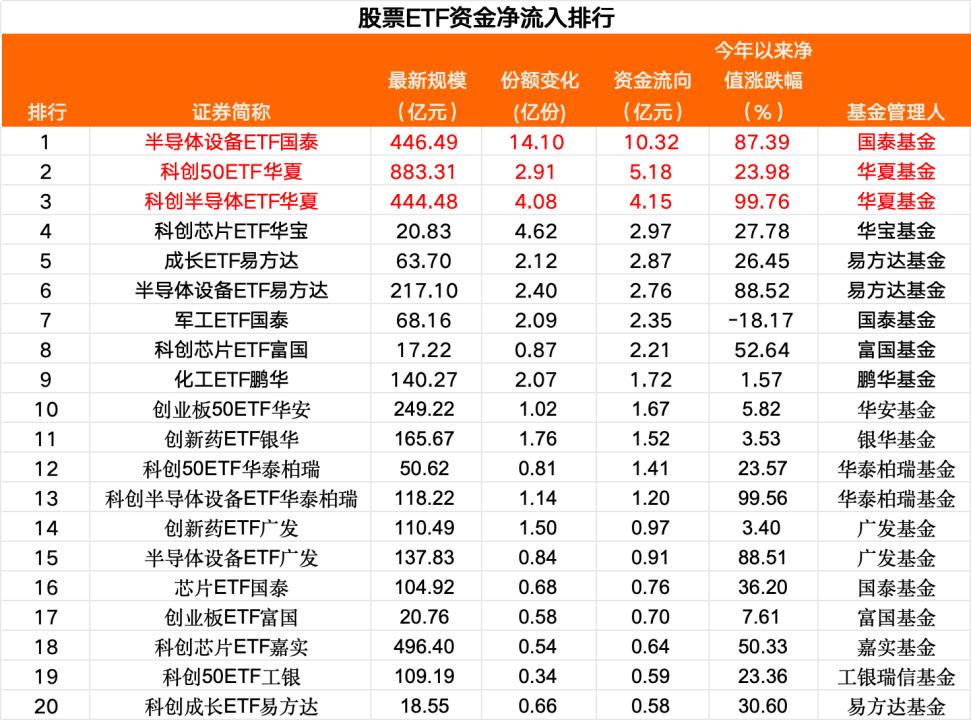
Wind data shows that on August 28, the total share of the stock ETF market decreased by 2.219 billion shares. Calculated based on the average transaction price, the net outflow amount on that day reached 52.55 billion yuan. Among them, 13 stock ETFs recorded a net inflow of more than 100 million yuan, with Semiconductor Equipment ETF - Guotai, STAR 50 ETF - China Asset Management, and STAR Semiconductor ETF - China Asset Management ranking top three in net fund inflow.
Judging from the top 20 stock ETFs in terms of net fund inflow, there are 9 ETFs related to semiconductors and chips, with a total net inflow of nearly 26 billion yuan; 5 of them are STAR Market-related semiconductor or STAR chip ETFs; 3 ETFs are related to the STAR 50 Index and 2 are related to the ChiNext Index respectively.
On August 28, the whole market was dominated by net fund outflow. From the perspective of major categories, industry-themed ETFs and global market ETFs took the lead in net inflow in the previous trading day, reaching 471 million yuan and 149 million yuan respectively; broad-based ETFs took the lead in net outflow, reaching 397.3 billion yuan. In terms of scale change, the size of broad-based ETFs decreased by 134.48 billion yuan.
Specific to the index dimension, on August 28, the single-day net inflow of ETFs tracking the Semiconductor Materials and Equipment Index took the lead, reaching 14.7 billion yuan; the single-day net outflow of ETFs tracking the CSI 300 Index took the lead, reaching 15.52 billion yuan. Observed from the 5-day dimension, recent capital inflow into ChiNext Index-related ETFs exceeded 46 billion yuan, and capital inflow into CSI 500 Index-related ETFs exceeded 27 billion yuan.
Wind data shows that the total net outflow of funds from stock ETFs since August still exceeds 100 billion yuan, of which the net outflow of funds last week exceeded 3 billion yuan.
ETFs under leading public fund companies attract capital inflows
Data shows that the net inflow of some ETFs under leading fund companies continues.
As of August 28, the ETFs with relatively high net inflow under E Fund Management include Growth ETF - E Fund, with the latest size of 63.70 billion yuan and a net inflow of 2.84 billion yuan; Semiconductor Equipment ETF - E Fund has the latest size of 217.10 billion yuan and a net inflow of 2.72 billion yuan; STAR Growth ETF - E Fund has the latest size of 18.55 billion yuan and a net inflow of 570 million yuan; STAR Chip ETF - E Fund has the latest size of 46.48 billion yuan and a net inflow of 460 million yuan; Dividend ETF - E Fund has the latest size of 188.78 billion yuan and a net inflow of 320 million yuan.
For ETFs under China Asset Management, in the previous trading day, STAR 50 ETF - China Asset Management and STAR Semiconductor ETF - China Asset Management ranked top in single-day net inflow, recording net inflows of 5.18 billion yuan and 4.15 billion yuan respectively, with the latest size reaching 883.31 billion yuan and 444.48 billion yuan respectively, and the corresponding tracking indices recorded an average daily trading volume of 8.17 billion yuan and 7.972 billion yuan in the past month respectively.
Chen Xiaoyang, fund manager of China Universal Asset Management, said that although China's domestic demand needs to be boosted and structural problems such as overcapacity in some industries remain to be solved, the supporting conditions and fundamental trend of long-term positive economic development have not changed. In the investment process, we should weaken the focus on total volatility, concentrate on structural opportunities, and identify and grasp structural opportunities in the stock market. In the medium and long term, China's "engineer dividend" is taking over from the "demographic dividend", and the sufficient supply of high-quality talents is promoting the upgrading of Chinese enterprises' position in the global value chain, so we continue to be optimistic about the high-quality sectors empowered by the engineer dividend.
Looking ahead to the second half of the year, Wang Wenlong, fund manager of Yongying Fund, believes that AI is still a fast-growing track in the technology sector, and it is very likely that only the changes brought by AI are real. Therefore, there are many performance clues of resonance both domestically and overseas, such as cloud computing, computing power, storage and network. In the next step, we will focus on investment in strong sub-sectors of AI with confirmed and deterministic performance delivery, and raise the requirements for asset quality.
This article is from the WeChat Official Account "China Fund News" (ID: chinafundnews), the author is Tian Xin, and is published with authorization from 36Kr.