Hard Kr Exclusive | Incubated by Dongguan Artificial Intelligence Research Institute, focusing on the R&D of physics AI in the mold manufacturing field, this enterprise has obtained tens of millions of RMB in seed round financing from Sinovation Ventures.
Author | Qiao Yujie
Editor | Yuan Silai
This article has 2100 words, which is expected to take 5 minutes to read.
36Kr learned that Hemu Artificial Intelligence Technology (Chengdu) Co., Ltd. (hereinafter referred to as "Hemu Intelligence"), a company focused on manufacturing physical AI, has recently completed a multi-million RMB seed round financing, with the investor being Sinovation Ventures.
Founded in May 2026, Hemu Intelligence was incubated by Dongguan New Generation Artificial Intelligence Industrial Technology Research Institute in cooperation with mold manufacturing enterprise Duanpin Precision. It is a company dedicated to mold physical AI, manufacturing semantic computing and implementation.
Specifically, Hemu Intelligence hopes to further learn and replicate the process experience accumulated by veteran technicians on the basis of deep learning of mechanical drawings, build an AI process brain for mold manufacturing enterprises, and cover links including product quotation, mold design, DFM, process scheduling, production processing, quality control inspection, so as to improve the automation and intelligence level of the entire manufacturing process.
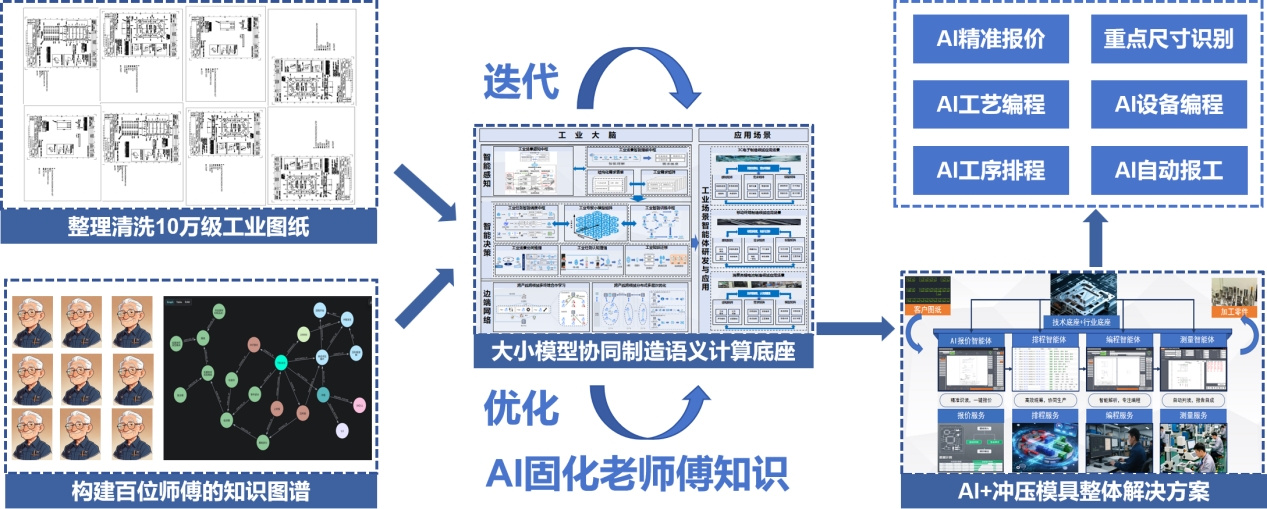
Image source / The enterprise
Xu Chen, the founder of the company, is the founding dean of Dongguan New Generation Artificial Intelligence Industrial Technology Research Institute, with more than 15 years of in-depth experience in the field of intelligent manufacturing and industrial AI. Zou Luhua, the co-founder, has been engaged in the field of high-end precision molds for nearly 20 years and is an expert in high-end mold manufacturing management.
The choice of mold manufacturing as the entry scenario is related to the long-standing "veteran technician dependency" problem in the industry. At present, the labor cost of mold manufacturing accounts for about 70% of the total variable cost. On the one hand, there is a shortage of senior skilled workers in the manufacturing industry, and rising salaries have further compressed the profit margin of enterprises. On the other hand, key positions in mold manufacturing generally require practitioners to have more than 3 to 5 years of practical experience, with a long talent training cycle and high threshold. At present, there is a shortage of new talent to replace the experienced senior workforce in the industry.
The Hemu Intelligence team has conducted comprehensive investigation and research on industrial manufacturing enterprises since 2024. Xu Chen told 36Kr: "We have visited more than 200 enterprises and found that factories basically do not allow data to be connected to the Internet due to the management needs of core confidential information. Many enterprises cannot directly deploy large models at all. Therefore, if we want to develop industrial AI, we must first solve the problem of localized computing, and only the collaborative mode of large and small models is the only feasible implementation path."
To solve this problem, the team spent two years sorting out 100,000 high-quality drawing data, and excavated the experience of more than 100 veteran mold technicians to build an industry knowledge system. According to the company, the team has initially completed the preliminary construction of the semantic space and computing base for precision mold manufacturing based on the collaboration of large and small models, and has completed the development of nearly 10 agents. Some of the agents already have experience equivalent to that of a mold engineer with more than 5 years of working experience.
In terms of specific applications, Hemu Intelligence has currently applied AI capabilities to links such as process programming, intelligent quotation and process route planning.
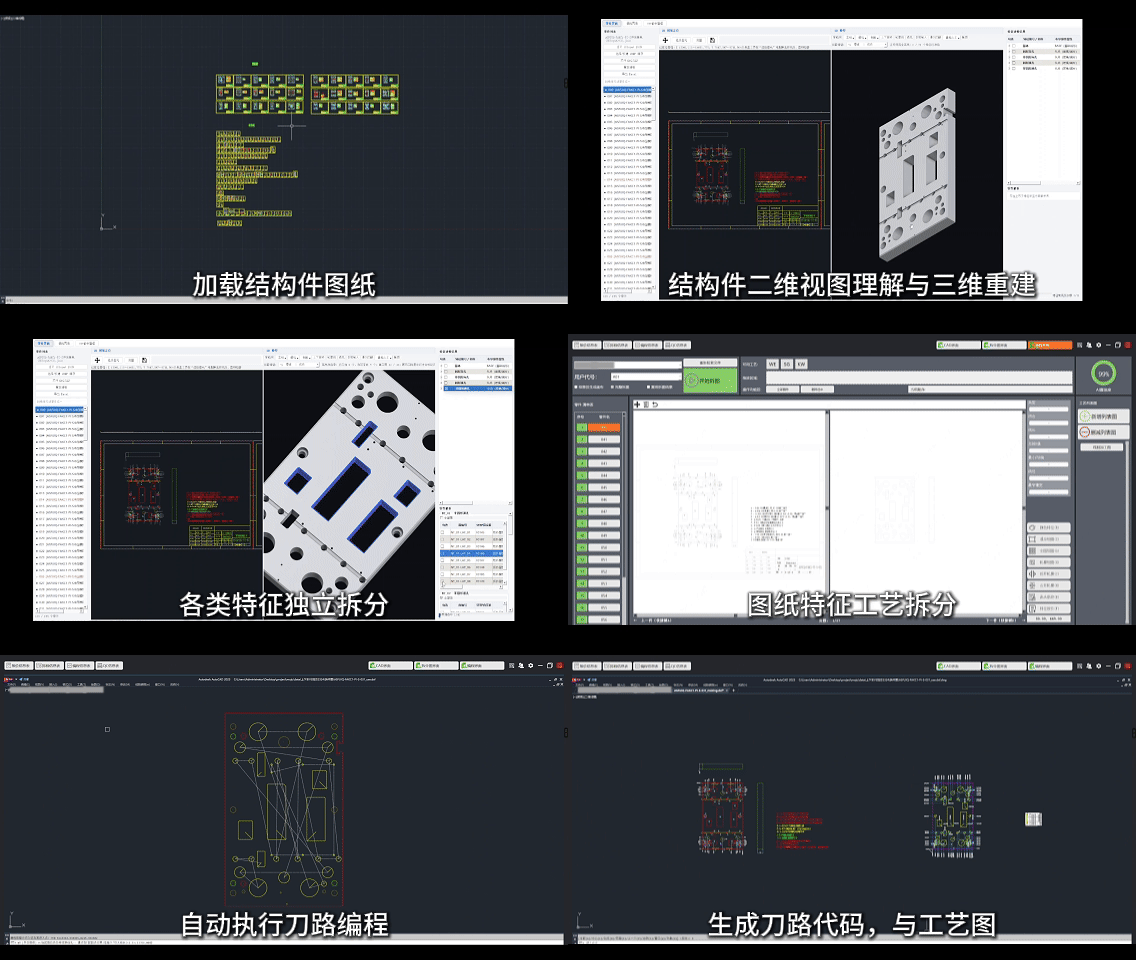
Image source / The enterprise
For example, in the process programming link, AI can identify part features, automatically select different processing methods such as CNC, electrical discharge machining, and grinding machines, to optimize processing costs while meeting accuracy requirements. At present, the processing efficiency of this link has reached about 6 times that of manual work. In the quotation link, the system can calculate the cost in reverse based on the understanding of manufacturing processes to achieve accurate quotation, while reducing the labor input of traditional quotation positions. In terms of process route planning, AI can participate in process scheduling, recommend corresponding processing paths according to processing conditions, and improve the overall production scheduling efficiency.
In terms of technical path, Hemu Intelligence adopts the architecture of "large model base + small model cluster + process knowledge precipitation". The large model is mainly responsible for understanding scenario semantics and decomposing tasks, while the small model is responsible for executing specific processes. For features that appear frequently in the manufacturing process, such as geometric features like holes and cavities, the company trains dedicated small models to achieve higher-precision process execution.
At present, the team has trained more than 1,600 sets of small models for high-precision task execution in different manufacturing scenarios. The process knowledge system further constrains and verifies the output of the model, so that the results can meet the actual manufacturing conditions. Based on this technical architecture, Hemu Intelligence has currently developed agents such as 2D drawing error correction, PDF to CAD, and 2D to 3D, and can complete process preprocessing and autonomous programming in 15 types of processes including CNC, electrical discharge machining, and wire cutting.
In terms of commercialization, Hemu Intelligence currently mainly provides FDE accompanying AI empowerment services, as well as sales of standardized agent software and hardware products. Its goal is to help mold manufacturing enterprises shorten the proofing process, reduce the cost of manufacturability evaluation, reduce mold change time, and improve the first-pass yield in the large-scale manufacturing process.
In the future, Hemu Intelligence also plans to further develop hardware products around the existing AI brain, embed semantic computing capabilities into industrial carriers such as localized equipment, intelligent inspection equipment or robots, and gradually form a "brain + carrier" product sales model.
The following is an excerpt of the communication between 36Kr and Xu Chen, the founder of Hemu Intelligence:
36Kr: What is the difference between Hemu Intelligence's Uniwood large model and current industrial software?
Xu Chen: Industrial software is a process operation tool that assists humans, and it is a bridge connecting humans with processing objects and manufacturing equipment. However, industrial software cannot understand the manufacturing principle, and still requires veteran technicians to learn to operate and use tools to complete industrial tasks. The self-developed Uniwood large model of Hemu Intelligence is a semantic computing system for precision mold manufacturing driven by physical constraints, mechanics and assembly principles, topology and structure analysis, material properties and mechanics, which can independently complete manufacturing tasks and has the capability of autonomous evolution.
36Kr: What is the difference between the construction path of Uniwood and the current industrial Agent?
Xu Chen: The current development direction of industrial Agent is more focused on improving the tool operation efficiency of veteran technicians. For example, there are many applications that use language commands to drive parametric design of parts, and load some fixed experience and constraints in the process. This is an advanced stage of "assisted driving", which can greatly improve manufacturing efficiency. But Hemu Intelligence's Uniwood is committed to the understanding of manufacturing physical AI, and autonomous evolution is its key label. Only by manipulating increasingly powerful industrial software based on its understanding ability can it become a real "highly efficient intelligent driving".
36Kr: How is the experience of veteran technicians extracted? How do large and small models collaborate with each other?
Xu Chen: After long-term on-site research in factories, we have initially completed the closed loop of token computing in the field of precision mold manufacturing. Veteran technicians use the chain of thought to drive a target task. As long as their chain of thought can be accurately decomposed into standard SOPs, the experience can be represented by algorithms in segments. In actual operation, after the Uniwood large model understands the scenario semantics, it schedules thousands of expert small models to repeatedly adapt to the scenario, so as to approach the deterministic manufacturing target. At present, the self-developed "Crayfish" based on Uniwood can improve the recognition accuracy of some key processes to more than 95% after 5-8 rounds of self-evolution, which is fully comparable to the ability of veteran technicians.