It is revealed that OpenAI hoards Mac mini units by the ton, and tens of thousands of these devices are all used for AI training.
Wait a minute, AI labs are stockpiling Mac mini by the *ton*?!
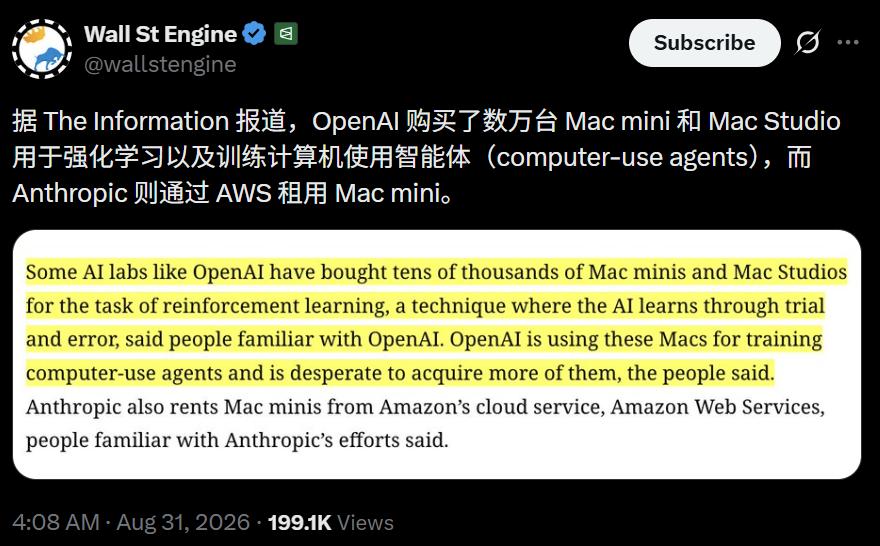
The Information just broke the news that OpenAI has procured tens of thousands of Mac mini and Mac Studio units, and is still chasing Apple for more supply as of now.
Anthropic took a different path, renting Mac computing power from Amazon AWS. According to calculations by netizens, the cost is just over 1 US dollar per unit per hour, totaling 500 to more than 900 US dollars per month.
Renting is not cheap, and buying is not cost-effective either. When it comes to computing power per dollar, Apple chips cannot beat NVIDIA, and there is no dispute over this point.
Then what are they doing this for?
These machines are used for reinforcement learning, to train Computer-use Agents that can operate computers on their own.
Tens of thousands of small metal boxes are being hauled into AI labs
To train Agents, the model needs to practice on real physical computers.
Tens of thousands of machines run at the same time, with the models inside clicking the mouse, opening apps, looking at the screen, making mistakes, and starting over again.
Computing power cards from any manufacturer are available for purchase, but there are some tasks that only Mac can handle.
Apple's rules are as follows.
macOS virtual machines can only run on Apple's own hardware
On Apple silicon Macs, a single device can run a maximum of two macOS virtual machines at the same time
AWS's EC2 Mac still uses the "dedicated host" model to this day: you rent an entire physical Mac, with a minimum billing period of 24 hours. The reason stated in the official documentation is that this is required by Apple's license agreement.
So if you want 10,000 macOS environments, you have to set up thousands of real physical devices.
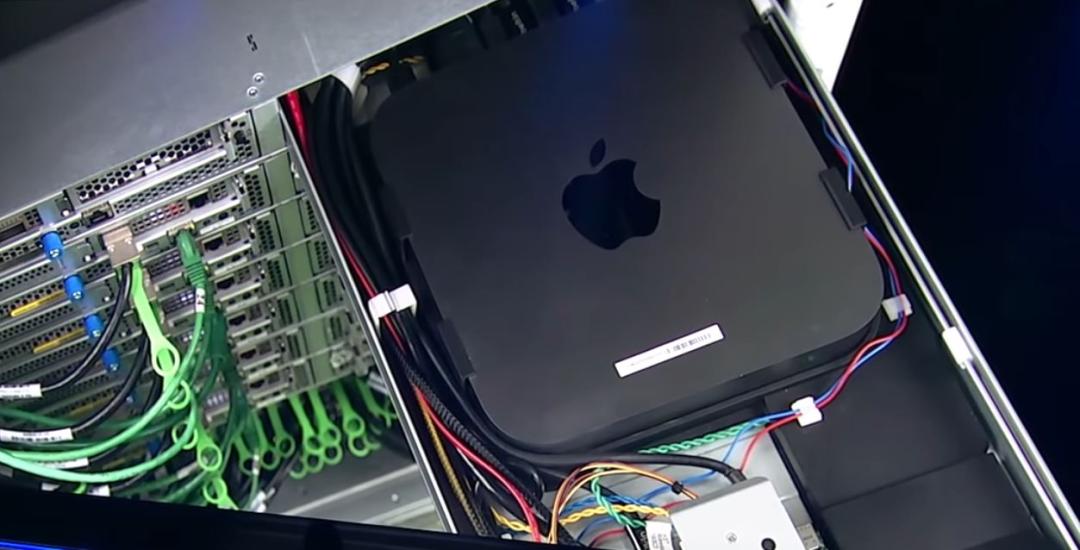
Doug Brooks, senior product manager of Apple Silicon, once gave an explanation on this point.
Agents need a machine that they have full control over, separated from the main work computer, and can run nonstop for days on end. The Mac mini is exactly such a perfect system for this scenario.
You can see how explosive this wave of demand is just by looking at the financial reports.
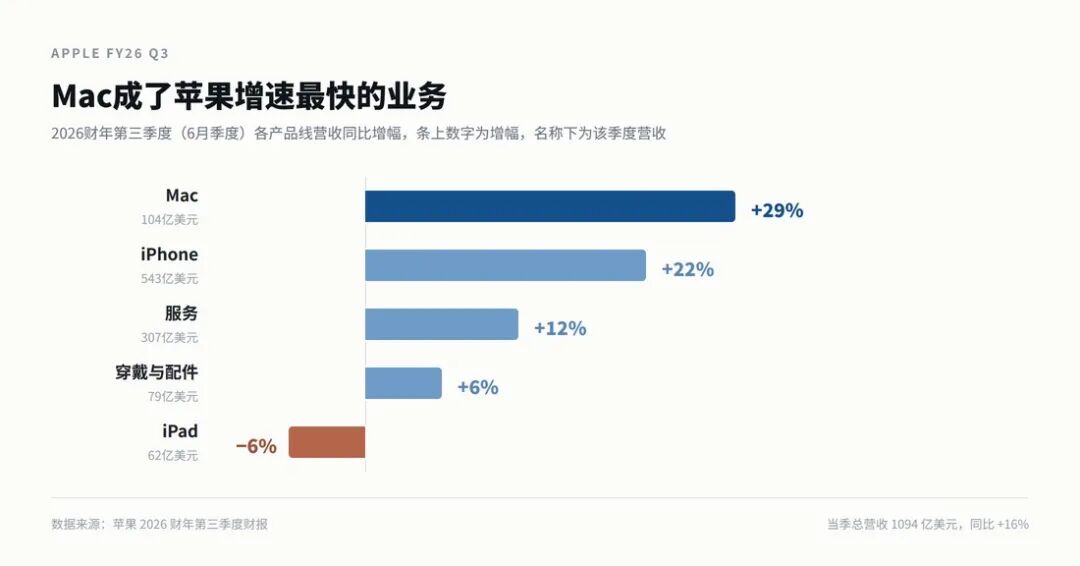
Apple's Mac revenue in the latest quarter hit 10.4 billion US dollars, up 29% year on year, the highest growth rate among all product lines. This achievement is entirely driven by these tiny square boxes.
The tradeoff is product shortages: the configurations most popular with AI developers have been out of stock for months.
Some people on X have already expressed relief that they placed their Mac Studio orders early.
Unified memory, plus a fan that never throttles under full load
A macOS environment alone is not enough, the machine itself must be able to run large models smoothly.
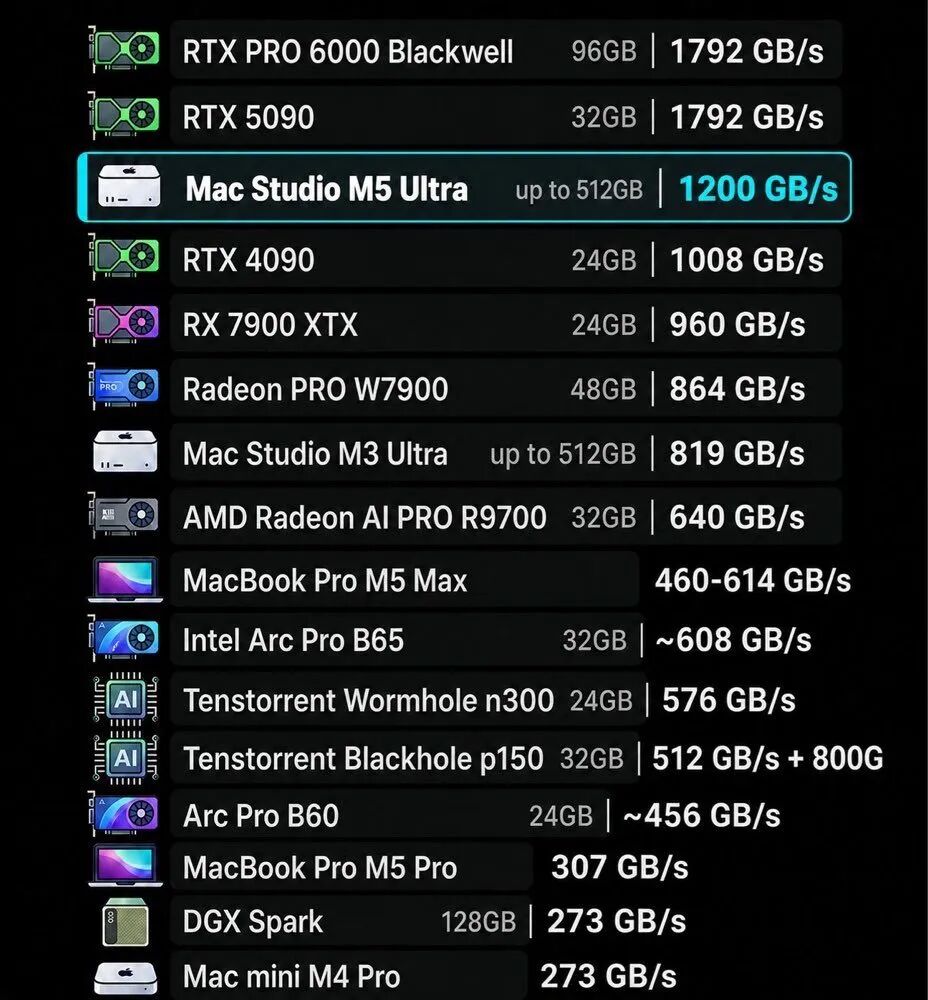
Apple chips cannot beat NVIDIA GPUs, but the unified memory architecture is something that other manufacturers cannot replicate in the short term.
The CPU and GPU share a single memory pool, eliminating the need to split large models into parts to fit onto multiple graphics cards and then transfer data back and forth between them.
When running large models, "being able to fit the whole model in memory" is often more critical than "running as fast as possible".
The M5 Ultra supports up to 512GB of unified memory with a bandwidth of 1.2TB/s. Apple claims that the large model prompt processing speed of the M6 Mac mini in LM Studio is 4.8 times that of the M4 and 13.5 times that of the M1.
The second advantage is that it can withstand long hours of full-load operation.
Lightweight MacBook models will throttle after running for dozens of minutes, while Agents run 7×24 nonstop for days at a time.
Heat dissipation directly determines whether the machine can perform the task stably.
The open-source solution from EXO Labs can connect multiple Macs into a cluster, running models of the 671B parameter level locally.
Tutorials on "using Mac mini as a permanent home server" keep popping up in the developer community, and services that rent out Mac computing power by the hour have even emerged.
What is the actual experience of running Agents on Mac like
Big tech companies buy these Macs to fill up their server rooms.
Ordinary people buy them to get real work done.
Developer Octavio Herrera spent a whole week testing 6 different models on his entry-level M4 Mac mini with 32GB RAM in one go.

Qwen3-30B-A3B, MoE, Q4 quantization: 24-30 tok/s, occupying 17.3GB of memory
GPT-OSS-20B: 28-29 tok/s, occupying 11.3GB of memory
Gemma 4 26B-A4B: 20-22 tok/s, occupying 14.6GB of memory
Dense Qwen3.8-27B: 4.4 tok/s
Control group, DeepSeek v4-flash via API: ~57 tok/s
The result is obvious. To run local large models on entry-level devices, using MoE architecture is basically the only feasible option.
Chip computing power is one aspect, and the other bottleneck is memory.
The local programming Agent from JetBrains requires at least 64GB of memory just for its built-in 27B quantized model.
The PCWorld hardware configuration guide puts it more straightforward: 64GB is the absolute minimum baseline.
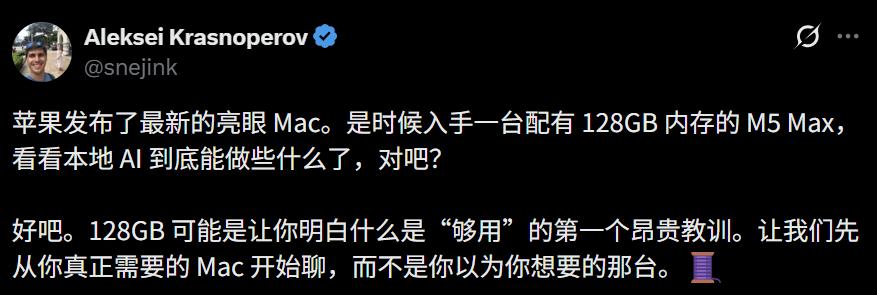
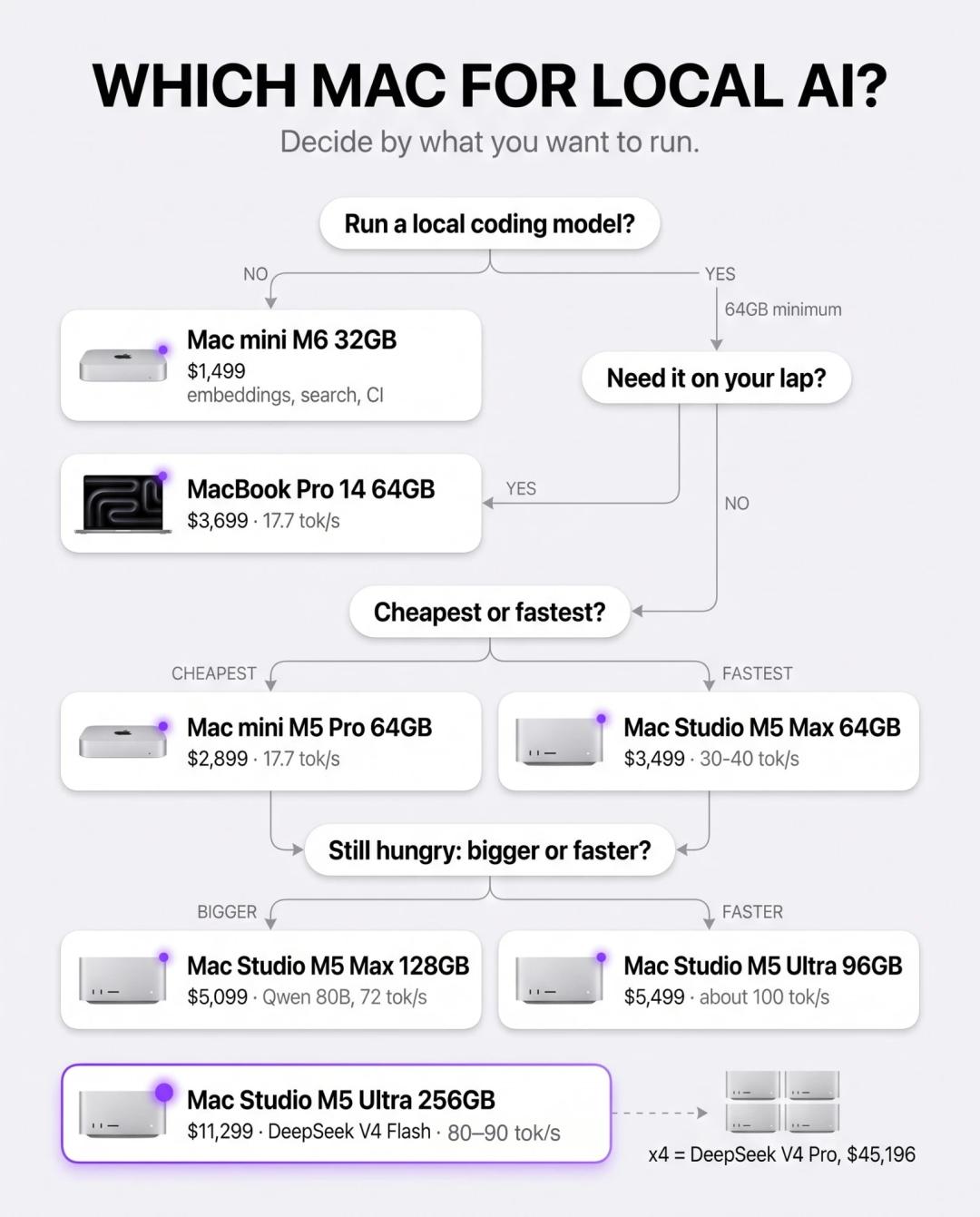
Some users on X have calculated the performance for every configuration.
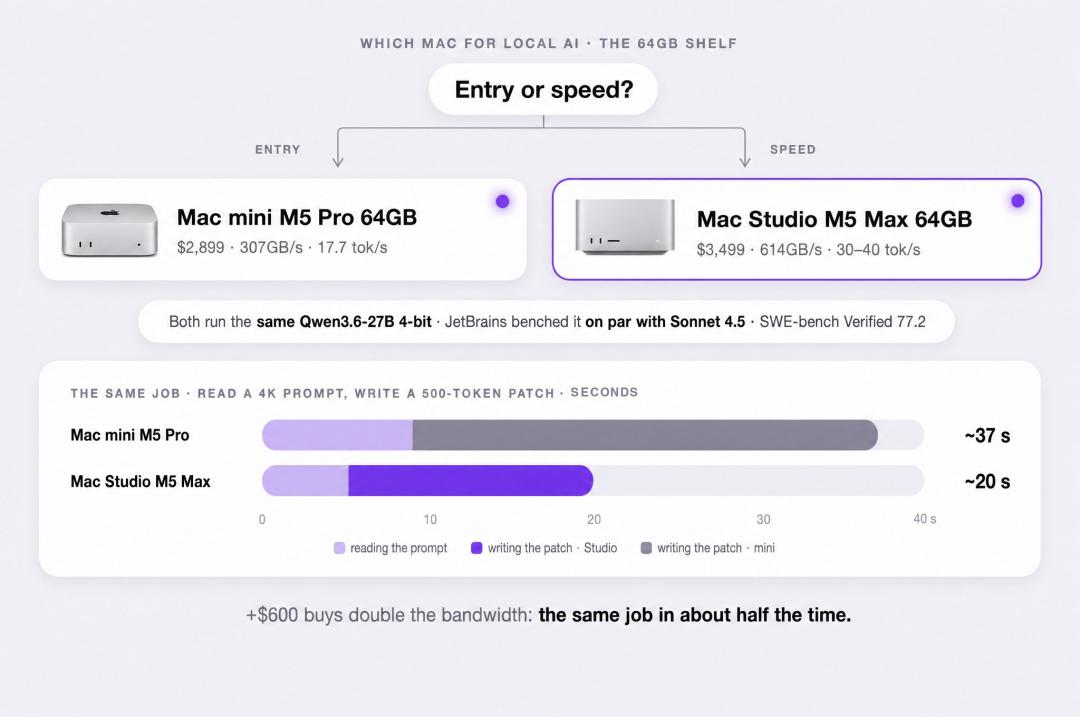
$3499, M5 Max 64GB: Qwen3.6-27B runs at 30-40 tok/s. It processes a 4K prompt in about 5 seconds, modifies a 500-token patch in 13-17 seconds, with end-to-end latency of 20 seconds. The same task takes 37 seconds on the lower-spec Mac mini.
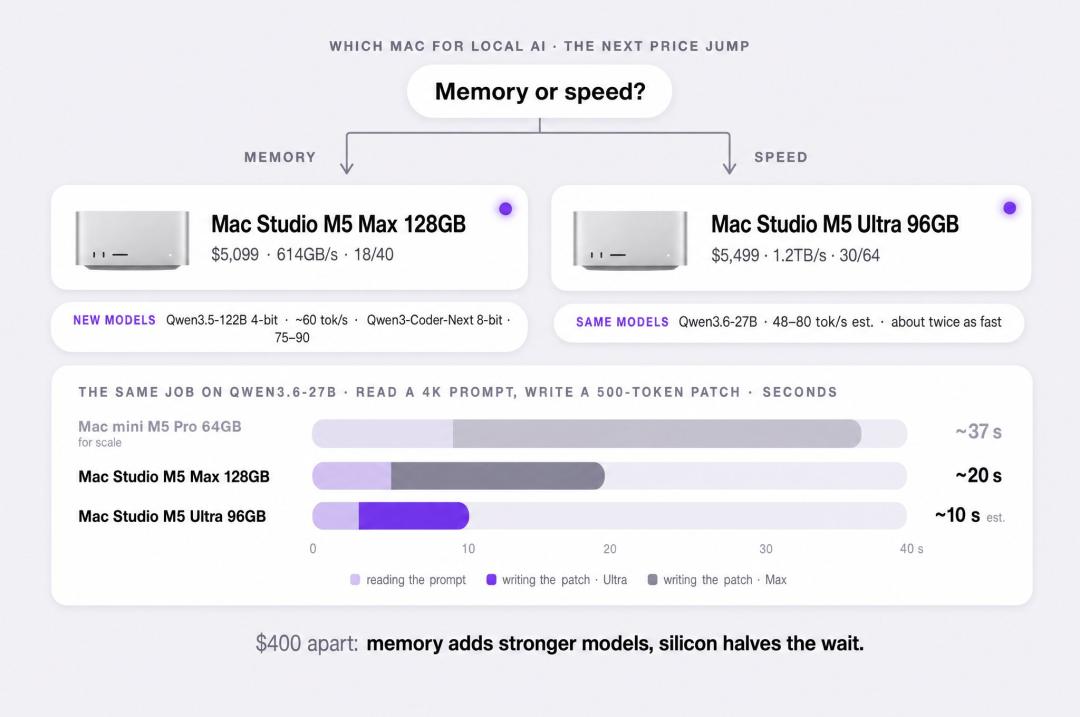
$5099, M5 Max 128GB: Bandwidth remains unchanged, the model capacity doubles, and it can run the 80B Qwen3-Coder-Next on MLX at 75-90 tok/s.
$5499, M5 Ultra 96GB: Memory stays the same, the chip is faster, the same 27B model runs at 48-80 tok/s, with end-to-end latency reduced to 10 seconds.
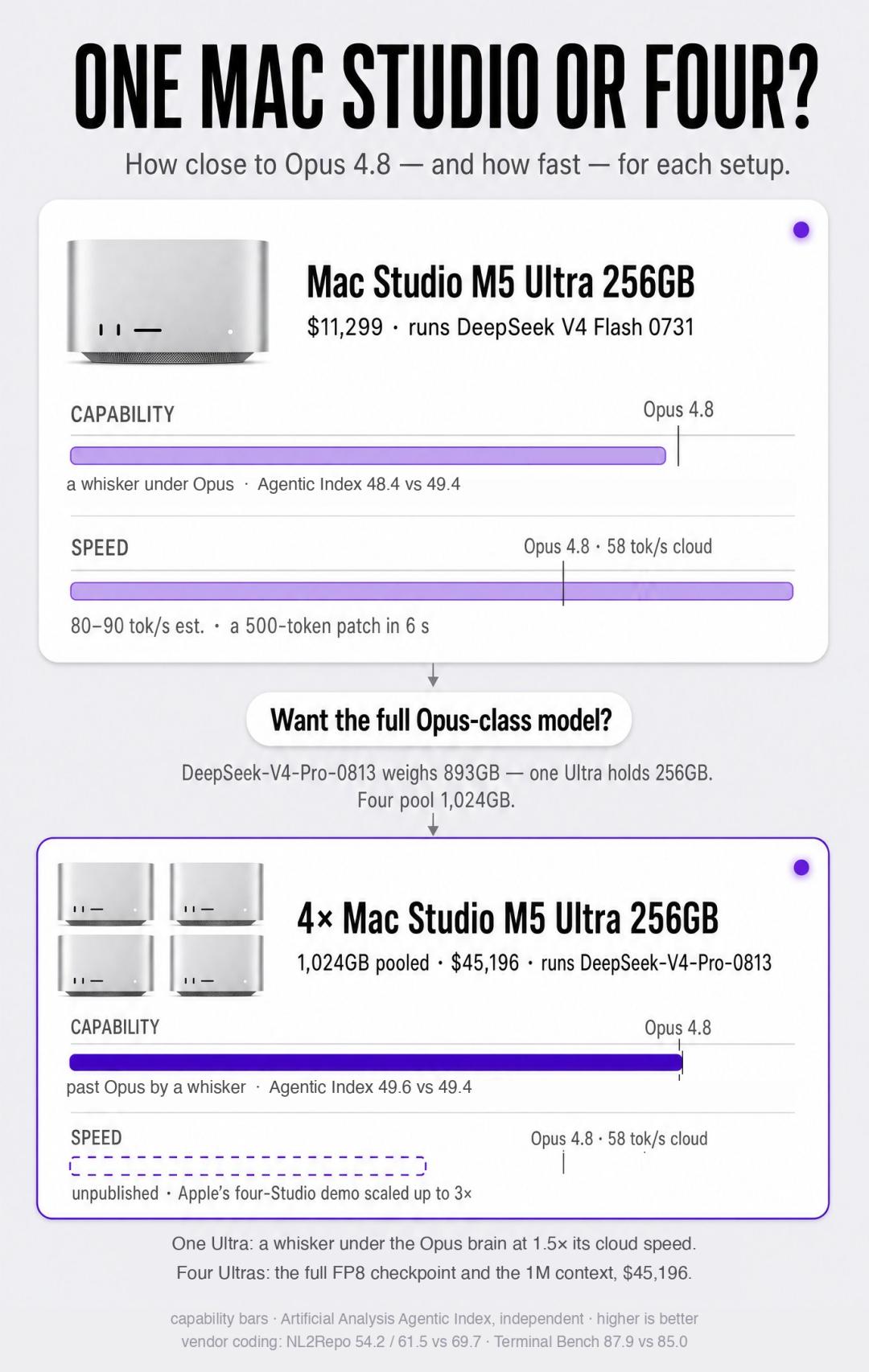
$11299, M5 Ultra 256GB: The first Mac that can fit the full 4-bit quantized DeepSeek V4 Flash on a single device, with an expected speed of 80-90 tok/s.
According to data from Artificial Analysis, the cloud service of GPT-5.6 Sol runs at 75-79 tok/s, and Opus 4.8 at about 58 tok/s.
In other words, a Mac sitting on your desk can already generate text at a speed matching the fastest cutting-edge model cloud services.
Recently, Tim Cook stated at the earnings call: "We are in a once-in-a-century flood of memory pricing, and prices are rising exponentially."
The cost-effective Mac mini model released in China over a year ago was priced at 4499 RMB.
The current M6 Mac mini starts at 6999 RMB.
Apple refuses to take the orders, Jensen Huang is already standing at the door
With tens of thousands of units of orders on the table, Apple turned them down.
Apple has been stepping back from the enterprise market for years.
It discontinued the Xserve server in 2011, shut down macOS Server in 2022, and even stopped production of the Mac Pro this March.
Apple itself also builds servers with Apple Silicon, but these are only for its Private Cloud Compute service.
Some enterprises came to buy this set of computing power, but were rejected.
The Information also dug up a more notable detail: Apple does not have a dedicated engineering team serving enterprise customers at all, nor a single person in charge of developer relations for this business.
Todd Dailey, former Apple enterprise AI product marketing manager who left the company this April, spoke out directly.
He said it's a joke to claim that any team at Apple has a real plan to embrace enterprise AI.
The most in-demand AI business has finally been outsourced to two startups: webAI, and Mount Thor founded by Peter Voell, a former OpenAI computing infrastructure employee. One of them doesn't even have a completed official website yet.
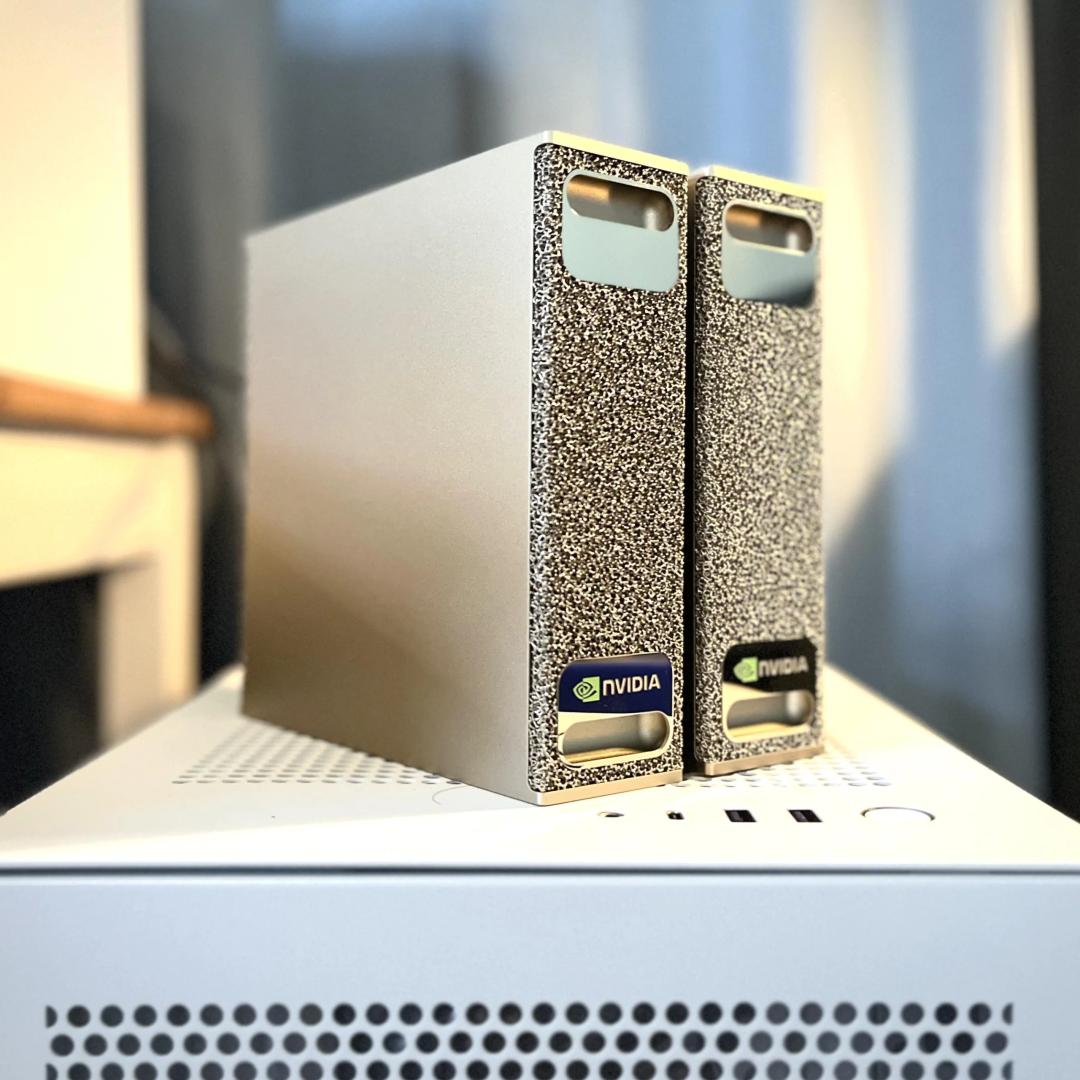
In that case, don't blame Jensen Huang for not being polite — the DGX Spark is designed to directly target the weaknesses of Mac.
At this year's CES in January, NVIDIA released another software update for it, boosting the maximum performance by 2.5 times compared to the launch version, and it can even be attached next to a MacBook Pro as an external accelerator.
Enterprises and developers keep talking highly of it for a simple reason: it is always in stock.
Only then did Apple respond to the situation.
Traditionally, Mac's year-end updates are released in October or November, but this year on August 25, Apple launched the new Mac mini and Mac Studio, with promotional copy directly targeting running cutting-edge large models locally and multi-machine clusters for the first time.
Now AI labs treat Mac mini as infrastructure, while Apple still positions it as a consumer desktop computer.
By the way, what is your own Mac mini running right now?
References:
https://www.theinformation.com/articles/apple-stumbled-ai-hardware-success-mac?rc=epv9gi
This article is from the WeChat official account "AI Era", author: Moses, republished with authorization from 36Kr.