Hugging Face is thrown in at the deep end, with a price tag of just $399.
Hugging Face has launched another robot, which has become so popular that one unit is sold every 4 seconds.
This time, it created a "duck".
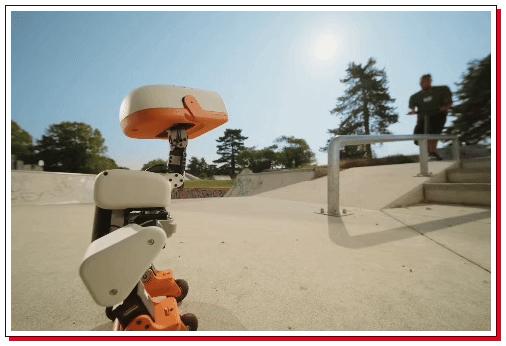
Recently, Pollen Robotics, the robotics team under Hugging Face, released a robotic duck named Microduck: it is 25 cm tall, weighs less than 800 grams, has two short legs, an openable and closable duckbill, and is priced at $399, equivalent to about 2800 CNY.
This small robot, which looks somewhat like a digital pet, can walk, kick balls, roller skate, and can also bend down to "pick up" objects on the ground with its beak.
But obviously, Hugging Face does not just want to sell a cheaper and cuter robot.
Over the past two years, this company famous for its open-source AI community has developed from the robot training framework LeRobot to low-cost robotic arms and robot models, and then successively launched two robots priced at several hundred dollars.
Why is a company that originally ran an open-source AI community taking robot development more and more seriously?
The answer may lie in this $399 little duck.
A "duck" that can be trained repeatedly
If you only look at the official demonstration, Microduck is easily mistaken for a slightly more expensive digital pet.
This little duck, which is only as tall as a bottle of mineral water, supports its chubby body with two short legs and waddles as it walks. It can sit down, stand up, squat down, and lift its legs to kick the small ball in front of it; if you install two small rollers on its feet, it can also skate unsteadily.
The duckbill, which seems to be mainly for being cute, is not a decoration. It is actually an openable and closable gripper. Microduck will lower its whole body, use its beak to "pick up" small things on the ground such as markers and socks, and then stand up and take them away.
If it accidentally falls, no one needs to help it up. It will twist its body, readjust its legs, and get up on its own.

However, in today's robotics world, these movements are not really technical wonders. Humanoid robots can already do somersaults, punch and dance. What is so special about a little duck that can kick balls and roller skate?
It is an open-source robotic duck, and developers can retrain its movements according to their own wishes.
Microduck comes with multiple sets of pre-trained motion Policies out of the box, but Pollen Robotics also opens up its SDK, simulation environment and reinforcement learning tools at the same time.
In other words, after you buy it for $399, you are not just a robot user, but can also become its "coach".
For example, if you think this duck walks too slowly, you want it to run faster, or even teach it a new movement that is not available officially. You can even teach it on its virtual avatar.
Developers can replicate hundreds or thousands of identical "virtual ducks" in the MuJoCo physics simulation environment on the computer. They will constantly try to step their legs, keep balance, fall, and then try again. If they perform well, they will get higher rewards; if the movement is wrong, the algorithm will continue to adjust.
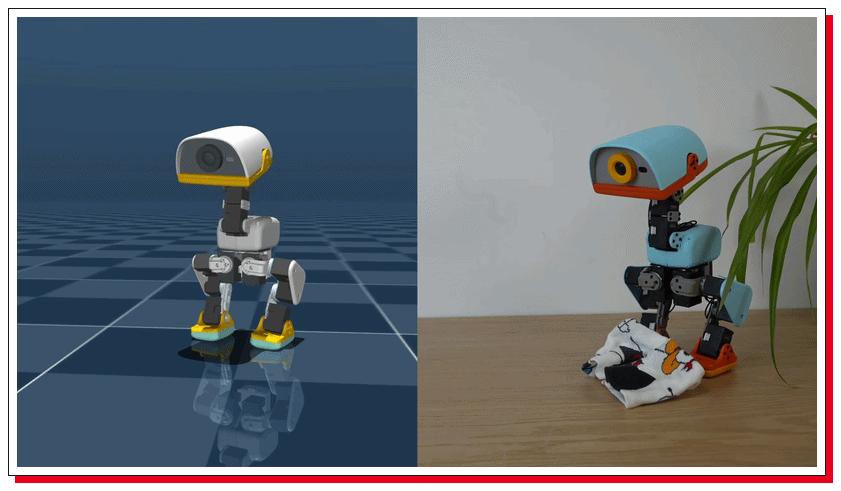
The official training example can run 4096 simulation environments at the same time. When using a CUDA GPU, the official estimated training time for a usable walking gait is about 1 to 2 hours.
In other words, the real Microduck in the real world is still standing quietly on the table, while thousands of ducks in the computer may have fallen countless times.
When the virtual duck finally learns a movement, developers can export the trained neural network Policy and deploy it to the real Microduck.
This is Sim-to-Real, which is often mentioned in the robotics field -- from simulation to reality.
Of course, success in the virtual world does not mean that the real machine will definitely succeed. The friction of the real ground, the motor status, and the center of gravity of the body cannot be completely consistent with the computer simulation. If the real machine walks crookedly or falls, developers can go back to the simulation environment to modify the parameters, retrain, and then deploy again.
And this cycle goes on and on.
Hugging Face is even trying to lower the computing power threshold together.
If your computer has an NVIDIA GPU that supports CUDA, developers can train directly locally; if you do not have a suitable GPU, you can also submit the same set of training tasks to the cloud GPU through Hugging Face Jobs. After the training is completed, deploy the obtained Policy back to Microduck.
Therefore, Microduck is a development version robot with two legs.
The reason why it is made so small is not just for being cheap and cute, but more importantly, it "can afford to fall". For developers who need a lot of trial and error, a low-cost real machine that can be tested repeatedly is very important.
Making robots cheaper and easier to use is exactly what Hugging Face has been doing for the past two years.
Why does Hugging Face insist on making robots?
Over the past two years, Hugging Face's business has been extending to the robotics field.
The earliest starting point can be traced back to March 2024, when Rémi Cadene, who participated in the Tesla Optimus project, joined Hugging Face to be in charge of a new open-source robotics project. Two months later, LeRobot went online.
At first, what Hugging Face did was what it was familiar with -- software.
LeRobot is not a robot, but a set of open-source robot learning tools. Models, datasets and training methods can be shared by developers on this platform.
This is very "Hugging Face". When it worked on large models in the past, it also gathered models and datasets scattered everywhere on one platform, so that developers do not have to reinvent the wheel.
But Clément Delangue, CEO of Hugging Face, observed that the AI of robots is still in a very early stage, and everyone is "working on their own" -- each laboratory has its own technology stack, and data, models and hardware are isolated from each other.
Delangue believes that if everyone can cooperate on open source and standards, robots may also usher in their own "ChatGPT moment".
In fact, this matter has already shown some signs. According to a report by IEEE Spectrum this year, the number of robot datasets on LeRobot has increased from 1145 at the end of 2024 to more than 58,000, making it the largest dataset category on Hugging Face Hub. NVIDIA, Alibaba, research institutions, and enthusiasts who tinker with robots at home are all uploading models on Hugging Face.
But as it went on, Hugging Face found that software alone is not enough. For example, models can be downloaded for free, but robots cannot.
Delangue saw that more and more AI developers began to be interested in robots, but they were discouraged by the price: as high as $20,000, $30,000, $50,000, or even $100,000. An AI developer who just wants to try robots can hardly pay so much money for an experiment first.
Therefore, Hugging Face began to try to develop low-cost robots. It first launched the SO-100 and SO-101 robotic arms priced at hundreds of dollars, and in 2025, it directly acquired Pollen Robotics, which had been making open-source robots for 9 years. The latter already had a mature research robot Reachy 2, which means that Hugging Face has for the first time truly obtained the ability to develop robot bodies.
After having the ability to build "large robots", they instead started to make robots smaller and cheaper: Reachy Mini sells for $399, and Microduck is still priced at $399.
Delangue hopes to make robots "so cheap that you can easily make a decision, buy one and put it next to your laptop, then start tinkering with it."
And he did exactly that himself.
When he received Reachy Mini for the first time, Delangue spent 5 hours assembling it. Some people joked that it was a bit like assembling IKEA furniture: you tighten all the screws yourself, and you will have more affection for it after finishing the assembly.
Delangue agrees very much. He said that making a thing by yourself is a kind of happiness in itself. What Hugging Face wants is not that users open the package and finish using a few pre-installed functions, but that they can't help but continue to modify it after assembly: some people add wheels to it, some people replace the motor, some people install a pair of hands. It is best that these changes are not conceived by Hugging Face, but grow out of the community itself.
Delangue once said in an interview that what Hugging Face is really interested in is not a certain model, a certain dataset or a certain kind of hardware, but those "small contributions" that many people can participate in.
This idea is more or less with Hugging Face-style idealism.
Delangue hopes that more people will not only use robots, but also participate in deciding what robots should look like. Instead of letting several companies guess, it is better to leave the choice to the people who use them.
Thomas Wolf, co-founder of Hugging Face, also expressed the same view: Robots may be the next frontier unlocked by AI, but they should be open, cheap, and private.
Therefore, Hugging Face does not necessarily want to define what the next robot looks like. On the contrary, it wants to leave this question to more people to answer.
Open-source Hugging Face is moving towards NVIDIA
Around the release of Microduck, Hugging Face itself has reached a delicate crossroads.
According to a report by The Information, NVIDIA has agreed to acquire Hugging Face for $12.9 billion. Reuters later cited this news. However, up to now, neither NVIDIA nor Hugging Face has officially announced this transaction. Business Insider was told that the two parties have not signed the final agreement, and the transaction is still subject to possible changes.
If the deal is finally completed, it will be a quite meaningful combination.
Over the past few years, Hugging Face has been emphasizing openness and sharing, and even repeatedly warned that the future of AI should not be controlled by a few Silicon Valley companies. When talking about robots, Clément Delangue also said that if only a few people decide what to create in the future, it is an "extremely dangerous" thing.
On the other side, there is NVIDIA, which almost dominates AI computing power.
But the two companies have actually been getting closer for a long time.
NVIDIA was one of the investors in Hugging Face's 2023 financing. In the robotics field, the relationship between the two is even closer: NVIDIA's GR00T model, Isaac Lab-Arena, etc. have successively entered the LeRobot system. Earlier this year, Hugging Face also jointly introduced their Physical AI cooperation with NVIDIA, and gave a set of figures at that time: NVIDIA has about 2 million robot developers, while Hugging Face has more than 13 million AI developers. What the two want to do is to connect these two groups of people together.
Even on the newly released Microduck, you can see the shadow left by NVIDIA.
According to the official training documentation, developers who want to train Microduck locally currently need a CUDA GPU. Because Microduck uses MuJoCo Warp for reinforcement learning training, and this official link relies on CUDA.
So what about AMD users?
Two days after the release, some developers tried to migrate the training environment to a solution that supports AMD GPUs. This version is not officially provided by Hugging Face, and only part of the tasks have been completed so far, and it has not been verified on the real machine.
Therefore, the official default path is CUDA, but open source gives developers the opportunity to modify and create another path on their own.
There is currently no evidence that Hugging Face is abandoning AMD. On the contrary, AMD is still providing LeRobot-related models optimized for ROCm in the Hugging Face ecosystem.
But if Hugging Face is finally acquired by NVIDIA, whether this choice can always exist will become a problem worthy of further observation.
Conclusion
At the end of the day, Hugging Face still wants to repeat the story of the large model era in the robotics field: make hardware cheaper, make models, data and tools flow, and let more people come in to participate.
Only this time, AI has a physical body, and things are not that simple.
Whether the open-source prosperity in the large model era can be repeated in the robotics field, Microduck has only just started this journey.