The reason for the Mac mini shortage has been uncovered: both OpenAI and Anthropic are scrambling to snap up available units.
Memory chip prices have skyrocketed, making computers almost unaffordable for ordinary consumers. On the other side, devices suitable for running AI workloads are selling extremely well.
Citing internal sources at OpenAI, The Information reports that over the past few months, OpenAI has purchased tens of thousands of Mac mini and Mac Studio units for the development of reinforcement learning and computer-operating agents.
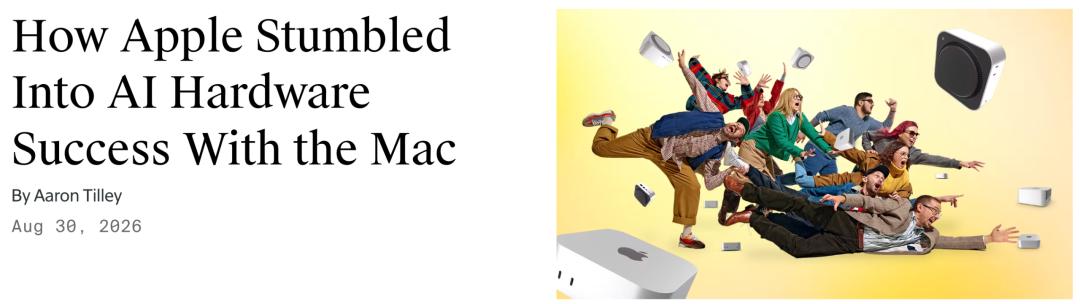
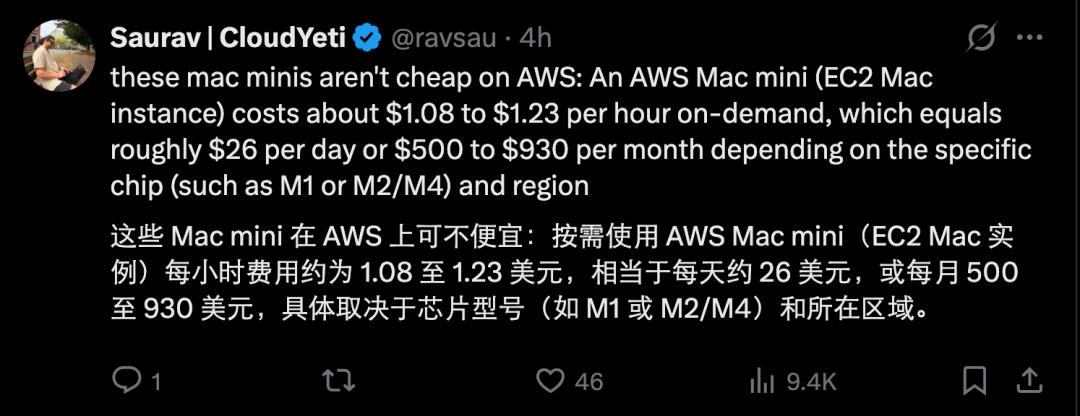
These devices are deployed in a centralized manner to train and test Agents that can operate computers independently. The report also states that Anthropic is renting a large amount of Mac computing power through Amazon AWS.
Apple Mac computers were previously mainly targeted at ordinary consumers and professional creators. Today, they are starting to enter top AI labs in the form of clusters, undertaking code testing, email organization, document processing, and multi-step task execution.
The identity of Mac is changing, gradually transforming from a personal computer to part of AI infrastructure.
Why are AI labs starting to stock up on Macs?
OpenAI and Anthropic do not lack GPUs.
They have huge clusters of NVIDIA accelerators and are continuously procuring more data center computing power. OpenAI suddenly purchasing a large number of Macs is targeting the new demands brought by computer-operating agents.
This type of Agent needs to click buttons, enter text, drag files, and work continuously across different applications. The Computer-Using Agent previously released by OpenAI learns how to directly operate graphical interfaces through reinforcement learning.
Training such systems requires a large number of operating system environments that can run in parallel and be reset repeatedly. Agents perform tasks in these environments, the system records operation trajectories and judges whether the results are correct, and then these feedbacks are used for subsequent training.
Mac here is more like a training ground and execution node for agents. It can provide a native macOS environment, avoiding deviations in interface, permissions, and application compatibility between simulation systems and real devices.
Therefore, OpenAI's procurement of tens of thousands of Macs does not mean that the main training of its cutting-edge models has migrated from NVIDIA GPU clusters to Apple devices. Macs are more likely to undertake parallel interaction, trajectory collection, task verification, local inference, and part of the post-training work. The centralized update of model parameters is most likely still completed by data center accelerators.
Apple's M-series chips adopt a unified memory architecture, where the CPU, GPU, and Neural Engine can access the same memory pool, reducing repeated data transfer between different memory regions. For local large model inference, this can alleviate the common video memory capacity limitation of consumer-grade discrete graphics cards.
The latest M5 Ultra Mac Studio can be equipped with up to 512GB of unified memory, with a memory bandwidth of 1.2TB/s. Such a large memory pool can hold quantized models with extremely large parameter scales in a single device. The active heat dissipation design of desktop computers is also more suitable for high-load tasks that last for hours or even days.
Apple has also enhanced multi-device collaboration in the new Mac Studio. According to Apple's official introduction, multiple devices can form a cluster via Thunderbolt 5, and the distributed AI inference performance can reach up to 3 times that of a single device.
Apple is finally starting to take this business seriously
Mac mini used to be the cheapest desktop computer in Apple's ecosystem. It is small in size, low in power consumption, and can run for a long time without a display. With the popularity of persistent AI Agents, these originally ordinary product features have suddenly become very suitable for data centers and local AI deployment.
The Wall Street Journal previously reported that Mac mini accounted for only about 3% of Apple's US Mac sales in the previous year. After entering 2026, it has become a popular host for private, all-weather Agents. Some high-memory versions once had delivery delays of weeks or even months.
Apple also seems to have been caught off guard by this wave of demand.
Citing Todd Dailey, former enterprise AI product marketing manager at Apple, The Information reports that Mac's popularity in the enterprise AI market is highly accidental, and Apple had not previously established a complete enterprise engineering support and developer relationship system around this market.
In June this year, Apple held a rare closed-door corporate event at Apple Park, and Jared Kaplan, co-founder of Anthropic, also attended the event. Reports show that Mac mini became the key product of the entire event.
By August 25, Apple released the M6 Mac mini and M5 Ultra Mac Studio, with the marketing focus clearly shifted to on-device AI, large model inference, and multi-device clusters. Apple also explicitly stated that developers can run and fine-tune large models locally on Mac.
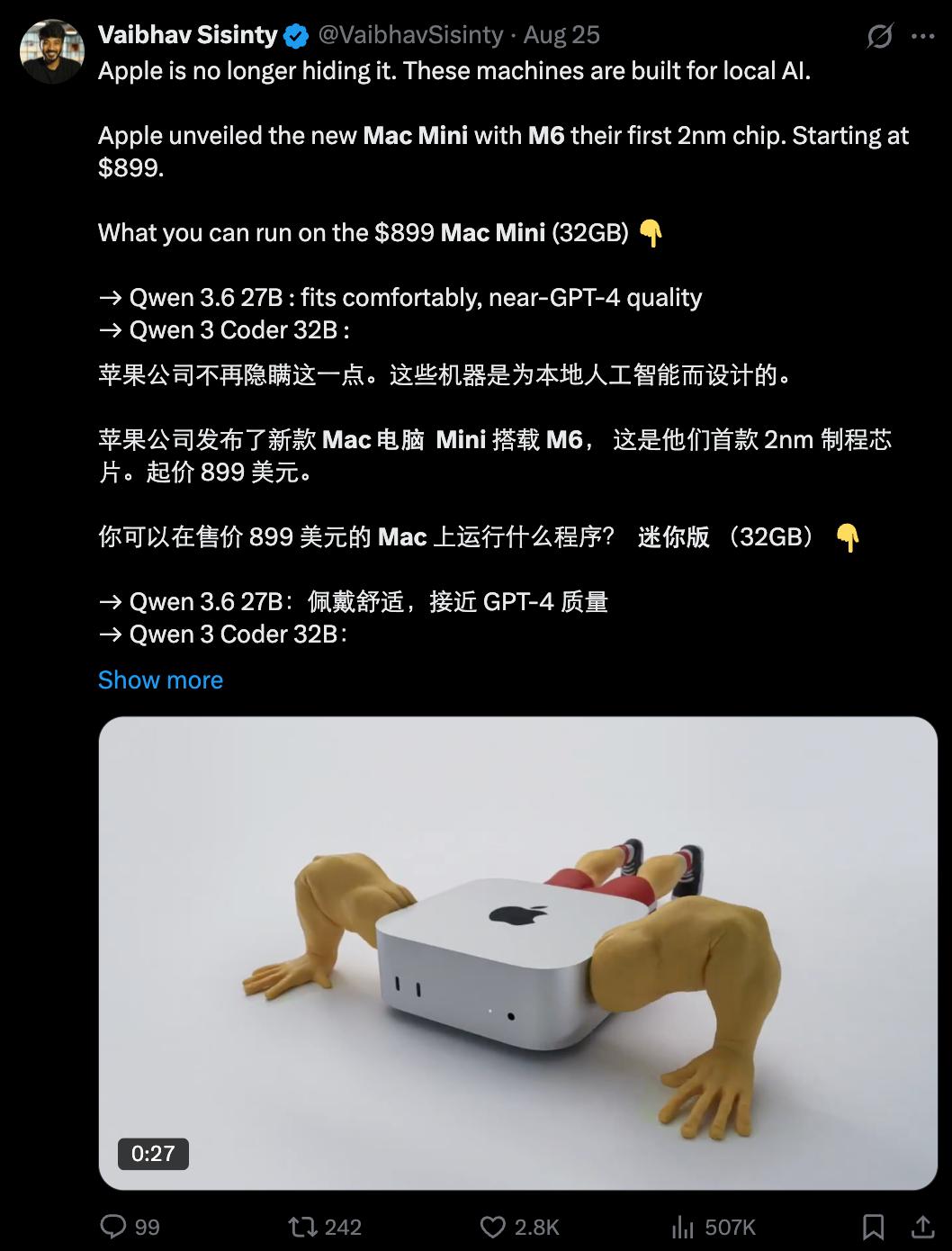
Prices have also risen accordingly. The starting price of the new M6 Mac mini in the Chinese market is 6999 yuan. In 2024, the starting price of the M4 Mac mini with 16GB of memory was 4499 yuan. In two years, the entry price of Mac mini has increased by about 56%. Chip upgrades are part of the reason, and rising memory and storage costs are also pushing up the overall price of the device.
AI demand is already reflected in Apple's financial data. In the third quarter of Apple's 2026 fiscal year, Mac business revenue reached 10.352 billion US dollars, a year-on-year increase of about 28.7%, outpacing the growth rate of other hardware categories in the same period.
The demand for high-memory Macs from enterprises and developers has become a non-negligible variable in this round of growth.
Desktop AI has become a new battlefield for Apple and NVIDIA
Apple's changes have already attracted NVIDIA's attention.
From DGX Spark to the newly announced RTX Spark this year, NVIDIA is compressing the AI computing power of data centers into desktops and laptops. RTX Spark integrates Grace CPU and Blackwell GPU, delivers up to 1 PFLOP of AI computing performance and 128GB of unified memory, and supports the CUDA, TensorRT, and RTX software stacks at the same time.
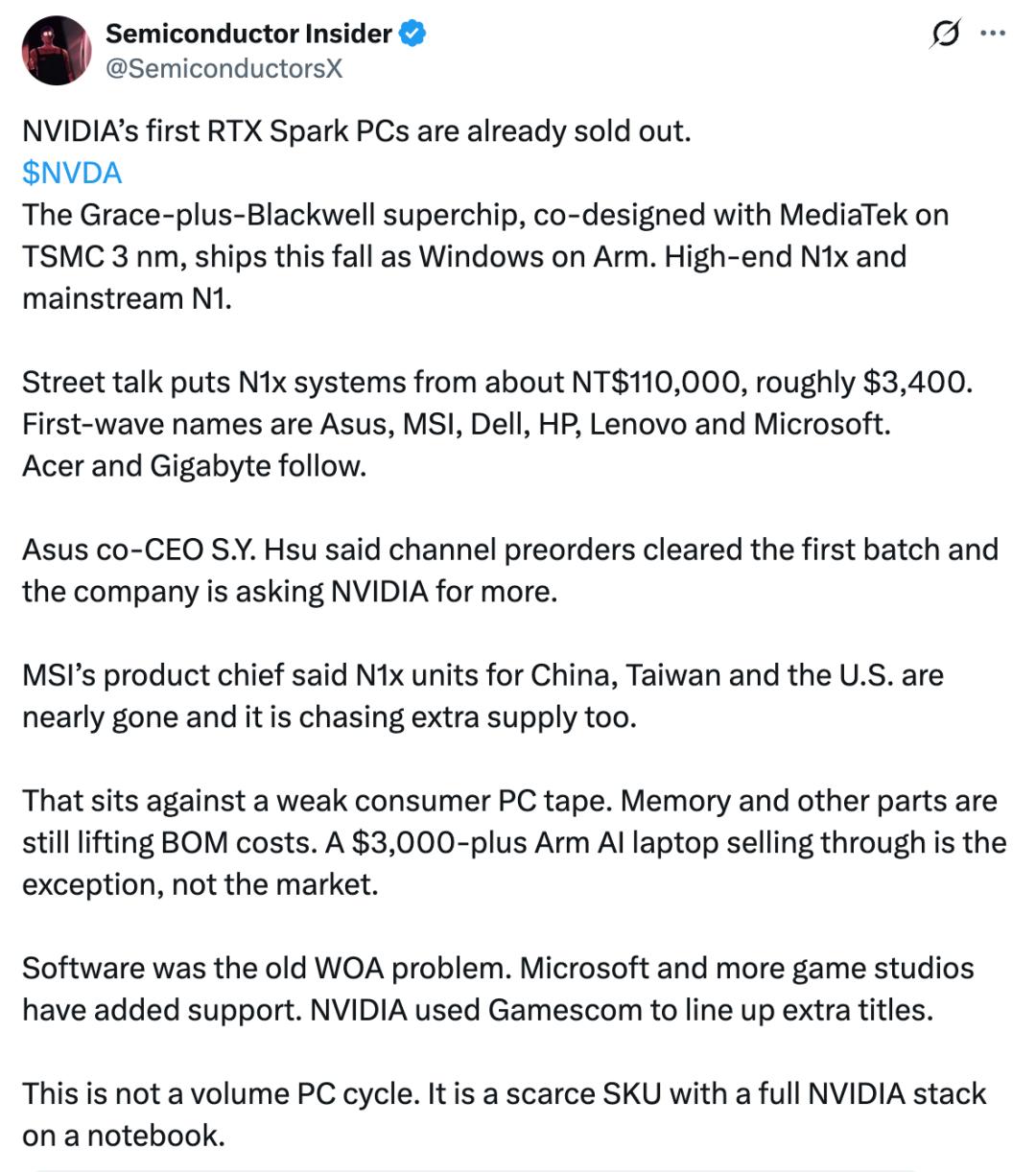
NVIDIA directly defines it as a new type of PC for personal agents. According to official plans, the first batch of RTX Spark laptops and compact desktops will be launched this fall.
The products have not been officially released yet, but supply has already tightened. According to reports, the first batch of RTX Spark models from ASUS has been fully booked by channel customers, and the first batch of high-end N1x models from MSI is also almost sold out. Both companies are striving for more quotas from NVIDIA.
Apple and NVIDIA have thus stepped onto the same new track.
Apple has large-capacity unified memory, high energy efficiency, and a native macOS environment. NVIDIA masters CUDA, TensorRT, and a more mature AI development ecosystem, and is deeply integrated with the Windows agent system. The core scenarios for both sides to compete include local inference, Agent execution, reinforcement learning trajectory generation, model evaluation, and lightweight post-training.
These desktop devices will not replace large-scale training clusters in the short term. They fill a layer that cloud computing power cannot fully cover: allowing Agents to get close to user data, operating systems, and real applications, and run continuously with low latency.
Supply issues have also emerged accordingly.
AI data centers are consuming large amounts of DRAM and NAND, driving up costs across the entire storage market. At the same time, local AI and agents require larger memory capacities. The simultaneous competition for memory between upstream data centers and downstream AI terminals eventually forms a chain reaction of rising prices, delivery delays, and shortages of high-end models.
The popularity of Mac mini reveals a new hardware route in the agent era. Future AI computing power will not only be concentrated in giant data centers, and more and more computing tasks will be distributed to local nodes in offices, homes, and enterprise computer rooms.
The next competition in AI hardware has extended from the cloud to every desk.
References:
https://www.theinformation.com/articles/apple-stumbled-ai-hardware-success-mac
https://wccftech.com/openai-hoarding-tens-of-thousands-of-apple-mac-mini-and-mac-studio-devices-as-asus-and-msi-burn-through-their-entire-first-batch-of-nvidia-rtx-spark-chip-and-beg-for-more/
This article is from the WeChat Official Account "JIQIZHIXIN" (ID: almosthuman2014), authored by AI-focused contributors, and authorized for release by 36Kr.