The most terrifying prophecy about AI is coming true step by step.
Not long ago, you might have come across a piece of news: global mRNA giant Moderna and Merck jointly announced that the Phase III clinical trial of their investigational mRNA cancer vaccine Intismeran (research code V940/mRNA-4157) has yielded positive results.
This is an unprecedented achievement. Before this, all existing cancer vaccines for humans were preventive vaccines, which are injected into healthy people to reduce the risk of cancer. This vaccine, by contrast, is a therapeutic vaccine that targets two key endpoints in the cancer treatment process: "Recurrence-Free Survival" and "Distant Metastasis-Free Survival". The completion of the Phase III clinical trial means that both endpoints have met all the standards after tests with a sufficiently large sample size, with stable, reproducible results and excellent safety performance, leaving only one step before it can be put into real clinical application.
The capital market also affirmed this achievement with a very positive attitude. On the day the news was released on August 19, Moderna's stock price skyrocketed by 170% in a single day, with its market value surging by tens of billions of dollars. Merck's share price rose by 12%, marking its largest increase since March 2009. The NASDAQ Biotechnology Index, which includes Moderna and Merck, jumped 4 percentage points, hitting a record high.
However, this strong performance only lasted for one day. On the next day, August 20, Moderna and Merck saw sharp drops of more than 20% and more than 4% respectively. The entire K-line has not rebounded to this day, remaining in a volatile state.
Why did this happen? Some people think it is normal, simply because the rise was too drastic at the beginning. But more people believe that this may be a "doomsday carnival": because this new vaccine is not only a breakthrough in the human medical industry, but also a breakthrough driven by AI.
Simply put, the key to mRNA therapy is to let the body's immune system accurately identify latent cancer cells so as to eliminate them precisely. However, the differences between cancer cells and normal cells may only lie in a few gene mutations. The gene bank is extremely huge, and healthy cells mutate at any time every day. To find those functional and key mutation targets is a vast, multi-year project for human researchers, and each case is independent and cannot be directly replicated to other scenarios.
AI perfectly solves all these problems. With the help of large AI models, researchers at Moderna can complete the deduction of protein folding, binding force prediction and immune response simulation in just a few hours, and then accurately select up to 34 targets with the strongest immune killing power, which makes it possible to widely use mRNA therapy to achieve cancer cure.
Just imagine, in the future, this approach will succeed countless times and create countless "unprecedented" achievements. At that time, will the leader in drug and therapy research be a pharmaceutical company, or an AI company full of engineers? This is deeply unsettling. What is even more unsettling is that all of this was predicted a year ago.
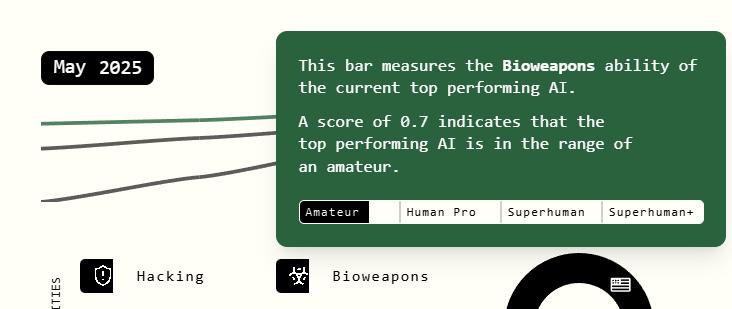
In the famous prediction "AI2027", the authors accurately predicted that in the second half of 2026, the industry discussion about artificial intelligence will shift from "is this a bubble economy" to "AI will help human society achieve the next major breakthrough", and some technical jobs in human society have begun to be replaced by AI. At the same time, on the artificial intelligence capability diagram given by the authors, the performance of AI at the node of the second half of 2026 in the field of biotechnology will reach 1.4, which has reached the level of professional practitioners.
Not only that, "AI2027" also predicts that in the middle of 2026, China will usher in the "AI awakening" moment. China will find a proper solution to the problem of insufficient computing power, and then develop large models with capabilities that qualify for the first tier, while falling into disputes related to "distillation".
Today our topic is this prediction that keeps coming true. Let's talk about what this prediction has observed, what it points to, and what it is anxious about.
The "Thought Experiment" of the Whistleblower
When it comes to predictions, many people will instinctively think of religious myths or science fiction novels.
Strictly speaking, the core goal of religious myths is to explain unknown natural phenomena and preach the order that people should follow, not necessarily to look to the future for solutions. For example, Greek mythology uses a huge and rich genealogy of gods to depict the movement of the sun and the moon, and the alternation of the four seasons, but Zeus and Gaia are not responsible for solving human troubles, and rarely give revelations about the future. "Science fiction" is essentially a narrative method, which is based on reality and carries out deduction that conforms to the laws of science, but its final foothold is "a certain anxiety or fear that people cannot solve at the moment", and tries to leave everything to time to see the "result".
But "AI 2027" is completely different. There are five authors of "AI 2027", namely Daniel Kokotajlo, Scott Alexander, Thomas Larsen, Eli Lifland, and Romeo Dean. Except for Scott Alexander, who is a content creator responsible for the readability of the text, all other authors have academic backgrounds.
It is necessary to focus on introducing Daniel Kokotajlo. Daniel Kokotajlo worked as a researcher in the governance department at OpenAI between 2022 and 2024. The so-called governance department can be roughly understood as the "strategic department" of large domestic technology companies, which is responsible for designing a complete top-level architecture, process and supervision mechanism for the smooth implementation of the company's strategy. Specifically for the governance department of OpenAI, its work content is to ensure that AI R&D is carried out on the premise of safety and controllability, and to balance OpenAI's social responsibility and commercial value.

(Daniel Kokotajlo, personal social media)
Reading here, you should also realize the problem that OpenAI is no longer a non-profit organization. Under this premise, even if OpenAI still emphasizes its social responsibility and public welfare value, the priority of these values is obviously lower than the interests of shareholders and the company. This is unacceptable to Daniel Kokotajlo. He believes that many signs indicate that OpenAI's so-called "pursuit of AGI" is more driven by interests, and it will try every means to bypass supervision in order to achieve this goal as soon as possible. This is also the direct reason why Daniel Kokotajlo left his job.
In June 2024, Daniel Kokotajlo announced his resignation on personal social media, and publicly stated that the cause OpenAI is building is seriously under-regulated, and under the temptation of huge interests, it is constantly breaking its self-restraint, which is very likely to bring "catastrophic consequences", because "these systems are not ordinary software; they are artificial neural networks that can learn from massive amounts of data... Human understanding of these fields is still in its infancy", "we still have a lot of unknowns about how these systems work, and whether they will remain aligned with human interests when they become more intelligent and may surpass human-level intelligence in all fields".
In order to speak out to the public, Daniel Kokotajlo refused to sign OpenAI's "non-disparagement agreement", and thus gave up options worth millions of dollars at that time, which is a truly admirable act of standing by his principles. Daniel Kokotajlo was also selected into the 2024 "Time" AI 100 list for this feat.
In short, from the composition of the authors, we can see that "AI 2027" has a very essential difference from religious myths and science fiction novels. Its creative team not only has a solid academic background, but also has sufficient first-hand internal perspectives, and the issues it discusses are all real problems that exist within front-line large model companies. Its goal is to describe as specifically and quantitatively as possible how the artificial intelligence industry will develop in the future, when and in what form AGI will be born, and what impact it will bring after its birth.
In addition, "AI 2027" also released a detailed deduction model. For example, as we mentioned earlier, "AI 2027" predicts that in the second half of 2026, AI's capability in the field of biotechnology has reached the level of "professional practitioner". The capability level here actually has four indicators, namely "amateur", "professional practitioner", "super-human", and "superintelligent". In the explanatory document, the authors take "programmer" as an example to elaborate that the "super-human" capability means that a company can use 5% of its overall computing power budget to run agents whose number is 30 times that of its human research engineers, and each agent completes coding tasks in AI research at an average speed 30 times faster (such as experimental implementation, excluding conception or priority sorting).
For example, on the key indicator of computing power, "AI 2027" has two frequently used units of measurement, one is TPP, and the other is H100e. H100e is easy to understand, as the name suggests, it refers to "H100 equivalent computing power". The more difficult concept to understand is TPP, which stands for "Total Processing Performance".
In the whole "AI 2027", the authors believe that "AI computing power" cannot be directly equated with "computing power", because AI chips or AI accelerators are computing devices specially designed for such parallel computing (such as GPUs), and their efficiency in computing tasks is much higher than that of traditional processors (such as CPUs). Therefore, after obtaining the overall computing power data, they need to further filter out "AI computing power", and the threshold is a computing unit with Total Processing Performance (TPP) of at least 4000 and Performance Density (PD = TPP / chip area) of at least 4. This threshold is roughly equivalent to the A100 launched by NVIDIA in 2021, while the H100 is approximately 15800 TPP.
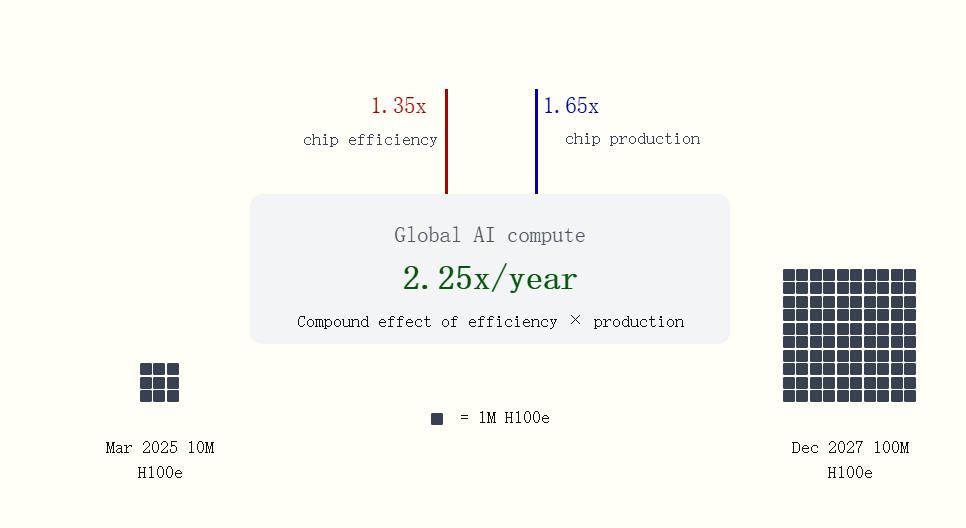
Propositions such as the distribution of computing power resources, the allocation of computing power among relevant entities, and how AI will allocate limited computing power resources are all based on computable deductions on this basis. For example, in their deduction of AI computing power production capacity as shown in the figure below, it is estimated that by December 2027, the globally available AI-related computing power will increase by about 10 times from the level in March 2025 (that is, 2.25 times per year), reaching 100 million H100e.
Of course, it also needs to be made clear that the author team of "AI 2027" also acknowledges that many scenario predictions lack sufficient evidence for conclusive inference, so a considerable degree of "intuitive judgment" needs to be incorporated. At the same time, since "AI 2027" is a scenario prediction with a span of two and a half years and a "quarter" as the cycle unit, the authors will also regularly evaluate which predictions are correct and which are very unreasonable, and adjust the prediction model based on those successful predictions. Therefore, I think the most accurate definition of "AI 2027" is probably a "thought experiment" by a group of AI practitioners.
Those Things That Have Already Happened
After fully understanding the background and resume of the creative team, the unique value of "AI 2027" is very intuitive.
Overall, taking the end of 2026 as the node, the part before that can be regarded as an industry research report produced by a research team with solid academic foundation and access to sufficient first-hand information. After the end of 2026, it is a scientific research team with deep insight into the artificial intelligence industry that uses ideas such as wargame deduction to predict possible future scenarios. Under this premise, theoretically, the "high accuracy" that "AI 2027" has shown so far is not too surprising. For example, the wave of data center construction and the outbreak of AI Agent, anyone who has a basic understanding of the artificial intelligence industry can say a few words about these events.
However, as mentioned above, "AI 2027" was created by the authors with strong unease, and this unease was formed after their "practice". Based on this background, "AI 2027" not only predicts "events", but also spends a lot of space describing possible "controversies".
For example, the first prediction node of "AI 2027" is April 2025, and the keyword at this time node is AI Agent. The authors believe that before April 2025, the so-called "intelligence" is more limited to the role of "assistant". You need to issue accurate instructions, and you need to continuously confirm at each step to ensure the feasibility of the results. After April 2025, "intelligence" will begin to show its subjectivity, and it will have the ability to complete tasks independently and become the main executor of the workflow.
I guess this is probably inspired by Manus. In March 2025, one of the most important reasons why Manus was able to take over from DeepSeek and become one of the signals of "counterattack" in China's AI industry is that its product is infinitely close to the legendary "general-purpose AI Agent", which can realize "independent thinking" and "fully automated execution" and form new workflows.
But the authors believe that under the current computing power conditions, high-quality AI Agents that can support real work tasks are very expensive, and over time these products will not become cheaper due to popularization or more computing power. A greater possibility is the emergence of "K-shaped differentiation": AI Agents with the best performance will continue to rise in price, and only products that require basic capabilities will continue to fall in price. At the same time, for developers who provide products, their development cost to implement these functions will decrease rapidly, at a rate of about 50 times per year.
Imagine, what will be the next step? Won't the ARR of large model companies and AI Agent suppliers keep hitting new highs, and those companies that try to build businesses around AI Agent not only fail to achieve the expected "cost savings", but fall into the embarrassment of "severe cost overruns"? This is exactly one of the hot topics in Silicon Valley technology circles right now. I mentioned many cases including Uber and Coinbase in my article "The Summit That Predicted the 'Internet Bubble' Began to Discuss the 'AI Bubble'", so I won't go into details here. Interested readers can jump to that article for more information.
Another example, the second prediction node of "AI 2027" is "the end of 2025". The authors believe that there will be a construction boom of data centers at this time, among which OpenBrain (a fictional company in the text, but you should know who it refers to), the world's leading large model company, will announce the construction of the world's largest data center.
This prediction seems very boring at first glance, because the core of the "Stargate" plan led by the US government and jointly participated by OpenAI, SoftBank, and Oracle is a data center cluster, which was announced as early as January 2025. In November 2025, it was announced that the consortium had obtained investment and loan support, and the construction was officially launched. In fact, everything went very smoothly as expected.
But the point is, the authors mentioned "building ultra-large-capacity data centers" is only one of the ways for OpenBrain to improve model capabilities, and the other way is to develop AI Agents that can assist in AI development. This AI Agent has the ability to program independently, retrieve information independently, and judge environmental needs independently. In the process of large model development, such capabilities can double the "training speed", that is, "the model will be frequently updated to a new version trained on